




Design renewal in India is a one-time step. A registered design lasts ten years, and you can extend it once, for five more years, if you apply before the ten years run out. If you miss that date, the design lapses, but you have one year to ask for it back.
This guide is for founders, product teams and brand owners who hold Indian design registrations. It covers when the term ends, how to renew, what a lapse means, and how restoration works.
Quick answer: Design renewal in India means applying in Form 3 to extend copyright in the design for a second and final period of five years. The application must reach the Controller before the first ten years end. The fee is Rs 2,000 for natural persons, startups and small entities, and Rs 8,000 for others. A design that lapses for want of that fee can be restored if you apply in Form 4 within one year and the Controller is satisfied that the failure was unintentional and there was no undue delay.
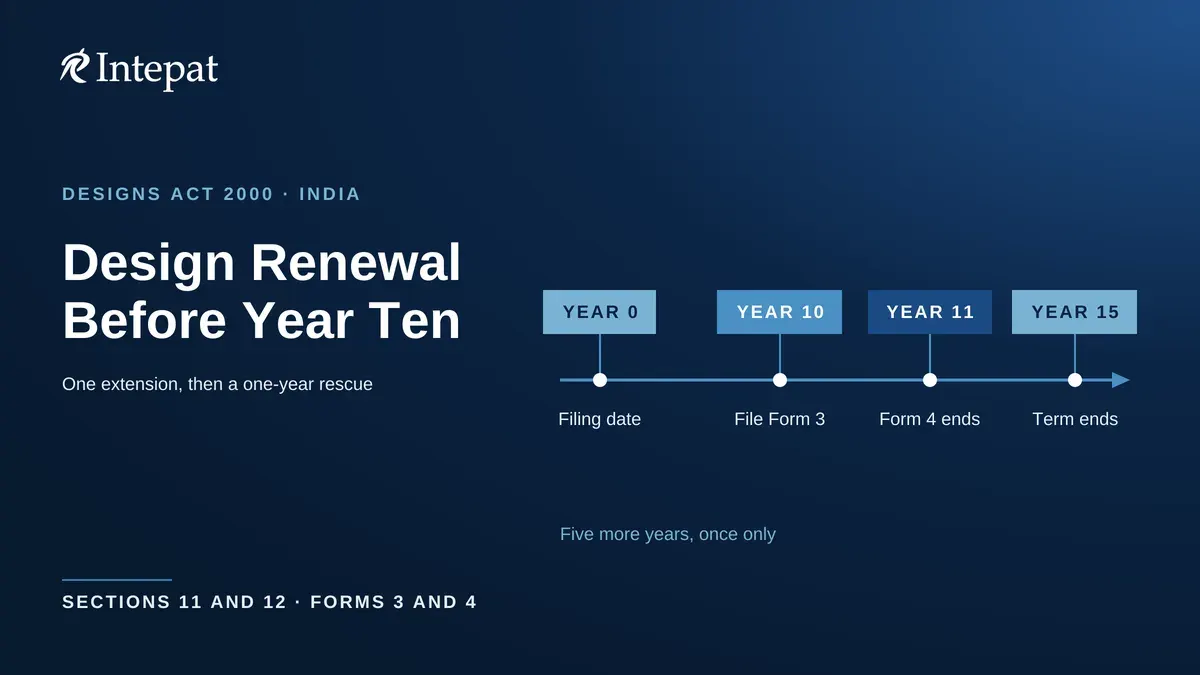
How long a registered design lasts
The first term is ten years from the date of registration. In India, a design is registered as of the date you filed the application, even though registration itself comes later. So your ten years usually run from your filing date.
There is one exception. Where your registration was allowed a reciprocity date on a convention priority claim, registration, extension and expiry are all counted from that reciprocity date instead. Check the register entry for your design to see which date applies.
There is a second limit. If you later register the same design for other articles in the same class, that later registration cannot extend copyright beyond the period of the earlier one.
After the five-year extension there is nothing further to renew. The longest a registered design can last is fifteen years. Our guide to industrial design registration explains how the right is first obtained.
Design renewal in India: how to file Form 3
You renew by filing Form 3, the application for extension of copyright, with the Controller before the original ten years expire. Once you have paid the fee, the Controller extends the copyright for five years from the end of the first ten. This is the Form 3 extension, and it is available only once.
The fee depends on who owns the design. You pay the lower fee if you are a natural person, a qualifying small entity, an Indian startup recognised under the Startup India initiative, or a qualifying foreign startup that files the required declaration. The higher fee applies if any joint owner falls outside those categories.
If you claim the startup or small-entity rate, file Form 24, with the documents it asks for, with each fee-bearing form, including the extension and restoration forms.
| Step | Form | Natural person, startup or small entity | Others |
|---|---|---|---|
| Extension of copyright for five years | Form 3 | Rs 2,000 | Rs 8,000 |
| Restoration of a lapsed design | Form 4 | Rs 1,000 | Rs 4,000 |
| Additional fee, paid when restoration is allowed | None | Rs 1,000 | Rs 4,000 |
| Unpaid extension fee, paid when restoration is allowed | None | Rs 2,000 | Rs 8,000 |
| Total cost of restoring, in official fees | Rs 4,000 | Rs 16,000 |
Verified as of November 2026 against the First Schedule to the Designs Rules 2001, entries 3, 4 and 5, as substituted by the Designs (Amendment) Rules 2021. The complete schedule is the First Schedule to the Designs Rules, listed under Sources; our design fee guide explains the fee categories.
Renewing on time costs half of what restoration does, and restoration is not guaranteed. Put the expiry date in your calendar when the certificate arrives.
What happens if you miss the renewal date
If the extension fee is not paid in time, the design ceases to have effect at the end of the ten years. From then on, it is no longer a live registration.
You may still apply to restore it. The application must be made within one year from the date the design ceased to have effect. After that year, the Act gives no route back.
Restoration is only for a design that lapsed because the extension fee was not paid. It cannot carry a design past its fifteen-year limit.
| Event | When it falls | Where it comes from |
|---|---|---|
| Copyright term counted from | Filing date (or reciprocity date, if allowed) | Sections 5(6) and 11(1); rule 30(3) |
| Last day to file Form 3 | Before the end of year 10 | Section 11(2); rule 23 |
| Design lapses if no extension | End of year 10 | Section 12(1) |
| Last day to file Form 4 | One year after the lapse | Section 12(1); rule 24 |
| Fees due after restoration is allowed | Within one month of the order | Rule 25(1) |
| Term ends for good | End of year 15 | Section 11(2) |
The term rows count from your filing date or allowed reciprocity date. The Form 4 deadline counts from the lapse, and the payment window from the Controller’s order.
How restoration of a lapsed design works
The restoration of a lapsed design is not automatic. The Controller must be satisfied, on your evidence, that the failure was unintentional and that you did not delay unduly; once satisfied, the Controller must restore the design when the fees are paid. The procedure is written, with a hearing if you ask for one or the Controller thinks fit.
The proprietor, or the proprietor’s legal representative, files Form 4 with the fee. Where joint proprietors hold the design, one or more of them may apply without the others, with the Controller’s leave.
The application must include a verified statement that sets out in full why the extension fee was not paid, and the Controller may ask you for more evidence. Write it carefully.
The Controller then looks at two things: whether the failure to pay was unintentional, and whether there was undue delay in applying for restoration. If the Controller sees no prima facie case, you will be told so. You then have one month to ask for a hearing, or the application is refused.
If restoration is allowed, you have one month from the order to pay the unpaid extension fee and the additional fee. The Controller publishes the decision in the Official Journal of the Patent Office. The Controller may also require that any document or matter that should have been entered in the register is entered first.
A restored design does not gain extra time. The extension still runs five years from the end of the original ten.
What restoration does not cover
Restoration brings the registration back, but not for the gap. No suit or other proceeding can be brought for piracy committed between the date the design lapsed and the date it was restored.
A restored registration is also subject to any prescribed provisions, and to any terms the Controller imposes to protect or compensate people who began to use the design during that gap, or took definite steps to do so. If a competitor started selling copies while your design was lapsed, the Controller may impose terms in their favour, and you cannot sue for those sales.
Before you rely on the extra five years
A missed renewal is often an oversight rather than a decision. Three points are worth checking well before the tenth anniversary, so that the Form 3 extension goes in on time and the fee is the right one:
- The start date. Confirm the filing date or reciprocity date on the register, and count ten years from it.
- The owner category. The fee depends on who owns the design when you file. If it now belongs to a company that is not a small entity or startup, expect the higher fee.
- The register entries. If you acquired the design before it lapsed, file any outstanding application to record your ownership with the restoration request. Office practice is to record the change before restoration goes ahead, and not to entertain a request from someone who acquired the design only after it lapsed.
The Department for Promotion of Industry and Internal Trade has proposed changes to the design term, including a staged renewal model. These are proposals, not law. Our note on proposed amendments to the Designs Act tracks them. If you are unsure whether your design is registrable in the class you need, see registrable and non-registrable designs.
FAQ
Ten years from the date of registration, which is the filing date of the application, or the reciprocity date where one was allowed (Designs Act 2000, sections 5(6) and 11(1); rule 30(3)). You can extend it once, for five more years, by applying in Form 3 before the ten years end. The maximum term is fifteen years, and there is no second extension.
Before the original ten years expire (section 11(2); Designs Rules 2001, rule 23). The extension runs for five years from the end of the first ten, so filing early loses you nothing. The fee is Rs 2,000 for natural persons, startups and small entities, and Rs 8,000 for others (First Schedule, entry 3).
Yes, within one year from the date the design ceased to have effect (section 12(1)). File Form 4 with a verified statement explaining why the fee was not paid (section 12(2); rule 24). The Controller must be satisfied that the failure was unintentional and that you did not delay unduly in applying (section 13(1)).
In official fees, Rs 4,000 for natural persons, startups and small entities, and Rs 16,000 for others. That is the Form 4 fee, plus the unpaid extension fee and the additional fee, both paid within one month of the order allowing restoration (rule 25(1); First Schedule, entries 3 to 5).
No. The extension under section 11(2) runs for five years from the end of the original ten years. Restoration under section 13 restores the registration once the unpaid extension fee and the additional fee are paid, and does not restart the term. The design still ends fifteen years from its registration date, and piracy committed during the lapse cannot be sued on (section 14(2)).
This article explains design renewal and restoration in India as at November 2026 and is for general information only. It is not legal advice. Official fees, forms and procedures change; confirm current figures with the Designs Office of IP India before you file. For advice on your registration, consult a registered patent agent or an IP attorney.
Sources
- The Designs Act, 2000, Government of India, IP India, read 14 November 2026.
- The Designs Rules, 2001, consolidated, IP India, read 14 November 2026.
- The Designs (Amendment) Rules, 2021, G.S.R. 45(E), 25 January 2021, Gazette of India, read 14 November 2026.
- Manual of Designs Practice and Procedure, Office of the Controller General of Patents, Designs and Trade Marks, read 14 November 2026.