




Registrable and non-registrable designs in India divide on a statutory line. To register, a product’s shape, configuration, pattern or ornament must appeal to the eye, be applied by an industrial process, be new or original, be significantly distinguishable from known designs, and not have been disclosed anywhere before your filing or priority date. Function, trademarks and artwork fall outside.
| Quick answer |
| Registrable: a new or original look (shape, configuration, pattern, ornament, or a composition of lines or colours) applied to an article by an industrial process and judged solely by the eye. Not registrable: shapes dictated solely by function, trademarks, property marks, artistic works, and, with narrow exceptions, any design disclosed anywhere in the world before your filing or priority date. One class per application: articles are classified under the Locarno system, and a separate application is needed for each class. Government filing fee: Rs 1,000 for a natural person, startup, or small entity; Rs 4,000 for other applicants (verified as of July 2026). |
What Counts as a Design Under Indian Law?
The Designs Act, 2000 protects only the features of shape, configuration, pattern, ornament, or composition of lines or colours applied to an article. They may be two or three dimensional, must be applied by an industrial process, and in the finished article must appeal to and be judged solely by the eye. That is the Section 2(d) definition, the yardstick applied at examination.
Two points follow. “Article” means any article of manufacture, including a part of an article only if that part is capable of being made and sold separately. And they are judged as they appear in the finished article: what counts is how the design strikes the eye, not how well the article performs. The Act and the Designs Rules, 2001 are published on the Controller General’s designs page.
Why Function Can Sink Your Design Filing
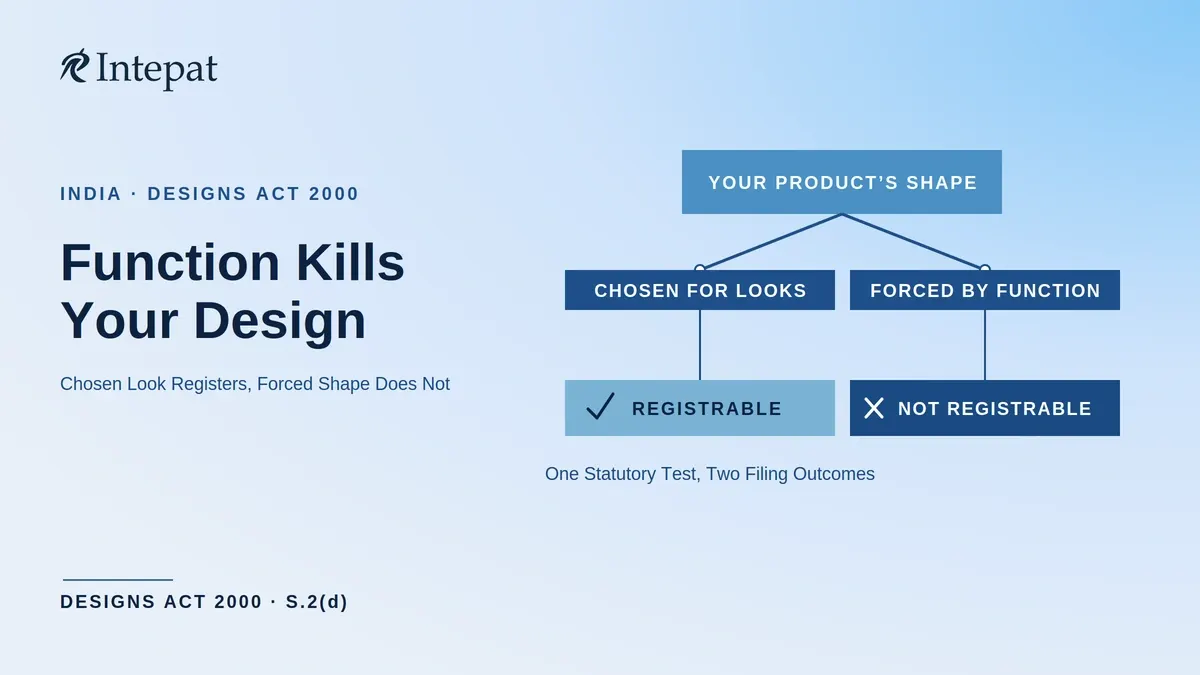
A product shape can be new and still fail as a design, because it exists to make the product work rather than to look a particular way. Section 2(d) excludes any mode or principle of construction and anything which is in substance a mere mechanical device.
The exclusion is narrower than it looks. It does not bar a shape because the shape also does a job; it bars a shape that is, in substance, only a mechanical device, its appearance settled entirely by what the article has to do. So the question before filing is: did function force the shape, or did you choose it? Where two shapes would have worked equally well and you picked one for its appearance, function is not your obstacle, though the design must still clear the next section. Where the engineering left no option, there is nothing to register.
What Designs Can Be Registered?
Section 4 sets out four grounds on which a design shall not be registered, and Section 5 adds a public-order requirement. A design can be registered when it is:
- New or original. Under Section 2(g), “original” covers designs which though old in themselves are new in their application.
- Not previously disclosed. The design must not have been disclosed to the public in India or any other country, by publication in tangible form, by use, or in any other way, before the filing date or, where priority is claimed, the priority date. Novelty is judged globally.
- Significantly distinguishable. A design that is not significantly distinguishable from known designs or combinations of known designs cannot be registered. A trivial variation on a known shape will not do; what matters is whether the result is significantly distinguishable to the eye. The novelty and originality requirements for designs are examined in detail in our separate guide.
- Free of scandalous or obscene matter. Section 4(d) is an absolute bar: such a design shall not be registered. Separately, Section 5(1) requires that the design not be contrary to public order or morality, and under Section 35 the Controller may refuse it on that ground.
A design is registered in one class only, following the current Locarno Classification published by WIPO. That does not mean one article per registration: Section 6(1) allows a registration to cover any or all articles in the class, which the application must name, and the Rules recognise a “set”, meaning articles of the same general character ordinarily sold or used together and bearing the same design. Articles in different classes need separate applications.
What Cannot Be Registered as a Design?
Beyond function-dictated shapes, the definition excludes three families of subject matter, each belonging to a different branch of IP:
- Trademarks. A brand identifier is not a design. Section 2(d) points to the trade mark definition in the older 1958 statute; marks today are registered under the Trade Marks Act, 1999, and under either definition, a mark that tells customers who made the goods cannot be a design.
- Property marks, meaning marks denoting that movable property belongs to a particular person. Section 2(d) still cites Section 479 of the Indian Penal Code, 1860; the Penal Code was replaced by the Bharatiya Nyaya Sanhita, 2023 from 1 July 2024, where the corresponding provision is Section 345.
- Artistic works under Section 2(c) of the Copyright Act, 1957: paintings, sculptures, drawings (including diagrams, maps, charts, and plans), engravings, photographs, works of architecture, and works of artistic craftsmanship, whether or not the work has artistic quality.
The Designs Manual adds an illustrative list of items the Registry treats as non-registrable: book jackets, calendars, certificates, dressmaking patterns, greeting cards, leaflets, maps, postcards, stamps, medals, labels, tokens, and cartoons. The Registry’s rationale for that list is that the article must have a function beyond carrying the design. Wallpaper and textiles qualify; a printed sheet whose only purpose is to display the design does not.
Words, letters and numerals sit alongside this. Under Rule 14(6) of the Designs Rules, 2001, they are removed from the representation where they are not of the essence of the design; where they are, the Controller may require a disclaimer of exclusive rights in them.
One further trap concerns parts. Section 2(a) brings in a part of an article only where that part is capable of being made and sold separately. In Hero MotoCorp v Shree Amba Industries (CS(COMM) 1078/2018, Delhi High Court, 16 August 2023), a judge deciding an interim injunction read those words as requiring a component with “an independent life as articles of commerce and not merely as substitutes/accessories”, and took the prima facie view that a motorcycle front fender was not registrable. The court added that it was “not determining the question of registrability of spare parts in general”. The statutory test stays as the statute puts it; independent commercial identity is a fact-sensitive consideration, not a settled rule.
Registrable and Non-Registrable Designs at a Glance
Common product features against the statutory line:
| Feature of your product | Can it be a design? | Why |
| New product shape chosen for its looks | Yes | Shape or configuration judged by the eye |
| Surface pattern or ornamentation | Yes | Pattern or ornament applied to an article |
| Colour combination that defines the look | Yes, if clearly depicted | Composition of lines or colours; the essence must be shown in the representation |
| Shape dictated solely by function | No | Mere mechanical device excluded |
| Logo used as a badge of trade origin | No | Trade mark excluded; protect it under trademark law |
| Decorative graphic applied to an article | Assessed on its facts | Judged by how it functions and is applied, not by the label “logo” |
| A painting, drawing, or photograph as such | No | Artistic work; protect it under copyright law |
| Features derived from artwork, industrially applied | Assessed on its facts | Tested separately under Section 2(d) as a design |
| Label, greeting card, calendar | Generally no | The Designs Manual treats the article as a mere carrier of the design |
| A part of an article | Only if capable of being made and sold separately | Independent commercial identity is a relevant, fact-sensitive consideration |
| Design published or sold before filing | Generally no | Prior disclosure defeats novelty, subject to the priority date and narrow exceptions |
Clearing this line is necessary, not sufficient: a feature inside the definition must still satisfy Sections 4 and 5.
Design, Trademark or Copyright: Which Protects Your Product’s Look?
Because the definition excludes trademarks and artistic works, one product can raise all three regimes, and choosing wrongly can leave its look unprotected.
A registered design gives you the exclusive right to apply the design to articles in the registered class for ten years, extendable once by five years if you apply before the term expires. On an ordinary Indian application those ten years run from your filing date, because registration takes effect from that date, not from the day the certificate arrives. Where a reciprocity date is allowed on a convention priority claim, Rule 30(3) reckons registration, extension and expiry from that reciprocity date instead.
One post-registration step catches founders out. Before articles carrying the design are sold, Section 15(1)(b) requires them to be marked, and Rule 26 prescribes the mark: REGISTERED, REGD., or RD, with the registration number. Fail to mark and you cannot recover a penalty or damages unless you show you took all proper steps to ensure marking, or that the infringer already knew of, or had notice of, the copyright in the design. Textile goods with printed or woven designs, other than handkerchiefs, are exempt from marking, as are certain charcoal-dust articles.
The copyright boundary matters most for businesses that start with artwork. Where a design is registered under the Designs Act, copyright does not subsist in it. Where a design is registrable but left unregistered, Section 15(2) of the Copyright Act ends copyright in it once the article has been reproduced more than fifty times by an industrial process, by you or with your licence. Read that as a copyright rule, not a grace period: your first public sale can already defeat design registrability under Section 4(b).
That is not the end of the artwork. In Cryogas Equipment v Inox India (2025 INSC 483, 15 April 2025), the Supreme Court held that an original artistic work “does not lose the same merely because a ‘design’ derived from it has been industrially applied to create a product”. The drawing on your wall and the pattern stamped onto ten thousand units are two different things. Our note on the twin test for copyright and design conflicts works through the decision.
| Regime | What it protects | Term |
| Registered design | The eye-appealing look of a mass-produced article | 10 years plus one 5-year extension |
| Trademark | Signs identifying the commercial source of goods | Renewable terms under the Trade Marks Act, 1999 |
| Copyright | Original artistic works as such | Author-based term under the Copyright Act, 1957. The fifty-reproduction rule ends copyright in an unregistered but registrable design; the underlying artistic work is assessed separately |
Showed Your Design Already? What Disclosure Does to Registrability
Disclosure anywhere in the world before your filing or priority date defeats registrability, and Section 4(b) is drafted broadly, catching publication in tangible form, use, “or in any other way”. A disclosure to a single person who is under no obligation of confidence can be enough.
The Act preserves three narrow lifelines, and their limits matter. Your disclosure to another person is not publication where the circumstances make it contrary to good faith for that person to use or publish the design. A disclosure by someone else in breach of good faith is treated the same way. Nor is acceptance of a first and confidential order for articles bearing a new or original textile design intended for registration. Separately, a design shown at an exhibition officially notified by the Central Government can still be registered if prior notice went to the Controller and the application follows within six months of first exhibiting.
Note what the first does not say. It protects disclosures made in circumstances that put the recipient under an obligation, not disclosures you simply made honestly. An unrestricted launch, a public social post, or an open crowdfunding campaign is a disclosure, and your good faith will not save it.
The operating rule: file before you launch, and put confidentiality in writing before showing the design to manufacturers, distributors, or investors.
How to Check Registrability Before You File
Four steps cover the ground, and cost far less than a refused application.
First, search what already exists, and do not stop at design registers. Section 4(b) catches disclosure by publication, by use, or in any other way, so earlier catalogues, marketplace listings, competitor sites and evidence of prior sale all count. The WIPO Global Design Database covers registered designs across major jurisdictions, and an e-register of Indian designs is on the IP India website (in current practice, verified as of July 2026). No register will surface an unregistered product already on the market. Second, apply the function test: for each feature of the product’s look, ask whether it was chosen or forced. Third, confirm the Locarno class, which controls both the search and the application. Fourth, confirm ownership. Under Section 2(j), where an author creates a design for another for good consideration, the proprietor is the person for whom it was executed; rights can also pass by assignment. If a freelance designer, tooling vendor, or contract manufacturer shaped your product, record ownership of the design and any underlying artwork in writing before you file.
If the design clears these checks, the filing fee is Rs 1,000 for a natural person, startup, or small entity and Rs 4,000 for other applicants, per application per class (verified as of July 2026). That is the application fee alone; later steps carry their own fees. The full design e-filing fee structure and the step-by-step process for design registration in India are in our companion guides. If you have already filed abroad, a reciprocity application in India must be filed within six months of the first convention filing, a period that cannot be extended.
FAQ
A logo used as a badge of trade origin is a trade mark, and Section 2(d) of the Designs Act, 2000 excludes trade marks from the definition of a design. Protect it under the Trade Marks Act, 1999. A decorative graphic applied to an article is assessed on how it functions, not on the label.
No. Section 2(d) of the Designs Act, 2000 excludes anything which is in substance a mere mechanical device, meaning a shape whose appearance is settled entirely by what the article has to do. A shape that serves a function may still be registered if its appearance was a genuine choice.
Generally no. Under Section 4(b), disclosure anywhere in the world by publication or use before the filing or priority date bars registration. Two Section 16 exceptions turn on the recipient’s obligation, not your honesty; a first confidential textile order and a notified exhibition under Section 21 are separate, narrower routes.
A design is registered in one class only, under Section 5(3) of the Designs Act, 2000. To protect the same design on articles in other Locarno classes, a separate application must be filed for each class, each attracting its own fee. A single application can, however, cover more than one article within its class.
Yes. Under Section 19 of the Designs Act, 2000, any interested person may petition the Controller at any time to cancel a registration, on grounds including prior registration in India, prior publication, lack of novelty or originality, or that the subject matter is not a design at all. Registrability defects therefore survive registration.
A single colour alone is unlikely to qualify: Section 2(d) of the Designs Act, 2000 protects a composition of lines or colours applied to an article. Where a colour combination is the essence of the design, the Designs Manual requires it to be clearly depicted in the representation.
This article explains the law on registrable and non-registrable designs in India as at July 2026 and is for general information only. It is not legal advice. Registry fees and procedures change; confirm current details with the Designs Wing of the Patent Office before you file. Registrability is decided case by case on examination of the specific design and article. For advice on your specific design, consult a qualified IP practitioner.