




Filing abroad without permission can still mean criminal prosecution, but a narrow exception now applies. From 1 June 2026, a new proviso to Section 118 of the Patents Act, 1970, removes imprisonment and fine for an unauthorised Section 39 foreign filing, but only where, in the opinion of the Central Government, the invention had no defence or atomic-energy relevance. Section 40 is untouched.
This article covers India only, under the Patents Act, 1970, the Patents Rules, 2003, and the Jan Vishwas (Amendment of Provisions) Act, 2026 (Act No. 8 of 2026). It assumes the reader already knows what a foreign filing licence is; for that ground-level guidance, see Intepat’s foreign filing licence and Section 39 compliance guide.
Quick answer
- The proviso covers only Section 39 contraventions. A Section 35 secrecy-direction breach keeps full Section 118 exposure.
- Section 118 is disapplied, not replaced: serial number 35 of the 2026 Act inserts no monetary penalty or adjudicating-officer mechanism for the excepted category, unlike the 2023 rework of Sections 120, 122 and 123.
- Section 40 is untouched: deemed abandonment and revocation risk remain.
- Section 124 still extends exposure to a company and its responsible officers, subject to a due-diligence defence.
- Section 39(3) already takes a genuinely foreign-first-filed invention outside Section 39 entirely, and is easy to overlook.
- The exemption turns on the Central Government’s opinion, not self-assessment; the 2026 Act does not itself prescribe a procedure for obtaining that opinion.
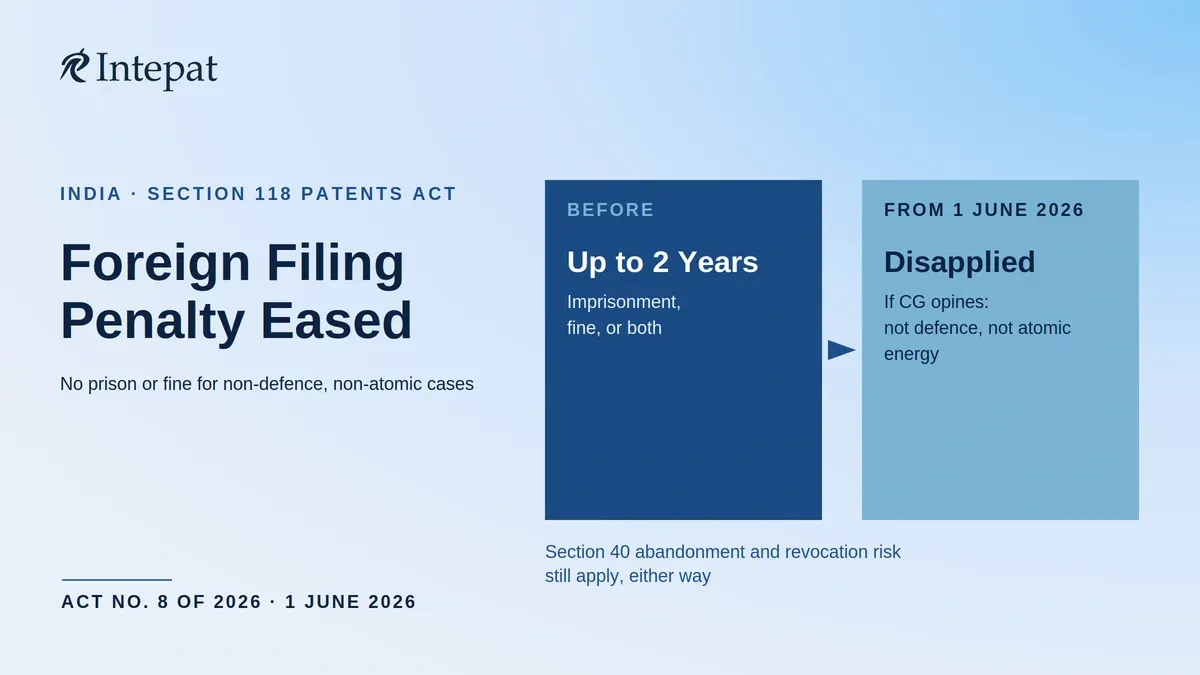
What changed under Section 118, and when it took effect
The Jan Vishwas (Amendment of Provisions) Act, 2026, Act No. 8 of 2026, amends the Patents Act at Schedule serial number 35: Chapter XX’s heading changes from “Penalties” to “Punishments,” a proviso is inserted after Section 118, and Section 119 (register falsification, unrelated to foreign filing) is omitted. The Act received Presidential assent on 7 April 2026 and was published the next day. Its own Section 1 leaves commencement of each Schedule entry to a separate Central Government notification, with different dates permitted for different enactments; secondary commentary reports 1 June 2026 as the date serial number 35 came into force, but this article has not independently located that Gazette notification. Confirm the commencement date at egazette.gov.in before relying on it for a filing deadline.
The operative proviso:
“Provided that in the case of contravention of section 39, if in the opinion of the Central Government the invention was not relevant for defence purpose or atomic energy at the time of such contravention, the provisions contained in this section shall not apply.”
Where the Central Government decides a Section 39 violation did not involve a defence- or atomic-energy-relevant invention, Section 118’s punishment simply does not attach. This is a carve-out from criminal liability, not a decriminalisation of Section 39 and not a switch to a civil penalty; only the Section 118 consequence changes, for one class of contravention.
Section 39’s framework, including the non-resident first-filing carve-out
Section 39(1) restricts an India-resident from making, or causing to be made, a patent application outside India unless a written permit has been granted, or an application for the same invention was first made in India at least six weeks earlier, with no Section 35 direction in force. That “same invention” qualifier is the operative text: on its face it does not reach subject matter first added in a later foreign filing (see the scenarios below). This is this article’s own reading of the statutory phrase; no case law or Patent Office guideline addressing a partial-overlap or added-embodiment fact pattern was located. Section 39(2) requires the Central Government’s prior consent for a defence- or atomic-energy-relevant invention.
Section 39(3) is easy to miss: “This section shall not apply in relation to an invention for which an application for protection has first been filed in a country outside India by a person resident outside India.” Where a genuine non-resident or foreign company first files abroad, Section 39 may not apply at all. Naming an India-resident inventor does not, alone, resolve the question; who made or caused the filing does. This carve-out predates 2026 and sits within Section 39 itself.
Not sure whether a planned filing needs permission first? Check your foreign filing licence position before the six-week clock runs out.
Before the amendment, and what the proviso actually changes
Before the proviso, Section 118 punished every Section 39 contravention identically, up to two years’ imprisonment, fine, or both. Sections 120, 122 and 123 were already reworked into monetary, adjudicated penalties by the 2023 Jan Vishwas Act, effective 1 August 2024; Section 118 was untouched until 2026.
Readers expecting that same pattern, imprisonment removed and a monetary penalty substituted, will not find it: the proviso disapplies Section 118 outright, and serial number 35 inserts no monetary penalty or adjudication mechanism for the excepted category. Because it is limited to “contravention of section 39,” full punishment continues, unchanged, for a Section 35 breach. Neither the amended Act nor the current Rules prescribe how the Central Government forms its opinion, or whether it operates as a trial defence.
Who else remains exposed
Section 124 provides that where “the person committing an offence under this Act is a company,” the company and every person in charge of, and responsible to, it for the conduct of its business are deemed guilty and liable to be proceeded against, unless that person proves the offence happened without their knowledge or despite due diligence; any officer who consented, connived in, or neglectfully caused the offence is separately deemed guilty. This depends on an offence under the Act, such as Section 118, being made out in the first place, and Section 124 itself is not amended by the 2026 Act.
Atomic energy also creates risk outside Section 118: Section 4 bars a patent for an invention within Section 20(1) of the Atomic Energy Act, 1962; Section 65 lets the Central Government direct revocation of a granted one. A favourable Section 118 opinion says nothing about either.
Section 40 operates independently of Chapter XX. A Section 35 or Section 39 contravention causes the Indian application to be treated as abandoned, and a granted patent becomes liable to revocation under Section 64, still requiring proceedings, not automatic.
Pre-commencement violations: an open question
The 2026 Act’s own savings clause preserves rights, liabilities and proceedings already accrued before commencement. Read alone, that supports treating a pre-1 June 2026 contravention, and any pending prosecution, as governed by the old law.
That is not the whole picture. Where a later law reduces punishment, Indian courts have applied it even to pending matters: in T. Barai v. Henry Ah Hoe, (1983) 1 SCC 177, the Supreme Court held Article 20(1) bars only a greater retrospective penalty, not a lesser one, and gave the accused a later, reduced punishment. The Supreme Court applied this in 2024 in M/S A.K. Sarkar & Co. v. State of West Bengal, 2024 INSC 186, holding at paragraph 9 that “it is only retroactive criminal legislation that is prohibited under Article 20(1)” and that where an amendment “reduces the punishment for an offence… there is no reason why the accused should not have the benefit of such reduced punishment.” Neither case addressed a savings clause as specific as the 2026 Act’s, and no court has weighed the two against each other here. Treat a pre-commencement contravention prosecuted after 1 June 2026 as genuinely open.
Practical scenarios
US provisional filed with no prior Indian filing and no FFL. A Section 39 contravention on the foreign filing itself. Section 118 exposure turns on a Central Government opinion the applicant cannot self-certify; whether Section 40 also affects a later Indian application filed in respect of that contravention is not expressly addressed by the text, and is treated here as an open question, not a stated consequence.
PCT filed directly with a foreign receiving office or the International Bureau. The Patent Office’s own Manual (paragraph 07.02.02) requires Section 39 permission for filing directly with a foreign receiving office or the IB; still subject to Section 39(3) and who made or caused the filing.
Invention potentially relevant to defence, filed abroad. A high-risk scenario. The proviso needs the Central Government to form the opinion that there was no defence relevance; a Section 35 secrecy direction, where one is in force, remains fully punishable regardless, since the proviso is confined to Section 39.
Invention potentially relevant to atomic energy, filed abroad. Sections 4 and 65 apply only to inventions relating to atomic energy within Section 20(1) of the Atomic Energy Act, 1962, a narrower category than “defence purpose.” Neither section is amended by the 2026 Act, and a favourable Section 118 opinion does not affect either.
Narrow Indian provisional, then a materially expanded foreign filing after six weeks. The six-week route is textually limited to “the same invention”; added embodiments or claim scope arguably fall outside it and may independently require Section 39 permission. No authority directly addressing this fact pattern was located.
Foreign company first files abroad, naming India-resident inventors. Section 39(3) turns on who made or caused the first foreign application and that person’s residence, not on inventorship; naming an India-resident inventor alone does not resolve it. This article does not address assignment or corporate-instruction structures beyond that statutory text.
Indian application filed first, foreign filing follows inside the six-week window. Still a contravention; only a permit or the full six weeks cures it.
Compliance checklist before filing abroad
- Identify every India-resident who will make or cause the foreign application to be made; where Section 39(3) may apply, identify who first filed abroad and that person’s residence.
- If defence or atomic-energy relevance is plausible, apply under Section 39, not the proviso.
- File in India first and calendar the six-week window, or get a permit.
- Where a foreign filing follows an Indian provisional, confirm it claims the same invention.
- Confirm no Section 35 direction is in force.
- For direct IB filings or a non-resident first applicant, check Section 39(3).
- If an unauthorised filing already happened, get advice promptly; Section 39 and Rule 71 do not expressly provide a retrospective cure.
Comparison: before and from 1 June 2026
| Issue | Before | From 1 June 2026 | Continuing risk |
| Section 39, non-defence invention | Up to 2 yrs, fine, or both | Disapplied once CG opines no defence/atomic relevance | No set procedure for that opinion |
| Monetary penalty, excepted category | N/A | None; removed, not replaced | None identified |
| Section 39, defence/atomic-energy invention | Up to 2 yrs, fine, or both | Unchanged | Full exposure remains |
| Section 35 secrecy breach | Up to 2 yrs, fine, or both | Unchanged; proviso is S.39 only | Full exposure remains |
| Atomic-energy invention (S.4, S.65) | Patent barred or liable to revocation | Unaffected by the 2026 Act | Independent of Section 118, applies even with a favourable opinion |
| Company/officer exposure (S.124) | Applies, due-diligence defence | Unchanged | Wherever S.118 applies |
| Application deemed abandoned (S.40) | Applies | Unchanged | Regardless of S.118 outcome |
| Patent liable to revocation (S.40, S.64) | Applies | Unchanged | Needs proceedings; not automatic |
| Pending prosecution, pre-commencement violation | Old S.118 applied | Savings clause and case law both arguable | Genuinely unresolved |
| Register falsification (S.119) | Up to 2 yrs, fine, or both | Omitted | Not examined here |
What this means for filing strategy
The proviso narrows criminal exposure for one fact pattern: a Section 39 violation the Central Government later agrees had nothing to do with defence or atomic energy. It does not touch the filing-licence requirement, soften Section 40, or create a monetary-penalty safety net. Calling this “criminal liability removed” overstates what the text supports. Build Section 39 compliance, including the Section 39(3) analysis, into the filing calendar from the start, not afterward.
FAQs
It remains a Section 39 contravention. Section 118 punishment does not apply where the Central Government opines the invention was not defence or atomic-energy relevant; otherwise, imprisonment up to two years, fine, or both, still applies.
No. Protection depends on the Central Government forming that opinion, not the applicant’s own view; the 2026 Act does not itself prescribe a procedure for obtaining it.
Yes. Section 40 is unaffected: the application can still be deemed abandoned, and a granted patent remains liable to revocation under Section 64, regardless of Section 118.
It depends on who made or caused the first foreign application, and that person’s residence. Section 39(3) excludes an invention first filed abroad by a genuine non-resident applicant. Naming an India-resident inventor alone does not settle this.
It can, for the same invention, if the foreign filing follows six weeks later with no Section 35 direction in force. On the statutory text it does not extend to a materially expanded later filing, or to one made earlier without a permit, though no authority addressing that specific fact pattern was located.
Rule 71’s permission process is prospective. Neither Section 39 nor Rule 71 expressly provides for permission after the foreign filing, and this article did not locate an authority establishing a retrospective route.
Apply for permission before filing abroad under Section 39(2). Do not rely on the Section 118 proviso for that risk. If the invention also relates to atomic energy, Sections 4 and 65 raise a separate, atomic-energy-specific risk that neither the proviso nor a defence-relevance finding addresses.
Disclaimer
This article discusses a recently commenced amendment not yet tested in reported judgments. It is general information, not legal advice, and does not substitute for counsel on a specific filing, particularly where defence or atomic energy relevance is possible.