




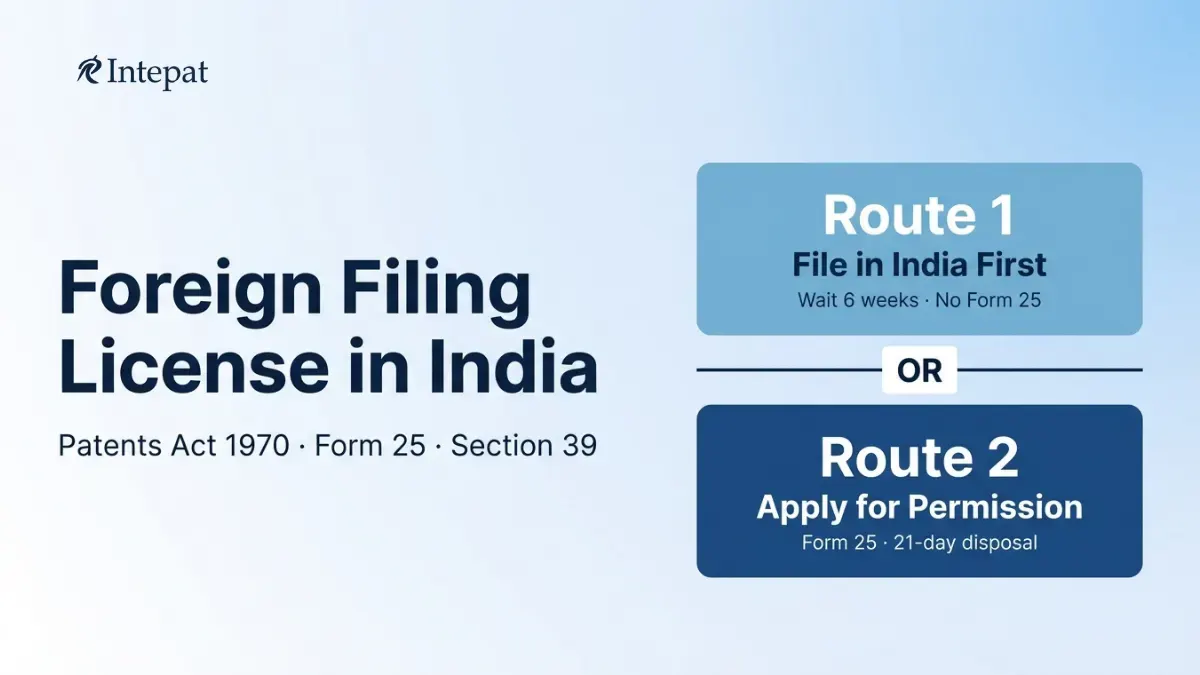
If you are resident in India and want to file a patent application outside India, you must satisfy Section 39 of the Patents Act, 1970 before that foreign filing is made, not after. The mechanism is commonly called the Foreign Filing License (FFL) or Foreign Filing Permission (FFP). For most applicants, the requirement is met simply by filing in India first and waiting 6 weeks, provided no secrecy direction is issued under Section 35 during that period. For those who need to file abroad sooner, prior written permission is available through Form 25, which is ordinarily required to be disposed of within 21 days under Rule 71 of the Patents Rules, 2003. Getting either route wrong is not a procedural oversight: penal exposure may arise under Section 118, and any resulting patent may face revocation or invalidity challenges depending on the facts. This article covers who needs a foreign filing license, both routes to satisfy Section 39, the updated 2024 fees, and the specific rules for defence and atomic energy inventions.
What is a Foreign Filing License?
A Foreign Filing License is the written permission granted by the Office of the Controller General of Patents, Designs and Trade Marks (CGPDTM) that authorises a person resident in India to file a patent application outside India. Section 39 of the Patents Act, 1970 makes this mandatory before filing abroad, regardless of whether the applicant is an individual inventor, a startup, or a large company. The obligation can arise in direct foreign national filings, PCT filings, and Paris Convention priority filings where the first filing has not yet been made in India.
The rationale sits in national security. Section 39 works in conjunction with Section 35, which gives the CGPDTM the power to impose secrecy directions on applications that relate to defence or other sensitive technologies. The foreign filing license requirement ensures that inventions originating from persons resident in India pass through a security review window before being disclosed to foreign patent offices.
Who Needs a Foreign Filing License in India?
The trigger is residential status, not nationality. An Indian national who is resident outside India at the time of filing may not require a foreign filing license. A foreign national who is resident in India may. Section 39 uses the phrase “resident in India”, but the Patents Act, 1970 does not define it. In practice, advisers often assess residency with reference to the framework under the Income Tax Act, 1961 as a conservative compliance benchmark, particularly in cross-border founder and employee situations. Applicants in borderline cases should confirm their position with a registered patent agent before filing.
This catches a specific group that frequently overlooks the requirement: founders who have returned to India to build their startup. If they have crossed the residency threshold, the obligation may apply even if they hold a foreign passport or have co-applicants based abroad. In multi-inventor or multi-applicant structures, the analysis should focus on whether any person resident in India is making or causing the foreign filing to be made. Where there is any Indian-resident inventor, founder, or decision-maker involved in the filing chain, the safer approach is to review Section 39 compliance before proceeding with any foreign filing. The safest first step for any applicant with a cross-border profile is to confirm residential status before filing a patent application in India or abroad.
Do not rely on nationality alone. Section 39 turns on residence, not passport. An Indian passport holder based abroad may not be caught. A foreign passport holder based in India may be.
When a Foreign Filing License is Not Required
The principal statutory trigger under Section 39 is residence in India. The express carve-out in Section 39(3) applies where the first application outside India was made by a person resident outside India. Where that condition is met, Section 39 does not apply. The most commonly used practical route, however, is the 6-week window described in the next section — which applies to resident applicants who have first filed in India. For applicants whose filing strategy involves entirely non-resident parties and a foreign-first filing, global IP filing can proceed without engaging Section 39, but the residency position of each applicant should be confirmed before relying on this.
Two Ways to Comply: The 6-Week Route vs. Applying for a Foreign Filing License
Section 39 gives resident applicants two ways to file abroad without committing a violation. The flowchart below shows which route applies in each situation.

Route 1: the 6-week wait is the default choice for most applicants. File a provisional patent application or complete specification at the Indian Patent Office first, then wait at least 6 weeks from that Indian filing date before filing abroad, provided no secrecy direction has been issued under Section 35 and no such direction remains in force. The Indian filing can also serve as the priority application for a later foreign or PCT filing, provided priority is properly claimed within the applicable timelines. No Form 25 is required, no fee is payable, and no separate CGPDTM approval is needed. The Indian filing receipt and its filing date are typically sufficient evidence of compliance.
Route 2: prior written permission under Section 39(2) is used when the applicant cannot or does not want to file in India first, or when waiting 6 weeks could jeopardise a foreign filing deadline. The applicant submits Form 25 to the CGPDTM and must wait for written permission before filing abroad. Under Rule 71 of the Patents Rules, 2003, the Controller is ordinarily required to dispose of the request within 21 days of filing.
PCT applicants filing via RO/IN:
For applicants resident in India filing a PCT application through RO/IN, Section 39 compliance should be addressed before the PCT filing is made. Filing through RO/IN should not be treated as a workaround to bypass Section 39 requirements. In Puneet Kaushik & Anr. v. Union of India, the Delhi High Court reinforced that a PCT filing from India can still trigger Section 39 compliance considerations. The safer approach is to either file first in India and wait six weeks (if no secrecy direction is issued) or obtain prior written permission through Form 25 before submitting the PCT request.
How to Apply for a Foreign Filing License: Form 25, Documents, and Fee
Where Route 2 is the chosen path, the request is made through Form 25 (Request for Permission for Making Patent Application Outside India) and filed with the appropriate patent office. Form 25 can be filed electronically through the CGPDTM’s IP India e-filing portal.
Under Rule 71 of the Patents Rules, 2003, the Controller is ordinarily required to dispose of the request within 21 days from the date of filing. The 21-day period applies to disposal of the request and should not be treated as a guarantee that permission will be granted in every case. Applicants should therefore avoid filing Form 25 at the last minute where a foreign filing deadline is approaching.
The following documents and details are typically required:
- Form 25 with the prescribed fee
- A disclosure of the invention, including drawings where applicable
- Name and address of each inventor and applicant who is resident in India
- Details of the countries where the patent application is intended to be filed
- Name and address of any assignee, where applicable
- Power of Attorney, if a registered patent agent is appointed to act on behalf of the applicant
Fee (First Schedule, Patents Rules, 2003)
- Natural persons, startups, small entities, and educational institutions: ₹1,600
- All other entities: ₹8,000
These are the standard electronic filing fees under the current fee schedule. Applicants filing physically should verify whether any additional surcharge applies based on the mode of filing.
Once written permission is granted, the applicant may proceed with the foreign filing in the approved jurisdiction(s). Filing abroad before receiving written permission may result in non-compliance with Section 39.
Defence and Atomic Energy Inventions: Special Rules for Foreign Filing
Where the invention relates to defence or atomic energy, the proviso to Section 39(2) creates an additional layer of approval: the Controller cannot grant permission for foreign filing without the prior consent of the Central Government. In such cases, the 21-day disposal timeline under Rule 71 does not apply, which means the approval timeline can be significantly longer and less predictable. Applicants working in defence, atomic energy, or dual-use technologies should build substantial lead time into any foreign filing strategy.
The 6-week route through a prior Indian filing does not override this requirement where a secrecy direction has been issued and remains in force under Section 35. Until such direction is revoked, foreign filing cannot proceed.
If a secrecy direction is imposed and the applicant believes it is no longer necessary, Section 36 provides a mechanism for review. The Central Government must reconsider the direction at intervals of six months, and the applicant may also request an earlier review where justified. If the Central Government determines that publication would no longer be prejudicial to the defence of India, the Controller must revoke the secrecy direction.
Consequences of Filing Abroad Without a Foreign Filing License
Filing abroad without complying with Section 39 can trigger both civil and penal consequences under the Patents Act, 1970. These consequences are cumulative and may apply simultaneously.
| Type | What happens | Source |
|---|---|---|
| Civil | A patent application made in contravention of Section 39 may be deemed abandoned under Section 40. If a patent has already been granted, it may also become vulnerable to revocation under Section 64. | Sections 40 and 64, Patents Act, 1970 |
| Criminal | Imprisonment for up to 2 years, or fine, or both. Where the contravention involves a company, liability may extend to persons responsible for authorising or directing the filing. | Sections 118 and 124, Patents Act, 1970 |
Section 40 states that an application made in contravention of Section 39 shall be deemed to be abandoned. If a patent has already been granted, it may subsequently become vulnerable to revocation under Section 64 — revocation is a legal exposure, not an automatic consequence at the moment the contravention occurs.
Penal exposure under Section 118 operates alongside these consequences: imprisonment for up to 2 years, or fine, or both. In a company context, liability may extend beyond the named inventor to persons who were responsible for, or consented to, the foreign filing. Section 124 of the Patents Act, 1970 specifically addresses offences by companies.
Frequently Asked Questions
Where any applicant or inventor is resident in India, the conservative compliance approach is to treat Section 39 as engaged before any foreign filing is made. The presence of a foreign co-founder does not remove that obligation. The same applies if the applicant entity is an Indian-registered company — a company incorporated in India is itself treated as resident in India, so Section 39 applies even if every named inventor is based abroad.
Yes, if any applicant or inventor is resident in India and the Indian filing has not been made at least 6 weeks before the PCT filing. For India-resident applicants filing through the Indian Patent Office as Receiving Office, Section 39 compliance is checked as part of the filing pathway. In practice, the absence of a required foreign filing license can prevent the application from being accorded international filing status through that route. Satisfy Section 39 before submitting the PCT request, not after.
No. The 6-week period in Section 39(1)(a) is fixed. Filing abroad before 6 weeks have elapsed from the Indian filing date requires prior written permission via Form 25 under Section 39(2). There is no shortened version of the 6-week route — the only alternative is the Form 25 process.
If none of the inventors and none of the applicants are resident in India, Section 39 does not apply. The Section 39(3) carve-out covers situations where the first application outside India was made by a person resident outside India. However, if the applicant entity is an Indian-registered company, it is treated as resident in India regardless of where its inventors are based, and Section 39 is engaged. Confirm the residency position of every applicant and inventor before relying on this exemption.
No separate permission or Form 25 is required. The Indian application filing receipt showing the filing date is the evidence that the 6-week condition under Section 39(1)(a) has been met. Keep it available at the time of the PCT or foreign filing — the receiving office or foreign patent office may ask for confirmation of the Indian filing date.
The deemed abandonment under Section 40 and the penal exposure under Section 118 are already technically engaged. The immediate step is to get a registered patent agent to assess the full position: whether the 6-week window was in fact satisfied even if no one recognised it at the time, whether any secrecy direction was ever in play, and what the damage control options are. There is no self-correction mechanism or administrative amnesty in the Patents Act 1970. The assessment is legal, not procedural.
The 21-day period under Rule 71 is a statutory disposal deadline for the CGPDTM, not a deemed-grant provision. If no response is received within 21 days, the safest course is not to file abroad and instead file a provisional patent application in India and wait out the 6-week mark under Route 1. Filing abroad on the assumption that silence equals permission is not supported by the Patents Act 1970, and doing so risks the same consequences under Sections 40 and 118 as filing without any permission at all.
Yes. The Madras High Court in Selfdot Technologies (OPC) Pvt. Ltd v. Controller General of Patents confirmed that Section 39 applies to all patent applications filed abroad by Indian residents, including patents of addition. The fact that the original or parent application was first filed in India does not exempt a subsequent related filing from the Section 39 requirement. Each foreign filing must independently satisfy Section 39 before it is made.
Section 39 is a pre-filing obligation, not a post-filing formality. Getting it wrong deems the Indian application abandoned, places the granted patent at risk of revocation, and can expose the applicant and those who directed the filing to penal liability. For applicants with complex residency profiles, defence-adjacent technology, or tight international deadlines, a review with a registered patent agent before the foreign filing date is the only reliable way to confirm the requirement has been properly satisfied.