




How to file a trademark in the USA: you apply to the United States Patent and Trademark Office (USPTO). There are five filing options in two groups: four ways to file directly with the USPTO, and one international route through the Madrid Protocol (run by WIPO, the UN agency for international IP). Whichever you use, an applicant based outside the US must act through a US-licensed attorney.
This guide is for businesses outside the United States, including Indian companies and startups planning to register a US trademark from India. It explains who can file, the four direct routes and the Madrid route, how to choose between them, what you need to supply, the fees, the timeline, response deadlines, and ongoing maintenance.
Quick answer
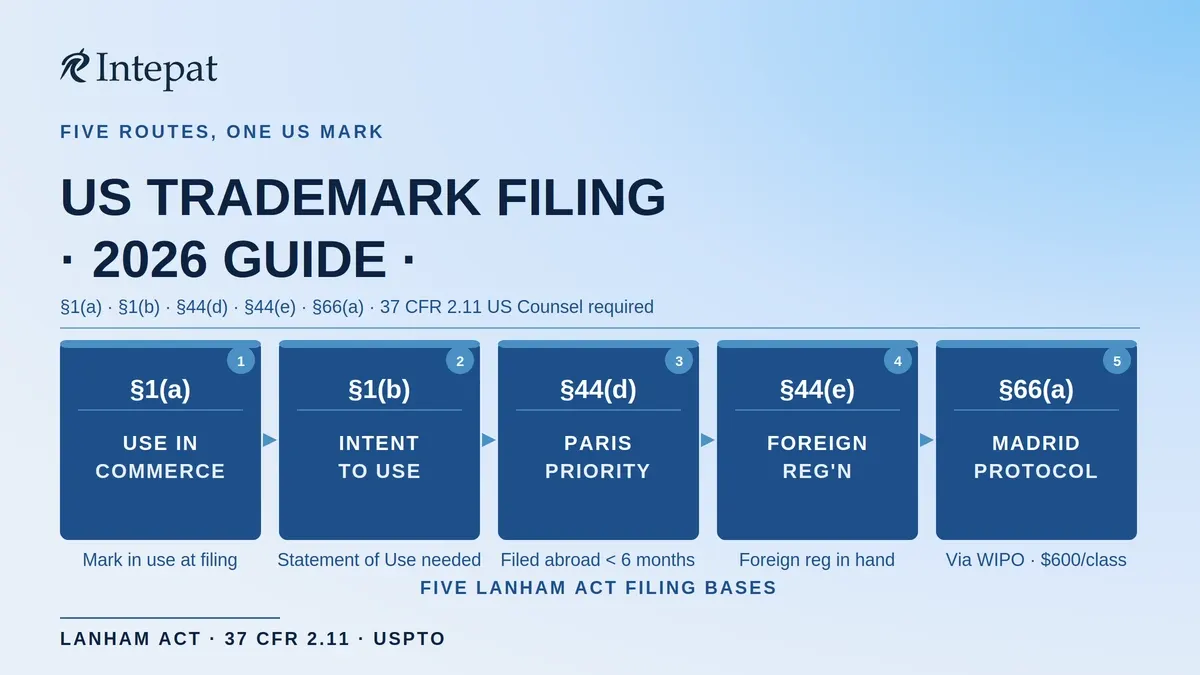
- Five filing options: four direct USPTO routes (already using the mark = 1(a); intend to use it = 1(b); claiming an earlier foreign filing date = 44(d); relying on a foreign registration = 44(e)), plus the international Madrid route (66(a)).
- Base USPTO fee: $350 per class (Sections 1 and 44); $600 per class (Section 66(a) Madrid). Verified as of May 2026.
- Applicants based outside the US must be represented by a US-licensed attorney.
- The Paris Convention six-month priority window applies to Section 44(d) claims.
- Section 1(b) applicants must file a Statement of Use after the Notice of Allowance to obtain registration.
How to file a trademark in the USA: 10 steps
The US trademark registration process runs from a clearance search through to ongoing maintenance, in ten steps:
- Conduct a USPTO clearance search, using the method in our US trademark search guide.
- Select the route: direct USPTO or Madrid.
- Choose the basis that fits your situation (use, intent-to-use, foreign priority, foreign registration, or Madrid).
- Engage US counsel (mandatory for applicants based outside the US).
- Prepare owner details, the mark, goods/services, any priority claim, and a specimen if required.
- File via Trademark Center, or via the Indian Registry for Madrid.
- Respond to any Office Action within the deadline.
- Clear publication and the 30-day opposition window.
- File the Statement of Use (Section 1(b) only).
- File Section 8, 9, 15, or 71 maintenance documents on cycle.
Each step is explained below.
Who can file a US trademark and who must sign it
Any natural or legal person who owns or intends to use a mark in US commerce can apply for federal trademark registration at the USPTO. Nationality does not restrict ownership: an Indian company, a UK partnership, a Singapore-based individual, or a US corporation can each be the applicant of record.
Get the owner’s exact legal name and entity type right at the outset. For Indian applicants, a mismatch between a private limited company, an LLP, a partnership, a proprietor, and an individual can create ownership and prosecution problems later that are awkward to fix.
The decisive question for any non-US applicant is the domicile rule. An applicant whose domicile is outside the United States or its territories must be represented before the USPTO by a US-licensed attorney. This is the US Counsel Rule, and it covers all USPTO trademark matters: new applications, responses to office actions, statements of use, maintenance filings, and proceedings before the Trademark Trial and Appeal Board.
In practice, a foreign-domiciled applicant cannot file or run the case at the USPTO on its own. The attorney of record must be US-licensed, and Intepat coordinates that. The applicant stays the trademark owner and still personally signs the declarations and sworn statements that only the owner or an authorised person can sign. A filing made without compliant US representation will typically be refused.
The four direct routes and the Madrid route
A US trademark application is filed on one of five options, in two groups: four direct USPTO routes, and the Madrid route handled through WIPO. You pick the option at filing.
| Filing route | What it means |
| Already in use (Section 1(a)) | The mark is already used in US commerce; a specimen and dates of first use are submitted at filing |
| Intent to use (Section 1(b)) | The applicant has a genuine intention to use the mark but has not begun; registration follows a later Statement of Use |
| Foreign priority (Section 44(d)) | A matching foreign application was filed in a Paris Convention country in the previous six months, and the US filing claims that earlier date |
| Foreign registration (Section 44(e)) | The applicant owns a registered trademark in its home country and seeks US registration on the strength of it |
| Madrid extension (Section 66(a)) | An existing WIPO international registration extends protection to the United States under the Madrid Protocol |
Two points matter for the decision. The Madrid route (66(a)) stands apart: it cannot be combined with the direct routes. And foreign priority (44(d)) is not a standalone path to registration; it is a claim you attach on top of another route to lock in an earlier filing date, and you still register through use (1(a)) or a foreign registration (44(e)).
For an Indian applicant, all five are available. Foreign registration (44(e)) needs an Indian registration already in hand; the Madrid route (66(a)) needs an Indian trademark application or registration to act as the home mark it is built on.
Direct USPTO filing versus Madrid Protocol extension
The two practical routes for a non-US applicant are direct USPTO filing (Sections 1 or 44) and the Madrid route (Section 66(a)). The choice turns on cost, the dependency risk, how much control you keep over the case, and how many countries you are targeting.
Direct USPTO filing treats the US application as a stand-alone matter: US counsel files, the USPTO examines, the mark is published in the Trademark Official Gazette, and registration (absent successful opposition) issues on the main federal register, the Principal Register. Most ordinary brand names qualify for it; only weak or descriptive marks may be diverted to a secondary register that carries thinner protection. The US registration is independent of any foreign filing for its survival.
The Madrid route runs through the Indian Trade Marks Registry, which acts as the home office for the filing. It is open to an applicant who is an Indian national, is domiciled in India, or has a real and effective business establishment in India, and who already has an Indian trademark application or registration (the home mark) to build on. The applicant files that home Indian mark; it anchors a single international application, which the Indian Registry checks and forwards to WIPO, usually within two months, on payment of a handling fee in rupees. WIPO then records the registration and notifies each country named in it, and the USPTO treats the US leg as a 66(a) application.
The Madrid route carries a five-year dependency window. If the Indian home mark is withdrawn, cancelled, expires, or is finally refused within five years of the international registration date, the protection in every country it covers, including the United States, falls with it. This is the dependency risk (sometimes called central attack). Direct USPTO filing has no such link back to the Indian mark.
| Factor | Direct USPTO (Sections 1, 44) | Madrid 66(a) |
| Per-class fee at USPTO/WIPO | $350 per class | $600 per class plus WIPO basic and complementary fees |
| US counsel required at filing | Yes | Yes for US prosecution; not for the WIPO filing itself |
| Dependency on Indian filing | None | Five years from international registration date |
| Office Action response window | 3 months, extendable once by 3 months for $125 | 6 months, no extension |
| Best suited for | One or two jurisdictions | Multiple Madrid countries from one filing |
When the US is the only target, direct filing is usually simpler. When the US is one of several Madrid countries you are targeting, a single international application can be more economical, but the comparison depends on the number of countries and classes, WIPO and attorney fees, and country-specific risk. The global IP filing service runs that comparison before you commit.
What an application requires: mark, goods/services, specimen
A USPTO trademark application must identify the mark, the owner, the goods or services, and the filing basis.
The mark is filed either as a standard character mark (no stylisation claimed) or as a special form mark (logo, design, stylised lettering, colour claim). Marks that are merely descriptive, primarily a surname, or confusable with an earlier US mark can be refused.
Goods and services are identified using the Nice Classification, the 45-class international system maintained by WIPO. The USPTO Trademark Identification Manual offers pre-approved descriptions; using one avoids the $200 per class free-form text surcharge.
A specimen of use shows the mark as actually used: a label, tag, packaging, or product photograph for goods; a website page, invoice, or marketing material for services. It is required at filing for Section 1(a) and at the Statement of Use stage for Section 1(b). Mocked-up or digitally altered specimens are refused.
Section 44(d) needs the foreign application particulars (filing date, country, application number). Section 44(e) needs a copy of the foreign registration, with an English translation (including of the goods and services) if it is not in English. For both, the Section 44 goods/services in the US application cannot exceed the scope of the foreign application or registration.
For an Indian applicant planning a Section 44(d) priority claim, the Indian filing must be the first filing in a Paris Convention country and precede the US filing by no more than six months. See the Intepat guide to trademark registration in India.
US trademark registration cost: USPTO fees and ranges
USPTO trademark fees were restructured in early 2025. The figures below are the electronic filing fees (paper filing, allowed only in exceptional cases, costs much more), verified against the USPTO fee schedule as of May 2026.
| Item | Fee |
| Base application under Sections 1 and 44 (Trademark Center) | $350 per class |
| Madrid route application, or later addition of the US to an existing Madrid registration (collected by WIPO) | $600 per class |
| Insufficient information surcharge | $100 per class |
| Free-form goods/services description surcharge | $200 per class |
| Long identification surcharge, per additional 1,000 characters per class | $200 |
| Statement of Use (Section 1(b)) | $150 per class |
| Extension of Time to File Statement of Use (per 6-month extension) | $125 per class |
| Request for 3-month extension to respond to Office Action | $125 (one per Office Action) |
| Section 8 Declaration of Use | $325 per class |
| Section 9 Renewal | $325 per class |
| Section 15 Declaration of Incontestability | $250 per class |
For a typical single-class direct Section 1(b) filing, the predictable USPTO outlay is $350 at filing plus $150 at the Statement of Use, totalling $500 per class for the first registration; each six-month extension adds $125 per class. US attorney fees are separate. For a Madrid 66(a) designation, the per-class US fee paid through WIPO is $600; the Indian handling fee is paid in rupees, and WIPO basic and complementary fees in Swiss francs.
From filing to registration: the USPTO timeline
The path below assumes no Office Action, no opposition, and no extensions. Actual timelines run longer, and current averages are published live at the USPTO’s trademark processing wait times page.
- Filing. Application submitted through the Trademark Center; a serial number issues the same day.
- Examination assignment. The USPTO’s current-year target is 5 months from filing to first examining action, with a long-term goal of 4.5 months.
- Examination. The examining attorney reviews the application and either approves it for publication or issues an Office Action.
- Publication. If approved, the mark is published in the Trademark Official Gazette.
- Opposition window. Any party who believes it would be damaged by registration has 30 days from publication to oppose or to request an extension.
- Registration or Notice of Allowance. For Section 1(a), 44(e), and 66(a), the registration certificate generally issues after publication, absent successful opposition. For Section 1(b), a Notice of Allowance issues after the opposition period closes, subject to USPTO processing time.
- Statement of Use stage (Section 1(b) only). The applicant has six months from the Notice of Allowance to file a Statement of Use evidencing actual use; up to five further six-month extensions are available, giving a maximum runway of about 36 months. Registration issues after acceptance.
End to end, the USPTO’s current-year target for total processing time (filing to registration or abandonment) is 11 months for straightforward applications, and 14 months once suspended and opposed matters are counted; an application that draws Office Actions, oppositions, or extensions will run longer.
Office actions, refusals, and response deadlines
A USPTO Office Action is the examining attorney’s written list of refusals or requirements that must be cleared before the application can proceed, ranging from minor (a correction to the goods description) to substantive (a likelihood-of-confusion or descriptiveness refusal).
For applications under Sections 1 and 44, the response window is three months from the Office Action issue date. A single three-month extension is available for a $125 fee, requested before the first deadline expires, capping total response time at six months. For Section 66(a) Madrid applications, the window is six months with no extension, reflecting Madrid Protocol treaty constraints.
Failure to respond results in abandonment. A Petition to Revive is available for $250 if the failure was unintentional, but it must be filed promptly after the USPTO’s notice.
Substantive refusals (likelihood of confusion, or descriptiveness) are answered by US counsel within the response deadline. For Madrid-route applicants receiving a provisional refusal through WIPO, see responding to a provisional refusal. A pre-filing search reduces the risk of a likelihood-of-confusion refusal.
Maintaining a US trademark: Section 8 and Section 9 filings
A US registration stays alive only if the owner files periodic documents showing continued use; missing them leads to cancellation.
A Section 8 Declaration of Use is due between the fifth and sixth year after registration: a sworn statement that the mark is in use, with a current specimen. Fee: $325 per class. A six-month grace period is available on an additional fee.
A combined Sections 8 and 9 filing is due between the ninth and tenth year and every ten years after that. Section 8 evidences continued use; Section 9 renews the registration for ten years. Combined fee: $650 per class.
A Section 15 Declaration of Incontestability is optional. After five years of continuous use, the owner may file it for $250 per class; once accepted, it shields the registration from certain challenges.
For Madrid-route US registrations, the maintenance filing is the Section 71 Declaration ($325 per class) on the same cycle, with WIPO renewal every ten years.
The US regime differs from systems where renewal alone suffices: an owner who renews but cannot show continued use loses the registration. A comparative view is in the Intepat note on trademark cancellation across jurisdictions.
Choosing the right route for your business
Start from where your business actually is.
| Your situation | Route |
| Already using the mark in US commerce | Section 1(a) |
| Plan to use it but have not started | Section 1(b) |
| Filed an Indian application in the last six months | Section 44(d), for the priority date |
| Already hold an Indian registration | Section 44(e) |
| Targeting the US plus several Madrid countries | Section 66(a) Madrid |
Beyond your current use position (the table above), the deciding factor is breadth. For the US alone, a direct route is usually simpler. For the US plus several Madrid countries, the single Madrid filing can be more efficient to run, as long as you are comfortable with the five-year dependency.
One practical point for Indian applicants: if the Indian application that would anchor a Madrid filing is facing a serious objection or opposition, a direct US filing under Section 1(b) or Section 44 may be the safer route, because the US application does not depend on the Indian mark surviving.
Intepat coordinates US trademark filings, working with US counsel as required. The global IP filing service handles route analysis, US counsel selection, pre-filing search, application preparation, prosecution monitoring, and maintenance. For Indian applicants whose first step is the home filing that anchors a Section 44 or 66(a) US application, see trademark services.
Frequently asked questions
No. A foreign company or individual can own a US trademark, and you do not need a US company or US address. What you do need is a US-licensed attorney of record, because applicants based outside the US cannot file at the USPTO on their own.
No. Any applicant whose domicile is outside the United States must be represented by a US-licensed attorney for all USPTO trademark matters. An Indian company is therefore a foreign-domiciled applicant, and the USPTO will refuse a filing made without a compliant US attorney of record. Intepat coordinates US counsel as part of its global IP filing service.
Yes. Section 1(b) lets you file on a bona fide intention to use, before any US use, but you must show actual use through a Statement of Use before the registration issues. Foreign-registration (Section 44(e)) and Madrid (Section 66(a)) filings do not need US use before registration, though use is needed to keep the mark later.
Yes. If you already hold an Indian registration, you can file in the US on a Section 44(e) basis without first using the mark in US commerce, and the US mark must match the Indian one. For the home filing that this relies on, see our trademark registration in India guide.
Section 1(a) is for applicants already using the mark in US commerce at the date of filing; a specimen and dates of first use are required then. Section 1(b) is for applicants with a bona fide intention to use; no specimen is required at filing, but a Statement of Use must be filed within six months of the Notice of Allowance, extendable up to five times.
Six months from the date of the first foreign application filed in a Paris Convention country. The US Section 44(d) application must be filed within those six months and must claim priority from the earlier foreign filing, which then governs priority against intervening filings.
The USPTO base fee is $350 per class for Sections 1 and 44, verified as of May 2026. Section 66(a) Madrid extensions cost $600 per class, collected by WIPO. Surcharges apply for incomplete applications ($100 per class), free-form descriptions ($200 per class), and long identifications. US attorney fees are separate.
Only if the owner keeps filing use documents: a Section 8 Declaration between the fifth and sixth year, and a combined Sections 8 and 9 filing between the ninth and tenth year and every ten years after. Section 8 is $325 per class; the combined filing is $650 per class. Non-filing leads to cancellation.
Disclaimer: This article describes US trademark filing procedure under US trademark law, with cross-references to Indian trademark law for the Madrid route filed via India. Fees and deadlines are set by the USPTO and can change; the figures here are verified as of May 2026, and the live USPTO processing wait times page should be checked for current averages. Applicants based outside the US must be represented before the USPTO by a US-licensed attorney. This guide is general information, not legal advice; consult a qualified IP practitioner for your specific facts.