




A UK trademark search checks the UK Intellectual Property Office register for identical or confusingly similar marks before you file at the UKIPO. The free search at UKIPO covers UK national marks, comparable UK marks cloned from EUTMs after Brexit, and UK designations of Madrid Protocol international registrations. Most Indian applicants can run a first-pass search themselves.
| Quick Answer |
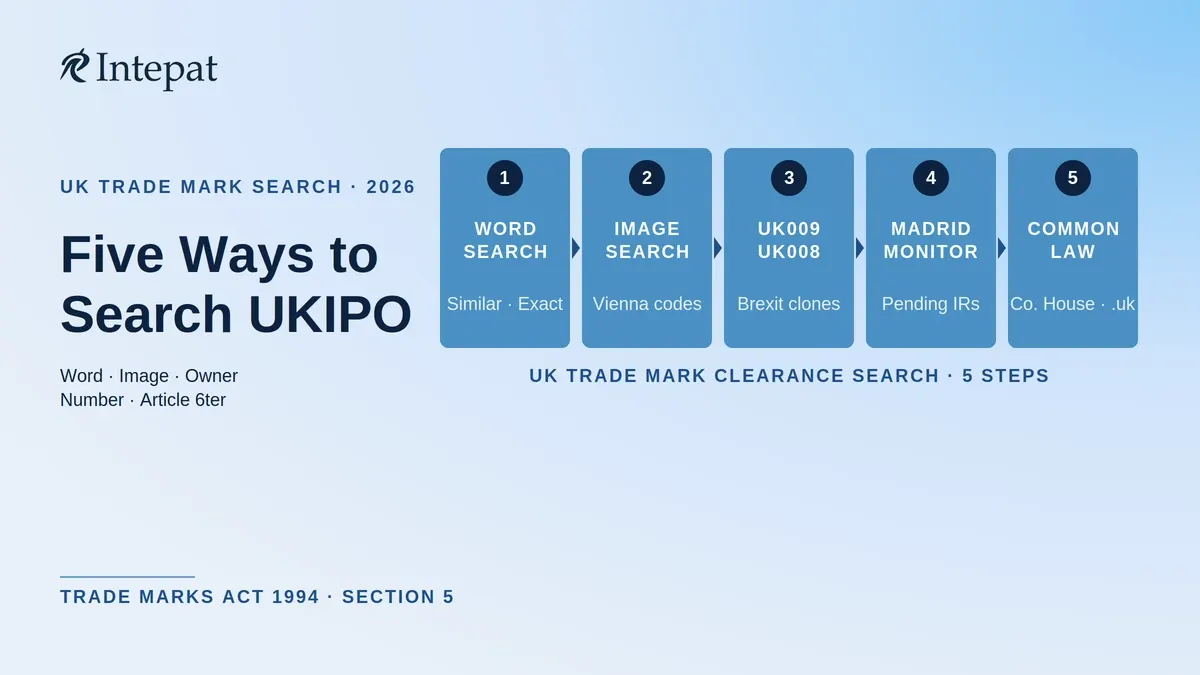
| Where: Free search at UKIPO. TMview adds participating offices including the UK; Madrid Monitor adds UK designations of international registrations. What to check: Word marks (five search modes) and figurative marks (Vienna codes at three levels of detail). What to also flag: UK009 comparable marks (cloned from EUTMs at Brexit) and UK008 comparable marks (cloned from UK designations of international registrations), plus unregistered marks with goodwill in the UK. Conflict standard: Section 5, Trade Marks Act 1994; the identity-or-similarity plus likelihood-of-confusion test. Filing fee from 1 April 2026: £205 for an online TM3 in one class, £60 for each additional class. |
What a UK trade mark search covers, and what it does not
The UK register is maintained by the UK Intellectual Property Office (UKIPO) under the Trade Marks Act 1994. A search of the register shows which earlier rights an examiner is likely to identify when your application is examined under Section 37, and which proprietors may file a notice of opposition under Section 38 after publication. It does not tell you whether your mark is registrable on absolute grounds under Section 3, which is a separate examiner judgment, and it does not surface unregistered rights that may support a passing-off claim.
For Indian applicants, the UK search plays the same role the Indian public search plays at home: it lets you see the conflict landscape before committing to filing. The UK adds three wrinkles. First, the register now carries comparable UK marks cloned from EU registrations after Brexit. Second, post-Brexit common-law rights matter more because EUTM cover no longer extends to the UK. Third, UK examiners do not refuse on relative grounds: they notify, which means earlier-rights hits are commercially significant even when they will not block your application.
| Territorial scope |
| A UK national trade mark covers England, Wales, Scotland, Northern Ireland, and the Isle of Man. Jersey, Guernsey, and Gibraltar maintain separate registers and must be searched and filed separately for cover there. Guernsey switched to a stand-alone application process in 2016; Jersey continues to operate on a re-registration basis tied to a UK mark. |
Where to search: the UKIPO trade mark register, TMview, and Madrid Monitor
Three free databases cover the UK landscape. The first stop is the UKIPO’s own search at trademarks.ipo.gov.uk, accessible from the Search for a trade mark page on gov.uk. This database holds UK national marks, comparable UK marks, and UK designations of international registrations once they have been notified to the UKIPO by WIPO. The gov.uk search page also links to Article 6ter searches for protected flags, emblems, and hallmarks: this is a narrow public-symbol check and does not replace ordinary word, owner, number, or image searching.
The second is TMview, hosted by the European Union Intellectual Property Office at tmdn.org/tmview. TMview aggregates data from participating national offices, the EUIPO, and several international partners. For an Indian applicant assessing both EU and UK exposure in one pass, TMview is the practical entry point because it returns hits across jurisdictions side by side.
The third is WIPO’s Madrid Monitor at madrid.wipo.int. Madrid Monitor is the source of record for international registrations and their territorial designations. A UK designation appears on the UKIPO register once the UKIPO has accepted it, but the application status before that point is visible only on Madrid Monitor. For clearance against pending international filings that could reach the UK, Madrid Monitor must be checked.
A useful sanity check: if a mark is registered as an EUTM but does not appear on the UKIPO register, it offers no protection in the UK after 1 January 2021. The proprietor would need to rely on a comparable UK mark (created automatically at Brexit) or on common-law rights.
The UKIPO search modes: word, image, owner, and number
The UKIPO search facility offers four entry routes. Each addresses a different clearance question.
Word or phrase search is the primary route. The facility supports five search types: Similar, Exact, Contains string, Contains word, and Starts with. The Similar option is the most useful for clearance because it accommodates minor spelling differences and phonetic equivalents (“fone” and “phone”). It will not substitute for a human assessment of conceptual similarity, and the UKIPO’s own guidance notes that the algorithm gives an indication rather than a verdict.
Image search uses the Vienna Classification (covered in the next section) to find figurative marks.
Owner search lets you check what marks a specific proprietor holds. This matters when you suspect a competitor may have filed defensively, or when you need to assess the breadth of a rights-holder’s portfolio before approaching them for consent.
Number search retrieves a specific application or registration by its UKIPO number. This is the route to use when a third party has cited a registration against you and you need the file history.
A practical filter: in current portal practice (verified May 2026), the default search returns both live and dead marks. For clearance, an “All Live” filter is usually the right setting; for historical context, including dead marks can help. The class scope is also adjustable. An “All Class” search across a common word returns more results than the system can display, so narrowing to the Nice classes that match your goods or services is needed. Our Nice Classification search tool helps with that step.
Searching for figurative marks using the Vienna Classification
Logos and other figurative elements are classified using the Vienna Classification, an international system administered by WIPO under the Vienna Agreement of 1973. The UK uses the Vienna codes at three levels of detail: Category (broadest, for example “Animals”), Division (a more specific subdivision), and Section (the most granular).
Category-only searching returns large result sets that often exceed the display ceiling, so Section-level codes give the most useful starting point. The UKIPO image search supports Boolean combinations: an “Or” operator returns marks containing any of the specified codes; an “And” operator returns marks containing all of them. For a logo with two distinct figurative elements (for example, a stylised letter combined with an animal), an “And” search narrows the result set significantly.
Vienna search is the right tool for assessing whether an existing figurative mark resembles your logo visually. It is the wrong tool for assessing whether the word element of a composite mark conflicts with yours; for that, the word-search routes apply. A composite mark typically warrants two searches.
For Indian filers, the Vienna system is the same one used by the Indian Trade Marks Registry. The codes are common across jurisdictions, which makes a single Vienna analysis reusable across UK, EU, WIPO, and Indian searches. Our Vienna codes in trademark search guide covers the classification logic.
Comparable UK marks: the post-Brexit register and how to spot them
When the Brexit transition period ended on 31 December 2020, the UKIPO automatically created comparable UK trade marks for all EU trade marks then registered. These rights came into being on 1 January 2021, retaining the filing date, priority date, and seniority of the parent EUTM, but standing as independent UK registrations that can be challenged, assigned, or renewed separately.
Two prefix conventions identify them on the UK register. A registration number beginning UK009 is a comparable UK mark cloned from an EUTM (the last eight digits match the original EUTM number). A registration number beginning UK008 is a comparable UK mark cloned from a UK designation of an international registration. A UK registration starting with any other digit pattern is a UK national mark filed directly at the UKIPO.
These prefix conventions matter for clearance. A comparable UK mark dating from January 2021 may rest on years of EU use that does not necessarily translate into UK use. Under UK law, a registration is vulnerable to revocation for non-use under Section 46 where genuine use in the UK cannot be shown for the relevant five-year period. For comparable UK marks, EU use before 1 January 2021 can count where the relevant five-year non-use period includes pre-2021 time. EU-only use after 1 January 2021 does not count as UK use. From 2026 onward, many rolling five-year non-use periods will fall wholly after Brexit, making evidence of UK use increasingly decisive.
The practitioner reading: a UK009 or UK008 hit in your search is not automatically a blocker. If the comparable mark has not been used in the UK during the relevant period, a non-use revocation action under Section 46 may be available. The hit is real; the underlying right may be weaker than the registration date suggests.
What the UKIPO examiner finds: the Section 5 notification system
Section 5 of the Trade Marks Act 1994 sets out the relative grounds for refusal: identical marks for identical goods (Section 5(1)), similar marks where a likelihood of confusion exists (Section 5(2)), conflicts with marks of repute (Section 5(3)), and earlier rights including passing off (Section 5(4)). The conflict standard the examiner applies is the same one the public search tool helps you anticipate.
The UK system differs from many others in how those grounds are enforced. Under the Trade Marks (Relative Grounds) Order 2007, the Registrar does not refuse an application on Section 5 grounds. Instead, when the examiner conducts a search of earlier trade marks under Section 37, the UKIPO notifies the applicant of relevant earlier marks and, after publication, notifies the proprietors of those earlier marks that an application has been published. It is then for the earlier-rights holder to decide whether to file a notice of opposition on Form TM7 within two months of publication. The opposition period is extendable by one month on a Form TM7A request before the deadline.
For an Indian applicant, this is a material difference from the Indian system, where examiners do raise Section 11 objections directly. In the UK, your application can proceed to registration even when earlier rights exist on the register, provided no proprietor opposes. Conversely, a clear examination report does not mean the path is unopposed. The notification reaches earlier-rights holders, and a search that surfaced a likely opposer is the only protection you have against an opposition you did not anticipate.
UK examination is also quick. Direct UK applications are typically examined within two to three weeks of filing, which is faster than the corresponding stage in most other major jurisdictions. UK designations of Madrid Protocol international registrations are examined within 18 months under the Protocol.
The Sky v SkyKick effect: why broad specifications matter for your search
The UK Supreme Court’s judgment in SkyKick UK Ltd v Sky Ltd [2024] UKSC 36, handed down on 13 November 2024, confirmed and sharpened the approach to bad faith in trade mark applications where specifications are unjustifiably broad. The court held that a party challenging a registration may rely on objective facts to displace the presumption of good faith; if displaced, the proprietor must explain the commercial logic of the specification. However, bad faith is not presumed merely because the proprietor had no current economic activity for every listed item; the objection must be tied to goods or services for which there was no plausible commercial rationale at the time of filing. A finding of bad faith does not invalidate the whole mark but does invalidate the registration for those goods or services for which there was no genuine intention to use.
For someone running a UK clearance search, the SkyKick effect cuts two ways. The first cut is informational: a search hit on a broad specification (for example, a registration covering “computer software” in its entirety in Class 9) may overstate the actual scope of protection if the proprietor cannot demonstrate genuine intent to use across that breadth. The second cut is strategic: an opposition or invalidation defence against such a hit is now more viable than it was before November 2024.
The practical reading: do not treat every broad Class 9 software registration as an absolute blocker. Look at the actual use the proprietor has made. Where a hit appears doctrinally serious but commercially narrow, a partial-invalidation action under Section 47 may clear the path. This is not a quick fix, but it changes the negotiating posture.
The corollary for your own filing strategy: a specification broader than your actual or intended use is now a registration risk, not just a clearance risk. Draft the specification to match the goods and services you genuinely plan to trade in.
Beyond the register: passing-off rights and common-law searches
UK law protects unregistered marks through the common-law tort of passing off. To succeed in a passing-off action, a claimant must establish three elements: goodwill in the mark, a misrepresentation by the defendant that is likely to deceive, and damage flowing from the misrepresentation.
This matters for clearance because the register does not show passing-off rights. A search that returns no UKIPO hits can still expose you to a passing-off claim from a business that has built goodwill in a similar mark without registering it. After Brexit, the gap widened: rights holders who had previously relied on EUTM cover for the UK now sometimes rely on pre-2021 UK use to support passing-off claims, even where the comparable UK mark itself is vulnerable to non-use revocation.
A practical common-law sweep covers the UK Companies House register for trading names, the .uk domain space, the main social platforms, and any trade-specific directories for your sector. The Companies House check is particularly important because it surfaces incorporated entities trading under a name you might assume is clear. None of this substitutes for a professional clearance opinion in commercially significant cases, but it gives a defensible first-pass picture of unregistered use.
For Indian applicants familiar with the passing-off doctrine under Section 27(2) of the Trade Marks Act 1999, the UK common-law action follows the same tripartite test, with substantially the same evidentiary demands.
When DIY search is enough and when to instruct a professional
A self-conducted UKIPO trade mark search is sufficient for an early go or no-go decision on a brand name, and the UKIPO offers a Right Start option (£125 at Stage 1 plus £30 per additional class, from 1 April 2026) that gives you a UKIPO-prepared examination report before you commit the full filing fee.
The threshold for professional clearance is reached when one or more of these conditions apply: the mark is to be used in multiple jurisdictions and the UK is part of a wider filing programme; a search has returned ambiguous hits that need a likelihood-of-confusion assessment under the Sabel/Canon/Lloyd line of CJEU authority, now assimilated into UK trade mark law and applied subject to future UK court divergence; the mark involves transliteration from a non-Latin script, where phonetic conflicts are not captured by the algorithmic search; or a comparable UK mark hit needs an investigation into actual UK use before deciding whether to file regardless.
Our trademark search services cover all four scenarios, including coordinated UK and EU searches and assessment against the post-SkyKick specification position.
From clean search to filing: the Form TM3 route and 2026 fee changes
A clean search becomes a filing on Form TM3 (online: e-TM3). From 1 April 2026, the UKIPO fee schedule was revised for the first time since 1998. The base online application fee is £205 in one class, with each additional class charged at £60. The paper TM3 carries a £45 surcharge (£250 base). Right Start applications, which deliver a UKIPO examination report at the halfway point, cost £125 at Stage 1 and £125 at Stage 2 (£250 total for one class), plus £30 per additional class per stage.
Renewals from 1 April 2026 are £245 per registration plus £60 per additional class. Expedited examination costs £370. A standard opposition limited to Section 5(1) or 5(2) grounds costs £125 on Form TM7; oppositions on other grounds cost £250.
For Indian filers, the UK application requires an address for service in the UK (which for these purposes includes the Isle of Man), Gibraltar, or the Channel Islands under the Trade Marks Rules 2008. If you do not have one, instructing a UK-based representative is the practical route.
The UKIPO is in the middle of its One IPO transformation programme, which launched new digital services for patents in April 2026 and is now beginning trade marks transformation. The current trade mark filing routes and search facility remain in place during this phase.
Fee schedule and procedural references verified as of May 2026.
Frequently Asked Questions
Yes. The UKIPO operates a free public search at trademarks.ipo.gov.uk that covers UK national marks, comparable UK marks created at Brexit, and UK designations of Madrid Protocol international registrations. Paid services from commercial providers add features such as scheduled monitoring, bulk export, and curated common-law sweeps.
No. EU trade marks ceased to cover the UK on 1 January 2021. At that point, the UKIPO automatically created comparable UK trade marks for all EUTMs then registered. EU applications still pending on 31 December 2020 had to be re-filed in the UK separately. New EUTM filings give no UK cover.
A UK registration number beginning UK009 is a comparable UK trade mark cloned from an EU trade mark at Brexit. A UK number beginning UK008 is a comparable UK trade mark cloned from a UK designation of a Madrid Protocol international registration. Both are independent UK rights despite their cloned origin.
The opposition period is two months from the date the application is advertised in the UK Trade Marks Journal, under Rule 17(2) of the Trade Marks Rules 2008. A one-month extension is available on Form TM7A if the request is filed before the original deadline expires.
A UK trade mark covers the UK and extends to the Isle of Man. It does not by itself give complete protection in Jersey, Guernsey, or Gibraltar; separate local steps should be considered for those territories. Jersey and Guernsey each maintain their own registers; Gibraltar has a separate filing process.
Go to the UKIPO search at trademarks.ipo.gov.uk, select the word or phrase option, and run the Similar search type first. This returns marks that closely resemble your term phonetically and by spelling. Follow up with Contains word and Starts with searches to cover partial matches. Filter to live marks and narrow to the Nice classes that cover your goods or services before reviewing results.
Yes. The UKIPO search facility includes an image search that uses Vienna Classification codes. Identify the figurative elements in your logo (animals, letters, geometric shapes, and so on), find the corresponding Vienna codes, and run the search at Section level for the most targeted results. A composite mark with a word element and a logo warrants both a word search and a separate image search.
Yes. From 1 January 2021, the UKIPO requires an address for service in the UK (including the Isle of Man), Gibraltar, or the Channel Islands for all new trade mark applications and proceedings. An Indian address is not accepted. Most Indian applicants instruct a UK-based trade mark attorney or representative, whose address then serves as the address for service.
Disclaimer
This article provides general information on the UK trademark search position as at May 2026. It is not legal advice and does not create a solicitor-client or attorney-client relationship. UKIPO fees, forms, and procedural rules are subject to change, and the One IPO transformation programme is expected to introduce service changes during 2026 and 2027. For advice on your specific circumstances, including coordination of UK and Indian filings, instruct a qualified trade mark attorney in the relevant jurisdiction.