




Registering a trademark in the United Kingdom is governed by the Trade Marks Act 1994 and administered by the UK Intellectual Property Office (UKIPO). An applicant files a single application covering one or more Nice Classification classes, the UKIPO examines it on absolute grounds, publishes it for a two-month opposition window, and, where no objections or oppositions arise, completes registration in approximately four months. From 1 April 2026, the online filing fee is £205 for the first class and £60 for each additional class.
This article covers trademark registration in the United Kingdom under the Trade Marks Act 1994, including post-Brexit filing requirements, the two available routes to protection, examination practice following the SkyKick Supreme Court judgment, and the April 2026 fee increase. It is intended for Indian businesses and brand owners considering UK trademark protection.
| UK Trademark Registration: Key Facts | |
| Filing route | UKIPO direct or WIPO Madrid Protocol |
| Online fee from 1 April 2026 | £205 for first class; £60 per additional class |
| Typical timeline | Approximately 4 months (no objections or oppositions) |
| UK address for service | Required for all non-UK applicants filing directly |
| Registration duration | 10 years (from filing date, once registered), renewable indefinitely |
| Examination scope | Absolute grounds only (Section 3 TMA 1994); relative grounds raised by third parties |
What qualifies as a registrable trademark under UK law
Under Section 1(1) of the Trade Marks Act 1994, a sign qualifies for registration if it is capable of being represented on the register in a clear and precise manner, and if it is capable of distinguishing the goods or services of one undertaking from those of other undertakings. A trade mark may consist of words, personal names, designs, letters, numerals, colours, sounds, holograms, multimedia elements, or the shape of goods or their packaging.
The UKIPO examines every application for absolute grounds for refusal under Section 3 of the Trade Marks Act 1994. A mark will be refused if it is devoid of distinctive character; descriptive of the characteristics, kind, quality, or purpose of the goods or services; customary in the relevant trade; contrary to public policy or accepted principles of morality; deceptive; or if the application has been made in bad faith. Section 47 of the Act is a separate provision covering grounds for invalidity of a registration and becomes operative in post-registration invalidity proceedings, not at the examination stage. A mark that lacks inherent distinctiveness may still be registered if the applicant demonstrates that it has acquired distinctiveness through use, provided that use has been genuine and substantial in the UK.
The UKIPO does not ordinarily refuse an application of its own motion merely because of earlier conflicting marks. It searches for same or similar earlier marks and may notify the applicant and the owners of identified earlier rights, but the decision to oppose rests with the owner of the earlier right. Relative grounds, such as likelihood of confusion under Section 5 of the Act, are raised through third-party opposition after publication.
Two routes to UK trademark protection
Since 1 January 2021, the date on which the Brexit transition period ended, there are two routes to obtaining a registered trade mark in the United Kingdom.
Route 1: Direct application at the UKIPO
An applicant files directly through the UKIPO’s online trade mark application service. This route gives the applicant a UK-specific filing date, full control over the specification of goods and services, and the ability to respond to examination reports and manage proceedings through the UKIPO portal. For applicants who are not based in the UK, Gibraltar, or the Channel Islands, a UK, Gibraltar or Channel Islands address for service must be appointed before the application can proceed. This requirement has applied to all new direct filings since 1 January 2021.
Route 2: International registration via the Madrid Protocol
An applicant who holds a base trademark filing or registration in a Madrid Protocol member country may file a single international application through WIPO, designating the United Kingdom as one of the countries in which protection is sought. India acceded to the Madrid Protocol on 8 July 2013, which means Indian applicants can use their Indian trademark application or registration as the base mark, file an international application through the Indian Trade Marks Registry, and designate the UK alongside other member countries. The UKIPO then examines the UK designation as if it were a direct national application. For a Madrid designation, a UK, Gibraltar or Channel Islands address for service is required only if the UK designation is subject to a refusal, opposition, or invalidity or revocation action.
The EUIPO route, which formerly allowed EU trademark registrations to extend protection into the UK, ceased to apply on 1 January 2021. EU trademark registrations filed on or after that date do not confer rights in the UK.
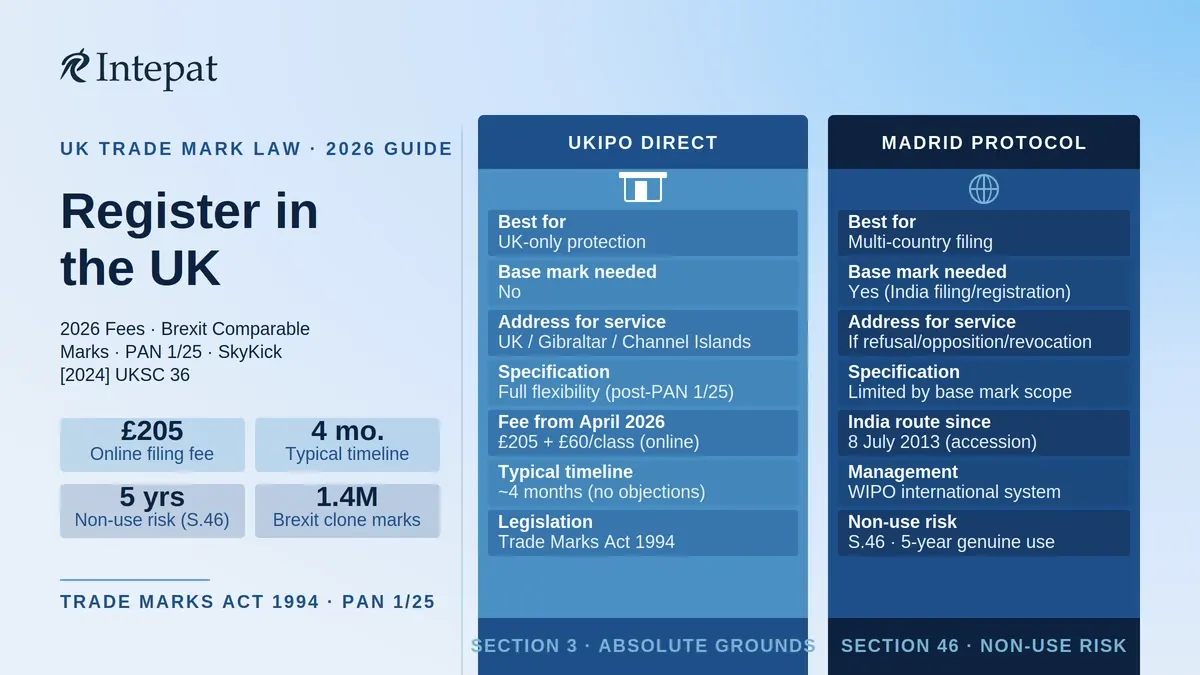
Indian businesses expanding into the UK market should weigh both routes against their filing objectives. The table below summarises the key differences.
| Factor | Direct UKIPO filing | Madrid Protocol designation |
| Best for | UK-only protection | Multi-country filing from a single application |
| Base mark required | No | Yes (Indian application or registration) |
| Filing office | UKIPO | Indian Trade Marks Registry via WIPO |
| Address for service | Required for non-UK applicants | Required if objection, opposition, invalidity, or revocation arises |
| Specification | Higher flexibility; drafted for UKIPO directly | Constrained by base mark scope |
| Management | UK national right | International registration managed through WIPO |
For guidance on preliminary clearance steps before any filing decision, our trademark search overview sets out the search methodology recommended before filing in any jurisdiction.
How to file a trademark application at the UKIPO
An application filed directly at the UKIPO must contain: a clear representation of the mark; a specification of the goods and/or services, organised by Nice Classification class (the international system grouping goods and services into 45 classes, with NCL edition 13-2026 in force from 1 January 2026); and the name and address of the applicant. Where the applicant has no address in the UK, Gibraltar, or the Channel Islands, a UK, Gibraltar or Channel Islands address for service must be provided. A UK-based representative or attorney can serve in this capacity, but appointing a representative is not compulsory under the Trade Marks Act 1994.
The applicant must also include a declaration that the trade mark is being used by the applicant, or with the applicant’s consent, in relation to the goods and services applied for, or that there is a bona fide intention that it will be so used. This declaration does not require evidence of existing use at the filing stage; proof of use is not required to obtain or renew a UK trade mark registration.
Where an applicant wishes to claim priority under the Paris Convention based on an earlier filing in another convention country, the priority details must be included in the application. The UK is a signatory to the Paris Convention, and a six-month priority window applies from the date of the first filing.
The UKIPO also offers a Right Start route. From 1 April 2026, the applicant pays £125 at Stage 1 and a further £125 at Stage 2 for the first class, with additional-class fees paid in corresponding staged amounts of £30 per stage. This route allows the applicant to receive an examination view before paying the second-stage fee, but the total official fee for one class (£250) is higher than the standard online application fee of £205.
Before filing, prepare the following:
- applicant name and address;
- mark representation;
- goods and services specification, organised by Nice Classification class;
- priority claim details, if any;
- UK, Gibraltar or Channel Islands address for service, where required;
- commercial rationale for any broad or multi-class specifications, in light of PAN 1/25;
- clearance search results.
What UKIPO examines and what it does not
After filing, the UKIPO assigns the application a filing date and examines it against absolute grounds under Section 3 of the Trade Marks Act 1994. Where the examiner considers that the mark fails on one or more absolute grounds, an examination report is issued, ordinarily within two to three weeks of filing. The applicant is given a period of not less than two months from the date of the report to file arguments or evidence in response.
Where an objection is raised under the absolute grounds covering distinctiveness or descriptiveness, the applicant may argue inherent distinctiveness or provide evidence that the mark has acquired distinctiveness through use. Where an objection is raised on other grounds, such as public policy or deceptive character, acquired distinctiveness does not overcome the objection.
If the examination is passed, the application is published in the UK Trade Marks Journal. Publication opens a two-month period during which any person may file a notice of threatened opposition, which extends the opposition window by one further month. If no opposition is filed by the end of the opposition period, the mark proceeds to registration. Where no objections or oppositions arise at any stage, registration commonly completes in around four months from filing, although the actual timeline depends on UKIPO workload and whether any third-party action arises. The UKIPO then issues a certificate of registration, and the registration is effective from the filing date.
Post-filing timeline:
Filing → Examination report (ordinarily 2–3 weeks) → Applicant response if required (2-month window) → Publication in Trade Marks Journal → Opposition window (2 months, extendable to 3) → Registration and certificate issued
The SkyKick effect: why your specification scope now matters more
In SkyKick UK Ltd v Sky Ltd [2024] UKSC 36, the UK Supreme Court found that trade mark registrations can be wholly or partially invalidated for bad faith where the specification of goods or services is excessively broad and the applicant had no genuine intention to use the mark across all claimed goods or services. The decision confirmed that an applicant does not need a settled or developed intention to use a mark for all covered goods at the time of filing, but must at minimum have an intention to establish a business or explore its viability in the relevant area.
Following the judgment, the UKIPO published Practice Amendment Notice 1/25 (PAN 1/25) on 27 June 2025, with immediate effect. PAN 1/25 states, at paragraph 12, that examiners will now routinely raise bad faith objections during examination where a specification is considered “manifestly and self-evidently broad”. This represents a shift from prior practice, under which examiners rarely raised bad faith objections proactively. The UKIPO has confirmed that an objection will always be raised where an application claims goods or services across all 45 Nice classes, or claims all goods in Class 9.
The practical consequence for Indian applicants is that specifications should be drafted to reflect the applicant’s genuine current and reasonably anticipated commercial activities. Broad terms such as “computer software” or “clothing” are not automatically objectionable in isolation, but a specification composed predominantly of such terms across many classes may attract a bad faith objection. Applicants responding to a bad faith objection have two months to provide a commercial justification. PAN 1/25 is available in full on the UKIPO’s published guidance pages at gov.uk.
The table below illustrates how specification scope risk typically arises and how it can be reduced.
| Higher-risk specification | Safer approach |
| “Computer software” as a standalone broad term across many classes | Specify the software’s field, function, or intended commercial use |
| Claiming all goods in Class 9 | Limit to the specific Class 9 goods the applicant genuinely uses or intends to use |
| Filing across many unrelated classes with class headings only | Restrict to classes covering current or reasonably anticipated business activities |
| Broad defensive filing without recorded rationale | Document the commercial rationale before filing, in case a bad faith objection arises |
For applicants who need to check which Nice Classification class covers their goods or services before drafting a specification, Intepat’s trademark classification tool provides a searchable class guide.
Opposition: who can challenge and how
After publication in the Trade Marks Journal, any person may oppose the application on absolute grounds. Only the owner of an earlier right may oppose on relative grounds, such as likelihood of confusion with an earlier registration under Section 5(2) of the Trade Marks Act 1994, or damage to the reputation of an earlier mark with a reputation in the UK under Section 5(3). An opponent files a notice of opposition within the two-month window (or three months if a notice of threatened opposition was filed), and the applicant is then given two months to file a counterstatement. Evidence rounds follow, after which either party may request a hearing before a hearing officer at the UKIPO.
Where an opposition is based on an earlier mark that has been registered for more than five years, the applicant may require the opponent to prove genuine use of that earlier mark in the UK during the relevant five-year period. If the opponent cannot demonstrate genuine use, the earlier mark cannot be relied upon to block the application for the goods or services in respect of which it has not been used.
Decisions of the UKIPO, whether at examination or on opposition, may be appealed to the Appointed Person or to the High Court of England and Wales, the High Court of Northern Ireland, or the Court of Session in Scotland. For a comparison of opposition procedures across multiple jurisdictions, see Intepat’s overview of trademark opposition proceedings.
Fees from 1 April 2026: what Indian applicants need to budget
The UKIPO increased its official fees by approximately 25% across trade marks, patents, and designs, effective 1 April 2026. This is the first increase in trade mark fees since 1998, enacted through the Intellectual Property Fees (Miscellaneous Amendments, Revocation and Transitional Provisions) Rules 2026. The fee structure from 1 April 2026 is set out below.
| Fee item | Until 31 March 2026 | From 1 April 2026 |
| Online application (1 class) | £170 | £205 |
| Each additional class | £50 | £60 |
| Paper application (1 class) | £200 | £250 |
| Right Start Stage 1 (1 class) | £85 | £125 |
| Right Start Stage 2 (1 class) | £85 | £125 |
| Renewal fee (1 class, 10 years) | £200 | £245 |
| Late renewal fee (TM11) | £50 | £60 |
| Opposition fee (relative grounds only) | £100 | £125 |
| Opposition fee (incl. bad faith / passing off) | £200 | £250 |
Verified as of May 2026 against UKIPO published fee schedule.
The filing date, not the date of preparation, determines which fee schedule applies. Applications prepared before 1 April 2026 but submitted on or after that date are subject to the new fees. Trade mark renewals may be paid up to six months before the renewal deadline, which means a renewal due before 1 October 2026 could have been paid at the pre-increase rate if submitted by 31 March 2026.
Duration, renewal, and the non-use risk
A UK trade mark registration is valid for ten years. Once registered, the registration is effective from the filing date, which is deemed the date of registration under the Trade Marks Act 1994. The registration may be renewed indefinitely in ten-year intervals, provided the renewal fee is paid. The renewal fee for one class is £245 from 1 April 2026, with £60 for each additional class renewed. A six-month grace period is available for late renewal. From 1 April 2026, the late renewal fee is £60, in addition to the applicable renewal fee and any additional-class renewal fees.
Under Section 46 of the Trade Marks Act 1994, a registered trade mark may be revoked if it has not been put to genuine use in the UK in relation to the registered goods or services for a continuous period of five years following completion of the registration procedure. Genuine use means real commercial use in the UK market; token use designed solely to preserve registration rights is insufficient.
For Indian companies that register in the UK as part of a broader international filing strategy but do not immediately establish UK market activity, this non-use risk is a practical concern. A registration that is vulnerable to revocation on grounds of non-use is also weakened as a basis for opposing a later application. Indian applicants holding UK rights should review their use position regularly and maintain contemporaneous records of UK-directed commercial activity.
Brexit comparable marks and what changed for Indian brand owners
When the UK left the EU on 1 January 2021, the UKIPO automatically created a comparable UK trade mark for every EUTM that was registered immediately before the end of the Brexit transition period. The transition exercise created approximately 1.4 million comparable UK trade marks from registered EUTMs, alongside a separate creation of comparable design rights. Each comparable UK mark carries the same filing date, priority date, and specification as the original EUTM, but is now an entirely independent UK right governed by UK law.
The transitional arrangement allowed owners of comparable UK marks to rely on evidence of use of the original EUTM in the EU, including in the UK before Brexit, to defend their marks in non-use proceedings. From 1 January 2026, comparable UK marks face a materially higher non-use risk where the relevant five-year period falls wholly after 1 January 2021. In that situation, genuine use must be shown within the UK territory under Section 46 of the Trade Marks Act 1994. Pre-2021 EU use may still be relevant only where the relevant five-year period includes time before 1 January 2021.
For Indian-owned or Indian-client businesses that hold EUTMs and had assumed that UK protection was automatically secured through the comparable mark route, this change has direct implications. A comparable UK mark that has not been genuinely used in the UK since January 2021 is now exposed to a rising revocation risk. The remedy is either to establish genuine UK use, or, where use cannot be substantiated, to consider re-filing a fresh direct UKIPO application, which will however carry a later filing date.
Indian businesses filing new international applications through the Madrid Protocol and designating the UK should note that comparable marks already on the register may constitute earlier rights for opposition purposes, but an opponent relying on such a mark will, from 2026 onwards, face a proof-of-use requirement if the mark has been registered for more than five years. For a broader view of international trademark filing strategy from India, see registration of foreign trademarks in India.
Protecting an unregistered mark: passing off in the UK
Section 2(2) of the Trade Marks Act 1994 preserves the common law of passing off for unregistered marks. A business that has built up goodwill in an unregistered trade mark in the UK may bring a passing-off action to restrain a third party from misrepresenting its goods or services as those of the claimant. The three elements required to establish passing off are goodwill, misrepresentation, and damage. Courts assess goodwill by reference to the UK market; reputation established only in India, or in the EU prior to Brexit, does not automatically constitute goodwill sufficient to support a UK passing-off claim.
Passing off provides a remedy in principle, but it is more expensive and uncertain to litigate than an infringement action based on a registered trade mark. A registered trade mark provides a statutory infringement right, so the proprietor does not need to prove goodwill in the way required for passing off. Indian businesses entering the UK market should therefore treat registration as the baseline protection strategy, not an optional supplement to common-law rights.
Where to go from here
For Indian businesses preparing to register a trade mark in the United Kingdom, the practical starting point is a clearance search to identify existing UK registrations that could conflict with the proposed mark. The WIPO Global Brand Database provides free access to international marks, including UK designations of Madrid registrations. A direct search of the UKIPO register is also advisable before filing.
Once clearance is satisfactory, the filing decision turns on route: direct UKIPO application for UK-only protection, or a Madrid Protocol designation through the Indian Trade Marks Registry for simultaneous multi-country coverage. Either route requires a specification of goods and services aligned with the applicant’s genuine commercial activities, particularly following PAN 1/25.
Intepat advises Indian companies on UKIPO filings, Madrid Protocol designations, and portfolio management across multiple jurisdictions.
Frequently Asked Questions
Registration at the UKIPO takes approximately four months from the filing date where no examination objections or oppositions arise. If objections are raised, the applicant has a minimum of two months to respond. An opposition after publication extends the timeline further, depending on the complexity of proceedings.
From 1 April 2026, an online UKIPO application costs £205 for the first Nice Classification class and £60 for each additional class. Paper applications cost £250 for the first class. These are government fees; professional attorney fees are separate.
Yes. Any natural or legal person may file a trade mark application at the UKIPO. An Indian company filing directly must appoint a UK, Gibraltar or Channel Islands address for service, since the applicant’s address is outside those territories. This requirement has applied to all new direct UKIPO filings since 1 January 2021.
India acceded to the Madrid Protocol on 8 July 2013. An Indian applicant holding a base trade mark application or registration in India may file a single international application through the Indian Trade Marks Registry, designating the United Kingdom alongside other member countries. The UKIPO examines the UK designation as a national application and applies UK law.
A comparable UK trade mark is a UK registration automatically created by the UKIPO for every EU Trade Mark (EUTM) registered immediately before the end of the Brexit transition period on 31 December 2020. Each comparable mark is an independent UK right with the same filing date as the original EUTM. From 1 January 2026, where the relevant five-year period falls wholly after 1 January 2021, genuine use must be shown within the UK to satisfy the requirement under Section 46 of the Trade Marks Act 1994.
Under Section 46 of the Trade Marks Act 1994, a UK trade mark registration may be revoked by any person if the mark has not been put to genuine use in the UK for a continuous period of five years following completion of registration. A registration vulnerable to revocation for non-use is also weakened as a basis for opposing later applications or bringing infringement proceedings.
Yes. Section 2(2) of the Trade Marks Act 1994 preserves the common law tort of passing off. An unregistered mark that has established goodwill in the UK market may be protected through passing-off proceedings. However, registration provides stronger and more enforceable rights, and the burden of proof in registered trade mark infringement proceedings is lower than in passing-off litigation.
Practice Amendment Notice 1/25, published by the UKIPO on 27 June 2025, changed examination practice following the Supreme Court’s judgment in SkyKick UK Ltd v Sky Ltd [2024] UKSC 36. Examiners now raise bad faith objections during examination where a specification is considered manifestly and self-evidently broad. Applicants should ensure that their specifications reflect genuine current and anticipated commercial activities.
A non-UK applicant filing directly at the UKIPO must appoint an address for service in the UK, Gibraltar or the Channel Islands before the application can proceed. For Madrid Protocol designations, a UK, Gibraltar or Channel Islands address for service is required when responding to objections, oppositions, invalidity, or revocation proceedings.
The UKIPO searches for earlier same or similar marks and may notify the applicant and the owners of identified earlier rights. However, earlier marks ordinarily become a bar to registration through opposition or post-registration invalidity proceedings, rather than through automatic refusal by the examiner.
Right Start is a staged filing route at the UKIPO. From 1 April 2026, the first-class fee is paid in two stages of £125 each, with additional-class fees of £30 per stage. The route allows the applicant to receive an examination view before committing the second-stage fee, but the total official fee for one class (£250) is higher than a standard online application (£205).
Pre-2021 EU use may be relevant where the relevant five-year period includes time before 1 January 2021. For five-year periods that fall wholly after 1 January 2021, use outside the UK generally will not constitute genuine use of a comparable UK trade mark under Section 46 of the Trade Marks Act 1994.
Sources: Trade Marks Act 1994 (legislation.gov.uk); UKIPO trade mark forms and fees schedule (verified May 2026); UKIPO guidance on 2026 fee changes; UKIPO Practice Amendment Notice 1/25 (gov.uk, 27 June 2025); UKIPO comparable UK trade mark guidance; WIPO Madrid System; WIPO Nice Classification NCL (13-2026).
Disclaimer: This article is intended for general informational purposes only and does not constitute legal advice. Trade mark law is subject to change and the information above is verified as of May 2026. For advice specific to your trade mark or jurisdiction, consult a qualified trade mark attorney.