




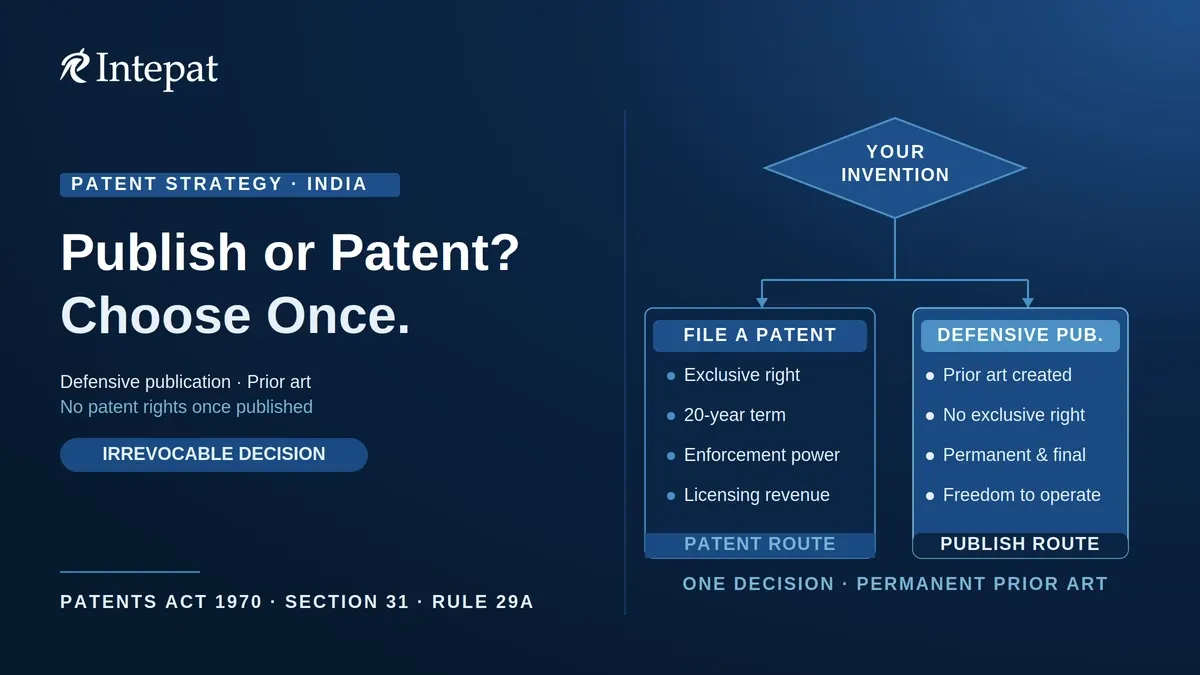
A defensive publication is the deliberate public disclosure of an invention so that it enters the public domain as prior art, creating a record that can be cited against later patent applications claiming the same technical subject matter. It confers no exclusive right and no enforcement power: its purpose is to put the disclosed solution on the public record permanently.
Quick Answer
- A defensive publication creates prior art that can be cited against later patent applications claiming the same disclosed subject matter.
- It permanently surrenders your own patent rights on that disclosure. This cannot be undone.
- It works best when cost, freedom to operate, or publication speed matters more than holding an exclusive right.
The trade-off is direct: you give up the possibility of patenting the disclosed invention, but you make it harder for others to later claim patent rights over the same disclosed technical solution. This article explains when that trade-off makes sense for a startup or inventor in India, what the disclosure must contain to work, and where to publish it, with a brief note on grace-period differences compared to the United States and Europe.
What a Defensive Publication Actually Does
Under the Patents Act 1970, an invention qualifies as a “new invention” only if it has not been anticipated by publication in any document or by use anywhere in the world before the relevant filing or priority date. When a patent examiner searches for anticipation, the search covers publications “in India or elsewhere”: the whole world, not just India.
A defensive publication is a document placed in the public record with a verifiable date. It functions as prior art against any later patent application whose relevant priority date falls after the publication date. An examiner is required to search for this kind of prior art, and a disclosure that sufficiently describes the invention is likely to defeat a later application on novelty grounds.
What the mechanism also does, and what many founders do not register, is defeat your own patent rights on the same subject matter. Once you publish, your own publication stands as prior art against any patent application you might later file on the same invention. India does not operate a general inventor grace period. The narrow exceptions under the Patents Act 1970 (for officially notified exhibition displays and papers read before a learned society) carry strict conditions described later in this article.
The decision to publish defensively is therefore permanent and irreversible. It must be taken only after confirming that patent protection on the disclosed invention is not wanted now and is not likely to be wanted in the future.
When Choosing Publication Beats Choosing a Patent
Defensive publication makes strategic sense in several situations that Indian startups and R&D teams encounter regularly.
The cost-benefit analysis fails for this particular invention. Prosecuting a patent in India involves professional fees, official fees, and renewal fees across a 20-year term. For an invention with a short commercial window, or one that is a building block rather than the core product feature, those costs may not be justified. Publishing the disclosure costs a fraction of that while removing the administrative burden of prosecution.
Freedom to operate matters more than exclusivity. Freedom to operate means the ability to use, make, and sell your own product without infringing a third-party patent. Some inventions are enabling infrastructure: technology used internally but not intended to be monetised through licensing. The goal is not to stop competitors from using the idea, but to reduce the risk that a later-filed patent application claims the same disclosed subject matter and is used against the company. A defensive publication does not clear earlier patents or earlier-filed unpublished applications, and it is not a substitute for a freedom-to-operate search. It operates only against later filings.
The product life cycle is short. In fast-moving technology sectors, a product may be commercially obsolete before a patent reaches grant, a process that can take several years. The defensive publication takes effect on day one, with no prosecution lag.
The invention is one of many. A team generating a high volume of incremental innovations cannot economically patent everything. Disclosing the inventions that do not warrant patent investment clears them from the portfolio while blocking competitors from patenting them, freeing prosecution resources for the inventions that do warrant investment.
The subject matter relates to traditional knowledge. The Patents Act 1970 excludes from patentability any invention that, in effect, is traditional knowledge or an aggregation of known properties of traditionally known components. Where an innovation is adjacent to documented traditional practices, a defensive publication in a widely indexed platform can serve a useful blocking function alongside India’s own Traditional Knowledge Digital Library.
| Not Sure Which Route? |
| Intepat’s patent agents help you decide before you disclose. |
| Get Expert Advice |
What the Disclosure Must Contain to Work
A defensive publication that does not meet the enabling-disclosure standard is not reliable prior art. If a patent examiner can argue that the disclosure fails to describe the invention in sufficient technical detail for a person skilled in the relevant field to reproduce it without undue effort, the disclosure may not anticipate the later claim.
The disclosure must describe the invention fully enough that reproduction is possible from the document alone, without additional experimentation. This is the same standard applied to complete patent specifications. A press release, product brochure, or a general conference abstract is unlikely to meet it.
The publication must also carry a verifiable date that is externally confirmable. This is the date that matters in any novelty contest. And once the disclosure is published, there is no mechanism to retract it. If the invention later proves commercially significant in a way not anticipated at the time of publication, the patent route on the disclosed subject matter is permanently closed.
Before you publish: five questions to answer first
- Is this invention core to the product, or is it a building block we are comfortable releasing?
- Is there any chance we will want patent protection in India, the US, Europe, or other markets?
- Have we confirmed that earlier third-party patents do not already restrict our freedom to operate?
- Does the disclosure describe the invention in enough technical detail for someone skilled in the field to reproduce it?
- Are we prepared to make this information permanently and irrevocably public?
If you answered yes to the first or second question, consult a registered patent agent before publishing.
How to Publish Your Disclosure in India
Technical Disclosure Commons is a free, publicly accessible platform that is indexed by Google Patents, making publications findable by patent examiners worldwide. No fee and no subscription is required to publish. Submissions receive an automatic date stamp on upload. This is the lowest-cost route to immediate, indexed prior art.
Research Disclosure (operated by Questel) is a paid service that has operated since 1960 and is widely recognised by patent offices. Research Disclosure is included in WIPO’s PCT minimum documentation list, which means International Searching Authorities are expected to search it during international examination, giving publications here a stronger chance of being cited. It also offers anonymous publication, allowing a company to establish prior art without identifying itself.
IP.com Prior Art Database is a paid platform used by a number of large technology companies for systematic disclosure programmes, with distribution to patent offices and databases.
Academic journals and conference proceedings can also constitute defensive prior art where the publication is indexed and the date is externally verifiable.
What If You Have Already Disclosed?
India has no general grace period for voluntary public disclosures. A website publication, an investor deck shared without a confidentiality agreement, a product launch, a blog post, or a presentation at a regular trade conference will constitute prior art against a later Indian patent application on the same subject matter.
Several narrow statutory exceptions exist under the Patents Act 1970: communication to the Government for investigation purposes, public working for reasonable trial only (within one year of the priority date), publication after a provisional filing on the same application, and, in limited circumstances, unauthorised disclosure where the inventor can prove the publication was made without consent and applied as soon as reasonably practicable. None of these covers ordinary voluntary publication.
The one exception with a clear procedural mechanism is Section 31 of the Patents Act 1970, which covers displays at exhibitions notified by the Central Government by gazette notification and papers read before a learned society or published in that society’s transactions. If either of those situations applies, you may still file a patent application within twelve months of the exhibition opening or the paper’s presentation or publication. To claim this grace, Form 31 must be filed under Rule 29A of the Patents Rules 2003, along with the prescribed fee. The First Schedule currently prescribes e-filing fees of Rs 500 for natural persons, startups, small entities, and educational institutions, and Rs 2,500 for others; the corresponding physical-filing fees are Rs 550 and Rs 2,750 respectively (verified as of June 2026). If your situation does not fit Section 31 precisely, consult a registered patent agent before assuming the disclosure can be remedied.
What a Defensive Publication Cannot Do
A defensive publication gives no right to sue. It carries no presumption of exclusivity and no basis for collecting royalties. If enforcement is the goal, a patent is the only route. A defensive publication and a patent are not interchangeable tools: they serve fundamentally different purposes.
If the barrier to filing is cost rather than strategic preference, a provisional patent application filed under Section 9 of the Patents Act 1970 is often the better intermediate position. It secures a priority date without requiring completed claims, preserving the option to prosecute to grant while deferring the larger cost. A provisional is available for ordinary Indian applications only; it buys twelve months to assess whether full prosecution is justified. A defensive publication closes the patent option permanently. For a complete walkthrough of the provisional filing process, see our guide on filing a provisional patent application in India.
Defensive Publication vs Patent: A Decision Table
| Factor | Defensive Publication | Patent |
| Cost | Low (free to modest fee) | Material: professional fees, official fees, and renewals |
| Time to effect | Immediate on publication | Several years to grant |
| Protection type | Can create prior art against later applications claiming the same subject matter; no exclusive right | Exclusive right to prevent others from making, using, or selling |
| Reversibility | Permanent; cannot undo | Can be abandoned before grant; post-grant, may be surrendered |
| Licensing revenue | None | Available once granted |
| Best fit | Freedom to operate, short product life, high-volume incremental inventions, cost-constrained situations | Core product technology, licensing strategy, investor signalling, long commercial window |
One further option: filing a patent application and then allowing it to publish (even if prosecution is later abandoned) creates a searchable prior-art record while preserving the patent option during the early period, at higher cost than direct defensive publication.
A brief comparative note: in the United States, an inventor has a one-year grace period after their own public disclosure to file a patent application. The European Patent Convention does not provide a general grace period. India’s position is closer to the European one. A disclosure that preserves US filing rights under the American grace period may still destroy Indian and European novelty if an Indian or European application was not already filed before the disclosure.
For a step-by-step guide to filing and examination in India, see our article on the patent filing procedure in India. For a broader view of what a patent protects and what it does not, see what a patent means and why it matters. For IP strategy across a portfolio, see patent strategy and portfolio management.
Frequently Asked Questions
What is defensive publication in Indian patent law?
A defensive publication is the deliberate public disclosure of an invention to create prior art that can be cited against later patent applications claiming the same disclosed subject matter. It is not a patent and confers no exclusive right. Under the Patents Act 1970, a published document is searched by the examiner and cited against any later application claiming the same subject matter, provided the publication is sufficiently enabling and predates the relevant priority date.
Does defensive publication destroy my own patent rights in India?
Yes. India does not operate a general inventor grace period. Once your invention is publicly disclosed, it is prior art against your own patent application. The narrow exceptions under Section 31 of the Patents Act 1970 (for officially notified exhibition displays and papers read before a learned society) require a patent application to be filed within twelve months of the disclosure. Outside those exceptions, publishing before filing ends the ability to patent in India.
What must a defensive publication contain to be effective as prior art?
The disclosure must be detailed enough that a person with ordinary skill in the relevant field can reproduce the invention from it without undue effort. A high-level product description or press release is unlikely to meet this threshold. The publication must also carry a verifiable date that is externally confirmable.
Can I publish anonymously?
Some platforms, including Research Disclosure, offer anonymous publication. This allows the prior-art effect to be established without identifying the inventor or organisation. The anonymity does not affect the status of the publication as prior art.
Is there a grace period for exhibitions or conferences in India?
India has no general grace period for voluntary disclosures such as product launches, blog posts, or regular conferences. A narrow exception under Section 31 of the Patents Act 1970 applies to officially notified exhibition displays and to papers read before a learned society. The application must be filed within twelve months. Other narrow exceptions cover unauthorised disclosures, Government communications, and reasonable public trials; none covers ordinary voluntary publication.
What if a competitor patents a variation of my published disclosure?
A defensive publication protects only the subject matter it actually describes. If a competitor patents a non-obvious variation or improvement that your disclosure did not fully cover, your publication may not anticipate their claim. A patent application from you covering that variation would need to have been filed before the disclosure for it to block the competitor’s filing.
Where can I publish a defensive publication?
Free options include the Technical Disclosure Commons (tdcommons.org), which is indexed by Google Patents, and academic journals or conference proceedings with externally verifiable publication dates. Paid services include Research Disclosure (Questel) and IP.com. Research Disclosure is included in WIPO’s PCT minimum documentation list, which increases the likelihood of it being searched during international examination. Each platform produces a dated, searchable record; the critical requirement is that the disclosure is sufficiently enabling.
Can defensive publication give me freedom to operate in India?
Not by itself. A defensive publication can reduce the risk that a later-filed patent application claims the same disclosed subject matter, but it does not clear earlier patents or earlier-filed applications that have not yet published. Freedom to operate requires a separate search of existing patents and published applications. Defensive publication and freedom-to-operate analysis address different risks and are not substitutes for each other.
What is the difference between a provisional patent application and a defensive publication?
A provisional patent application, filed under Section 9 of the Patents Act 1970, secures a priority date and preserves the right to pursue a patent within twelve months. It keeps the patent option open. A defensive publication abandons the patent option permanently and places the invention in the public domain. The provisional is the better intermediate position when the goal is to preserve options while deferring the full prosecution cost.
This article provides general information on defensive publication under Indian patent law and is not legal advice. Patent strategy is fact-specific and depends on the nature of the invention, the applicant’s commercial goals, and current Patent Office practice. Consult a registered patent agent for advice on your specific situation.