




Anticipation of invention means your invention is not new because its key features were already available to the public before you filed. Under Indian patent law, an anticipated claim fails the novelty test and cannot be patented. India offers no general grace period, so the safest step is to file before any non-confidential disclosure.
Quick answer for founders
• If your invention is not new, it is not patentable. Anticipation is the legal name for “not new.”
• A single earlier document must show your whole invention to defeat novelty. Examiners cannot stitch several documents together to attack novelty.
• Almost any non-confidential disclosure can anticipate: a publication, a public demo, a sale, a website post, an open pitch deck.
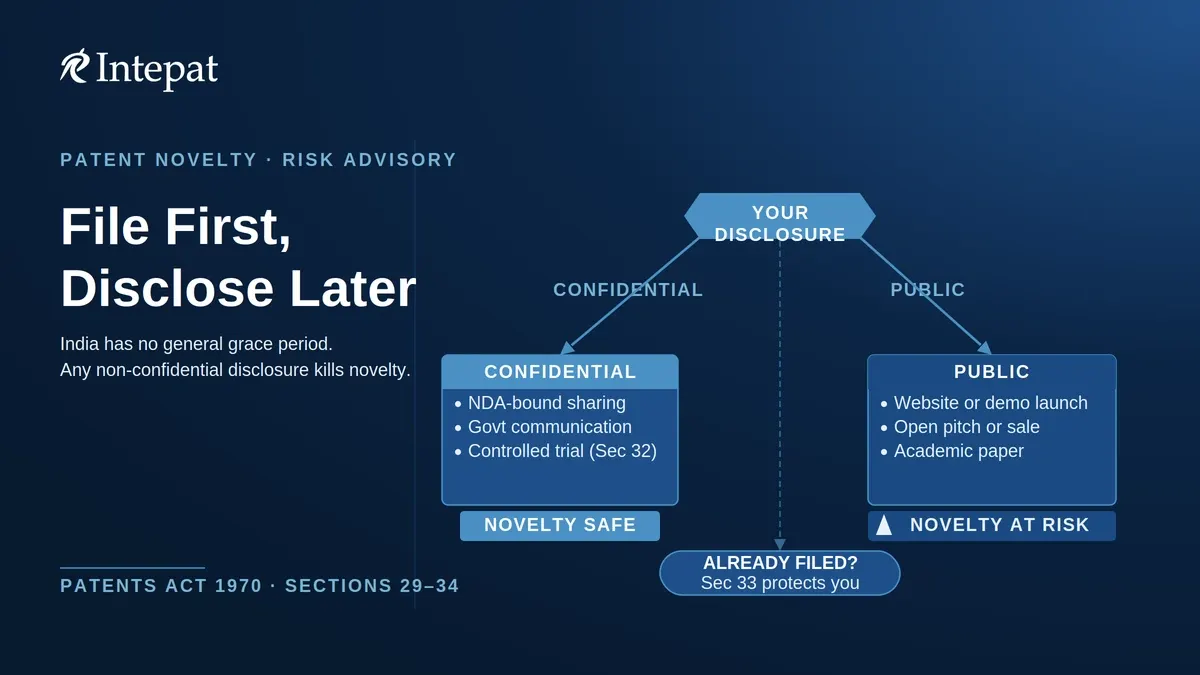
• India has no general grace period. Sections 29 to 34 save only a few narrow situations, and you must prove them.
• File first, disclose later. A filed application locks your priority date.
What anticipation of invention means
A patent is granted only for a new invention. The Patents Act defines a “new invention” as one that has not already been published or used, and has not fallen into the public domain or become part of the state of the art, before you file. When an invention is already known to the public, it is “anticipated,” and an anticipated claim is not new.
Novelty is the first hurdle in Indian patent law. It is a yes-or-no question: either the invention was available to the public before your filing date, or it was not. There is no partial credit. If even one of your claims describes something the public already had access to, that claim is anticipated and the patent office can refuse it. For a fuller treatment of how examiners assess this, see our guide on the novelty requirement in patents.
How novelty is judged: the single-document rule
Anticipation turns on a strict comparison. A prior document destroys novelty only if that one document contains every feature of your claimed invention, set out either in plain words or by clear implication. If your invention combines features that are scattered across two or three separate papers, none of those papers anticipates it on its own.
The earlier document must also be enabling. A vague hint, a wish, or an unexplained result is usually not enough; the document has to describe the invention clearly enough for a skilled person to actually make it.
This single-document rule is why combining references is not allowed when testing novelty. Mixing several documents together, sometimes called mosaicing, is permitted only for the separate question of inventive step, not for novelty. So an invention can be new (no single document shows the whole of it) and still fail later for being obvious once documents are read together. Novelty and obviousness are different tests.
A quick example. Suppose one earlier patent describes a smart water bottle with both a temperature sensor and a self-cleaning cap. A later claim to that same combination can be anticipated, because one document shows the whole of it. But if one document shows only the sensor and another shows only the cap, the two cannot be stitched together to defeat novelty; read together, they may still support an inventive-step objection.
The level of detail matters too. A specific earlier disclosure takes away the novelty of a broad claim: if a copper spring is already known, you cannot claim a “metal spring” as new. The reverse is not automatic: a broad earlier disclosure of a “metal spring” does not, by itself, destroy the novelty of a specific copper spring.
What counts as a public disclosure
Prior art is everything that was made available to the public before your filing or priority date, in any form. It is not limited to patents. It includes journal articles, conference papers, product manuals, brochures, websites, and social media posts, as well as a public demonstration or a commercial sale of the product.
Two kinds of disclosure matter, and one travels further than the other. A publication anywhere in the world can destroy novelty, which is why this is often called anticipation by previous publication. For prior public use or public knowledge, the Act’s opposition and revocation grounds are framed around India, while the definition of a new invention is written more broadly and refers to use in this country or elsewhere in the world. Because the law treats public availability broadly, the safe assumption is simple: any non-confidential public use, sale, demonstration, or disclosure, anywhere, is a novelty risk unless the specific facts have been professionally reviewed. That applies equally to a trade-show demo, a customer pilot, an open pitch, or a post on your own website.
One route catches founders off guard. An invention can also be anticipated by prior claiming, where another person filed for the same invention in India just before you, even if their application had not yet been published when you filed. You cannot find this by searching public databases, which is one more reason to file early. If you have already put your idea out, read our note on whether you can still patent an idea after public disclosure.
| Public or confidential? A quick risk check | ||
| Higher risk (treat as public) Website or app-store launchVideo demo or open trade-show displaySale, brochure, or open pitchAcademic paperCustomer pilot without confidentiality | Lower risk (usually not public) Internal testingNDA-bound manufacturer discussionConfidential investor reviewControlled beta with written confidentiality | Risky middle ground Decks forwarded without an NDADemos in shared spacesPilots where users can inspect the invention with no confidentiality |
India has no general grace period
This is the point founders most often get wrong. India does not give you a general window to file after going public. Some countries let an inventor disclose first and still file within a fixed period; India does not work that way for ordinary disclosures. The moment your invention is publicly available, novelty is at risk, and filing afterwards does not reset it.
The Act does forgive a few specific situations, set out in Sections 29 to 34. These are narrow exceptions, not a general grace period. An everyday disclosure, a website launch, a pitch deck shared widely, a journal paper, or a product on sale, sits outside these exceptions and will usually count against you. Treat the exceptions as a safety net for unusual events, not as permission to disclose before filing.
Disclosures the Act does not hold against you
Sections 29 to 34 of the Patents Act 1970 set out the limited circumstances in which an earlier disclosure does not anticipate your invention. Sections 29 to 33 describe the saving situations; Section 34 is the umbrella that stops the patent office from refusing or revoking a patent by reason only of those situations. The burden of proving that one of these applies rests on you, the applicant, not on the patent office.
| Situation | What it covers | Time limit to file |
| Leak without your consent (Sec 29) | The invention was published using material obtained from you and put out without your consent. The cover is lost if you commercially worked it in India (beyond reasonable trial) before the priority date. | Apply as soon as reasonably practicable after you learn of the leak |
| Disclosure to Government (Sec 30) | You communicated the invention to the Government, or a person it authorised, so it could be investigated. | No fixed window for this disclosure itself |
| Exhibition or learned society (Sec 31) | Display at an exhibition the Central Government has notified for this purpose, or a paper you read before (or published with) a learned society. | Within 12 months of the opening of the exhibition or the reading or publication of the paper |
| Public working for trial (Sec 32) | The invention was publicly worked in India for a reasonable trial only, and it was reasonably necessary, given the nature of the invention, that the trial be done in public. | The public working fell within one year before the priority date |
| Use after you filed (Sec 33) | Your own use or publication after you filed a provisional or convention application, but only for matter actually described in that application. | Protected from that filing date onward |
Where anticipation is raised: examination, opposition, revocation
Anticipation is not only an examiner’s concern; it can be raised against your patent at three stages.
During examination, the examiner searches Indian and foreign patent and non-patent literature for anything that anticipates your claims. If a claim is anticipated, you will face an objection, and the application can be refused unless you amend or show an earlier priority date. A clean prior-art search before filing reduces this risk.
After your application is published but before grant, anyone may file an opposition, and lack of novelty is one of the grounds. Even after a patent is granted, it can still be challenged: a granted patent can be revoked if a claim is shown not to be new in light of earlier public knowledge, use, or publication. A patent is therefore never fully immune to a novelty attack, which is why getting novelty right at the start carries real weight.
File before you disclose: a practical sequence
The safest path is simple to state and easy to get wrong under pressure to launch. Treat the invention as confidential until you have filed.
- Keep the invention private. Where you must share it (with a manufacturer, co-founder, or investor), use a signed confidentiality agreement so the disclosure is not “public.”
- Run a prior-art search to see whether your idea is already out there before you spend on filing.
- File at least a provisional specification before any public reveal. A provisional secures a priority date, but only for the subject matter it actually and sufficiently discloses; later improvements you have not described can still be exposed until you file again. Your filing date is the line that decides what counts as prior art against you.
- Disclose freely only after filing. From your filing date onward, your own later use or publication does not anticipate the application you have already filed.
- If you have already disclosed, speak to a patent professional quickly. The Sections 29 to 34 exceptions are narrow, time-bound, and yours to prove, so the sooner they are assessed, the better your options.
Frequently asked questions
Anticipation of invention means a claimed invention is not new because its features, or its particular combination of features, were already available to the public before the filing or priority date. Under the Patents Act 1970, an anticipated claim fails the novelty requirement and cannot be patented, whether the disclosure was a publication, a public use, a display, or a sale.
No. India has no general grace period that lets you file after public disclosure. The Patents Act forgives only a few narrow situations in Sections 29 to 34, such as a leak without your consent or a notified exhibition. Ordinary disclosures like a website post or product launch are not covered.
Yes. A publication anywhere in the world can make your invention not new in India, including foreign patents, journal papers, and online content. Prior public use or public knowledge is framed around India in the Act’s invalidity grounds, though the definition of a new invention is written more broadly. The safe assumption is that any non-confidential disclosure, anywhere, is a risk.
No. Novelty is judged on the single-document rule: one earlier document must disclose every feature of the claimed invention. Combining multiple documents, known as mosaicing, is allowed only for the separate question of inventive step, not for anticipation or novelty.
Possibly, but not always. A public demonstration can anticipate your invention and threaten novelty. The exhibition exception under Section 31 applies only to exhibitions the Central Government has notified, and you must file within 12 months. Have a patent professional assess your specific facts before assuming the right is lost.
It depends on confidentiality. A pitch given under a clear confidentiality obligation is less likely to count as public disclosure. A deck circulated without restriction, forwarded on, or presented at a public event can create a novelty risk. Where you can, file at least a provisional before you pitch.
This article explains the law on anticipation and novelty in general terms and is not legal advice. Whether a particular disclosure anticipates an invention, and whether any exception under Sections 29 to 34 applies, depends on the specific facts and dates and should be assessed with a registered patent agent or attorney before you file or disclose.