




An invention disclosure form (IDF) is the document you use to brief a patent agent before a specification (the formal technical document filed with the Patent Office) is drafted. It captures what the invention is, what problem it solves, how it works, and what existed before it. A complete IDF reduces the risk of a specification that misses key aspects of your invention.
Scope: This article covers the invention disclosure form in the context of Indian patent filings under the Patents Act 1970 and Patents Rules 2003.
Quick answer
The IDF itself is not filed with the Patent Office. The information in it is used to prepare the specification and related patent forms, so it should be accurate, complete, and internally consistent.
Its job is to give your patent agent the raw material to prepare Form 1 (the patent application), the specification in Form 2, the declaration of inventorship in Form 5, and, where applicable, Form 3 for corresponding foreign applications.
A complete IDF covers: the invention title, the technical field, the problem you are solving, the closest existing solutions and their shortcomings, how your invention works, any preferred versions, drawings or sketches, disclosure history, and keywords.
Here is a summary of what to include in your IDF and why:
| What to include in your IDF | Why your patent agent needs it |
| Problem and existing solutions | To identify the inventive contribution and distinguish the invention from prior art |
| Technical working of the invention | To describe the invention clearly enough that someone in the field can reproduce it |
| Best version tested | To satisfy the best-method disclosure requirement |
| Drawings or sketches | To support clear embodiments and claims |
| Public disclosure history | To assess novelty and determine filing urgency |
| Inventor details | To prepare Form 1 and Form 5 correctly |
| Foreign filing plans | To manage Section 39 obligations and Form 25 applications |
What Is an Invention Disclosure Form?
An IDF is an internal document, typically prepared by the inventor, that translates technical knowledge into a structured format a patent agent can use to prepare a patent application. It is not prescribed by statute and has no official format; each firm or organisation uses its own version.
The reason it exists is practical: under the Patents Act 1970, a complete specification must “fully and particularly describe the invention and its operation or use and the method by which it is to be performed,” and must “disclose the best method of performing the invention which is known to the applicant.” An agent who receives only a verbal briefing or a research summary has to reconstruct that information through follow-up questions. A thorough IDF does that work upfront, in writing, before any drafting begins.
The IDF also feeds information into formal documents filed with the Patent Office: Form 1 (the patent application itself), the specification in Form 2, the declaration of inventorship in Form 5, and, where parallel foreign applications are running, Form 3 (the statement and undertaking regarding foreign applications). Errors at the IDF stage can propagate into those statutory filings.
Why the IDF Matters Before You File a Patent
Two statutory requirements make the quality of the IDF more than a drafting convenience.
The best-method requirement. The complete specification must disclose the best method of performing the invention known to the applicant at the time of filing. If the inventor withholds a preferred version, a superior material, or an optimised parameter while filling out the IDF because it “seemed obvious,” that information may not reach the specification at all. In practical terms: if you already know that one material, parameter range, configuration, algorithm, or process condition works better than the rest, do not leave it out of the IDF. A deficient best-method disclosure is a substantive weakness in the specification that cannot be fully repaired after the filing date.
The priority date. The IDF does not create legal priority. The filed specification does. But if the IDF is incomplete, the provisional or complete specification drafted from it may omit important subject matter, and that omission can affect claim support, priority, and amendment flexibility later. When an inventor files a provisional specification first and follows up with a complete specification within 12 months, the claims in the complete specification can claim the earlier filing date as their priority date only for subject matter that was “fairly based on the matter disclosed” in the provisional. In competitive technology spaces, losing the priority date by even a few weeks can defeat novelty.
These two requirements are why the IDF is not just an administrative step.
What to Include in Your Invention Disclosure Form
The sections below reflect what the Manual of Patent Office Practice and Procedure describes as the expected content of a specification, adapted to the pre-filing disclosure context. Each item tells your patent agent something the specification will need to contain.
Keep the IDF confidential.
Do not circulate it to investors, vendors, manufacturers, universities, consultants, or collaborators unless a confidentiality agreement is already in place. If outside disclosure is necessary before filing, tell your patent agent before sharing. Unauthorised disclosure of the IDF can become a public disclosure of the invention itself.
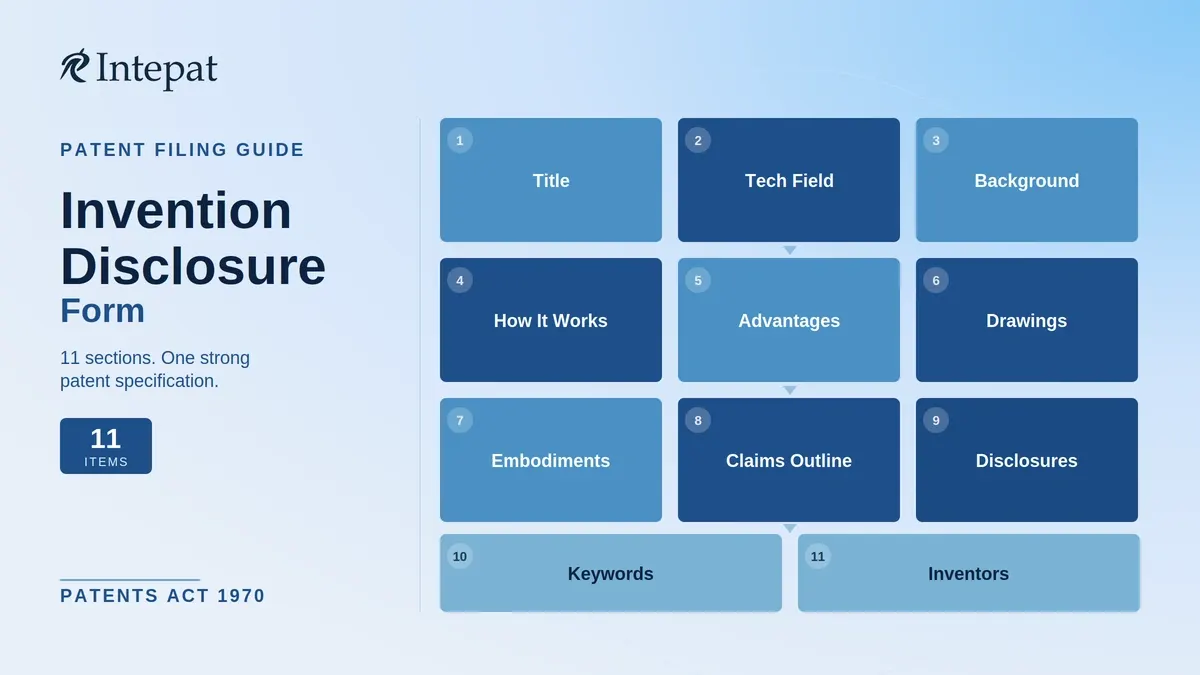
1. Title of the invention. The title must sufficiently indicate the subject matter and disclose specific features of the invention. Per the Manual of Patent Office Practice and Procedure, the title should normally not exceed fifteen words. Avoid titles that describe only the field (“Improvements in Textile Processing”) without pointing at the inventive feature.
2. Technical field. A short statement of the area to which the invention belongs. This is the “field of invention” section of the specification, and it anchors the invention in the correct technology domain for search and examination.
3. Background and problem. Describe the current state of the technology, the existing solutions, and their shortcomings. The complete specification requires the applicant to “distinguish the invention from the closest prior art.” The IDF is the right place to record what you already know about that prior art (existing patents, publications, and products in the same technical field): competitor products, published papers, pending patent applications in the same area.
4. The invention: how it works. Describe the invention in detail. Include: the core mechanism or principle, each component and how it interacts with others, any ranges, materials, or parameters that affect performance, and the best version you have tested. If you have multiple versions or embodiments (distinct variants of the invention), describe each. What is not described cannot be claimed.
When preparing an IDF for a patent in India, the goal is not to write legal claims but to give your patent agent enough technical detail to draft a strong specification. The difference between a weak and a strong IDF input is the level of technical specificity. For example: a weak description reads “the device improves battery life”; a strong description reads “the device reduces power consumption by switching the sensor from continuous sampling to event-triggered sampling when the measured vibration falls below a defined threshold.” The second version gives the agent a claim-worthy feature. The first gives them nothing to work with.
5. Advantages over the prior art. State specifically what your invention achieves that existing solutions do not. This feeds the “objects of the invention” section of the specification and supports the inventive step analysis: under the Patents Act 1970, an inventive step means a feature that involves technical advance compared to existing knowledge, or economic significance, and that makes the invention not obvious to a person skilled in the art.
6. Drawings and sketches. Provide annotated diagrams, photographs, flowcharts, or circuit layouts for any invention where the working mechanism is best illustrated visually. In a formal specification, drawings are placed on separate sheets rather than embedded in the text, but at the IDF stage rough sketches with labelled parts are enough for the agent to commission proper patent drawings. Include a key identifying what each reference numeral represents.
7. Preferred embodiments. If you have tested variants, describe the one that performs best. This feeds the best-method requirement directly.
8. Claims outline (optional but useful). You do not need to draft formal claims in the IDF: that is the agent’s work. But listing what you believe the invention’s key aspects are — the core product or process, important optional features, any sub-combinations you want protected — helps the agent understand the scope of protection you are seeking. Under the Patents Act 1970, claims must be “clear and succinct” and “fairly based on the matter disclosed in the specification.” Claims that go beyond the disclosure are objectionable and, if granted, are vulnerable to challenge. The outline claims in your IDF are a working guide for the agent, not the final legal text: the agent rewrites them into compliant form.
9. Disclosure history. Record every date and occasion on which the invention was disclosed outside confidential channels: conference presentations, publications, demonstrations, grant applications, social media posts. Public disclosure before filing is dangerous and may destroy patentability in India and in most other countries. India has narrow savings under Sections 29 to 34 of the Patents Act 1970, but they apply only in specific situations and often require strict timing or factual conditions. Do not assume a grace period applies without confirming with your agent.
Commercial working of the invention in India before the priority date is particularly risky: some statutory savings are unavailable once the invention has been commercially worked, except where the working amounts only to reasonable trial. The dates in the IDF determine whether your filing date is safe or compromised.
10. Keywords for prior art search. Provide the technical terms, synonyms, and related phrases that would appear in documents describing your invention or its prior art. These assist the prior art search your agent will conduct, and support the Patent Office’s own search under Section 13 of the Act.
11. Inventor details. Full names, addresses, nationalities, and employer details for every person who contributed to the inventive concept, not everyone who merely followed instructions, tested prototypes prepared by others, or reduced an already-conceived idea to practice. This information feeds Form 1 and the declaration of inventorship in Form 5, which must be filed with the complete specification or within one month of its filing. Note that the statutory expression “true and first inventor” has a specific scope under the Patents Act 1970: it expressly excludes the first importer of an invention into India and a person to whom an invention was first communicated from outside India.
The Disclosure Trap: Prior Publication and the Foreign Filing Rule
Two risk areas that the IDF disclosure history section is designed to catch:
Prior publication. If you published the invention — in a journal, at a conference, in a grant proposal, in a pitch deck shared with external reviewers — before filing, that publication is dangerous and may destroy patentability for the Indian patent application and for patent filings in most other jurisdictions. The narrow savings in Sections 29 to 34 of the Patents Act 1970 cover specific circumstances (government communications, international exhibitions, learned society papers with conditions) and not general commercial disclosures. Do not assume any of these savings apply without confirming the facts with your agent. Identify every disclosure event in the IDF so your agent can assess whether filing is still viable and advise on urgency.
The foreign filing rule. Under Section 39 of the Patents Act 1970, a person resident in India cannot file a patent application outside India without prior permission, unless an Indian application has been filed at least six weeks before the foreign filing and no secrecy direction is in force. Breach of Section 39 renders the Indian application deemed abandoned and the patent, if granted, liable to revocation. If you are considering filing in the US, Europe, or under the PCT alongside or before an Indian application, the IDF should record those plans so your agent can apply for foreign filing permission in Form 25 or structure the filing sequence correctly.
From the IDF to Your Patent Application: What Happens Next
Once the agent has the IDF, the typical sequence is:
- Patentability assessment. The agent reviews the IDF against known prior art. A patentability search at this stage surfaces documents that may affect the scope of protection available. This search is not mandatory before filing, but it is the step that tells you whether the claims you have in mind are likely to survive examination.
- Specification drafting. The agent drafts the specification in Form 2. If you are filing a provisional specification first to secure the priority date, the provisional will describe the invention based on what is in the IDF; the complete specification, which must follow within 12 months, will include the claims.
- Filing and prosecution. The complete specification is filed along with Form 1 (the patent application), Form 5 (declaration of inventorship), and, where applicable, Form 3 (the statement and undertaking regarding foreign applications). The initial Form 3 obligation is to file within six months of the Indian application date, but further disclosure obligations arise at later stages of prosecution and are governed by the current Rules; confirm the full timeline with your agent.
- Examination. A request for examination must be filed within 31 months of the filing date or the priority date, whichever is earlier (verified as of June 2026; check the current Rules for applications filed before the 2024 Patents Amendment Rules). The Patent Office then searches the prior art and raises objections. The quality of the original IDF is still relevant at this stage: a specification that disclosed the best method and described all embodiments will typically produce broader, more defensible claims.
For the statutory requirements that govern what a specification must contain, Section 10 of the Patents Act 1970 is the primary source: view the current text on IP India.
Is Your Invention Ready to Disclose?
Before you hand the IDF to your agent, run through these questions:
- Have you described how the invention works in enough detail for someone in your technical field to reproduce it?
- Have you identified the closest existing solutions and explained why your invention is different?
- Have you listed every public disclosure of the invention, with dates?
- Have you described your best version, not just the concept?
- Have you listed all inventors, including colleagues who contributed to the inventive concept?
- If you are planning to file in other countries, have you discussed the sequence and timeline with your agent?
A “yes” to each of these reduces the risk of a specification that either fails examination or grants protection narrower than what the invention deserves. A good invention disclosure for a patent agent should explain the invention fully, not merely attach slides or lab notes. If you need help preparing or reviewing an IDF before filing, Intepat’s patent drafting service covers the full process from disclosure to specification.
Frequently Asked Questions
An invention disclosure form is a pre-filing document in which an inventor records the technical details of an invention for a patent agent. It is not filed with the Patent Office and has no prescribed statutory format. Its purpose is to give the agent the information needed to prepare the specification in Form 2 and related statutory documents.
No. There is no statutory requirement to complete an IDF before filing a patent application in India. It is an internal process document used by firms and R&D organisations to structure inventor-agent communication. The statutory documents are the specification in Form 2, the declaration of inventorship in Form 5, and, where applicable, the Form 3 statement on foreign applications.
Information not in the IDF is unlikely to reach the specification. The complete specification must disclose the best method of performing the invention known to the applicant at the time of filing. Subject matter not described in the specification cannot be claimed. Omissions at the IDF stage can therefore permanently narrow the scope of protection available.
You can, and it helps the agent understand the scope of protection you are seeking. However, claim drafting is the agent’s formal responsibility: claims in the complete specification must be clear, succinct, and fairly based on the matter disclosed in the specification. Outline claims in the IDF are a guide, not final legal text.
No. The IDF is an internal firm document and is never filed or published. The patent application is ordinarily published 18 months after the filing date or the priority date, whichever is earlier, unless early publication is requested or an exception such as a secrecy direction applies. The IDF takes no part in that process.
When you file a provisional specification first, the claims in the complete specification can claim the earlier priority date only for subject matter disclosed in the provisional. A provisional built on an incomplete IDF may fail to cover key aspects of the invention, leaving those aspects without the earlier priority date.
This article explains the law on invention disclosure and patent specification requirements in India as at June 2026 and is for general information only. It is not legal advice. Government fees, forms, and procedures change; confirm current figures with the Indian Patent Office before you file. For advice on your specific invention, consult a registered patent agent.