




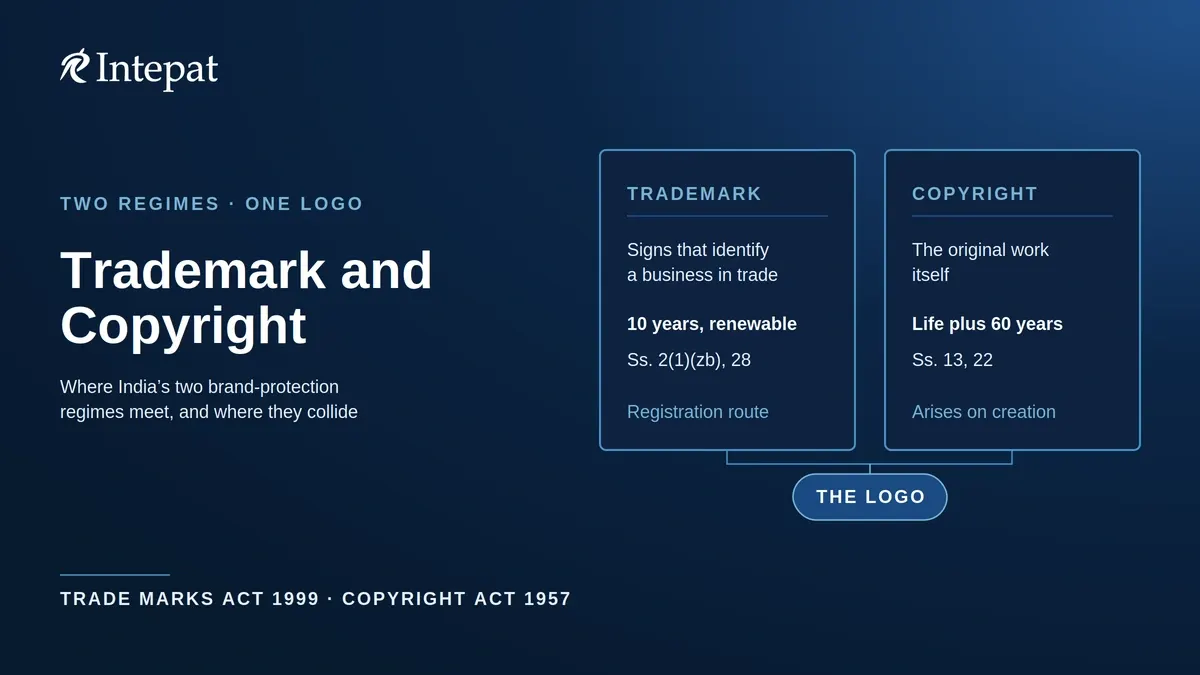
A trademark protects the signs that identify a business in trade, such as a brand name, logo or tagline. Copyright protects the original work itself, such as writing, artwork, music or code. An original logo can attract both at once, which is why the two regimes intersect more often than founders expect.
This article sets out the difference between trademark and copyright under Indian law, working from the Trade Marks Act 1999 and the Copyright Act 1957 with their respective Rules. Both regimes sit inside international frameworks, the Paris Convention on the trademark side and the Berne Convention on the copyright side, so the broad shape will look familiar in other jurisdictions. The procedures, fees and timelines below are Indian.
| Before you file The short version: |
| a trademark protects the sign; copyright protects the work. One can be renewed indefinitely; the other expires on a fixed statutory term.A trademark registration runs for ten years and can be renewed, provided renewal requirements are met and the registration is not otherwise removed or cancelled.Copyright arises when an original work is created. Registration is optional, not a condition of the right.For a commercial logo, the copyright fee is Rs 2,000 (not the Rs 500 that circulates online), and the application must be accompanied by a Trade Marks Registry certificate costing a further Rs 9,000.Do not assume that paying a designer transferred ownership. Check the engagement contract before you file anything. Fees and timelines verified as of July 2026. |
What a Trademark Protects in India
Section 2(1)(zb) of the Trade Marks Act 1999 defines a trade mark as a mark capable of being represented graphically and capable of distinguishing the goods or services of one person from those of others. The word “mark” is defined separately and covers a device, brand, heading, label, ticket, name, signature, word, letter, numeral, shape of goods, packaging or combination of colours.
Appearing in that definition is not the same as being registrable. A sign still has to be capable of distinguishing, and it still has to clear the absolute grounds for refusal in Section 9, which include marks devoid of any distinctive character.
Two things follow. A trademark is tied to trade: it protects a sign because of the job the sign does in telling a buyer where goods or services come from. And the right attaches to the goods or services specified in the registration. Classification into classes is an administrative function of the Registrar. It is the specification, not the class number, that sets the boundary.
Registration gives the proprietor the exclusive right to use the mark for the goods or services registered, and the right to sue for infringement, under Section 28. That right is subject to any conditions and limitations entered on the register.
There is one significant extension beyond the specification. Under Section 29(4), a registered mark can be infringed by use on goods or services that are not similar to those registered, but only where three conditions are met together: the marks are identical or similar, the registered mark has a reputation in India, and the use without due cause takes unfair advantage of, or is detrimental to, the distinctive character or repute of the mark.
An unregistered mark is not without protection. Section 27 bars an infringement action for an unregistered mark but preserves the right of action for passing off, and Section 34 separately protects a person who has continuously used a mark from a date earlier than the registered proprietor. Use may generate unregistered rights enforceable through passing off; valid registration creates the statutory exclusive right and the infringement remedy. They are different things, and one does not automatically produce the other.
Nor does filing require prior use. Section 18 allows a person claiming to be the proprietor of a mark “used or proposed to be used” to apply, so a business can file before it launches.
A registration lasts ten years and can be renewed for successive ten-year periods, with no statutory ceiling on the number of renewals. A missed renewal is not immediately fatal. Under the proviso to Section 25(3), the Registrar shall not remove the mark if the renewal application, fee and surcharge are filed within six months of expiry. If the mark has already been removed, Section 25(4) allows restoration on application made after six months and within one year of expiry. Separately, a registration can be removed for non-use under Section 47.
What Copyright Protects in India
Copyright subsists throughout India in original literary, dramatic, musical and artistic works, in cinematograph films, and in sound recordings. That word “original” is statutory, and it is a condition of subsistence rather than a formality.
The definitions do most of the remaining work. Under Section 2(c) of the Copyright Act 1957, an artistic work means a painting, sculpture, drawing, engraving or photograph, “whether or not any such work possesses artistic quality”, together with a work of architecture and any other work of artistic craftsmanship. There is no aesthetic merit test. The Supreme Court confirmed the breadth of the category in Cryogas Equipment Private Limited v. Inox India Limited (2025 INSC 483), observing that the expression carries a very wide connotation and may include abstract work comprising a few lines or curves arbitrarily drawn, which may or may not have visual appeal.
A literary work includes computer programmes, tables and compilations including computer databases, which is why software sits on the copyright side of the line rather than the trademark side.
Section 14 sets out what the owner can stop others doing, and it differs by class of work. For an artistic work the owner controls reproduction in any material form, including depicting a two-dimensional work in three dimensions and a three-dimensional work in two dimensions.
Copyright arises on creation. Section 45 says the owner “may” apply to enter particulars of the work in the Register of Copyrights, which makes registration optional. What registration provides is evidential: the Register is prima facie evidence of the particulars entered in it, and certified extracts are admissible without further proof of the original. That can reduce what has to be established in a dispute. It does not make ownership uncontestable.
Term is where the two regimes diverge most sharply. Under Section 22, copyright in a literary, dramatic, musical or artistic work published in the author’s lifetime runs until sixty years from the beginning of the calendar year following the year in which the author dies. It is not measured from the death anniversary, and it is not measured from publication.
Trademark and Copyright Compared Across Nine Points
| Point of comparison | Trademark | Copyright |
| Governing statute | Trade Marks Act 1999, Trade Marks Rules 2017 | Copyright Act 1957, Copyright Rules 2013 |
| What it protects | Signs that distinguish goods or services in trade: names, logos, taglines, shapes, packaging, colour combinations | Original literary, dramatic, musical and artistic works, films and sound recordings |
| How the right arises | Use may generate unregistered rights enforceable through passing off. Valid registration creates the statutory exclusive right and the infringement remedy | On creation of an original work |
| Is registration required | Not for passing off or prior use, but required to sue for infringement | No. Optional, and evidential in effect |
| Duration | Ten years, renewable for successive ten-year periods, subject to renewal and to removal or cancellation | Author’s life plus sixty years from the start of the following calendar year for most works (Section 22); sixty years from publication for films and sound recordings |
| Scope of the right | The goods or services specified in the registration, extending to dissimilar goods only on the reputation conditions in Section 29(4) | The acts specified in Section 14, under Indian law. Protection abroad depends on the law of the relevant country |
| Who owns it first | No statutory first-owner rule. A person claiming proprietorship may apply; entitlement may still be disputed | The author is the first owner, subject to the provisos (Section 17) |
| Symbols | No symbol is prescribed. What is regulated is representing a mark as registered when it is not | The copyright symbol is not required for the right to subsist |
| Main enforcement route | Infringement suit, or passing off for unregistered marks | Infringement action and civil remedies under the Copyright Act |
The row that catches most businesses is duration. Unlike a trademark registration, copyright cannot be renewed indefinitely: its term is fixed by statute, usually by reference to the author’s death or the date of publication. A company that buys copyright in a manuscript from a human author still holds a term measured from that author’s death, because the term measures from the author, not from the owner.
Which Right Applies to Your Logo, Name, Website and Software
The table below sets out where protection typically sits. It is not a set of guarantees. On the trademark side, everything depends on whether the subject matter is used or proposed to be used as a distinctive source identifier and whether it clears the registration requirements. On the copyright side, everything depends on whether the particular expression is original.
| Asset | Typical trademark protection | Typical copyright protection |
| Business or product name | Usually the principal right | Not ordinarily; a bare name may fail the originality requirement |
| Logo or device | Potentially, as a used or proposed-to-be-used mark; registration creates the statutory infringement remedy | Usually, as an original artistic work |
| Tagline or slogan | Potentially, if it distinguishes | Depends on the particular expression |
| Website copy, blog posts, brochures | Not ordinarily the principal protection | Usually, as literary works |
| Product photography | Potentially, if used as a source identifier | Usually, as artistic works |
| Software and source code | Product name, logo, app icon or other source-identifying signs, not the code itself | Usually, as a literary work |
| Packaging artwork | Potentially; packaging falls within the definition of a mark | Potentially, subject to the note below |
| Shape of the product itself | Potentially, subject to Section 9(3) | Requires a Designs Act assessment; copyright may remain relevant to the underlying artwork |
| A boundary worth knowing before you build a product line |
| Two rules sit in Section 15 of the Copyright Act, and they work differently. Under Section 15(1), copyright does not subsist at all in a design that is registered under the Designs Act 2000. Under Section 15(2), copyright in a design that is capable of registration under that Act but has not been registered ceases once an article to which the design has been applied has been reproduced more than fifty times by an industrial process. |
In Cryogas, the Supreme Court held that the original artistic work does not lose copyright merely because a design derived from it has been industrially applied to make a product. What Section 15(2) reaches is the derived design, not the underlying artwork considered separately. The Court set a two-pronged approach: first, whether the work is purely an artistic work or a design derived from it and subjected to an industrial process; and second, if it does not qualify for copyright, whether the test of functional utility shows it would qualify for design protection at all. This is worth taking advice on before a design goes into production runs rather than after.
Why Registering Copyright in a Logo Needs a Trade Marks Registry Certificate
This is the point at which the two regimes stop being parallel and start being connected, and it is the step that surprises most applicants.
The proviso to Section 45(1) of the Copyright Act 1957 applies where the application concerns an artistic work which is used or is capable of being used in relation to any goods or services. Where that condition is met, the application must say so, and must be accompanied by a certificate from the Registrar of Trade Marks confirming that no identical or deceptively similar trade mark stands registered, or applied for, in the name of anyone other than the applicant. Rule 70(6) of the Copyright Rules 2013 repeats the requirement in the same terms.
The trigger is the statutory use or capability condition, not the label “logo”. A logo that is used or is capable of being used in relation to goods or services falls within that condition, so the certificate is not optional for it.
The certificate is obtained on the trademark side, on Form TM-C under Rule 22 of the Trade Marks Rules 2017. The ordinary certificate shall ordinarily be issued within thirty working days of the request, and an expedited route gives a certificate ordinarily within seven working days. Both periods are subject to any requirements the Registrar raises, and if a statement of requirements is not complied with within two months, the request is treated as abandoned.
One point of frequent confusion in our filing practice: this certificate is not a clearance search. It reports on identical or deceptively similar marks standing in the name of someone other than the applicant, for the purpose of the copyright application. It is not a substitute for a proper availability search before you adopt a mark, and it should not be treated as one.
The cost of the whole exercise is not what most founders expect:
| Step | Fee | Source |
| Copyright application, artistic work not used in trade | Rs 500 per work | Copyright Rules 2013, Second Schedule, entry 9(a) |
| Copyright application, artistic work used or capable of being used in relation to goods or services | Rs 2,000 per work | Copyright Rules 2013, Second Schedule, entry 9(b) |
| Search certificate on Form TM-C, e-filing | Rs 9,000 | Trade Marks Rules 2017, First Schedule, entry 11 |
| Search certificate on Form TM-C, physical filing | Rs 10,000 | Trade Marks Rules 2017, First Schedule, entry 11 |
| Expedited search certificate, e-filing only | Rs 30,000 | Trade Marks Rules 2017, First Schedule, entry 12 |
Verified as of July 2026. Confirm current figures with the Copyright Office and the Trade Marks Registry before you file.
So for a commercial logo falling within the Section 45 proviso, the minimum ordinary official fees on the e-filing route are Rs 11,000: Rs 2,000 for the copyright application and Rs 9,000 for the Form TM-C request. That excludes professional fees and any further proceedings or corrective filings. In our experience, this is the figure that most often leaves a budget short, because the Rs 500 that appears in most online summaries applies only to an artistic work that is not used in trade.
When Someone Else’s Copyright Can Block Your Trademark
The connection runs in the other direction too. Section 11(3)(b) of the Trade Marks Act 1999 provides that a trade mark shall not be registered if, or to the extent that, its use in India is liable to be prevented by virtue of the law of copyright.
The practical scenario is ordinary. A business commissions a logo, files it as a trademark, and a third party who holds copyright in the underlying artwork objects, on the basis that the artwork was copied, adapted or reused without authority.
Two separate questions then arise, and they are easily conflated.
Who may oppose. Under Section 21(1), any person may give notice of opposition within four months of the advertisement of the application. Standing to oppose is not limited to trade mark proprietors, so a copyright owner is not shut out of the process.
On what ground refusal may rest. Section 11(5) is narrower. It provides that a mark shall not be refused on the Section 11(2) or 11(3) grounds unless objection is raised in opposition “by the proprietor of the earlier trade mark”. That is the exact statutory wording, and it should be read carefully before assuming that every person claiming an earlier copyright can invoke Section 11(3)(b) independently. Section 21(5) is also relevant: the Registrar, after hearing the parties, may take into account a ground of objection whether the opponent relied on it or not.
The Registry does not raise the Section 11(3) grounds during examination. What the founder should take from this is narrow and certain: unresolved copyright ownership in the underlying artwork creates a filing risk, and it is cheaper to address before the application goes in than after it is opposed.
Who Owns Copyright in a Commissioned Logo?
The author of a work is the first owner of the copyright in it, and for a drawing the author is the artist. Paying an invoice does not, by itself, change that.
The provisos to Section 17 of the Copyright Act move ownership in listed cases. Proviso (b) covers a photograph taken, a painting or portrait drawn, or an engraving or cinematograph film made, for valuable consideration at the instance of another person. Proviso (c) covers work made in the course of employment under a contract of service.
Those exceptions matter in both directions, and the second is the one businesses miss. If the designer is an employee of a design agency under a contract of service, proviso (c) can make the agency the first owner rather than the individual. An agency may also already hold the rights through an earlier assignment. Examine the engagement documents and the circumstances of creation, rather than assuming either that the freelancer owns it or that you do. The engagement contract is the first document we ask for when a client brings us a logo to file.
Where an assignment is needed, Section 19 sets conditions on it. It must be in writing signed by the assignor. It must identify the work and specify the rights assigned, the duration and the territorial extent, and it must state the royalty and any other consideration payable. Where the period is not stated, it is deemed to be five years; where the territorial extent is not specified, it is presumed to extend within India.
Two further points are routinely missed. If the assignee does not exercise the assigned rights within one year, the assignment in respect of those rights is deemed to have lapsed, unless the agreement says otherwise. And a commissioning contract can assign copyright in a future logo, with the assignment taking effect when the work comes into existence, which is one way to handle it at source. Addressing all of these in a copyright assignment agreement at the commissioning stage can avoid a later chain-of-title dispute.
One thing an assignment does not do is extinguish the author’s special rights under Section 57, which subsist independently of copyright and survive assignment.
What to File First, and in What Order
Neither Act prescribes an order for filing. What follows is a risk-management sequence, not a legal rule.
For a commissioned logo, establish authorship and ownership first, and obtain any assignment you need. A trademark filing does not cure a defective chain of title, so filing over an unresolved ownership question moves the problem rather than solving it.
With ownership settled, assess trademark availability and decide what to file. If you are choosing between the name and the device, the scope difference between a word mark and a logo mark will usually decide it, and the trademark registration process in India sets out the route. The official fee for a trademark application is charged per class and per mark:
| Applicant | Physical filing | E-filing |
| Individual, Startup or Small Enterprise | Rs 5,000 | Rs 4,500 |
| All other applicants | Rs 10,000 | Rs 9,000 |
Trade Marks Rules 2017, First Schedule, entry 1. Verified as of July 2026.
The startup and small-enterprise concession is close to half the standard fee, and in our experience it is the most commonly missed saving on a first filing.
If the asset earns its value as content rather than as a source identifier, copyright already exists and the only question is whether to register. Businesses may consider the copyright registration procedure in India where evidential certainty is commercially important, for example where ownership may be disputed, where the work will be licensed, or where a funder or acquirer will ask for a clean chain of title. The cost of registering copyright in India varies by class of work.
What doing nothing looks like. A name left unfiled can be registered by someone else, and the later applicant is the one holding the statutory remedy. A logo whose ownership was never documented tends to surface at the worst possible moment, in a funding round, an acquisition, or an opposition, when the designer is no longer easy to reach. Neither problem is expensive to prevent, and both are expensive to fix.
Where an invention or product design is also in play, the difference between trademarks, copyrights and patents sets out where the third right fits.
Frequently Asked Questions
Both, potentially. Copyright subsists automatically if the logo is an original qualifying artistic work. Trademark protection works differently: valid registration creates the statutory infringement remedy, while prior use may support a passing-off action where goodwill and the other elements are established.
Copyright registration is not mandatory in India. Copyright subsists on creation of an original work under Section 13 of the Copyright Act 1957, and Section 45 makes application to the Register of Copyrights optional. Registration provides prima facie evidence of the particulars entered in the Register.
A trademark registration lasts ten years and can be renewed for successive ten-year periods indefinitely. Copyright in a literary, dramatic, musical or artistic work published in the author’s lifetime lasts until sixty years from the beginning of the calendar year following the author’s death, under Section 22 of the Copyright Act 1957.
Under Section 17 of the Copyright Act 1957 the author is ordinarily the first owner, so paying an invoice does not by itself transfer copyright. Employment, agency and commissioning arrangements can change that, so check the engagement contract. Any assignment must be in writing and signed by the assignor.
Yes. The proviso to Section 45(1) of the Copyright Act 1957 requires an application for an artistic work used in relation to goods or services to be accompanied by a certificate from the Registrar of Trade Marks, obtained on Form TM-C. It is a procedural precondition, not a clearance search.
This article explains the law on trademarks and copyright in India as at July 2026 and is for general information only. It is not legal advice. Registry fees, forms and timelines change; confirm current details with the Trade Marks Registry and the Copyright Office before you act. For advice on your specific mark or work, consult a qualified IP practitioner.