




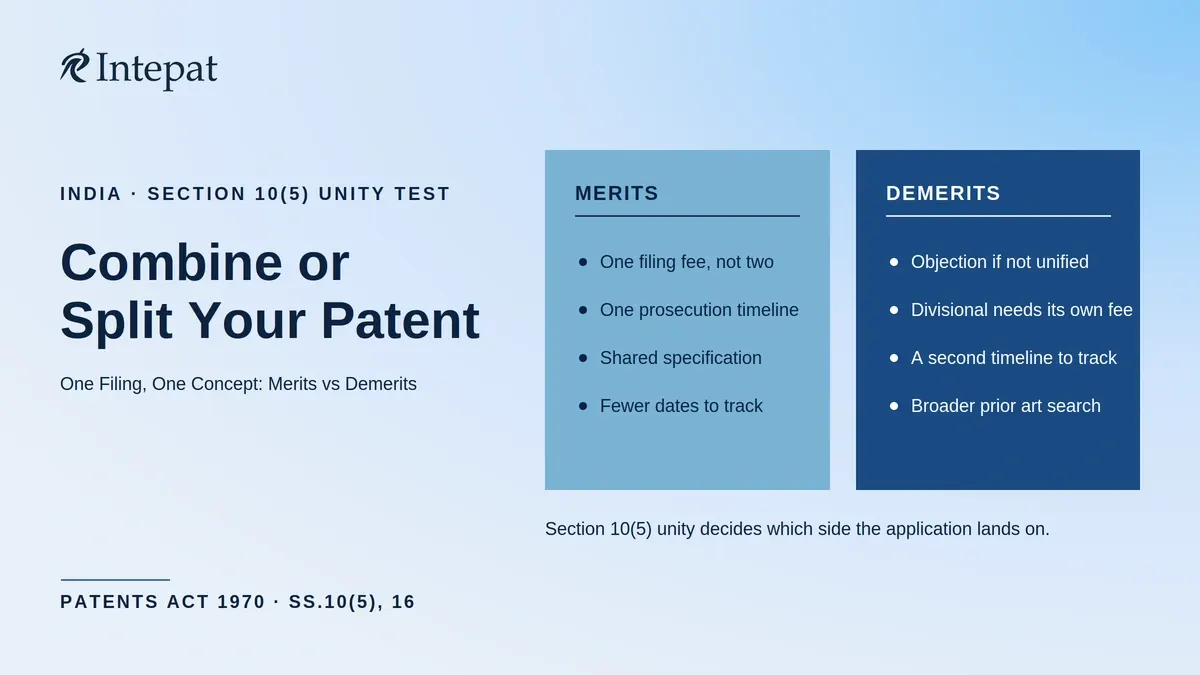
Filing multiple inventions in a single patent application can save an upfront filing fee and keep related work on one prosecution timeline, but it risks an objection that forces the application apart into a divisional patent application, at extra cost and delay. The right call turns on how closely the inventions are linked as a single inventive concept.
In India, this choice sits at the intersection of two provisions of the Patents Act 1970: Section 10(5), which sets the unity of invention India standard that claims must meet, and Section 16, under which the applicant may split a non-compliant application into a divisional, either voluntarily or to remedy a plurality objection the Controller raises. Both provisions, and the Controller’s practice under them, decide whether clubbing inventions saves money or ends up costing more.
| Quick answer: |
| An applicant can combine related inventions in one specification only if the claims are linked as a single inventive concept under Section 10(5) of the Patents Act 1970. Unrelated inventions filed together can draw an examiner objection, which the applicant meets either by amending or electing claims or by filing a divisional application under Section 16, the latter attracting its own filing fee and its own prosecution timeline. The Manual of Patent Office Practice and Procedure recognises a single inventive concept in several configurations, for example a product and its process, or a mechanism and an apparatus specifically designed to run it, not only those two. |
What Counts as Multiple Inventions in a Single Patent Application
A single complete specification carries multiple inventions when its claims cover more than one distinct technical idea, tested against the Section 10(5) Patents Act standard: claims “shall relate to a single invention, or to a group of inventions linked so as to form a single inventive concept” and “shall be fairly based on the matter disclosed in the specification.”
The Manual of Patent Office Practice and Procedure applies this test without regard to how the claims are drafted: a group of inventions can fail or pass the single inventive concept standard whether they appear as separate claims or as alternatives inside one claim. The Manual also sets a narrower rule for process-and-apparatus pairings: unity between a process and an apparatus or means requires that the apparatus have been specifically designed for carrying out that process, not merely that it is capable of performing it. Independent claims from different categories, such as a product and a process, can share one inventive concept and sit in the same application when they are linked and supported by the description.
Merits of Filing Multiple Inventions in a Single Patent Application
Where inventions genuinely share a single inventive concept, combining them in one application can avoid paying a separate First Schedule filing fee for each invention, and keeps the applicant on one prosecution timeline with one examiner and one First Examination Report to track, rather than several running in parallel.
For a founder team, this often matters more than the legal test itself. A product and the process built to manufacture it, for instance, can be described and supported by the same specification, which in practice avoids drafting the same background and disclosure twice across separate filings. The Manual illustrates this with examples such as a mould, the method of making that mould, and the process of casting an article using it, which it treats as constituting a single invention when linked and supported in this way. In practice, applicants who file closely related improvements together also reduce the administrative load of tracking renewal dates, examination requests, and correspondence across multiple files instead of one.
The Manual also carries a drafting-stage caution worth building into the same decision: while there is no fixed limit on the number of claims or independent claims in an application, it advises keeping that number limited so that the claims stay within a single inventive concept. Treating this as a drafting discipline from the first draft of the specification, rather than a fix applied after an examiner objects, is what turns the cost-saving merit of combining inventions into a durable one instead of a temporary one.
Demerits of Combining Unrelated Inventions in One Application
Where the inventions do not share a single inventive concept, combining them invites an objection that the claims relate to more than one invention. This is the flip side of the merit above: the same closeness that lets related inventions share one specification is exactly what an examiner checks for, and its absence is what triggers the objection.
The Manual records that the application may then be divided to meet that objection. Division is one route, not the automatic result: the applicant can also amend or elect claims so the parent specification satisfies Section 10(5) on its own, reserving the divisional route for where that is not workable.
The divisional, once filed, is a separate substantive application. It needs its own request for examination filed within the prescribed period, and the Controller may require amendment of either specification so that neither claims what the other already claims.
The financial saving that motivated the combined filing can disappear once a divisional becomes necessary. The divisional attracts the same First Schedule fee that a fresh application would, which varies by applicant category (natural person, startup, small entity, educational institution, or other) and by whether the application is filed electronically, so an applicant who clubbed two unrelated inventions to save one filing fee can end up paying that fee anyway, later, alongside a second prosecution timeline running well after the original filing date. As a practical observation rather than a stated legal consequence, a specification covering disparate technical fields can also draw a broader prior art search and more grounds of objection in the First Examination Report, since the examiner is assessing more than one inventive concept in the same report; where that happens, the response to the report can end up addressing two separate lines of argument instead of one.
If the application will eventually enter the PCT route, the international searching authority applies a separate unity test: it asks whether the claimed inventions share a technical relationship through one or more of the same special technical features (PCT Rule 13).
Non-compliance there draws an invitation to pay additional search fees, a different mechanism from the Section 10(5) objection used domestically. This piece on unity of invention in PCT national phase filings covers how the domestic and PCT unity tests interact through national phase entry, including the additional-fee mechanics.
How the Controller Tests Unity of Invention in Practice
The Manual gives worked pairings that it treats as a single inventive concept: a product and a process specially adapted for manufacturing that product, and a process and an apparatus or means specifically designed to carry it out.
It extends the same treatment to a locking system where separate independent claims for a plug and a socket can still constitute one inventive concept, and to a drug or pharmaceutical product filed alongside the process of making it and a composition containing it.
The recurring feature across these examples is a functional link, not mere overlap of subject matter. An apparatus that happens to be useful for a claimed process does not satisfy the process-apparatus test on its own; the Manual’s language requires that it be specifically designed for carrying out that process. Two products that solve unrelated problems in the same general field, by contrast, do not become one inventive concept simply because the same team built both of them in the same development cycle or the same funding round.
A Practical Filing Rule for Founders
Deciding whether to club or split inventions is a patent filing strategy India founders face before drafting begins, not after an objection lands. A workable decision rule follows from the Manual’s examples: club inventions when one is the natural counterpart of the other, such as a product and the process built to make it.
File separately from the outset when the inventions solve different problems, sit in different technical fields, or would need materially different prior art searches, even where both came out of the same product cycle.
Consider two contrasting cases. A hardware team that files claims to a locking mechanism together with the plug-and-socket components purpose-built for it is filing within the Manual’s own example of a single inventive concept. A software team that files claims to an unrelated data-compression method and a separate user-authentication method in the same application, because both shipped in the same product release, is combining two distinct technical ideas that an examiner is likely to treat as more than one invention, with a divisional as the eventual outcome.
If a Unity of Invention Objection Arrives Anyway
Section 16(1) lets the applicant file a divisional at any time before grant, either voluntarily or to remedy the Controller’s objection that the claims relate to more than one invention. The divisional is deemed filed on the date the original application was filed.
The Explanation to Section 16 is specific that the divisional is proceeded with as a substantive application and examined only once its own request for examination is filed within the prescribed period, so the applicant carries a second examination-request deadline to track from that point forward. Rule 24B(1)(iv) fixes that deadline at 31 months from the filing or priority date of the original application, or 6 months from the date the divisional itself was filed, whichever is later.
A Division Bench of the Delhi High Court has since clarified how far Section 16(1) reaches. In Syngenta Ltd. v. Controller of Patents and Designs (decided 13 October 2023), the Court held that a divisional need not show the plurality of inventions in the parent application’s claims; it is enough that the separate invention was disclosed in the provisional or complete specification, and this holding applies equally whether the divisional is filed voluntarily or to remedy the Controller’s objection. The ruling overruled an earlier single-judge decision that had read a claims-only requirement into Section 16(1).
The divisional’s complete specification cannot include any matter not in substance disclosed in the complete specification already filed for the original application, and the Controller may require amendment of either specification so that neither claims matter already claimed in the other. This guide to divisional patent applications sets out the full filing mechanics and timeline for this step. Where the two applications instead relate to an improvement on an already-filed invention rather than a distinct invention forced apart by objection, this comparison of patents of addition and divisional applications explains how a patent of addition differs from a divisional. For how the same unity question plays out once a comparable application is filed abroad, this cross-jurisdiction look at unity of invention compares the Indian position against other patent offices.
Frequently Asked Questions
Not without risk of objection. Section 10(5) of the Patents Act 1970 requires claims to relate to a single invention or a group of inventions linked as a single inventive concept, and the Manual of Patent Office Practice and Procedure treats a plurality of distinct inventions as a ground for the examiner to require division of the application.
Yes. A divisional filed under Section 16 is treated as a substantive application in its own right, and it attracts the same First Schedule filing fee that a fresh application would, on top of the fee already paid for the original application, plus its own request-for-examination fee within the prescribed period.
No. Section 16(2) is explicit that the divisional’s complete specification cannot include any matter not in substance disclosed in the complete specification already filed for the original application. A genuinely new invention needs its own fresh application with its own priority date.
Section 16(1) allows filing “at any time before the grant of the patent,” whether the applicant divides voluntarily or is remedying the Controller’s objection. Once filed, Rule 24B(1)(iv) sets the examination-request deadline: 31 months from the parent’s filing or priority date, or 6 months from the divisional’s filing date, whichever is later.
Section 16(2) bars the divisional from including matter not in substance disclosed in the original specification, so undisclosed matter cannot be added regardless of priority. For matter that was disclosed, Section 11(4) governs: the priority date of a divisional claim is the filing date of whichever earlier specification first disclosed it.
This article explains the law on filing multiple inventions in a patent application in India as at August 2026 and is for general information only. It is not legal advice. Government fees, forms, and procedures change; confirm current figures with the Indian Patent Office before you file. For advice on your specific invention, consult a registered patent agent.