




| Quick Answer |
| When an International Searching Authority raises a unity of invention objection during the PCT international phase, that finding does not bind the Indian Patent Office. The IPO examines unity independently at the national phase. India does not automatically treat unsearched inventions as withdrawn at national phase entry. Subject matter disclosed in the PCT specification remains available for divisional application strategy. Under Rule 13(2A) of the Patents Rules, 2003 (inserted by the Patents (Amendment) Rules, 2024), applicants may now base a divisional application on subject matter disclosed anywhere in the specification, not only in the original claims. |
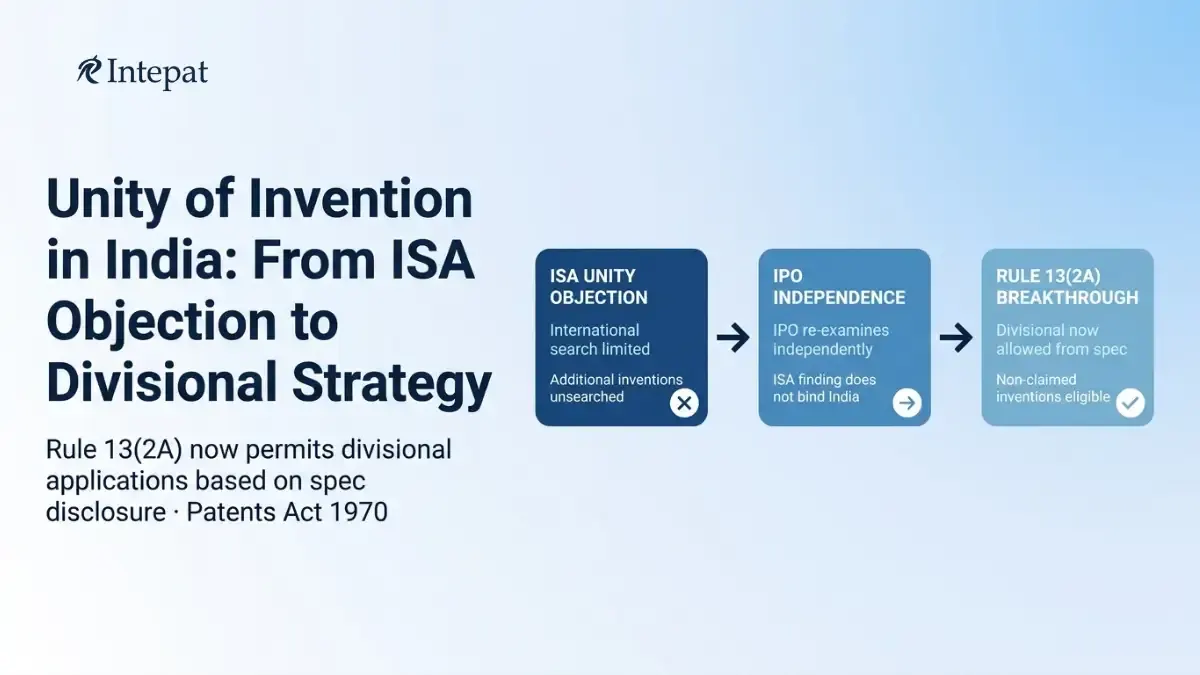
What the ISA’s Unity Objection Means Before India Entry
When an International Searching Authority (ISA) considers that a PCT application lacks unity of invention, it issues an invitation under PCT Rule 40 requesting the applicant to pay additional search fees for each invention beyond the first. At that point the applicant has three choices: pay the additional fees and have all inventions searched, restrict the claims to a single invention and proceed with one search, or pay under protest and challenge the ISA’s finding through the protest procedure.
Each choice carries consequences that reach into the Indian national phase. Applicants who paid additional fees will have obtained search results for more than one invention. Those who declined to pay will have an international search report covering only the elected invention, with the remaining inventions unsearched. Applicants who entered the Chapter II examination route through a demand will have received a written opinion from the International Preliminary Examining Authority, though that opinion remains advisory at the national phase.
What none of these choices does is determine what happens in India. The ISA’s unity finding and any restriction made internationally carry no binding force before the Indian Patent Office (IPO). The national phase opens on a fresh footing.
Does the IPO Re-Examine Unity of Invention, or Adopt the ISA’s Finding?
The IPO re-examines unity independently. Under PCT Articles 27(1) and 27(4), each designated Office forms its own view on unity of invention. In the PCT national phase context, the IPO ordinarily assesses unity by reference to the PCT Rule 13 framework, requiring claims to relate to one invention or to a group of inventions linked by a single general inventive concept defined through one or more special technical features that contribute over the prior art. The applicable Indian statutory basis is Section 16 of the Patents Act, 1970 read with the Patents Rules.
This independence matters for portfolio management. Inventions that were not searched internationally do not lapse at national phase entry by reason of that omission alone. Two situations should be distinguished: inventions that were simply not searched because the applicant did not pay additional ISA fees, and claims that were affirmatively amended out of the application under PCT Article 19 or Article 34 before national phase entry. The first category does not automatically lapse at national phase entry; the underlying disclosed subject matter remains available, particularly for divisional application strategy. The second is governed by the Article 19 or 34 amendment record that forms part of the national phase entry package under Rule 20 of the Patents Rules.
| India does not automatically treat unsearched inventions as withdrawn. |
| Unlike some jurisdictions, India does not apply PCT Articles 17(3)(b) or 34(3)(c) as provisions that treat inventions not covered by the international search as withdrawn unless a further national fee is paid. Where the ISA limited its search after a unity of invention objection, the unsearched inventions may still be pursued through divisional applications before the Indian Patent Office, provided the subject matter was disclosed in the PCT specification. |
The IPO will assess the claims it receives when it examines the national phase application following the request for examination under Section 11B of the Patents Act, 1970. If the IPO considers that the claims relate to more than one invention, it will raise a unity objection in the First Examination Report, not because the ISA said so, but on its own assessment. It may equally reach a different conclusion. Applicants who paid additional fees internationally and had two inventions searched may find the IPO raises no unity objection at all, or raises one on different grounds. The international search report informs the IPO’s examination; it does not control it.
When the IPO Raises a Unity Objection in the First Examination Report
A unity of invention objection in the First Examination Report typically identifies a plurality of inventions in the claims and invites the applicant to address it. The applicant has six months from the date of the FER to respond, under Rule 24B(4) of the Patents Rules. That period is extendable by three months on a request made on Form 4 with the prescribed fee, but the extension is not automatic and must be requested before the period expires.
Three responses are available. The applicant may argue that unity of invention is present: that a single general inventive concept links all claims through a special technical feature that contributes over the prior art. This argument may succeed where the ISA raised the objection on a narrow or formalistic reading and the applicant can demonstrate the technical connection. The applicant may also amend the claims to bring them within a single inventive concept, removing the claims that break unity. Amendments at this stage are governed by Section 59 of the Patents Act, which permits amendment only by disclaimer, correction, or explanation, and not so as to claim or describe matter not in substance disclosed in the application as filed, or to enlarge the scope of any claim.
The third option is to file a divisional application under Section 16 for the claims that fall outside the retained invention. This preserves the excluded subject matter without abandoning it. The divisional application carries the priority date of the parent application and requires its own request for examination within 31 months from the priority date of the parent application or within six months from the date of filing the divisional application, whichever is later, as amended by the Patents (Amendment) Rules, 2024 (Rule 24B).
Filing a Divisional Application in India After a PCT Unity Objection
Section 16 of the Patents Act, 1970 permits an applicant to file a divisional application at any time before the grant of the patent, either voluntarily or to remedy a Controller’s unity of invention objection that the claims relate to more than one invention. The divisional application must not include any matter not in substance disclosed in the complete specification filed with the parent application. Section 16(2) sets that boundary firmly.
Until March 2024, Indian practice created an additional obstacle for applicants seeking to file divisional applications voluntarily. The IPO had, for a period, required that plurality of inventions be identifiable in the claims of the parent application. Subject matter disclosed in the specification but not reflected in the claims was often rejected as a basis for division. This created a particular difficulty for PCT applicants entering the Indian national phase whose non-elected inventions were disclosed in the specification but had not been carried into the active claim set.
Rule 13(2A) of the Patents Rules, 2003, inserted by the Patents (Amendment) Rules, 2024 (G.S.R. 211(E), 15 March 2024), substantially strengthens and clarifies the position. The provision reads: “A patent applicant may, if he so desires, file one or more further applications under section 16, including in respect of an invention disclosed in the provisional or complete specification or a further application filed under section 16.” The amendment aligns Indian practice with the Division Bench ruling of the Delhi High Court in Syngenta Limited v. Controller of Patents and Designs (2023), which held that plurality of inventions may be ascertained from the specification, not only from the claims. For PCT applicants, this means a non-elected invention disclosed in the PCT specification, even if it was never claimed or was not carried into the active claim set at entry, can now ground a divisional application in India.
| Rule 13(2A) in force from 15 March 2024. |
| A PCT applicant whose non-elected inventions were disclosed in the specification but never claimed may now file a divisional application in India on the strength of that specification disclosure. The divisional must not introduce matter beyond the parent’s original disclosure, and must reflect genuine plurality of inventions. |
The table below sets out the change in practice.
| Before March 2024 | From March 2024 (Rule 13(2A)) | |
| Basis for voluntary divisional | Plurality must be identifiable in parent claims | Plurality may appear in specification (provisional or complete) or prior divisional |
| Non-elected PCT inventions disclosed but not claimed | High risk of rejection by IPO | Supported by statute |
| Timing | Before grant of parent patent | Before grant of parent patent (unchanged) |
One timing point requires attention. A divisional application cannot be filed after the parent application has been granted, refused, or abandoned. Applicants who receive a unity objection in the FER should assess the divisional option at the time of responding, not after the parent proceeds to grant.
What Foreign Counsel Should Review Before and at National Phase Entry
Foreign counsel instructing an Indian patent agent on a PCT national phase entry where an ISA unity of invention objection was raised during the international phase should address the following points before the application enters India.
First, identify every invention that was not searched or not examined in the international phase. This includes inventions for which additional ISA fees were not paid, and inventions that fell outside the IPEA’s examination scope. Each of these remains available for divisional application strategy in India, provided the subject matter was disclosed in the PCT specification.
Second, distinguish between inventions that were simply unsearched and claims that were affirmatively amended out of the application under PCT Article 19 or Article 34. The former category enters the national phase without being deemed withdrawn, but remains subject to the claim set as entered and to examination, including any unity objection and Section 59 amendment constraints. The latter is governed by the amendment record: the Indian national phase entry incorporates Article 19 and Article 34 amendments that were in effect at the time of entry, and claims deleted by those amendments are not automatically reinstated in the parent application, although the underlying disclosure may still support a divisional application under Section 16 read with Rule 13(2A).
Third, brief local counsel on the divisional option before the FER issues. A divisional filed voluntarily before examination allows the applicant to choose the claim set for each application. A divisional filed in response to a FER unity objection responds to the Controller’s characterisation of the inventions. Both are permissible under Section 16, but the strategic position differs.
Where multiple inventions are disclosed in the PCT specification but were not searched internationally, applicants should consider filing one or more voluntary divisionals before the First Examination Report issues, particularly where distinct commercial embodiments are identifiable. This avoids dependence on the Controller’s unity characterisation and allows proactive claim structuring across the portfolio.
Fourth, note that the IPO’s unity of invention assessment is independent of any finding made by the ISA or IPEA. Arguments that succeeded in the protest procedure internationally carry no binding effect in India, though they may be cited as persuasive material. The applicable framework is PCT Rule 13 as applied by the IPO examiner on the claims as entered.
Frequently Asked Questions
The IPO takes both international search reports into account but is not bound by them. The search reports inform the examination; they do not determine its outcome. The IPO may reach a different unity conclusion, or raise no unity objection at all.
Subject matter that was disclosed in the PCT specification but not searched remains available as the basis for a divisional application in India. What matters for divisional strategy is disclosure in the specification, not whether the invention was elected before the ISA. If claims were affirmatively deleted by an Article 19 or Article 34 amendment before entry, the position depends on the amendment record.
Yes, from 15 March 2024. Rule 13(2A) of the Patents Rules, inserted by the Patents (Amendment) Rules, 2024, expressly permits a divisional application based on an invention disclosed in the provisional or complete specification, whether or not it was ever claimed. The divisional must reflect genuine plurality of inventions and must not introduce matter beyond the parent’s original disclosure.
An argument that unity is present is available and can succeed. The applicant must demonstrate that all claims share a single general inventive concept through one or more special technical features that contribute over the prior art, satisfying the unity of invention standard in PCT Rule 13.2. Filing a divisional is not the only route. Where the technical relationship between claims is genuine and defensible, arguing unity in the FER response is the more efficient path. Local counsel familiar with IPO examination practice in the relevant technology area is best placed to assess the strength of that argument.
A divisional application under Section 16 may be filed at any time before the grant of the patent, provided the parent application is still pending. For the divisional itself, a request for examination must be filed within 31 months from the priority date of the parent application or within six months from the date of filing the divisional application, whichever is later, under the Patents (Amendment) Rules, 2024.
This article reflects Indian patent law and procedure as at April 2026. It covers PCT national phase practice before the Indian Patent Office. Readers should seek specific legal advice based on their factual situation.