




A patent agent in India is a person registered under the Patents Act 1970 to represent inventors and applicants before the Indian Patent Office. Registration requires Indian citizenship, a degree in science, engineering, or technology, and either passing a qualifying examination or satisfying a limited ten-year service route. This article covers eligibility, the examination, registration, and removal.
Scope: Indian law only. All statutory references are to the Patents Act 1970 and the Patents Rules 2003 unless stated otherwise.
Quick answer: For most candidates, becoming a registered patent agent in India requires: (1) Indian citizenship and age of 21 or above; (2) a degree in science, engineering, or technology; (3) passing the Patent Agent Examination (minimum 50 marks in each paper, 60% aggregate overall); and (4) applying on Form 22 with the registration fee. A limited alternative route exists for persons with not less than ten years of service as an examiner or in the functions of the Controller. Until your name appears in the Register of Patent Agents, you cannot lawfully practise as a patent agent.
What is a patent agent?
The Patents Act 1970 defines a patent agent as “a person for the time being registered under this Act as a patent agent.” The Register of Patent Agents is maintained by the Controller General of Patents, Designs and Trade Marks under Section 125 and may be kept in electronic form. Registration is what creates the status; a science or engineering degree or a passed examination alone does not.
Once registered, a patent agent is entitled under Section 127 to practise before the Controller and to prepare all documents, transact all business, and discharge such other functions as are prescribed in connection with any proceeding before the Controller under the Act. The scope of “practising as a patent agent” is further defined in the Explanation to Section 129 as: applying for or obtaining patents in India or elsewhere, preparing specifications and other documents under the Act or under the patent law of any other country, and giving advice other than of a scientific or technical nature as to the validity of patents or their infringement.
Why do companies hire patent agents?
The patent filing and prosecution process in India involves drafting a specification, filing with the Patent Office, responding to examination reports, participating in hearings, and handling oppositions. While Section 132 preserves two specific rights, the right of an applicant to draft their own specification and appear before the Controller, and the right of a non-patent-agent advocate to take part in hearings on behalf of a party — neither substitutes for registered patent agency for companies managing ongoing prosecution portfolios. Most organisations engaged in research and development retain a registered patent agent to handle Patent Office correspondence and keep the process on track.
Qualifications required (Section 126)
A person qualifies for registration under Section 126(1) by meeting all four conditions simultaneously.
| Condition | Requirement |
| Citizenship | Indian citizen |
| Age | At least 21 years at the time of application |
| Technical degree | Degree in science, engineering, or technology from a university established under law in India, or equivalent qualifications as the Central Government may specify |
| Examination or experience | Section 126(1)(c)(ii): passed the qualifying examination prescribed for the purpose; OR Section 126(1)(c)(iii): served for a total of not less than ten years as an examiner or in the functions of the Controller under Section 73, having ceased to hold that capacity at the time of applying |
The degree condition and the examination or experience condition are cumulative: a candidate must hold the degree (or equivalent) and satisfy the examination limb under Section 126(1)(c)(ii) or the ten-year service limb under Section 126(1)(c)(iii). Section 126(2) is a separate grandfathering provision for persons already registered as patent agents before the commencement of the Patents (Amendment) Act 2005; it is not part of the current entry route.
The Patent Agent Examination
Structure
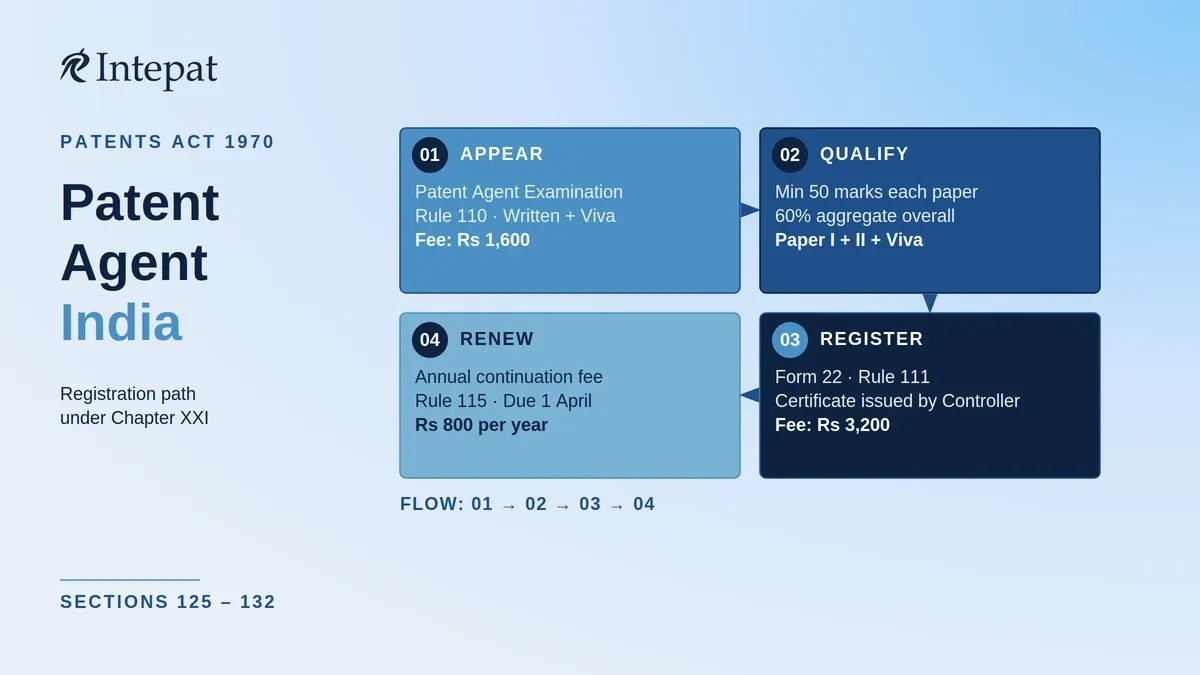
Rule 110 of the Patents Rules 2003 sets the examination structure. The qualifying examination consists of a written test and a viva voce examination. The written test comprises two papers.
Paper I covers the Patents Act 1970, the Patents Rules 2003, the Designs Act 2000, and the Designs Rules 2001.
Paper II covers drafting and interpretation of patent specifications, design specifications, and other documents.
Pass criteria
A candidate must secure a minimum of fifty marks in Paper I and Paper II respectively, and must obtain an aggregate of sixty percent of the total marks to be declared as having passed.
Applying for the examination
A person wishing to appear must make a request to the Controller, along with the fee specified in the First Schedule, after announcement of the examination and within the period specified in the announcement (Rule 109(3)). The Patent Office announces examinations on its official website at ipindia.gov.in. Examination fee (e-filing, natural person): Rs 1,600; physical filing: Rs 1,750 (verified as of June 2026 per entry 35 of the First Schedule to the Patents Rules 2003).
| Current notice: Patent Agent Examination 2027 |
| The IPO’s online application system is open from 1 July 2026 (10:00 AM) to 30 September 2026 (11:59 PM) (IPO homepage notice, 23 June 2026). A separate public notice dated 27 March 2026 sets out the following tentative timeline (subject to change): registration 15 June to 14 August 2026; admit cards from 15 December 2026; written examination 10 January 2027; written results second week of February 2027; viva voce last week of February 2027; final results third week of March 2027. The June notice supersedes the March registration window. Confirm current details at ipindia.gov.in. |
The specific supporting documents required are set out in each examination notice published by the Patent Office, and candidates should consult the relevant notice before applying.
Registering as a patent agent
Passing the examination alone does not confer the right to practise. Registration is the necessary step.
Under Rule 109(1) and Rule 111, every person who desires to be registered as a patent agent shall make an application on Form 22. After the Controller is satisfied that the candidate has passed the qualifying examination and has furnished any further information required, the Controller enters the candidate’s name in the Register of Patent Agents and issues a certificate of registration.
Registration fee: Rs 3,200 for e-filing by a natural person; Rs 3,500 for physical filing (verified as of June 2026 per entry 34 of the First Schedule to the Patents Rules 2003).
To verify that a person is currently registered, the IPO maintains a searchable Electronic Register of Patent Agents at iprsearch.ipindia.gov.in.
The documents to be submitted with the Form 22 application are set out in the IPO’s post-examination notice for each cycle. For the 2026 examination cycle, the IPO’s notice listed proof of date of birth, degree certificate, proof of citizenship, character certificate, disability certificate (if applicable), and the examination admit card. Candidates should refer to the relevant IPO notice at ipindia.gov.in for the exact requirements applicable to their cycle.
Keeping the registration current
Continuance of a person’s name in the Register is subject to payment of the annual continuation fee under Rule 115. For the first year, the fee of Rs 800 is paid along with the registration application. For every subsequent year, the annual fee of Rs 800 falls due on or before 1 April each year (verified as of June 2026 per entry 36 of the First Schedule). Defaulting by more than three months is a ground for removal under Rule 116(1)(d).
When a registration may be removed
The Controller may remove a name from the Register under two mechanisms.
Section 130 (Controller-initiated removal): The Controller may remove a name after giving the person a reasonable opportunity of being heard if satisfied that: (a) the name was entered by error or on account of misrepresentation or suppression of material fact; or (b) the person has been convicted of any offence and sentenced to a term of imprisonment, or has been guilty of misconduct in their professional capacity which in the Controller’s opinion renders them unfit to remain on the Register.
Rule 116 (administrative removal): The Controller may also delete a name on the patent agent’s own request, on death, on removal under Section 130(1), on fee default exceeding three months, or if the person ceases to be a citizen of India. Except where removal is on the agent’s own request or on death, a reasonable opportunity of being heard is required.
Restoration is possible on application under Section 130(2) and Rule 117. Under Rule 117(1), the application must be made on Form 23 within two months from the date of removal, and the Controller must be satisfied that sufficient cause exists.
Disqualifications for registration (Rule 114)
Certain categories of persons are not eligible to be registered even if they meet the Section 126 qualifications. Rule 114 lists the disqualifying conditions.
| Adjudged by a competent court to be of unsound mind |
| Undischarged insolvent |
| Discharged insolvent who has not obtained a court certificate that the insolvency was caused by misfortune without misconduct |
| Convicted by a competent court (within or outside India) to undergo imprisonment, unless pardoned or disability removed by Central Government order |
| Being a legal practitioner, has been guilty of professional misconduct |
| Being a chartered accountant, has been guilty of negligence or misconduct |
Practising without registration: the legal position
Section 129 prohibits any person from practising, describing, or holding out as a patent agent unless registered. This restriction applies to individuals, partnerships, and corporate bodies alike. Section 123 states that any person who contravenes Section 129 is punishable with a fine extending to Rs 1 lakh for a first offence and Rs 5 lakh for a second or subsequent offence.
Engaging a registered patent agent for your invention
If you are at the stage of protecting an invention, understanding what a patent specification requires is a useful starting point before you work with a patent agent. For those considering filing a patent application in India, the drafting and prosecution process is handled by a registered patent agent on your behalf.
Frequently asked questions
A patent agent in India is a person registered under the Patents Act 1970 whose name appears in the Register of Patent Agents maintained by the Controller. Registration entitles a person to practise before the Controller, prepare documents, conduct proceedings, apply for patents in India or abroad, draft specifications, and advise on patent validity and infringement.
Section 126(1) of the Patents Act 1970 requires four conditions: Indian citizenship, age of at least 21 years, a science or engineering or technology degree from a university established under Indian law, and either passing the qualifying examination or ten or more years of service as an examiner or Controller-function officer (having ceased at the time of applying).
The Patent Agent Examination (Rule 110, Patents Rules 2003) comprises two written papers and a viva voce. Paper I covers the Patents Act, Patents Rules, Designs Act, and Designs Rules. Paper II covers drafting and interpretation of patent and design specifications. Candidates must score at least 50 marks in each paper and 60% in aggregate to pass.
An advocate who is not a registered patent agent may take part in hearings before the Controller on behalf of a party, under Section 132 of the Patents Act 1970. However, to apply for patents on another’s behalf, draft specifications professionally, or practise as a patent agent, an advocate must be registered under Section 126.
No. Section 129(2) of the Patents Act 1970 prohibits any company or other body corporate from practising, describing itself, or holding itself out as patent agents. Registration as a patent agent is available only to individual persons who fulfil the conditions in Section 126.
Practising as a patent agent without registration contravenes Section 129 of the Patents Act 1970. Under Section 123, the penalty is a fine of up to Rs 1 lakh for a first offence and up to Rs 5 lakh for a second or subsequent offence.
The Form 22 registration fee is Rs 3,200 for e-filing by a natural person, or Rs 3,500 for physical filing (entry 34, First Schedule, Patents Rules 2003, verified as of June 2026). The first year’s continuation fee of Rs 800 is paid with the registration; subsequent annual fees of Rs 800 fall due on or before 1 April each year.This article explains the law on patent agents in India as at June 2026 and is for general information only. It is not legal advice. Government fees, forms, and procedures change; confirm current figures with the Indian Patent Office before you file. For advice on your specific situation, consult a registered patent agent.