




A patent specification is the document through which an inventor discloses an invention and defines the scope of protection sought. Every ordinary Indian patent application must be accompanied by a provisional or complete specification, submitted in Form 2 under the Patents Act 1970. The specification, not the application form, determines the scope of patent rights if protection is granted.
This article covers ordinary applications under Indian law. Convention applications and PCT national phase applications follow a different route and are not filed with a provisional. The article is current with the Patents Rules as amended to 2024.
| Requirement | What the law provides |
| Filing obligation | Section 7(4): every ordinary application must be accompanied by a provisional or complete specification. Convention and PCT national phase applications take the complete-specification route directly. |
| 12-month rule | Section 9(1): the complete specification must follow a provisional within 12 months, or the application is deemed abandoned. |
| Form | Rule 13(1): the specification is filed in Form 2. |
| Description | Section 10(4)(a): the description must fully and particularly describe the invention, its operation or use, and the method of performance. |
| Best method | Section 10(4)(b): the specification must disclose the best method of performing the invention known to the applicant. |
| Claims | Section 10(4)(c) and 10(5): the specification must end with claims defining the scope; the claims must be clear, succinct, and fairly based on the disclosure, and must relate to a single inventive concept. |
| Abstract | Section 10(4)(d) and Rule 13(7): a 150-word maximum abstract must accompany the complete specification, indicating technical field, technical advancement, and principal use. |
What a Patent Specification Is and What It Does
A patent specification is, in the Patent Office’s own language, a techno-legal document containing scientific and technical disclosure and claims for the invention. It performs two distinct functions: it teaches the public how the invention works (the disclosure function), and it defines the boundary of what the patentee may exclude others from doing (the claims function).
These two functions are interlocked. The specification must end with one or more claims that define the scope of protection sought, and those claims must be clear, succinct, and fairly based on what the description teaches. “Fairly based” means the claims must be supported by the description: subject matter that is not described cannot be claimed.
The patent framework in India is set out under the Patents Act 1970, which governs who may apply, what may be patented, and how the specification is evaluated at examination and beyond.
Provisional Specification: Securing the Priority Date Before the Invention Is Fully Developed
A provisional specification is filed when the invention is not yet complete but the applicant wants to establish a priority date against any subsequent disclosures or competing filings. Filing a provisional starts a 12-month clock. The complete specification must be filed within those 12 months. If it is not, the application is deemed abandoned by operation of the statute, with no ordinary extension available.
For a step-by-step walkthrough of the provisional route, including timing relative to public disclosures, see the article on filing a provisional patent application in India. Capturing the invention systematically through an invention disclosure form before filing helps organise the technical detail the provisional description must convey.
The provisional specification must contain a title and a description of the invention. The description typically covers the field of the invention, the background and prior art, the objects of the invention, and a statement of the invention. The applicant should include as much information as is available at the time of filing.
Claims are normally not included in a provisional. The Patent Office advises against them because the purpose of a provisional is to secure the priority date and describe the invention, not to define scope. The priority benefit for subsequent claims depends on whether the claimed subject matter is supported by what was disclosed in the provisional, not on whether claims happened to appear in it.
The complete specification may include developments or additions to the invention described in the provisional. Priority is determined claim by claim: claims supported by the provisional disclosure carry the provisional filing date, while matter added later receives a later priority position. This distinction matters where prior art emerges between the provisional and the complete filing.
Convention applications and PCT national phase applications take the complete specification route from the outset; a provisional is not the entry route for these. For the full PCT procedure, see the article on PCT national phase filing in India.
Complete Specification: The Four Mandatory Requirements
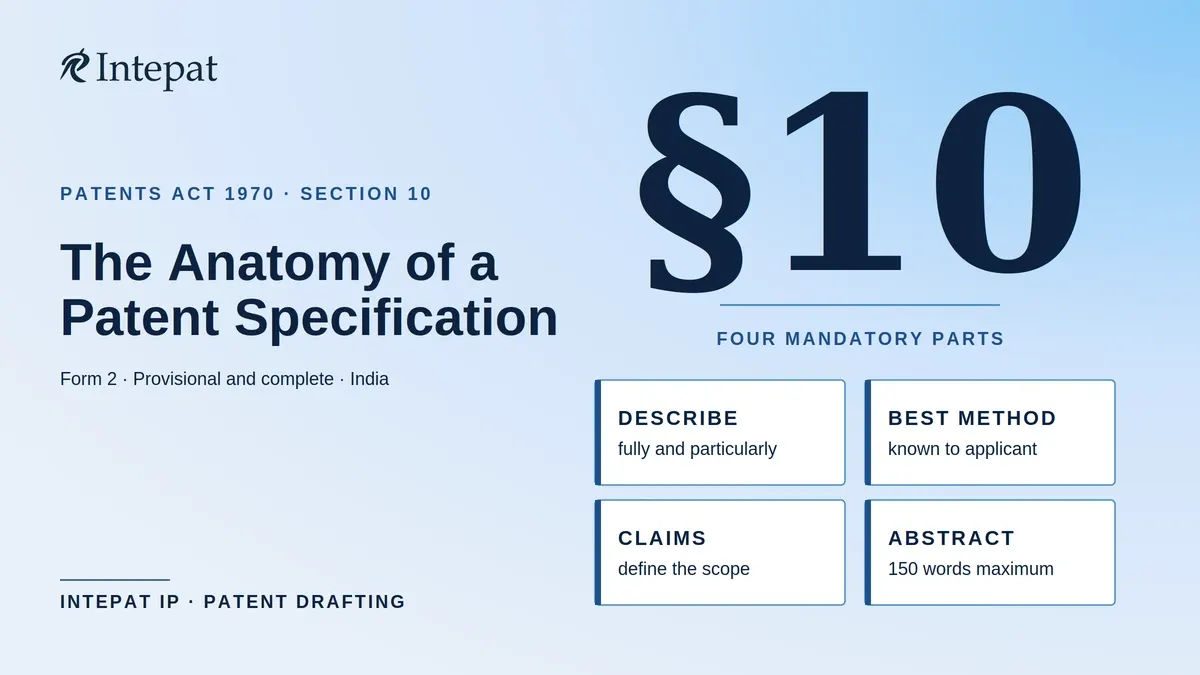
A complete specification must satisfy four statutory requirements. These are obligations, not guidelines:
- Description: fully and particularly describe the invention and its operation or use, and the method by which it is to be performed.
- Best method: disclose the best method of performing the invention known to the applicant.
- Claims: end with a claim or claims defining the scope of the invention for which protection is claimed.
- Abstract: be accompanied by an abstract.
On top of these four, an additional quality standard applies to the claims: they must relate to a single inventive concept and must be clear, succinct, and fairly based on the matter disclosed. Where the Controller considers that the application covers more than one inventive concept, the applicant may be required to divide it into separate applications.
The disclosure standard is specific: the description must enable a person of average skill and average knowledge in India to perform the invention based solely on what is disclosed in the specification. A specification that requires further research or experiments to reproduce the invention does not meet this standard.
The best-method requirement is one applicants sometimes treat as optional. It is not. The Act requires the applicant to disclose the best method known at filing, including any best method acquired during the provisional protection period. Withholding the best-known implementation to preserve it as a trade secret is not a route the statute permits: the patent grant is conditioned on full disclosure.
These requirements are the floor. Meeting them produces an examinable specification, not necessarily a defensible one. The drafting decisions within these requirements determine how much protection the granted patent actually delivers.
| Draft Safely |
| Build disclosure that supports defensible claims. |
| Consult Us |
How Claims Determine the Scope of Patent Protection in India
The claims are the operative part of the specification. They define the boundary of what the patentee may exclude others from making, using, selling, or importing. The complete specification must end with claims defining that scope, and the claims must be clear, succinct, and fairly based on what the description discloses.
Two errors run in opposite directions and both cost protection. First, claims that reach beyond what the specification describes are not fairly based and are vulnerable to objection at examination. Second, matter that is described in the specification but is not captured in the claims is not protected. The Patent Office’s position is clear: no exclusivity is obtained for matter described in the complete specification unless it is claimed; what is not claimed stands disclaimed and is open to public use, even if disclosed in the description.
Two further principles follow. The rejection of one claim does not lead to the rejection of all others; each is assessed on its own merits, so it is worth including claims for every distinct aspect of the invention. And a narrow claim set leaves everything adjacent unprotected; layering claims from the broadest defensible scope down to specific embodiments reduces the risk that a single adverse examination finding strips the entire application.
The structure and types of patent claims, including independent and dependent claims and the role of the transitional phrase, are addressed in the article on patent claims structure. This article addresses the specification-level relationship: disclosure must support claim scope, scope must be clearly defined, and disclosure that is not captured in a claim is given up to the public.
Abstract, Drawings, and Biological Material Disclosures
Abstract. Every complete specification must be accompanied by an abstract. The abstract must commence with the title of the invention; indicate the technical field, the technical advancement over existing knowledge, and the principal use of the invention (excluding speculative uses); and must not exceed 150 words.
Where the specification contains drawings, the applicant must indicate the figure or figures to accompany the published abstract, and each main feature mentioned in the abstract and illustrated by a drawing must be followed by the corresponding reference sign. The Controller may amend the abstract where the change would provide better information to third parties.
Drawings. Drawings may be included in any specification, and the Controller may require them where necessary to illustrate the invention. If included, drawings form part of the specification. Key technical requirements: drawings must be on separate A4 sheets with prescribed margins and must not be embedded in the specification text; dimensions must not be marked on the drawings; descriptive matter must not appear on the drawings except in flow diagrams; and reference signs must be used consistently across figures.
Biological material. Where a biological material cannot be adequately described and is not publicly available, additional disclosure rules apply:
- the material must be deposited at an international depository authority under the Budapest Treaty no later than the date of filing in India;
- a reference to the deposit must be made in the specification within three months from filing, or on or before the filing of a request for publication, whichever is earlier;
- all available identifying characteristics of the material must be included, along with the name and address of the depository institution and the date and accession number of the deposit;
- the source and geographical origin of the biological material must be disclosed; and
- access to the material at the depository becomes available only on and after the filing date in India, or after the priority date if priority is claimed.
The depository institution framework under the Budapest Treaty is addressed in a separate article.
Form 2, Filing Requirements, and Specification Structure
Every specification, whether provisional or complete, is filed in Form 2. Form 2 is filed with Application Form 1, the other documents the filing bundle requires, and the prescribed fees.
Form 2 is one of several documents in the filing bundle; the others and the fee structure are addressed in the dedicated articles on the patent filing procedure in India and patent fees in India.
The first page of Form 2 contains the title of the invention, the applicant’s name, address, and nationality, and the preamble to the description. The preamble signals whether the specification is provisional or complete. For a provisional, it reads: “The following specification describes the invention.” For a complete specification, it reads: “The following specification particularly describes the invention and the manner in which it is to be performed.”
The title should disclose the specific features of the invention and normally should not exceed 15 words. In a complete specification, the description is followed by the claims section, and the abstract is provided on a separate page.
Typical specification structure
| Form 2: Typical Section Sequence |
| 1. Title of the invention (not more than 15 words) |
| 2. Applicant name, address, and nationality |
| 3. Preamble (provisional or complete, as applicable) |
| 4. Field of the invention |
| 5. Background of the invention and prior art |
| 6. Objects of the invention |
| 7. Summary or statement of the invention |
| 8. Detailed description of the invention (with reference to drawings, if any) |
| 9. Examples and best method of performance (mandatory in complete specification) |
| 10. Claims (mandatory in complete specification; each claim defining scope, clear, succinct, and fairly based) |
| 11. Abstract (mandatory in complete specification; maximum 150 words) |
| 12. Biological material disclosure (where applicable: source, geographical origin, depository accession details) |
Amending a Specification After Filing
A provisional or complete specification, and any drawing accompanying it, may be amended after filing. Amendments arise most commonly in response to examination objections (in the response to a First Examination Report), to correct clerical or technical errors, or to refine claim scope before grant. The amendment regime has two layers: a substantive layer that determines whether an amendment is legally allowable, and a procedural layer that governs how the amended pages must be filed.
The substantive limits
An amendment may be made only by way of disclaimer, correction, or explanation, and is allowed only for the purpose of incorporating actual fact. Two further limits apply to amendments of a complete specification:
- no amendment is allowed where its effect would be that the specification, as amended, claims or describes matter not in substance disclosed before the amendment; and
- no amendment of a claim is allowed where the amended claim would not fall wholly within the scope of a claim of the specification before the amendment.
These two limits are independent. An amendment that introduces new matter fails the first; an amendment that broadens claim scope beyond the pre-amendment claims fails the second. Either failure is fatal regardless of formatting.
The procedural format
Where amendments are made, the pages incorporating them must be retyped and submitted to form a continuous document. A marked copy clearly identifying the amendments, together with page and line references and the reasons for each amendment, must also be filed. The earlier corresponding pages are treated as superseded. Amendments by slips pasted on the document, by footnotes, or by writing in the margin are not permitted.
The amendment application
An application to amend a specification or related document after filing must be made in Form 13.
Pre-grant and post-grant amendments
Pre-grant amendments are processed by the Controller without third-party opposition. Post-grant amendments may be published, and any interested person may file a notice of opposition within the prescribed period. The post-grant amendment procedure is addressed in detail in the article on amending patent specifications in India.
Four Drafting Decisions That Shape How Broad Patent Protection Will Be
After meeting the formal requirements, the drafting choices below determine whether the specification can support meaningful claim scope.
1. Disclosure depth determines claim reach.
The claims cannot extend beyond the disclosure. A thin description produces a correspondingly thin claim set. Applicants who describe only their preferred embodiment and then draft claims to cover all variants face examination objections, because claims reaching undescribed variants are not fairly based on the disclosure. Describe the invention at multiple levels of generality: the core embodiment, the variants, and the unifying principle. This gives the claims the foundation to reach the full scope of the invention.
2. The best method must be included, not merely referenced.
The applicant must disclose the best method of performing the invention known at filing. A specification that describes a general method but omits the best-known specific implementation does not satisfy this requirement, even where the omission is deliberate. The obligation covers any best method acquired even during the provisional protection period. Withholding the best-known implementation to preserve it as a trade secret is not a route the statute permits.
3. Omnibus claims cannot be granted.
An omnibus claim defines the invention by reference to the description or drawings rather than by its features (for example, “A method substantially as described herein”). Omnibus claims have no legal basis under the Patents Act and cannot be granted, because they are non-definitive with respect to scope. Fallback protection should be built into a structured set of dependent claims with genuine additional feature limitations.
4. Claims with excessive alternatives become unsearchable.
A claim must not comprise a number of alternatives or variable parameters that make it unsearchable. Additionally, dependent claims that omit, modify, or substitute a feature of the independent claim from which they derive (rather than adding further limitations) should be avoided. A well-structured claim set cascades from the broadest defensible independent claim to progressively narrower dependent claims, each adding a specific further limitation.
| Common drafting mistakes to avoid |
| Thin provisional disclosure: filing a provisional with minimal description and relying on the complete specification to supply the invention’s substance. Priority is disclosure-based; matter not in the provisional will not receive the provisional filing date. |
| Claiming undisclosed variants: drafting claims that reach beyond the embodiments actually described. Claims not supported by the description are vulnerable to objection. |
| Disclosing without claiming: describing variants in the specification but omitting them from the claims. Matter described but not claimed stands disclaimed and is open to public use. |
| Omitting the best method: withholding the best-known implementation. Disclosure of the best method known at filing is mandatory. |
| Biological material non-compliance: failing to deposit where required, omitting source and geographical origin, or failing to provide the deposit reference within three months of filing. |
| Attempting impermissible amendments: post-filing amendments that introduce new matter or result in claims falling outside the scope of the pre-amendment claims will not be allowed, regardless of how the amended pages are formatted. |
The specification is the legal and technical foundation of the patent application. What goes into it at filing sets the ceiling on what can be claimed, defended, and enforced through the life of the patent. The provisional fixes the priority date; the complete specification defines the scope; the claims determine what is owned. Professional drafting is the mechanism for putting these elements together so that the granted patent reaches the protection the invention deserves.
| Review Scope |
| Check whether your specification supports broad claims. |
| Get Review |
Frequently Asked Questions
What is a patent specification under Indian law?
A patent specification is a techno-legal document filed with a patent application under the Patents Act 1970. It contains the scientific and technical disclosure of the invention and the claims that define the scope of protection sought. For an ordinary Indian patent application, the application must be accompanied by a provisional or complete specification in Form 2.
What is the difference between a provisional and a complete specification?
A provisional specification establishes a priority date and provides an initial description of the invention. A complete specification, filed within 12 months of the provisional, fully describes the invention, discloses the best method of performing it, and ends with claims. The provisional secures the priority date; the complete specification defines the scope of protection. Priority for each claim depends on whether its subject matter is supported by the provisional disclosure.
Should I file a provisional or go straight to a complete specification?
File a provisional when the invention’s core concept is settled but the implementation details are still developing, or when there is competitive pressure to fix a priority date before publishing or pitching. File a complete specification directly when the invention is fully developed, when the 12-month complete-specification window would create scheduling pressure, or when the filing is a convention or PCT national phase application (which are not filed with a provisional). The choice is a strategic one; both routes are legally valid for ordinary applications.
Do PCT national phase applications need a provisional specification?
No. Convention applications and PCT national phase applications are not filed with a provisional specification. For a PCT national phase application, the title, description, drawings, abstract, and claims filed with the international application are treated as the complete specification in India.
What must a complete specification contain?
A complete specification must (a) fully and particularly describe the invention and its method of performance; (b) disclose the best method of performing the invention known to the applicant; (c) end with claims defining the scope of the invention; and (d) be accompanied by an abstract. The claims must relate to a single inventive concept and must be clear, succinct, and fairly based on the disclosure. The abstract may not exceed 150 words.
Which form is used to file a patent specification?
Every specification, whether provisional or complete, is filed in Form 2. It is filed together with Application Form 1 and the other documents the filing bundle requires, along with the prescribed fees.
Can I amend my patent specification after filing?
Yes, but within strict limits. An amendment is allowed only by way of disclaimer, correction, or explanation, and only for the purpose of incorporating actual fact. No new matter may be introduced, and amended claims must fall wholly within the scope of the pre-amendment claims. An application to amend is made in Form 13.
What is an omnibus claim and why is it not allowed?
An omnibus claim defines the invention by reference to the description or drawings rather than by its technical features (for example, “a method substantially as described herein”). Omnibus claims have no legal basis under the Patents Act and cannot be granted, because they are non-definitive with respect to the scope of the invention. Broad fallback protection should be secured through a structured set of dependent claims with genuine feature distinctions.
Does the specification need to cover biological material disclosures?
Where an invention involves a biological material that cannot be adequately described and is not publicly available, the applicant must deposit the material at an international depository authority under the Budapest Treaty. The deposit must be made no later than the Indian filing date; a reference to the deposit must appear in the specification within three months of filing or before a request for publication, whichever is earlier; and all identifying characteristics, depository details, and the source and geographical origin must be disclosed.
Disclaimer: This article is for general information only and does not constitute legal advice. Patent specifications require professional drafting. Consult a registered patent agent for your specific filing.