




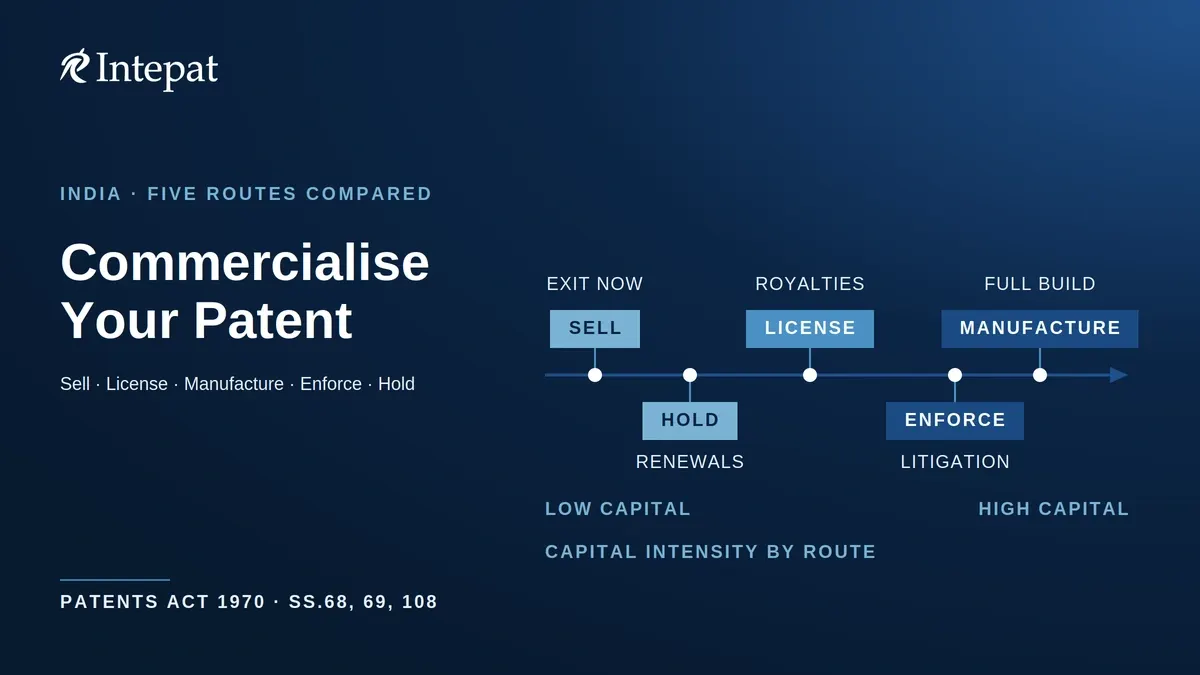
A granted Indian patent can be exploited in several ways: sell it outright, license it, manufacture the product yourself, or enforce it against infringers. Alongside those sits a separate decision, whether to maintain the patent, surrender it, or let it lapse. The right route depends on your capital, your risk appetite, and whether the patent is even granted yet.
This article covers the position under the Patents Act 1970 and the Patents Rules 2003 in India. It is a decision guide, not a how-to on any single route; fee figures are as verified in July 2026. The question is which route fits your situation, not how each is documented once you have chosen.
| The five decisions at a glance |
| • Sell: consideration as agreed, you exit, the buyer takes on the asset. • License: you keep ownership while another party works the invention for agreed consideration. • Manufacture: direct control of production, with the operational and market exposure that comes with it. • Enforce: you assert the exclusive right in court; available only after grant. • Maintain, surrender, or lapse: the patent still costs money and still carries obligations. |
| Grant status gates your options. A pending application cannot be enforced, and a pre-grant transfer runs through Section 20, not the Section 69 recordal used after grant. From three years after grant, the patent becomes eligible for a compulsory-licence application, and a working statement (Form 27) is due from whoever is the patentee or licensee for the relevant period. |
Selling the patent outright
Selling ordinarily means assigning ownership of the patent for contractually agreed consideration. The assignee becomes the proprietor and takes over the renewal obligations. The payment structure, and any continuing obligations on either side, depend on the assignment agreement rather than on the Act.
The route suits an organisation whose research has moved on, or that has no route to market of its own. An assignment must be in writing, embody all its terms and conditions, and be duly executed to be valid (Section 68). The assignee must then apply to the Controller to register its title, ordinarily on Form 16, and until that recordal the assignment document is generally not admissible as evidence of title or interest unless the Controller or a court directs otherwise (Section 69). How the assignment is drafted and recorded is covered in our guide to assignment agreements; the decision point here is simpler: you are trading future upside for consideration now.
The trade-off is that you cannot un-sell: if the invention becomes a category leader, the buyer captures that value. Selling is right when a defined exit is worth more than an uncertain larger return.
Licensing the patent
Licensing lets another party make, use, or sell the invention while you keep ownership. Consideration arrives on the payment structure agreed with the licensee, whether as royalties, fees, or a mix, and you can license the same patent to several parties or reserve it for one.
The appeal is that you monetise the patent without building a factory or a sales team. A licence must be in writing, embody all the terms and conditions governing the parties’ rights and obligations, and be duly executed (Section 68); the licensee must also apply to the Controller to register notice of its interest, ordinarily on Form 16 (Section 69). A licence can be exclusive or non-exclusive. The choice between those, the royalty structures available, and the clauses that make a licence enforceable are the subject of our guide to how a patent licence works under Indian law. For the routing decision, three things matter.
First, where consideration is tied to sales, production, or use, your return depends on the licensee actually working the invention, so the counterparty’s capability is part of the decision; upfront fees and minimum payments turn on the structure you negotiate. Second, you remain a patentee, so the working-statement and renewal obligations stay with you. Third, restrictive terms can rebound: certain conditions are void under Section 140, and terms such as exclusive grant-back or coercive package licensing can be treated as a failure to satisfy the public’s reasonable requirements, feeding a compulsory-licence application.
Manufacturing and selling it yourself
Self-manufacture gives you direct control over production, pricing, and market execution: you produce the patented product and take it to market under your own brand. The net return depends on production costs, demand, competing rights, and execution, and you carry the operational and market exposure.
| A patent is an exclusionary right, not a freedom-to-operate clearance. Section 48 gives you the right to stop others from making, using, or selling your invention. It does not, by itself, establish that manufacturing or selling your product avoids someone else’s patent. Before investing in tooling or a launch, a freedom-to-operate check is a separate exercise from owning the patent. |
A middle path is to outsource production alone, selling under your own name. One practical trap sits inside this route. If the defendant in an infringement suit proves it was unaware, and had no reasonable grounds to believe, that the patent existed, the court cannot award damages or an account of profits for that infringement (Section 111). Marking a product merely “patented” without the patent number is not by itself enough to fix an infringer with notice.
Enforcing the patent against infringers
Enforcement is commercialisation by asserting the exclusive right. Where a third party makes, uses, or sells your invention without consent, you can sue. A court may grant an injunction and, at your option, either damages or an account of profits, and may order infringing goods destroyed (Section 108). The parties may separately negotiate a licence or settlement, but the statutory reliefs are those in Section 108, and relief may be injunctive without monetary recovery, so the financial outcome is uncertain.
Two features shape the capital and risk profile. A suit must be brought in a district court or higher, and if the defendant counterclaims for revocation, the suit and counterclaim are transferred to the High Court (Section 104), changing the forum and the litigation profile. And enforcement is only available after grant, as covered below. If you are weighing a suit, our guide to patent infringement in India sets out the reliefs and the process in full.
Holding or exiting, and the cost of doing neither
Doing nothing looks free. It is not. A patent left idle runs a renewal schedule, carries compliance obligations, and remains exposed to a compulsory-licence application.
Renewal fees are payable for the third year onward, counted from the date of the patent, ordinarily the filing date rather than the grant date (Sections 45 and 53, Rule 80). At the currently prescribed electronic-filing rates, the undiscounted renewal fees for years three to twenty total around Rs 76,800 for a natural person, startup, small entity, or educational institution, and around Rs 384,000 for other applicants (First Schedule, entry 18). These are official fees, not total maintenance cost, and a 10% reduction applies where at least four years are paid in advance electronically (Rule 80). Miss a renewal and the patent ceases to have effect, and the subject matter is not entitled to protection (Section 53). If restoration is later obtained, no suit may be commenced for infringement committed between the date of cessation and the date the restoration application was published (Section 62). Restoration may be sought within eighteen months of cessation on Form 15 (Section 60).
Two continuing issues need attention regardless of route: statutory reporting and compulsory-licence exposure. Every patentee and every licensee must separately file a working statement in Form 27, once for each three-financial-year period, the first starting with the financial year immediately after the year of grant, within six months of the period’s expiry (Section 146 and Rule 131). There is no official fee for Form 27, but failure to furnish the statement can attract a penalty of up to Rs 1 lakh, with a further Rs 1,000 for each day the failure continues, adjudicated under Chapter XIV-A of the Rules on a complaint in Form 32, which any person may file. Separately, from three years after grant, any interested person may apply for a compulsory licence on grounds such as non-working in India, unaffordability, or unmet public demand (Section 84). Grant is not automatic: the Controller must be satisfied of the grounds and weigh the Section 84(6) factors, including your own efforts to work the invention. After two years from the date of the order granting a first compulsory licence, the Central Government or any person interested may apply to revoke the patent on the grounds of unmet public requirements, unaffordability, or non-working, and the Controller may revoke if satisfied (Section 85).
That is why holding is a decision, not a default. If the patent is worth keeping, keep it working and keep the record: documented working steps and responses to licence approaches materially affect a compulsory-licence outcome. If it is not worth keeping, the deliberate exit is to offer it for surrender under Section 63: the offer is published, may be opposed by an interested person, and takes effect only if the Controller accepts it and revokes the patent. No official fee applies to the surrender notice. The offer begins a considered statutory process rather than letting the patent cease through non-payment.
Comparing the five decisions
The routes differ on five axes founders actually weigh: cost to pursue, capital tied up, risk carried, ownership, and when the money arrives. The commercial columns are an illustrative profile, not a statutory consequence; the actual outcome turns on your agreement and your execution.
| Route | Upfront cost to you | Capital required | Risk you carry | Ownership | Money timing |
| Sell | Transaction, diligence, documentation, recordal | Usually limited after completion; agreement-dependent | Largely shifts to buyer; residual per the agreement | Transferred | As agreed in the assignment |
| License | Negotiation and drafting | Generally lower than manufacture; deal-dependent | Allocated by the licence terms | Retained | As agreed in the licence |
| Manufacture | Production and market build | High | High | Retained | After market entry |
| Enforce | Litigation cost | Medium to high | High; case can escalate | Retained | Uncertain; may be injunctive, not monetary |
| Maintain or exit | Renewal and compliance; no official fee for surrender notice | Renewal and compliance spend | Compulsory-licence exposure | Retained until surrender, cessation, or expiry | None |
No route is best in the abstract. The table lets you line up your own constraints against each column rather than reason route by route.
Matching the route to your situation
A few common situations point fairly clearly to a route. If your organisation is research-led with no appetite to manufacture, selling or licensing avoids the capital burden of self-manufacture, though contractual administration can remain; selling gives the cleaner exit. If you are cash-constrained but believe in the invention, non-exclusive licensing may generate consideration from more than one licensee without the capital call self-manufacture demands. If the product is market-ready and you can fund it, manufacturing gives the most direct control, at the cost of the greatest operational commitment. If someone is already infringing, enforcement may be commercially justified once you have assessed validity, infringement, evidence, and cost, and a negotiated licence may remain available.
Two inputs sharpen these choices. The first is what the patent is worth, which informs the assignment consideration or licence terms; our guide to patent valuation methods in India covers how that number is built and defended. The second is your renewal horizon: if you will not work, license, or sell the patent, the honest question is whether to keep paying to renew it at all.
If your patent has not been granted yet
A pending application is a different decision. Infringement proceedings are not available until grant, and a pre-grant transfer runs through a different mechanism than the Section 69 recordal applying after grant.
From publication until grant, you have the like privileges and rights of a patentee, but you cannot institute infringement proceedings until the patent is granted (Section 11A). Pending status does not, however, stop you from commercially exploiting the invention or from assigning the application. A person who becomes entitled to the application through a written assignment or agreement may seek substitution as the applicant under Section 20, on Form 6, with the invention identified by its application number. A pre-grant licensing arrangement is contractual and does not itself substitute the applicant. Only enforcement waits for grant, and any activity you document meanwhile is potentially infringing activity, to be assessed against the claims finally granted.
One pressure is absent, which is worth knowing. The three-year compulsory-licence period runs from the date of grant, not from filing, so a pending application carries no compulsory-licence exposure and no Form 27 obligation yet. That gives you room to decide your route deliberately. The practical move while pending is usually to prepare and, where it fits, to transact: settle whether you will sell, license, or manufacture, and value the invention, so you can act at grant.
Deciding your first move
Start with two facts about your patent: is it granted, and can you fund working it yourself. Granted and funded opens every route, including manufacture and enforcement. Granted but unfunded points to licensing or sale. Pending status permits assignment of the application, with substitution under Section 20 on Form 6, while enforcement waits for grant. Not worth working at all points to a deliberate offer of surrender rather than a silent lapse.
Whichever way you lean, the route you can defend commercially is the one built on a real valuation and a clear read of your own capacity to carry risk.
Frequently asked questions
Common routes for a granted patent are selling it by assignment, licensing it for consideration, manufacturing and selling it yourself, or enforcing it against infringers under the Patents Act 1970. Alongside these sits the decision to maintain, surrender, or let the patent lapse. The right route depends on capital, risk appetite, and grant status.
Yes. Selling assigns ownership to a buyer for agreed consideration, and you exit the asset; the assignee registers its title under Section 69. Licensing keeps ownership with you while another party works the invention. Both an assignment and a licence must be in writing and duly executed under Section 68.
The patent still needs renewal fees and still carries a Form 27 working-statement obligation. From three years after grant, any interested person can apply for a compulsory licence on grounds including non-working (Section 84), though grant is not automatic. Offering it for surrender under Section 63 carries no official fee.
You cannot enforce it: infringement proceedings cannot be instituted until the patent is granted (Section 11A). You can, however, exploit or assign the application; a person entitled through a written assignment may seek substitution as applicant under Section 20 on Form 6. Only enforcement waits for grant.
No. The three-year compulsory-licence period runs from the date of grant, not from the date of filing (Section 84). A pending application therefore carries no compulsory-licence exposure and no Form 27 working-statement obligation until the patent is actually granted, which gives you room to plan your route.
Disclaimer: This article is general information on patent commercialisation under Indian law and is not legal advice. Fee figures and statutory positions are stated as verified in July 2026 and are subject to change. Commercialisation decisions turn on facts specific to each patent and business; obtain advice from a qualified patent professional before acting.