




Patent valuation in India can mean three different things: the amount carried in the financial statements, a valuation required for a statutory transaction, or a price negotiated in a licence or sale. Market, income and cost approaches are all available, and the choice depends on the purpose, the evidence and the reliability of the inputs.
| Before you commission anything |
| India’s registered valuer framework recognises three asset classes, and none of them is intellectual property. A Companies Act patent valuation is therefore signed by a valuer registered for Securities or Financial Assets. That registration does not itself establish competence in claim interpretation, validity analysis or technology assessment, so where those matters move the number, the engagement needs separately identified patent and technical input. |
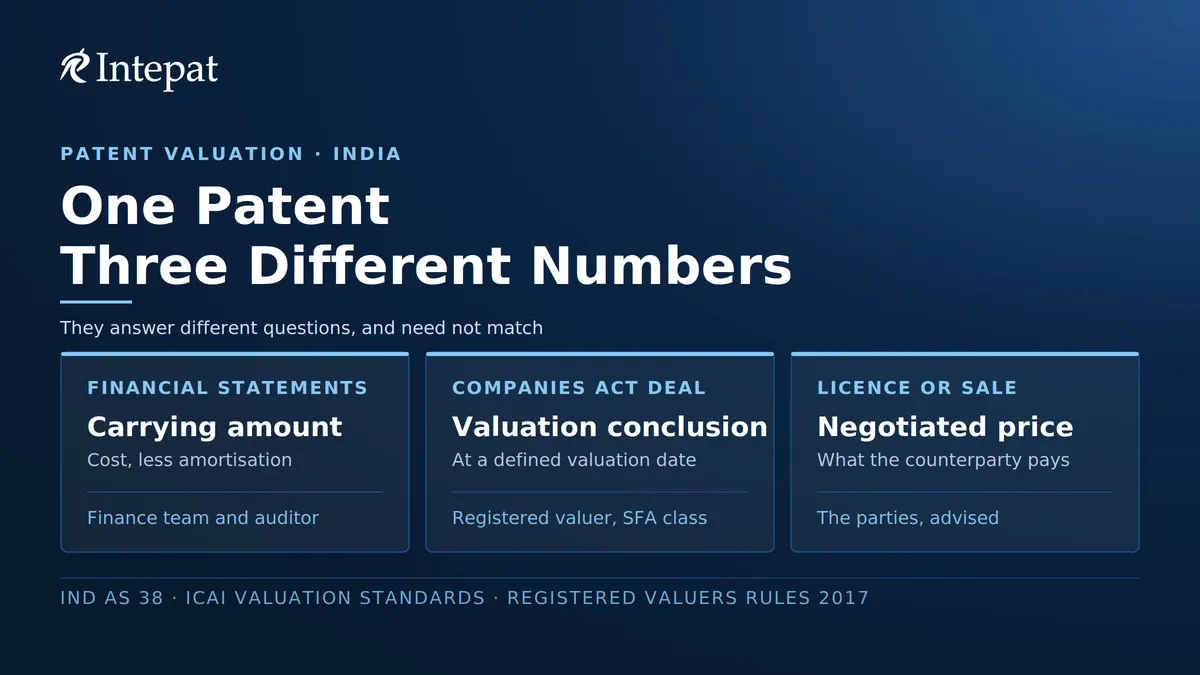
Three different numbers, and why they diverge
Most confusion about patent valuation comes from treating three questions as one. A finance director, a company secretary and a founder in a licence negotiation are asking different things.
| The question | What answers it | Who produces it |
| What appears in our financial statements? | Accounting carrying amount under the company’s applicable framework | Finance team and auditor |
| What value do we need for a Companies Act transaction? | Valuation conclusion for a specified purpose and valuation date | Registered valuer for the relevant asset class |
| What should we accept in a licence or sale? | Negotiated price, informed but not determined by valuation | The parties, advised |
Treating one as a proxy for another is a common source of error.
What the balance sheet shows, and which companies it applies to
Start with a question this article cannot answer for you: which framework does the company apply? Ind AS applicability turns on the Companies (Indian Accounting Standards) Rules and, for banks, NBFCs and insurers, on the applicable sectoral roadmap. The factors include listing status, net worth, voluntary adoption and group relationships, and a company listed or proposing to list only on an SME exchange is not mandatorily covered by the general corporate roadmap. Companies outside the applicable roadmap generally apply the notified Accounting Standards, where AS 26 addresses intangibles. Confirm which applies with the company’s accountant before relying on this section.
A carrying amount is an accounting measure determined under the applicable reporting framework and then reduced by amortisation and impairment. For an Ind AS preparer developing a patent in-house, Ind AS 38 constrains it twice. First on cost: research is expensed when incurred, and development is capitalised only once all six conditions in paragraph 57 are demonstrated, so the cost recognised runs from the date those conditions were first met and cannot reach back over expenditure already expensed. One misreading is worth correcting: the prohibition on recognising internally generated brands, mastheads and customer lists does not extend to patents, and a self-developed patent can be capitalised. What caps it is timing, not permission. A patent that was bought, alone or as part of a transaction, is measured on a different basis, and that is a question for the accountant.
Second on revaluation. An intangible may be carried at a revalued amount only where fair value is measured against an active market, and the standard says an active market cannot exist for patents, because each such asset is unique. Absent one, the asset stays at cost less amortisation and impairment.
So the carrying amount and a commercial valuation answer different questions and may diverge in either direction: a patent can be worth far more, or, if invalid, not infringed or obsolete, considerably less. One route stays open: an entity is encouraged, though not required, to describe significant intangibles it controls but has not recognised.
The three valuation approaches and when each fits a patent
Under the ICAI Valuation Standards there are three approaches: market, income and cost. Those standards are one permitted framework, not the governing law: until standards are notified under Rule 18, a registered valuer may use internationally accepted valuation standards or those adopted by any registered valuers organisation, and must identify in the report which were followed. Selection turns on the valuation basis and premise, the characteristics of the asset, and the availability and reliability of information. Nothing in the accounting treatment dictates it.
The market approach uses the Market Price, Comparable Companies Multiple and Comparable Transaction Multiple Methods. The circumstances in which it is not appropriate read like a description of Indian patent transactions, for reasons taken up below.
The income approach carries discounted cash flow, Relief from Royalty, Multi-Period Excess Earnings, the With and Without method, and option pricing models. It is indicated where the asset has few or no comparables, or produces income whose cash flows can reasonably be projected, and contra-indicated where it has not started generating income or where the amount and timing of cash flows are significantly uncertain, as with start-ups.
The cost approach uses the Replacement Cost and Reproduction Cost Methods, and applies where the asset can be quickly recreated with substantially the same utility, where liquidation value is wanted, or where neither other approach can be used. Its discipline is obsolescence: estimated cost must be adjusted for physical, functional and economic obsolescence, a wider concept than depreciation for reporting or tax.
Read those conditions together and the caution for patents follows. If each patent is unique, it is not an asset recreatable with substantially the same utility: reproducing the research spend reproduces neither claim scope, nor priority date, nor exclusivity. Where the patent is a principal revenue driver, a cost figure is better treated as a cross-check than as the answer.
Two rules govern the results. The valuer must maximise observable inputs and minimise unobservable ones. And where values under different approaches differ significantly, it is not appropriate to reach a final figure by assigning weightages: averaging a cost and an income number is not a reconciliation, it is a concession that the divergence was never explained.
Relief from royalty, and where the royalty rate comes from
Relief from Royalty is one recognised income method, generally adopted for licensing-related intangibles including patents. It estimates value as the present value of royalties avoided by holding the asset rather than licensing it.
The valuer forecasts revenue attributable to the asset over its remaining useful life, selects a royalty rate, deducts the cost of maintaining the licensing arrangement, applies a tax rate, and discounts. The royalty rate is often the input under most pressure, but the answer may also move materially with revenue attribution, economic life, the tax assumption and the discount rate. Ask how the conclusion changes under reasonable alternatives for each.
The standards offer two routes to the rate: market-based royalty rates for similar intangibles, or the profit split method. A comparable rate must be sourced from somewhere other than the Indian patent register, and adjusted for differences in technology, scope of rights, geography, exclusivity, field of use, remaining life and transaction circumstances.
Indian patent law names royalty factors in one place. In settling the terms of a compulsory licence, the Controller must endeavour to secure a reasonable royalty, having regard to the nature of the invention, the expenditure incurred in making or developing it and in obtaining and keeping the patent in force, and other relevant factors. Those factors govern licences the Controller imposes. They do not bind a private negotiation and should not be presented as a statutory methodology for one.
Remaining useful life: twenty years is a ceiling, not a forecast
The term of every patent is twenty years from the date of filing. For an international application designating India it runs from the international filing date, not national phase entry, and a model built without checking that can assume years the patent does not have.
Twenty years is the outer boundary of the forecast, not the forecast. For an Ind AS preparer, the useful life of an intangible arising from legal rights shall not exceed the period of those rights but may be shorter, and where economic and legal factors both apply it is the shorter of the two. The listed factors include expected usage, product life cycles, technological obsolescence, competitor action, and the maintenance expenditure required together with the entity’s ability and intention to meet it. Uncertainty justifies prudence, but not an unrealistically short life.
Maintenance is where the model meets the fee schedule. Renewal fees fall due from the end of the second year and step up four times.
| Renewal years | Natural person, startup, small entity, educational institution (e-filing) | Other applicants (e-filing) |
| 3rd to 6th year, each | Rs 800 | Rs 4,000 |
| 7th to 10th year, each | Rs 2,400 | Rs 12,000 |
| 11th to 15th year, each | Rs 4,800 | Rs 24,000 |
| 16th to 20th year, each | Rs 8,000 | Rs 40,000 |
| Full term, years 3 to 20 | Rs 76,800 | Rs 384,000 |
Official fees only, per the First Schedule to the Patents Rules 2003 as substituted by G.S.R. 211(E) dated 15 March 2024. Physical filing attracts higher fees. Agent and annuity-service charges are additional.
Paying at least four years in advance electronically attracts a ten per cent reduction. Across the full term the official cost is Rs 76,800 for a natural person, startup, small entity or educational institution filing electronically, and Rs 384,000 for other applicants. Because the schedule is back-loaded, a flat annual assumption misstates the timing of the cash flows even on the correct total, and timing is what a discount rate acts on.
Non-payment then affects enforcement in two ways, and the two should not be collapsed. Where the payment period is extended, the patent remains in force and the court has a discretion to refuse damages or an account of profits for infringement between the failure to pay and the extension. Its power to grant an injunction is unaffected. Where the patent has actually ceased and is later restored, no suit or other proceeding may be commenced or prosecuted for infringement between cessation and publication of the restoration application, and the Controller may impose conditions protecting anyone who began using the invention in that window. The first is a discretionary loss of monetary relief; the second a statutory bar on the proceeding itself. Identify which applies, and confirm the renewal history before pricing enforcement value.
Why comparable patent transactions are hard to find in India
Patent comparables can be difficult to identify, and the reasons are on the record. The Ind AS 38 passage quoted above decides an accounting question, but its reasoning is evidence about price observability and is citable as such: contracts are negotiated between individual buyers and sellers, transactions are relatively infrequent, the price paid for one asset may not evidence the fair value of another, and prices are often not public. The valuation standards arrive from the other direction, listing insufficient information about comparable transactions and the absence of an active market among the circumstances in which the market approach should not be used.
The third source is the one practitioners expect most from. Every patentee and licensee must file a statement on the working of the invention in India, once for each period of three financial years, and the Controller may publish it. The Form 27 substituted by the Patents (Amendment) Rules 2024 asks for the patent number, the financial year, whether the invention was worked, and if not, a tick against one of four reasons: the invention is under development or commercial trial, is under review or approval with regulatory authorities, is at the stage of exploring commercial licensing, or any other reason specified. It then asks whether the patent is available for licensing, with contact details. There is no field for revenue or value accrued in India.
So Form 27 yields a worked or not-worked signal and a licensing lead, not a royalty-rate comparable. That does not mean none exists: rates can be sourced from litigation records, contractual and company disclosures, foreign transactions in the same technology, and commercial royalty databases. It means sourcing and adjustment must be done deliberately and shown, not presented as though a rate had been looked up.
Who signs the valuation, and what they are registered for
The Companies (Registered Valuers and Valuation) Rules 2017 apply to valuations of company property or assets under the Companies Act 2013 or those Rules, and expressly leave valuations under any other law unaffected. The Companies Act framework does not itself require a registered valuer merely because the purpose is a private licence negotiation, a lending exercise or a board paper. It does not follow that no requirement applies: another statute, regulator, lender policy or transaction document may prescribe who signs.
Where the Rules do bite, the framework recognises three asset classes: Plant and Machinery, Land and Building, and Securities or Financial Assets. It creates no separate class for intangibles or intellectual property, and no provision expressly classifies a patent. In practice the work sits in the Securities or Financial Assets stream, and the regulator’s own material says so: the syllabus IBBI publishes for that class carries a dedicated intangible assets block, covering acquired and internally generated intangibles, valuations for standalone transfers and collateral lending, and methods including relief from royalty and excess earnings. The class is open to members of the Institutes of Chartered Accountants, Company Secretaries or Cost Accountants of India, or to holders of an MBA or postgraduate diploma in management with a finance specialisation, or a postgraduate finance qualification, each with three years’ experience.
What that syllabus does not contain matters just as much. It teaches how to value an intangible, and carries nothing on claim construction, validity or infringement. Registration therefore establishes competence in valuation technique, not in reading a patent. An individual valuer may hold both; the framework does not assume it, and neither should the company commissioning the work. Where those matters materially affect the number, the assignment needs qualified patent and technical input.
The Rules provide the route. A valuation report must identify the valuer and any other experts involved, and state the nature and sources of the information relied upon. A patent attorney’s claim-scope and validity analysis, or an engineer’s assessment of technology life, is an expert input to be named there. The valuer owns the conclusion and remains responsible for it.
Two conduct rules matter before appointment. A registered valuer must not charge a success fee, and must not offer convenience valuations to cater to a client’s needs. And a false statement in a report, made knowing it to be false, or the omission of a material fact known to be material, attracts liability under section 448 of the Companies Act 2013.
What to settle before you commission a patent valuation
Where the Rules apply, the report has a prescribed anatomy. Rule 8(3) lists twelve items it must contain.
| # | Rule 8(3) requires the report to state | Who usually supplies it |
| a | Background information of the asset valued | Company |
| b | Purpose of valuation and appointing authority | Company |
| c | Identity of the valuer and any other experts involved | Both |
| d | Disclosure of valuer interest or conflict, if any | Valuer |
| e | Date of appointment, valuation date and date of report | Both |
| f | Inspections or investigations undertaken | Valuer |
| g | Nature and sources of the information used or relied upon | Both: company supplies asset-specific information, valuer selects and discloses all sources |
| h | Procedures adopted and valuation standards followed | Valuer |
| i | Restrictions on use of the report, if any | Both |
| j | Major factors that influenced the valuation | Valuer |
| k | Conclusion | Valuer |
| l | Caveats, limitations and disclaimers | Valuer |
Rows (c) and (g) are where patent and technical expert input is named and sourced. The valuer decides what is relied upon and must disclose it.
Six things to settle before appointment. Identify why the valuation is needed and which law or transaction document drives it. Confirm whether a registered valuer is required, and by what. Fix the valuation date and the basis of value, because the standards define three bases, fair value, participant specific value and liquidation value, reaching different conclusions on the same asset. Verify ownership, assignments, licences, encumbrances, legal status and renewal history, since a ceased patent is a different question from a discounted one and the answer turns on restoration prospects, intervening-user protections and whatever associated rights survive alongside it. Prepare claim-to-product, validity-risk and economic-life inputs in writing. And ask for sensitivities showing how the answer moves with the royalty rate, revenue attribution, useful life and discount rate.
Settle those and the valuer’s judgement is applied to facts. Leave them out and the report still gets produced, on assumptions the company never saw. Being clear first about what you intend to do with the patent keeps the valuation and the licence you are negotiating pointed at the same question.
Frequently asked questions
Where the Companies Act requires a valuation, a registered valuer signs it. There is no intellectual property asset class, so the work falls within Securities or Financial Assets. For other purposes the Companies Act framework does not itself require a registered valuer, but another law, regulator or contract may.
Market, income and cost approaches are all available. Relief from Royalty is a recognised income method generally adopted for licensing-related intangibles including patents. The appropriate choice depends on the valuation purpose, the evidence available, whether cash flows can be attributed to the patent, and the reliability of the inputs.
For an internally generated patent under Ind AS 38, research is expensed and qualifying development capitalised only from the date the recognition criteria are met. Revaluation needs an active market, which the standard says cannot exist for patents. An acquired patent is measured differently. Either way, a carrying amount answers a different question.
No. The Form 27 substituted by the Patents (Amendment) Rules 2024 records whether the invention was worked, a tick-box reason if not, and whether the patent is available for licensing. It carries no field for revenue or value accrued in India, so it cannot supply a royalty-rate comparable.
Official renewal fees across years three to twenty total Rs 76,800 for a natural person, startup, small entity or educational institution filing electronically, and Rs 384,000 for other applicants. Paying at least four years in advance electronically attracts a ten per cent reduction. Agent charges are additional.
It should not be valued as a presently enforceable patent. If it is restored, section 62 bars proceedings for infringement committed between cessation and publication of the restoration application. Restoration prospects, intervening-user protections and associated know-how, licences or foreign family members must be assessed separately.
This article explains Indian patent, company and accounting requirements as they stood on 21 July 2026. It is general information, not legal, accounting, valuation or investment advice, and it does not create a professional relationship. Accounting references are to Ind AS 38 and apply only to companies preparing under Ind AS. Fee figures are official fees only. Where the Companies Act 2013 requires a valuation, a registered valuer must be engaged.