




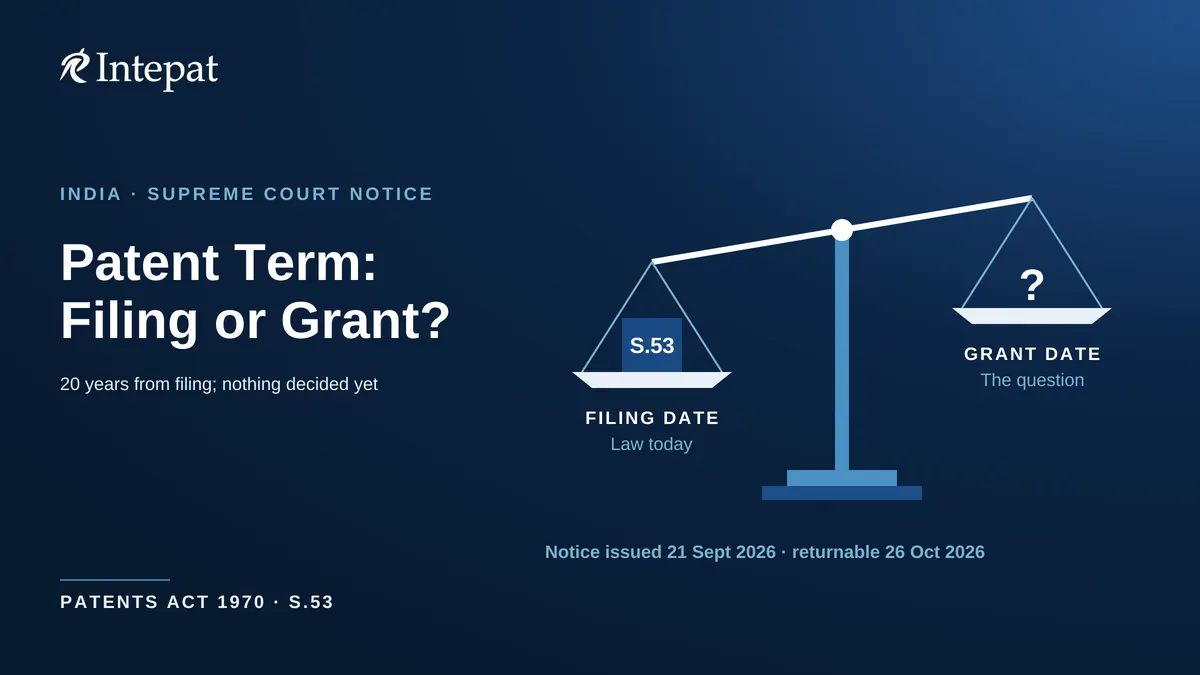
The patent term in India is 20 years counted from the date an application is filed, not the date the patent is granted, so waiting for grant reduces the protected years left. On 21 September 2026 the Supreme Court issued notice on a petition arising from a judgment that upheld that rule. It has decided nothing about it yet.
This article covers Indian law under the Patents Act, 1970 and the Patents Rules, 2003. It is written for founders and inventors who want to know what the Court has done, what the notice does not mean for a pending or granted patent, and which parts of the waiting time an applicant can influence.
| Quick answer: |
| The term still runs 20 years from filing. Publication gives an applicant interim rights but no right to sue until grant; once the patent is granted, damages can be sought from the date of publication. The Supreme Court has issued notice and requested an amicus curiae to assist; its order records no finding on the term. Early publication, a timely request for examination and, for eligible applicants, expedited examination are the levers on delay. |
What the Supreme Court has done so far
On 21 September 2026 a bench of Justices P.S. Narasimha and Alok Aradhe issued notice in Gunjan Sinha v. Union of India and requested an amicus curiae (a lawyer who helps the Court without acting for either side) to assist. Notice is a first step. The order records no finding on how a patent’s term is counted.
The matter is a Special Leave Petition (a request that the Supreme Court hear an appeal), Diary No. 43127/2026. It arises from the final judgment of the Calcutta High Court dated 22 April 2025 in MAT No. 903/2024. The petitioner appeared in person through virtual mode, and the Court issued notice on the petition and on the application to condone delay in filing it, returnable on 26 October 2026.
The Court also requested Ms. Kruttika Vijay, Advocate, to assist as amicus curiae and directed the Registry to give her a soft copy of the petition. The order does not set out the grounds of the petition. The Calcutta judgment supplies the background, since it rejected a constitutional challenge to the filing-date rule in Section 53 of the Patents Act.
How the patent term in India is counted, and what waiting costs
The 20-year patent term in India is counted from the date of filing of the application [Section 53 of the Patents Act]. No time spent in examination, opposition or appeal is added back. For an international application under the Patent Cooperation Treaty (PCT), the twenty years run from the international filing date, not the later date it enters India.
Where an Indian application is first filed with a provisional specification (an early, outline description), the applicant must file the complete specification (the full description and claims) within twelve months of that filing date, or the application is treated as abandoned [Section 9(1)]. Filing the complete does not by itself restart the term, although the applicant may ask, before grant, to cancel the provisional and post-date the application to the date of the complete [Section 9(4)].
Twenty years is the general rule. One exception: a patent of addition (for an improvement in or modification of a main invention) runs only for the remaining term of the main patent, and ends earlier if the main patent ceases [Section 55(1)].
Take an illustration, not a forecast: an applicant files on 1 March 2026 and the patent is granted on 1 March 2031. Five of the twenty years are gone before the patent can be enforced, and fifteen remain.
After expiry, the subject matter is not entitled to any protection [Section 53(4)]. A patent also ceases to have effect if a renewal fee is not paid in time [Section 53(2)].
The patentee of a lapsed patent can apply for restoration within eighteen months of the date it ceased to have effect, and the Controller must be satisfied that the failure to pay was unintentional and the application not unduly delayed [Sections 60 and 61].
Renewal years are counted from the date of the patent, which is its filing date, with fees beginning at the end of the second year [Section 45(1); Rule 80].
Where a patent is granted more than two years after filing, the fees that fell due in the meantime may be paid within three months of the patent being recorded in the register, or within an extended period ending no later than nine months from recording [Section 142(4)]. Delay does not change the annual fee scale, but several years’ fees fall due together shortly after grant, and paying them after the first three months adds a per-month extension fee. Those are years in which no infringement suit could be brought.
Publication is what gives an applicant rights before grant. Unless the applicant asks for earlier publication, an application is ordinarily published eighteen months from the earlier of its filing date or priority date, and the Controller (the Patent Office official who decides applications) ordinarily publishes within a further month [Rule 24]. From the date of publication until grant, the applicant has “the like privileges and rights as if a patent for the invention had been granted on the date of publication”, but a proviso bars any infringement proceedings until the patent has been granted [Section 11A(7)]. (The priority date is the filing date of an earlier application for the same invention, where one is claimed.) The table shows where an application stands at each stage.
| Stage | Term clock | Rights under Section 11A(7) | Suit for infringement |
| Filed, not yet published | Running from filing | None yet; the rights run from publication | Not available |
| Published, not yet granted | Running | Like privileges and rights as if granted on the date of publication | Not until the patent is granted |
| Granted | Running | Patent rights | Possible once granted |
The Calcutta High Court described the position this way: an infringement action may be brought only if a patent has been granted, “though damages can be sought with effect from the date of publication”. The two decided cases below, one on the validity of the rule and one on a file delayed by disputes, show how long the wait can run. They are individual cases, not averages.
Why the Calcutta High Court upheld the filing-date rule
In Gunjan Sinha v. Union of India (22 April 2025) a Division Bench of the Calcutta High Court held that Section 11A(7) and Section 53 “operate in two different fields” and declined to strike the filing-date rule down. It said any change to the term is for the legislature.
The facts were stark. The patent was applied for on 2 May 2005 and granted on 28 December 2012, a gap of about seven years and eight months, and the term was certified as twenty years from 2 May 2005. The appellants argued that the term rule and the interim rights provision conflict, and that renewal fees were taken for years in which the patent had not been granted or exploited.
The Court gave three reasons. The two provisions do different jobs: Section 11A(7) gives interim protection from publication to grant “without prematurely granting full patent rights”, while Section 53 deals with the term of a granted patent. The 2002 amendment had moved the term from fourteen years from the date of the patent to twenty years from filing. And a committee constituted under a Delhi High Court order in the Nitto Denko case (spelt “Nittoo” in the judgment) had considered term adjustment for office delay, which exists in the United States, and reported that the “proposal is not conducive to India where the monopoly of 20 years itself is considered too long to block genuine competition”.
The judgment’s next paragraph records the committee’s further view that an applicant can pursue regulatory approvals and commercialisation while the application is pending. Earlier in its judgment the Bench had observed that the petition did not show how the bar on infringement proceedings had prejudiced the petitioners, and that nothing had been placed before it on whether a report in the Nitto Denko proceedings had been accepted by the Delhi High Court. On the policy question, it left the matter to Parliament: such issues are “best left to the legislative minds”, and in all other cases “the duty of the Court is to interpret the law and not to enact the law”.
For context, the patent term from filing date reflects an international minimum rather than an Indian outlier; the minimum does not stop a country from offering longer protection. The TRIPS Agreement requires that the term “shall not end before the expiration of a period of twenty years counted from the filing date” [Article 33]. For ordinary utility patents the United States also ends the term 20 years from the US filing date (an earlier US or international application whose benefit is claimed counts; a foreign priority claim does not), but begins it on the date the patent issues and adjusts it for qualifying patent office delay, reduced for the applicant’s own delay [35 USC 154].
The Bombay case: 13 of 20 years gone, and why it is a different point
On 8 September 2026 the Bombay High Court recognised Dr. Tarkeshwar Patil, not IIT Bombay, as sole owner of an invention whose application dated from 2013. The judgment records thirteen of the twenty years elapsed in proceedings, with no patent yet granted. It decided ownership and procedure, not whether the term rule is valid.
The application is No. 2808/MUM/2013, dated 28 August 2013, for “An Apparatus and a Method for In-Vivo Power Generation”. A Deputy Controller rejected it on 17 July 2025, and Dr. Patil appealed under Section 117A. Justice Somasekhar Sundaresan recorded that the proceedings had been “costing the invention statutory patent protection for thirteen years out of the 20-year protection available in law”. He also recorded that a pre-grant opposition filed on 17 June 2019 was still being scheduled for hearing in 2024, “with over half of the statutory protection period already lost”.
The relief was ownership and procedure, and ownership turned on an assignment. IIT Bombay executed a Deed of Assignment in Patil’s favour on 3 July 2017, and the Court treated its institute policy as having otherwise vested the rights in the institute, so Patil prevailed because of that deed, not simply because he was the inventor. The Court held that “Patil is the sole and absolute owner of the invention in question”, quashed the rejection, restored the application to the Controller with Patil substituted as applicant, and directed a final reasoned order within eight weeks of the judgment being uploaded. It added that nothing in the judgment expresses an opinion on the merits of the application.
The judgment does not examine the validity of the term rule, and it is not part of the Supreme Court matter. Its use for a founder is narrower: it shows that delay in a file can come from disputes about ownership and opposition as much as from the examination queue, and that none of that time is added back to the term. If a patent does issue on that application, twenty years from 28 August 2013 would end on 28 August 2033, subject to renewal fees.
What the Supreme Court notice does not mean
The notice does not change the law. Section 53 still counts twenty years from filing, the Calcutta judgment has not been set aside, and the order frames no question on the term or the merits.
- The order records no stay of the Calcutta judgment.
- It also issues notice on an application to condone delay in filing the petition, so the delay is itself before the Court.
- The amicus request records the Court’s wish for assistance and does not indicate an outcome.
- Nothing in the order alters the term of any existing patent or pending application, or the renewal fees payable on it.
Whether the Court takes up the constitutional question, and what it would say if it did, is not something the order indicates. The safer course is to plan commercial timelines on filing-date counting and to treat any later ruling as a change that would have to be read when it arrives.
Three things within your control while the question is open
An applicant cannot change the term rule, but can influence patent pendency (the time an application waits for a decision). Three levers are available: an early publication request, a timely request for examination, and expedited examination for eligible applicants. Each is a decision about timing, not an entitlement to a faster result.
First, publication. A request in Form 9 brings publication forward [Rule 24A]. Early publication starts the publication-based rights sooner, but the invention also becomes public sooner. It does not replace a request for examination or confer expedited status.
An application becomes eligible for examination, in the order requests are filed, only once it is both published and the subject of a request (see the second lever). Where examination has already been requested, early publication lets the application join that queue without waiting for the eighteen-month date, though it does not move it up the queue [Rule 24B(2)(i)]. Our note on the early publication request covers how the request is made.
Second, the request for examination. For applications filed on or after 15 March 2024 it is due within thirty-one months from the date of priority or filing, whichever is earlier; older applications keep the earlier forty-eight-month period [Rule 24B(1)(i) and (vi)]. For an international application brought into India (a PCT national phase application), have your patent agent confirm which period applies, because the result depends on dates; if in doubt, plan on thirty-one months.
An application is not examined until the request is made. If more time is needed, the Controller may extend the time, or condone a delay, by up to six months on a request in Form 4 (the extension-of-time form, which carries a fee) made before that six-month period runs out; the relief is discretionary [Rule 138].
An application with no request within the applicable period, as extended, is treated as withdrawn [Section 11B(4)].
The request is made in Form 18. In practice, an early request generally puts the application in the examination queue sooner, while a late one keeps options open at the cost of a longer wait. The request for examination timetable sets out the steps that follow.
Third, expedited examination. The listed grounds include that the applicant is a startup, a small entity, or a female natural person (where all joint applicants are natural persons, at least one must be female), and other grounds such as government applicants are also listed [Rule 24C(1)]. The request is made in Form 18A, only electronically and within the examination-request period.
It must be accompanied by a request for publication unless the application is already published or such a request is filed [Rule 24C(3)]. A pending request for examination can be converted into an expedited one on payment of the relevant fees and filing the required documents [Rule 24C(2)].
On the expedited track the Controller is to dispose of the application within three months from the last reply to the first statement of objections or from the last date to put it in order, whichever is earlier, and that limit does not apply where there is a pre-grant opposition (a challenge by a third party before grant) [Rule 24C(12)]. Whether an applicant counts as a startup or a small entity is an eligibility question to settle before filing; founders can start from our guide to what a startup should know before filing a patent.
No patent can be granted within six months of publication [Rule 55(1A)], and none of these levers guarantees a decision date.
Frequently Asked Questions
From filing. Section 53(1) of the Patents Act sets the term at twenty years from the date of filing of the application, and for a PCT application designating India, from the international filing date. Filing a complete specification after a provisional does not by itself restart it, and the Supreme Court has not changed the rule.
No. The order of 21 September 2026 issues notice on a special leave petition and requests an amicus curiae. It records no finding on the term. The Calcutta High Court judgment under challenge upheld the filing-date rule, and that judgment has not been set aside.
Unless the applicant asks for earlier publication in Form 9, an application is ordinarily published eighteen months from the earlier of its filing date or priority date, and the Controller ordinarily publishes within a further month [Rule 24]. Until publication the Section 11A(7) rights do not exist. Publication does not by itself speed up examination.
No. Section 11A(7) gives an applicant the like privileges and rights as if a patent had been granted on the date of publication, but bars infringement proceedings until the patent is granted. Once it is granted, the Calcutta High Court noted, damages can be sought with effect from the date of publication.
No. Nothing in the order alters the term of any application or patent, or the renewal fees payable. Section 53 stands as written, so an existing patent’s term is still counted from its filing date. Read any later ruling when it arrives before relying on it.
An applicant can request early publication, file the request for examination in good time, and, if eligible under Rule 24C, request expedited examination in Form 18A. Each can bring a stage forward. None guarantees a decision date, no patent can be granted within six months of publication [Rule 55(1A)], and a pre-grant opposition may add time.
No. The 8 September 2026 judgment in Dr. Tarkeshwar Patil v. IIT Bombay decided who owns an invention and quashed a rejection. It records that thirteen of twenty years elapsed in proceedings, but it does not examine whether the filing-date rule is valid. The two cases are separate.
This article explains the law on the term of a patent in India as at October 2026 and is for general information only. It is not legal advice. Government fees, forms, and procedures change; confirm current figures with the Indian Patent Office before you file. For advice on your specific invention, consult a registered patent agent.
Sources
- The Patents Act, 1970, Sections 9(1) and (4), 11A(2), 11A(7), 11B(1), 11B(4), 45(1), 53, 55(1), 60(1), 61(1), 117A and 142(4), Government of India, consolidation incorporating amendments till 1 August 2024, Office of the Controller General of Patents, Designs and Trade Marks.
- The Patents Rules, 2003, Rules 24, 24A, 24B(1)(i) and (vi), 24B(2)(i), 24C(1), (2), (3) and (12), 55(1A), 80 and 138, and the First Schedule (Table I, entries 4(i) and 4(v), extension fees), as amended by the Patents (Amendment) Rules, 2024 (G.S.R. 211(E), 15 March 2024); the Patents (Amendment) Rules, 2025 (G.S.R. 865(E), 25 November 2025) checked and do not alter these provisions, Office of the Controller General of Patents, Designs and Trade Marks.
- Supreme Court of India, Record of Proceedings, Special Leave Petition (Civil) Diary No. 43127/2026, Gunjan Sinha @ Kanishk Sinha and Anr. v. The Union of India and Anr., order dated 21 September 2026, paragraphs 1 to 4.
- High Court at Calcutta, Gunjan Sinha @ Kanishk Sinha and Anr. v. Union of India and Ors., MAT 903 of 2024, judgment dated 22 April 2025 (2025:CHC-AS:712-DB), paragraphs 2, 16, 20, 22 and 24 to 26.
- High Court of Judicature at Bombay, Dr. Tarkeshwar Chandrakant Patil v. Indian Institute of Technology, Bombay and Ors., Commercial Miscellaneous Petition (L) No. 12000 of 2026, judgment dated 8 September 2026 (2026:BHC-OS:19905), paragraphs 1 to 2, 33, 41, 43, 55, 76 and 104.
- Agreement on Trade-Related Aspects of Intellectual Property Rights, Article 33, World Trade Organization.
- United States Code, Title 35, Section 154 (contents and term of patent; provisional rights), Legal Information Institute.