




A request for examination in India is the Form 18 filing that starts examination of a patent application; without it the Indian Patent Office does not examine the application. For applications filed on or after 15 March 2024 it is due within 31 months of the priority or filing date, whichever is earlier; a missed deadline deems the application withdrawn.
Under the Patents Act, 1970, no application is examined unless the applicant or any other interested person requests examination within the prescribed period, and an application with no request in time is treated as withdrawn by the applicant. The period is set by the Patents Rules, 2003. The Patents (Amendment) Rules, 2024, in force from 15 March 2024, cut it from 48 months to 31 months for applications filed on or after that date, so two tracks now run side by side.
This guide covers both tracks, the filing-date question for PCT national phase applications, Form 18 and Form 18A, the official fees by applicant category, and what the Rules do and do not offer after a missed request for examination deadline. For what happens once the Office takes up the request, see Patent Examination in India: Procedure, Timelines and Key Deadlines, and for the filing stage that precedes it, see the patent filing procedure in India.
Quick answer: File Form 18 within 31 months of the earliest priority date or the filing date, whichever is earlier, if the application was filed on or after 15 March 2024 (48 months if filed before). For a PCT national phase application entered in India on or after 15 March 2024, docket 31 months from the earliest priority date, or from the international filing date if no priority is claimed, whatever the international filing date. The e-filing fee is ₹4,000 for a natural person, startup, small entity or educational institution and ₹20,000 for other applicants. If the deadline is missed, the Controller’s general power to correct procedural irregularities cannot help; the only route in the Rules is a discretionary Form 4 request within six months of expiry, whether a condonation displaces the withdrawal is not settled, and after that only exceptional writ relief.
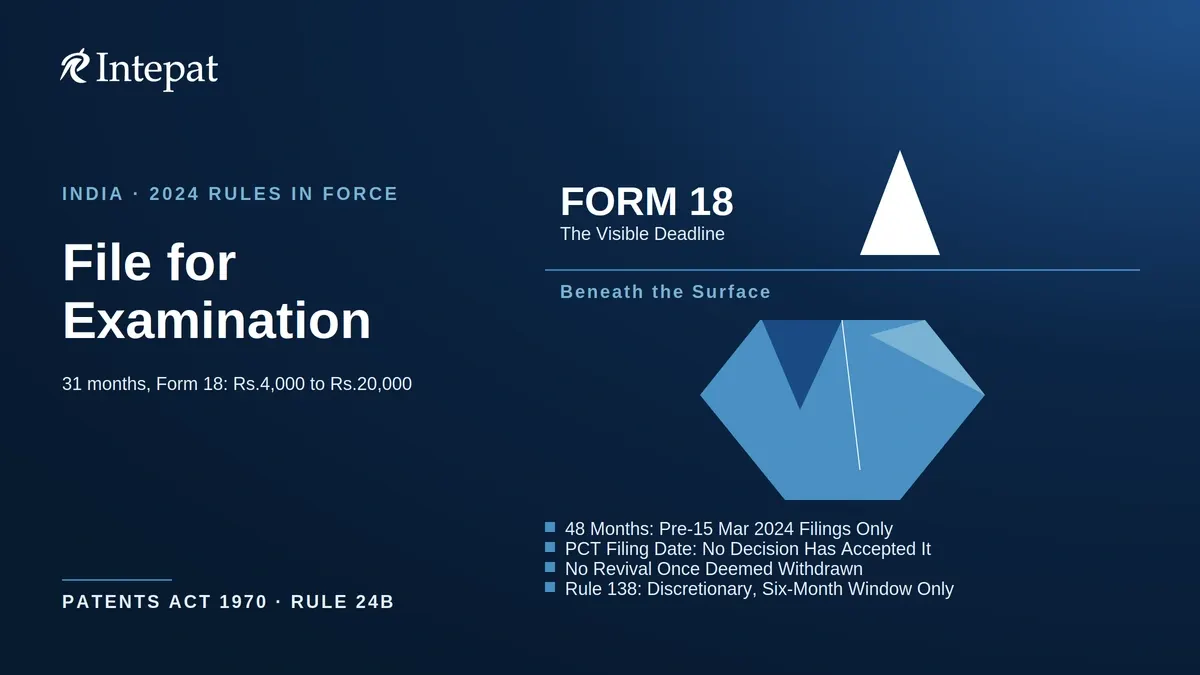
Request for Examination Deadline at a Glance
The request for examination period itself is measured from the earliest of the priority date and the filing date, and for a PCT national phase application the filing date is the international filing date, a point that bears on which track applies and is examined below.
The table below sets out the periods that govern a request for examination in India, each with its trigger and its rule.
| Situation | Period | Runs from | Rule |
| Application filed on or after 15 March 2024 | 31 months | Priority date or filing date, whichever is earlier | Rule 24B(1)(i) |
| Application filed before 15 March 2024 | 48 months | Priority date or filing date, whichever is earlier | Rule 24B(1)(vi) |
| PCT national phase application (filing date is the international filing date) | 31 months from the earliest priority date for every entry on or after 15 March 2024 (see the discussion of the transition below) | Earliest priority date (or the international filing date if no priority) | Rule 24B(1); firm docketing rule |
| Further (divisional) application | 31 months, or 6 months from filing the further application, whichever is later | Date of filing of the application or the priority date of the first mentioned application, as the rule words it; filing date of the further application | Rule 24B(1)(iv) |
| Missed deadline: Form 4 under Rule 138 | Up to 6 months, at the Controller’s discretion | Expiry of the Rule 24B period | Rule 138 |
| Putting the application in order for grant after the first examination report (the first statement of objections) | 6 months, extendable by 3 months on Form 4, requested before the period specified in the rule expires (safe practice: within the 6 months) | Date the first statement of objections is issued | Rule 24B(5) and (6) |
Verified as of September 2026 against the Patents Rules, 2003 as amended by the 2024 Rules. The last 48-month deadlines fall on 14 March 2028, so both tracks stay live for docketing until then.
Why the Deadline Is Absolute
The Act makes examination conditional on a request made “in the prescribed manner … within the prescribed period”, and provides that where no request is made within that period “the application shall be treated as withdrawn by the applicant”. The request is made on Form 18 within the period the Rules prescribe.
The withdrawal happens by operation of the Act, not by an order the Controller chooses to make, which is why the deadline carries no built-in grace period. Two features of the provision matter in practice. First, the deeming operates whenever nobody, applicant or interested person, requests examination in time, but the Act frames the result as a withdrawal “by the applicant”, so it is the applicant who bears the consequence. Second, a separate period, running from revocation, applies where a secrecy direction was in force; that case is outside this guide.
The 2024 amendment replaced “forty-eight months” with “thirty-one months” in the rule, so that a request for examination “shall be made in Form 18 within thirty-one months from the date of priority of the application or from the date of filing of the application, whichever is earlier”, and added a saving clause that keeps the earlier period for “an application filed before commencement of the Patents (Amendment) Rules, 2024”. Those Rules came into force on the date of their publication, 15 March 2024.
Which Track Applies: The Filing Date Decides, and the PCT Answer Is Not Settled
The track turns on one question: was the application filed before 15 March 2024 or on or after it? The saving clause speaks of an application “filed before commencement” of the 2024 Rules. For an ordinary or convention application that is the date on which it was filed at the Indian Patent Office.
For a PCT national phase application the Act fixes the filing date as the international filing date, not the entry date, and that creates an interpretive question on which practitioners should not rely.
The Act provides that the filing date of a PCT application processed by the Indian office as designated or elected office “shall be the international filing date accorded under the Patent Cooperation Treaty”, and the Patent Office Manual records that, where the applicant enters the national phase within 31 months of the priority date, the international filing date is “the deemed date of filing in India”. Where the Rules intend the actual entry date they say so: the Form 3 period for a national phase application is reckoned “from the actual date on which the corresponding application is filed in India”. The saving clause for the 48-month period carries no such words.
Read literally, those provisions would give a PCT application with an international filing date before 15 March 2024 the 48-month period even where it entered India after that date. The reports held record no decision accepting that reading, and the one reported case on the point runs the other way: in Smythe (Madras High Court, WP (IPD) No. 12 of 2025, 18 December 2025), a PCT application filed after September 2022 and claiming a September 2021 priority had a Form 18 rejected by the Patent Office portal when the applicant’s agent, having computed 31 months from the later of the two US applications, attempted it in December 2024; the published reports record no analysis of the transition provision. A PCT application with an international filing date on or after 15 March 2024 is on the 31-month track on any reading. Whichever track applies, the period runs from the priority date or the filing date, whichever is earlier. Where more than one priority is claimed, the priority date for PCT time limits is the filing date of the earliest application whose priority is claimed, and the convention period is likewise reckoned from the earliest basic application, so in practice the period runs from the earliest priority date.
Worked example. Priority date 1 June 2022; international filing date 25 May 2023; Indian national phase entry 20 April 2024. Docket the request for examination at 31 months from 1 June 2022, that is 1 January 2025, and file Form 18 with the entry documents. A literal reading of the filing-date provisions would put the deadline at 48 months, 1 June 2026, but that reading has not been judicially accepted and is inconsistent with the treatment in Smythe; the 17-month difference is a reason never to file late, not a reason to defer.
Docketing rule. For every application entered into the Indian national phase on or after 15 March 2024, docket 31 months from the earliest priority date and file Form 18 at entry. Intepat dockets on that basis. The interpretive question raised by the Act’s filing-date provision is worth knowing about only because it may one day support an application that was filed late; it is no basis for planning. The PCT National Phase Calculator computes the 31-month date from any priority date.
PCT National Phase Applications: Entry and Request in the Same Window
For PCT applications on the 31-month track, the national phase entry deadline and the request for examination deadline expire at the same moment: 31 months from the earliest priority date, or from the international filing date where the international application claims no priority, so Form 18 belongs with the entry documents.
Under the earlier framework an applicant entering at 31 months had up to 17 months more to file Form 18. That buffer does not exist for applications on the 31-month track. Two consequences follow for docketing systems. National phase entry and Form 18 should be a single coordinated event, and legacy dockets that schedule Form 18 as a separate post-entry deadline should be corrected before the affected applications reach their 31-month date.
An applicant who wants the Office to take up a national phase application before the 31-month period can make an express request on Form 18, which carries its own, higher fee. That is a different filing from the ordinary request for examination, and the fee table below keeps them apart. For the entry requirements themselves, see PCT National Phase Entry in India: 31-Month Deadline, Request for Examination and Filing Guide and, for the official India-specific national phase requirements, the WIPO PCT Applicant’s Guide, national chapter for India.
Form 18 and Form 18A: Ordinary and Expedited Requests
Form 18 is the ordinary request for examination; Form 18A is the request for expedited examination. Either the applicant or any other interested person may file Form 18 through the e-filing system at ipindia.gov.in, following the patent e-filing guide.
A person interested includes a person engaged in, or in promoting, research in the same field as the invention, so a competitor can start examination of an application that is not its own. Form 18A may be filed only by the applicant, is restricted to listed grounds, is filed only electronically, and must be filed within the same period as Form 18.
Where a patent agent acts, the authorisation is filed on Form 26 or as a power of attorney within three months of the application or document it covers; until it is filed, “no action shall be taken on such application or documents for further processing”. In practice Form 26 is filed at national phase entry or with the original application, so it is rarely a separate step at the examination stage, but an agent newly appointed for the request should file it with Form 18.
The grounds for expedited examination on Form 18A are a startup applicant; a small entity; a natural-person applicant who is female, or joint natural-person applicants of whom at least one is female; a government department, an institution established by statute and owned or controlled by the government, a government company, or an institution wholly or substantially financed by the government; an application in a sector the Central Government has notified on a request from the head of a Central Government department, after inviting public comments; India indicated as the competent International Searching Authority or elected as International Preliminary Examining Authority in the corresponding international application; or eligibility under an arrangement between the Indian Patent Office and a foreign office. A request already filed on Form 18 may be converted to Form 18A on payment of the conversion fee and submission of the supporting documents. A startup applicant relying on that ground pays the reduced fee shown in the table below; the fee concessions and expedited examination available to startups are covered separately.
A request for expedited examination must also be accompanied by a request for early publication on Form 9, unless the application has already been published on the applicant’s own publication request or such a request is already on file; a request that does not meet the rule’s requirements is processed as an ordinary request from the date it was filed. Eligibility, documents and timing are covered in Expedited Patent Examination in India: Eligibility, Procedure and Fees.
Official Request for Examination Fees by Applicant Category
The fees below are the e-filing figures from Table I of the First Schedule as substituted by the Patents (Amendment) Rules, 2024. Physical filing carries the higher figures the schedule prints for that mode, and Form 18A cannot be filed physically at all. Verified as of September 2026.
| Filing | Natural person, startup, small entity or educational institution | Other applicants, alone or with such persons | Table I entry |
| Form 18, request for examination under Section 11B and Rule 24(1) as the entry prints it, including an ordinary request on a PCT national phase application | ₹4,000 (physical ₹4,400) | ₹20,000 (physical ₹22,000) | 28(i) |
| Form 18, express request under Rule 20(4)(ii) to process a national phase application before 31 months | ₹5,600 (physical ₹6,150) | ₹28,000 (physical ₹30,800) | 28(ii) |
| Form 18A, request for expedited examination under Rule 24C | ₹8,000 (e-filing only) | ₹60,000 (e-filing only) | 29 |
| Form 18A, conversion of a Rule 24B request to expedited examination | ₹4,000 (e-filing only) | ₹40,000 (e-filing only) | 30 |
| Form 4, request under Rule 138, per month | ₹10,000 (physical ₹11,000) | ₹50,000 (physical ₹55,000) | 4(v) |
| Form 4, extension of the period for putting the application in order for grant under Rule 24B(6), per month | ₹1,000 (physical ₹1,100) | ₹4,000 (physical ₹4,400) | 4(iii) |
| Form 4, extension of the period for putting an expedited application in order for grant under Rule 24C(11), per month | ₹2,000 (physical ₹2,200) | ₹10,000 (physical ₹11,000) | 4(iv) |
Three points on the category column. A small entity, startup or educational institution must attach Form 28 to every document for which a fee is specified, so the status is asserted afresh at every fee-bearing step rather than carried over from the application. Where an application processed by a natural person, startup, small entity or educational institution is transferred, wholly or partly, to an applicant outside those categories, the new applicant pays the difference in fees along with the request for transfer.
A foreign company pays the “other applicants” fee unless it meets the Indian definition of a startup or small entity. A startup is an entity in India recognised as such by the competent authority under the Startup India initiative, or a foreign entity meeting that initiative’s turnover and incorporation criteria and filing a declaration to that effect; a small entity is an enterprise within the investment limits set for a medium enterprise under the Micro, Small and Medium Enterprises Development Act, 2006; an educational institution is a university established by a Central, Provincial or State Act, or another institution recognised by a designated government authority. A wrong category means the wrong fee has been paid. The Patent Fees Calculator gives the full schedule across the prosecution lifecycle.
Missed the Deadline: What the Rules Actually Provide
A missed request for examination deadline is not curable under the Controller’s general power to correct procedural irregularities, and there is no automatic revival. The only express route in the Rules is a request on Form 4 for condonation of the delay, made within six months of the expiry, which the Controller may grant or refuse.
Beyond the Rules, High Courts have in a few fact-specific cases directed the Office to accept a late request on a writ; that relief is exceptional, not a statutory revival mechanism, and it is dealt with at the end of this section. No applicant should plan a filing strategy around either route.
The general correction power lets the Controller, if he thinks fit and on such terms as he directs, correct “any irregularity in procedure” that in his opinion may be obviated without detriment to the interests of any person. The 2024 Rules removed that power for matters related to the request for examination period, so the period is outside it altogether.
The condonation rule, as substituted in 2024, provides that “the time specified for doing any act or taking any proceeding thereunder may be extended or any delay may be condoned by the Controller for a period of up to six months, upon a request made in Form 4, where such request is made before the expiry of the said period of six months”, and that “such request may be made any number of times within the specified period of six months”. The rule contains no exclusion list and it carries a per-month fee of ₹10,000 or ₹50,000 by e-filing, so a request filed five months after expiry costs five times the monthly figure. Read on its terms, a Form 4 filed within six months after the request for examination period expired asks the Controller to condone the delay in requesting examination.
Two cautions apply. The power is discretionary: the rule says “may”, and it gives no applicant an entitlement to condonation. And whether a rule-level condonation displaces the Act’s deeming of withdrawal, which attaches to the prescribed period, remains an open question; no decision under the substituted rule is cited here. Before the 2024 substitution, the Delhi High Court held in Nippon Steel Corporation v Union of India (8 February 2011) that once an application is deemed withdrawn the Controller cannot entertain an amendment to it, and in Sphaera Pharma Pte Ltd v Union of India (16 February 2018) that a request for extension under the condonation rule then in force had to be made before the prescribed time expired (both as recorded in the Patent Office Manual). Those decisions applied the earlier rule; they do not decide what the substituted rule can do.
The practical instruction follows from the uncertainty rather than from any assurance of relief. File the request well before the deadline, at national phase entry for PCT applications. If the deadline has passed, file Form 4 with the request and the fee at once, inside the six-month window; the outcome is at the Controller’s discretion. Once six months have passed from expiry without a Form 4, that route is itself out of time and no provision in the Act or the Rules offers a further route. The application’s status remains withdrawn, its published specification stands as a publication that any later application for the same invention will meet in the examiner’s search, and the priority date of a claim in a fresh application is, save where the Act provides otherwise, the date of filing of that application’s complete specification rather than a date carried over from the withdrawn one.
Writ relief sits outside the Rules and has been granted only on particular facts. In Synertec Pty Ltd v Union of India (Delhi High Court, W.P.(C)-IPD 53 of 2025, 12 December 2025) the court set aside the deemed withdrawal and gave the applicant two weeks to file Form 18, and in Smythe (Madras High Court, 18 December 2025) the court directed the Office to accept the request for examination. In each the deadline was missed through the patent agent’s error; the Synertec report records the applicant’s diligence, and the Smythe report that an agent’s mistake does not by itself imply an intention to abandon. In Neurocentria Inc v Deputy Controller of Patents and Designs (C.A.(COMM.IPD-PAT) 5 of 2025, 18 May 2026), by contrast, the court held the 48-month request for examination period then applicable mandatory, with no discretion in the Controller to extend it, and refused to let a belated amendment of the priority date revive an application already deemed withdrawn, agent negligence notwithstanding. The accounts here are from published reports of the decisions; read the judgments before relying on them.
Pre-Filing Checklist for Form 18
Clearing the items below before filing prevents them from surfacing in the first examination report, when the applicant is already inside the six-month reply period. Each item names the consequence the rules attach to it.
- Applicant category. Confirm the category for the fee (natural person, startup, small entity, educational institution or other) as it stands at the date of filing Form 18, and attach Form 28 where the category requires it. A wrong category means the wrong fee has been paid.
- Form 3. Confirm the initial statement and undertaking on foreign applications was filed within six months of the filing date (for a PCT national phase application, six months from the actual date of filing in India). Details of foreign applications filed since then must be furnished within three months of the first statement of objections, so gather them now. The Form 3 statement and undertaking guide sets out the content.
- Form 26. Confirm the agent’s authorisation is on record; if the agent is newly appointed, file Form 26 with Form 18.
- Publication. Confirm whether the application has been published. The Controller refers the application to an examiner only where the request has been filed and the application has been published, so where publication is still some months away and early examination matters, consider a request for early publication on Form 9 (₹2,500 or ₹12,500 by e-filing).
- Dates. Confirm the priority date, the filing date (for a PCT application, the international filing date) and the track that follows from them, and record the condonation outer date, six months after the request for examination deadline expires, as a secondary docket entry. The Patent Deadline Tracker holds both.
After Filing: Queue Order and the Timelines That Follow
Once the request is on file and the application is published, the Controller refers the application to an examiner “in the order in which the request is filed”. Three periods then follow in sequence, the first measured from that reference and the others from the step before them, none from the filing of Form 18.
The examiner’s report is ordinarily due within one month and not later than three months from the reference, the Controller ordinarily disposes of it within one month of receipt, and the first statement of objections is issued within one month of that disposal. The chain starts at the reference to the examiner, not at the filing of Form 18, and the wait for the reference is where the time goes. Based on Intepat’s recent prosecution experience, the interval from request to first examination report is currently 12 to 24 months in the ordinary stream, depending on the technology field and the office, and one to three months under Form 18A, for which the Rules compress the examiner’s period to ordinarily one month and not more than two months from the reference and the issue of the first statement of objections to fifteen days from the Controller’s disposal of the report. The status shows as “RQ Filed” on InPASS, the Office’s public application-status database, once the request is accepted; for reading the status codes, see How to Check Your Indian Patent Application Status on InPASS.
Filing early improves the application’s position in the queue because the order of reference follows the order of requests, but it does not move the application ahead of earlier requests. A further application, that is a divisional, takes the order of reference of the first mentioned application; where that application has already been referred for examination, the divisional must carry its own request for examination, and is published within one month and referred within one month of that publication. Expedited examination is the only prescribed route to shorter examination periods once the application is in the queue; early publication on Form 9 and, for a PCT application, the express request to process before 31 months can bring the reference forward but do not change the examiner’s periods. Where the request was filed by a person interested rather than the applicant, the first statement of objections still goes to the applicant or the applicant’s agent, and only an intimation that examination has taken place may be sent to the person who requested it. When the report issues, First Examination Report in India: Structure, Objections and How to Respond covers the reply.
Four Docketing Mistakes That Lose Applications
Most missed request for examination deadlines trace to one of four docketing errors rather than to a decision to let the application go. Each is avoidable with a rule that does not depend on judgment at the deadline.
Fixing the track by the wrong date. The track depends on the filing date, and for a PCT national phase application that is the international filing date. A docket that applies 31 months to every application entered after 15 March 2024 is safe; a docket that applies 48 months to an application whose international filing date is on or after 15 March 2024 is fatal. Portfolios migrated from legacy systems without a cutover audit are where this surfaces most.
Treating the deadline as extendable. The general correction power does not reach the request for examination period, and the condonation rule offers only a discretionary request within six months of expiry at ₹10,000 or ₹50,000 a month by e-filing. Docket that outer date as a warning, not as a second deadline to work to.
Docketing Form 18 as a separate post-entry step. For applications on the 31-month track, national phase entry and the request for examination expire together at 31 months from the earliest priority date. File them together.
Carrying the wrong applicant category. Form 28 accompanies every fee-bearing document for a startup, small entity or educational institution, and a transfer to an applicant outside those categories triggers the fee difference. Check the category before paying the Form 18 fee, not after a deficiency notice.
What to Do This Week
For every pending Indian application, confirm three dates: the earliest priority date, the filing date (the international filing date for a PCT national phase application) and the request for examination date the two produce. Where a provisional specification was filed first, confirm which date fixes the period before docketing.
Where the application entered India on or after 15 March 2024 and the request is not yet on file, file it now; the fee is the same whether it is filed on day one or on the last day, and the queue position is better. Where a deadline has already passed, the only step is a Form 4 condonation request inside the six-month window, filed today rather than at the end of it.
Frequently Asked Questions on the Request for Examination in India
For an application filed on or after 15 March 2024, Form 18 is due within 31 months from the priority or filing date, whichever is earlier; 48 months if filed before. For a PCT national phase entry on or after that date, docket 31 months from the earliest priority date, or the international filing date if no priority is claimed.
The application is treated as withdrawn. The Controller’s general power to correct procedural irregularities cannot reach it. A Form 4 request made within six months of the expiry asks the Controller to condone the delay; the power is discretionary. After that, no provision in the Rules offers a route back; writ relief is exceptional and fact-specific.
Not under the general correction power, withdrawn for this period in 2024. The Controller may condone a delay of up to six months on a Form 4 request within that period, at ₹10,000 or ₹50,000 a month by e-filing. Whether that displaces the deemed withdrawal is open; a High Court called the 48-month period then applicable mandatory.
They need not be filed on the same day, but for a PCT application entering the Indian national phase on or after 15 March 2024, docket both at 31 months from the earliest priority date, or the international filing date if no priority is claimed. Filing Form 18 with the entry documents removes that risk; Intepat files them together.
The Act allows “the applicant or any other interested person” to request examination. Where a person interested files it, the Controller still issues the first statement of objections to the applicant or the applicant’s agent, and may send only an intimation of the examination to the requester. The application then proceeds as usual, with the applicant answering the objections.
Form 18 is the ordinary request for examination, at ₹4,000 or ₹20,000 by e-filing. Form 18A is the request for expedited examination, open only to the applicant on the listed grounds, filed electronically at ₹8,000 or ₹60,000. Conversion costs ₹4,000 or ₹40,000 on payment of the fee and the documents the expedited rule requires.
Form 3 is not filed with Form 18. The initial statement and undertaking is due within six months of the filing date, and details of later foreign applications within three months of the first statement of objections. Checking Form 3 before filing Form 18 avoids a foreign-filing objection landing inside the six-month reply period.
An early request improves the application’s place in the queue, because the Controller refers applications to examiners in the order in which requests are filed, but it does not shorten the wait ahead of it. Expedited examination is the only prescribed route to shorter examination periods; early publication on Form 9 can bring the reference forward.
Legal Disclaimer
This post is for informational purposes only and is not legal advice. Statutory provisions are cited for reference based on the Patents Act, 1970 and Patents Rules, 2003 as amended up to September 2026, including the Patents (Amendment) Rules, 2024. Laws and procedures may change; verify current requirements with a registered patent agent before acting.