








Patent cost in India depends on the applicant category, number of claims, number of pages in the specification, and whether early publication or expedited examination is chosen. Because statutory fees arise at different stages of the patent lifecycle, the total cost varies based on filing strategy and prosecution decisions.
The minimum official government fee to file a patent in India is ₹1,600 for individuals, startups, and MSMEs, and ₹8,000 for large entities, provided the application contains up to 30 pages and 10 claims. Additional statutory fees apply separately for publication, Request for Examination (RFE), amendments during prosecution, and annual renewals from the 3rd year onward.
Estimate Patent Cost Instantly
Estimate official Indian patent filing, publication, and examination fees based on applicant category, number of claims, and pages.
Understanding Patent Costs in India
Patent filing in India is often perceived as expensive. In practice, the official filing fee is relatively modest. The confusion usually arises because applicants focus only on the initial filing stage, while several statutory fees arise later during the patent lifecycle.
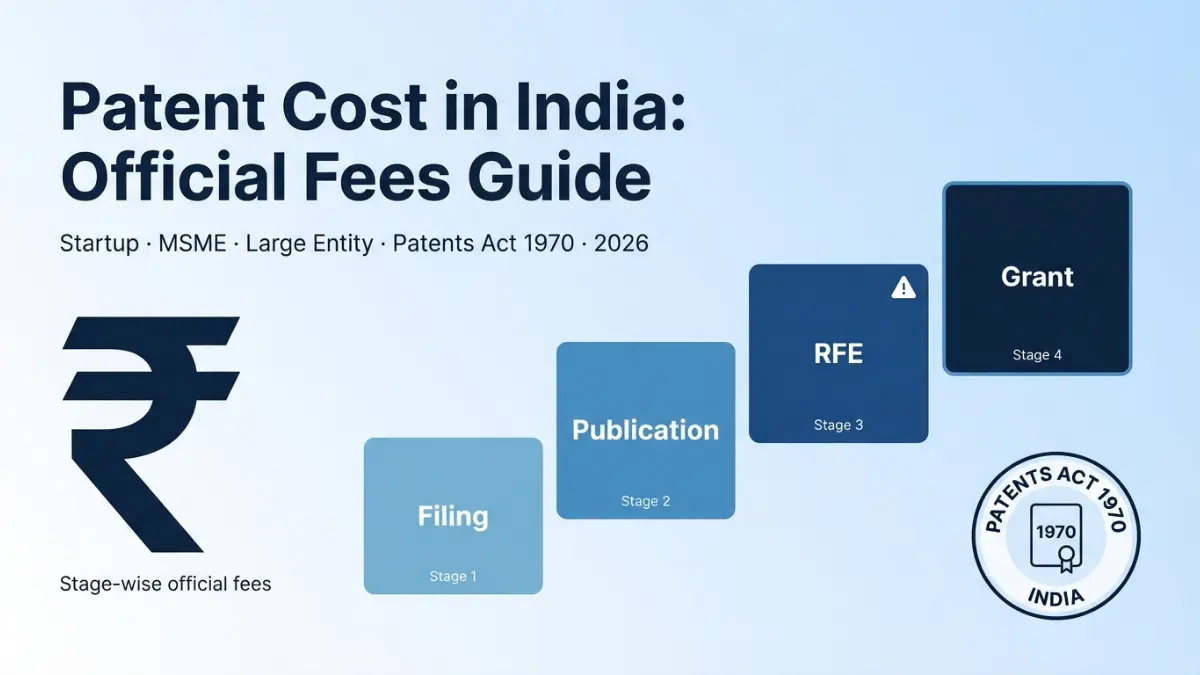
Government fees become payable at different procedural milestones, including early publication if requested, filing the Request for Examination (RFE), amendments during prosecution, divisional applications where required, and annual renewal fees from the 3rd year onward. Because of this stage-wise structure, patent cost in India does not operate as a single upfront payment.
Under the Indian patent framework, total statutory cost is influenced primarily by:
- Applicant category declared at filing
- Length of the specification and number of claims beyond statutory limits
- Whether ordinary or expedited examination is chosen
As a result, two applicants filing similar inventions can incur different total statutory costs depending on drafting approach, filing category, examination timing, and overall prosecution strategy.
A structured understanding of when each fee becomes payable enables realistic budgeting, smoother compliance management, and stronger long-term portfolio planning. Patent cost planning is therefore an integral part of patent strategy, not merely a financial calculation.
This guide explains the official statutory fees prescribed by the Indian Patent Office, clarifies when they arise, and outlines the practical factors that influence overall cost exposure across the patent lifecycle.
What Determines the Cost of a Patent in India
Patent costs in India do not follow a flat-fee structure. The total statutory cost depends on specific filing and procedural variables. Understanding these factors early allows applicants to estimate realistic budgets.
1. Applicant Category
Patent fees vary based on the applicant’s legal status under the Indian patent framework. The recognized categories include:
- Natural person (individual inventor)
- Startup
- MSME or educational institution
- Large entity
Each category attracts a different official fee scale. Individuals, startups, MSMEs, and educational institutions are eligible for reduced statutory fees, while large entities pay higher fees.
To claim startup or MSME benefits, Form-28 must be filed with supporting documents establishing eligibility. In joint filings involving both an individual and a company, the application is treated as a large-entity filing for fee purposes.
Applicant category affects filing, examination, amendment, and renewal fees throughout the patent lifecycle.
2. Length of Specification and Number of Claims
The Indian Patent Office permits up to 30 pages of specification and up to 10 claims without additional statutory charges.
Pages and claims beyond these limits attract per-unit government fees. For complex or technology-intensive inventions with detailed disclosures or multiple claim sets, excess page and claim fees can significantly increase total filing cost.
A focused drafting approach, supported by prior patent search where appropriate, helps define relevant claim scope and reduce unnecessary excess claim fees.
3. Speed of Patent Prosecution
Applicants can choose between ordinary examination and expedited examination. Expedited examination carries a higher statutory fee but reduces examination timelines.
Applicants may also request early publication instead of waiting for automatic publication after 18 months from the filing or priority date. Early publication involves a prescribed government fee.
Each acceleration option increases upfront statutory expenditure and should be evaluated against commercial timelines and enforcement objectives.
For procedural details, see:
4. Post-Filing Actions During Prosecution
After filing, additional statutory fees may arise during prosecution. These may include:
- Amendments to claims or specifications
- Divisional applications
- Certain procedural updates
While individual amendment fees are modest, multiple prosecution stages can increase total official cost over time.
Budget planning should therefore consider potential post-filing actions in addition to filing and examination fees.
Patent Fees in India – Statutory Fee Table (Official Fees Only)
The table below summarises the official government fees payable to the Indian Patent Office at different stages of the patent process. The amounts vary based on applicant category and procedural step.
| Sl. No. | On What Payable | Natural Person / Startup / MSME / Educational Institution (₹) | Large Entity (₹) |
|---|---|---|---|
| 1 | Application for Patent (Provisional or Complete) – Up to 30 Pages & 10 Claims | 1,600 | 8,000 |
| 2 | For each page in excess of 30 | 160 | 800 |
| 3 | For each claim in excess of 10 | 320 | 1,600 |
| 4 | Statement and Undertaking (Form-3) | No fee | No fee |
| 5 | Declaration of Inventorship (Form-5) | No fee | No fee |
| 6 | Request for Early Publication (Form-9) | 2,500 | 12,500 |
| 7 | Request for Ordinary Examination (RFE) (Form-18) | 4,000 | 20,000 |
| 8 | Request for Expedited Examination (Form-18A) | 8,000 | 60,000 |
| 9 | Amendment (before grant) | 800 | 4,000 |
| 10 | Amendment of Address or Procedural Update | 320 | 1,600 |
Important Notes on the Fee Table
The amounts above represent statutory government charges payable to the Indian Patent Office. These figures do not include professional drafting, prosecution, advisory, or representation fees.
Reduced fee eligibility for startups and MSMEs requires timely filing of Form-28 with valid supporting documents. If Form-28 is not filed or is defective, the application is treated as a large-entity filing and the higher fee category applies.
In joint filings involving both an individual and a company, the application is treated as a large-entity filing for fee purposes.
Excess page and excess claim fees apply only when the specification exceeds 30 pages or 10 claims.
Official fee schedules may be revised periodically by the Patent Office. The applicable fee structure should therefore be verified at the time of filing. The latest official fee schedule is available on the website of the Indian Patent Office.
Examination timelines depend on the applicable RFE deadline, which is 31 months or 48 months depending on the filing date.
For applicants who wish to estimate statutory fees dynamically based on pages, claims, and applicant category, a Patent Fees Calculator can be used for preliminary budgeting and stage-wise cost planning.
Realistic Budget Scenarios – What Applicants Typically Spend
The examples below illustrate approximate statutory government expenditure under common filing situations. These totals exclude professional drafting, prosecution, and renewal fees.
Scenario 1: Individual Applicant – Standard Filing
A student inventor filing a patent application within the standard page and claim limits, without acceleration or early publication, typically incurs the following statutory costs:
- 25-page specification
- 8 claims
- Ordinary examination
- No early publication
Estimated statutory total: ₹5,600
(Filing 1,600 + RFE 4,000)
This reflects the minimum typical government spend for a straightforward filing.
Scenario 2: Startup – Detailed Specification with Acceleration
A startup filing a technically detailed application with additional claims and opting for faster prosecution will incur higher statutory fees due to excess pages and expedited processing:
- 45-page specification
- 18 claims
- Early publication requested
- Expedited examination
Estimated statutory total: ₹17,060
Breakdown:
Filing 1,600
Excess pages 2,400
Excess claims 2,560
Early publication 2,500
Expedited examination 8,000
Acceleration and expanded claim scope increase upfront statutory expenditure.
Scenario 3: Large Entity – Moderate Excess Claims
A large entity filing a moderately detailed application with some excess pages and claims, under the ordinary examination route, typically incurs:
- 35-page specification
- 12 claims
- Ordinary examination
- No early publication
Estimated statutory total: ₹35,200
Breakdown:
Filing 8,000
Excess pages 4,000
Excess claims 3,200
RFE 20,000
Large-entity classification significantly increases statutory outlay even without acceleration.
Hidden and Long-Term Patent Costs Applicants Often Miss
While filing and examination fees are predictable, additional statutory costs may arise during prosecution and later stages of the patent lifecycle. These are often underestimated during initial budgeting.
1. Multiple Examination Rounds and Amendments
Many patent applications require more than one response to the First Examination Report. Each amendment filed before grant attracts a prescribed statutory fee.
Although individual amendment fees are modest, multiple rounds of amendments or post-hearing submissions can gradually increase total official expenditure.
2. Divisional Patent Applications
If the Patent Office raises a lack of unity objection, protection may need to be pursued through one or more divisional applications.
Each divisional is treated as a separate patent application and attracts its own filing, publication, and examination fees. Where multiple inventive concepts are disclosed, total statutory cost can increase significantly.
3. Patent Renewal (Maintenance) Fees
Renewal fees become payable from the third year onward and continue annually for as long as the patent remains in force. The renewal amount increases progressively across the twenty-year patent term, and failure to pay the prescribed fee results in lapse of rights.
Because renewal obligations extend well beyond the filing stage, long-term budgeting should account for the full lifecycle cost of maintaining protection. Applicants can estimate future renewal commitments using a Patent Renewal Fees Calculator, while a detailed explanation of timelines, payment stages, and consequences of non-payment is available in our guide on Patent Renewal in India.
4. Acceleration and Strategy-Driven Cost Increases
Choosing early publication, expedited examination, or filing broader claim sets at the outset can increase upfront statutory expenditure.
These decisions may be commercially justified, but they directly influence overall cost exposure.
Planning Patent Costs Strategically in India
Patent costs in India arise in stages rather than as a single upfront payment. While the initial filing fee is relatively modest, total statutory expenditure depends on applicant category, specification length, claim count, examination route, and post-filing actions during prosecution.
Recent amendments to the Patents Rules, including the reduction of the Request for Examination deadline to thirty-one months for newer filings, make timely cost planning more critical than ever. Missing a fee-linked deadline can result in deemed abandonment of the application, with no restoration available in certain cases.
Cost escalation often arises from avoidable excess claim drafting, delayed examination decisions, or reactive amendments during prosecution. Early claim planning supported by structured prior-art assessment, and disciplined prosecution management, can help control statutory exposure from the outset.
A realistic patent budget therefore considers filing, examination, potential amendments, divisional filings, and long-term renewal obligations as part of a single lifecycle framework. Clear stage-wise planning supports better predictability, stronger portfolio management, and alignment between protection strategy and commercial objectives.
Get a Professional Patent Cost Estimate
Get a clear, stage-wise patent cost estimate based on your invention, applicant category, and filing strategy so you can plan budgets and timelines with confidence.
FAQs on Patent Fees and Cost in India
1. What is the minimum official cost to file a patent in India?
The minimum statutory filing fee for a patent application in India is ₹1,600 for individuals, startups, MSMEs, and educational institutions, provided the application contains up to 30 pages and 10 claims. For large entities, the official filing fee is ₹8,000 under the same limits.
2. Does the patent filing fee include examination and publication costs?
No. The filing fee covers only submission of the patent application. Separate statutory fees are payable for early publication (if requested) and for filing the Request for Examination (RFE), which is mandatory for the application to proceed to substantive examination.
3. How do the number of claims and pages affect patent cost in India?
Patent applications exceeding 30 pages or 10 claims attract additional statutory fees per extra page and per extra claim. For inventions involving detailed disclosures or broader claim coverage, these excess fees can materially increase the total official patent cost.
4. Are patent fees lower for startups and MSMEs?
Yes. Individuals, startups, MSMEs, and educational institutions are eligible for reduced statutory patent fees. To claim this benefit, Form-28 must be filed with valid supporting documents. If eligibility is not properly established, the application is treated as a large-entity filing and higher fees apply.
5. Is the Request for Examination (RFE) mandatory, and does it affect patent cost?
Yes. Filing a Request for Examination is mandatory for all patent applications in India. The RFE attracts a separate statutory fee and must be filed within the prescribed deadline, which is 31 months for applications filed on or after 15 March 2024. Failure to file the RFE within the applicable timeline results in deemed abandonment of the application.
6. Are patent renewal fees included in the filing cost?
No. Patent renewal fees are separate from filing and examination costs. Renewal fees are payable annually from the 3rd year onward, whether the application is pending or granted. Failure to pay renewal fees within the prescribed period results in lapse of patent rights.
7. What is the total cost of obtaining a patent in India?
There is no single fixed total cost. The overall statutory expenditure depends on applicant category, specification length, number of claims, examination route, amendments during prosecution, and renewal duration. Applicants may use a Patent Fees Calculator for preliminary stage-wise budgeting.