




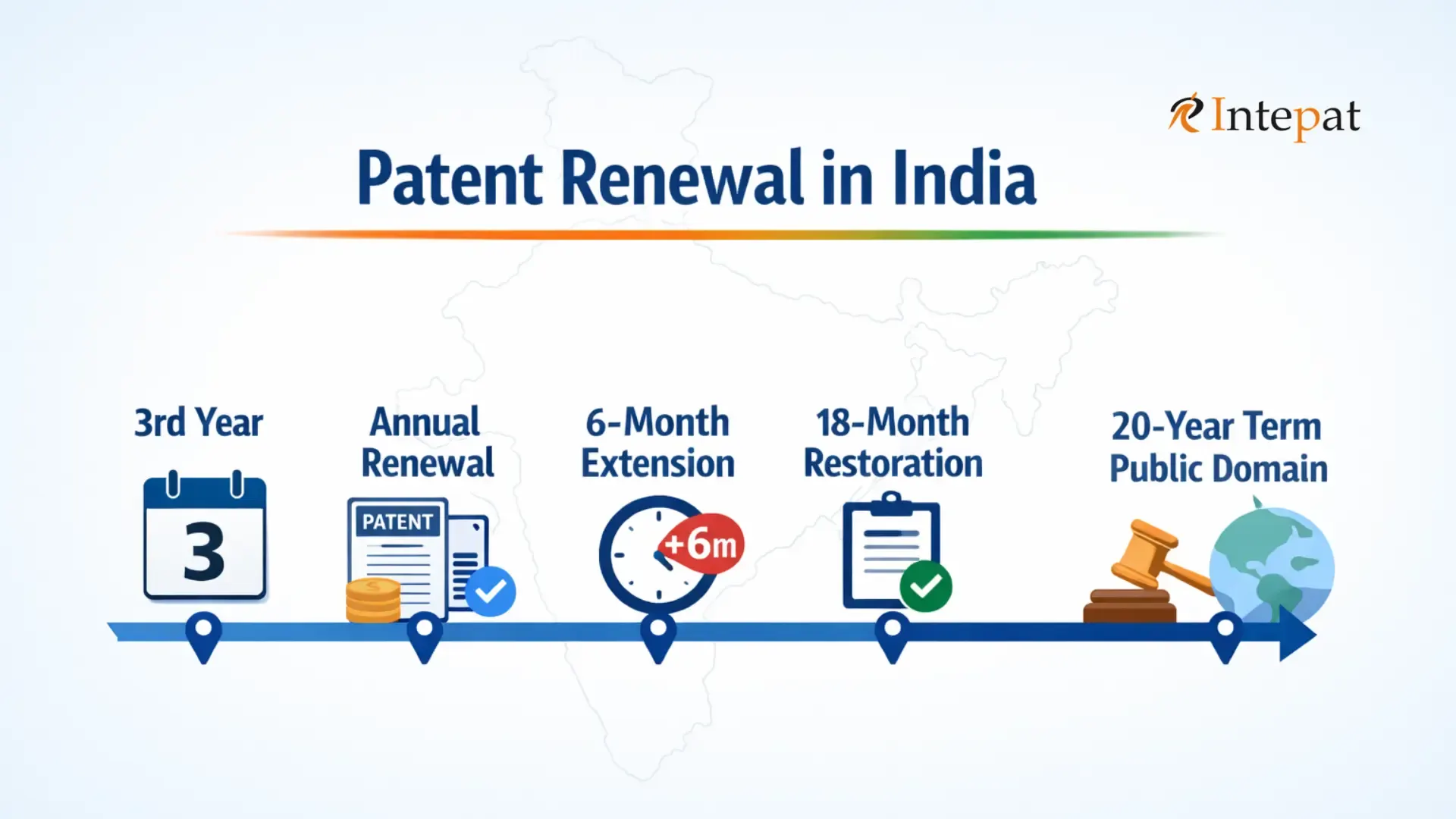
In India, a patent must be renewed every year from the 3rd year onwards to remain valid for up to 20 years from the filing date. If the renewal fee is not paid on time, a 6-month extension period is available on payment of late fees. If payment is not made even within this extended period, the patent lapses. Restoration may be possible within 18 months from the date of lapse, subject to statutory conditions.
Patent protection does not continue automatically after grant. The patent owner is responsible for paying annual renewal fees within the prescribed timeline. Confusion often arises around when the 3rd year begins, how renewal is calculated in PCT national phase cases, and what happens if a deadline is missed.
This guide explains the patent renewal process in India in clear and practical terms, covering timelines, fee structure, late payment rules, lapse consequences, and restoration options so that patent owners can maintain enforceable rights with confidence.
When Does Patent Renewal Start in India?
Patent renewal in India begins from the 3rd year counted from the filing date of the patent application. Renewal fees are not payable for the 1st and 2nd years. From the 3rd year onwards, the patent owner must ensure that renewal fees are paid annually to maintain the patent in force.
How the Due Date Is Calculated
The renewal fee for a particular patent year must be paid before the expiry of the immediately preceding year.
For example:
- The renewal fee for the 3rd year must be paid before the end of the 2nd year from the filing date.
- The renewal fee for the 5th year must be paid before the end of the 4th year.
The calculation is always linked to the filing date, not the grant date. This distinction is important because patents are often granted several years after filing.
What Is Considered the Filing Date?
For regular Indian patent applications, the relevant filing date is the date on which the application was filed before the Indian Patent Office.
In the case of PCT national phase applications filed in India, the renewal timeline is calculated from the international filing date, not from:
- the Indian national phase entry date
- the priority date
- or the grant date
Even if the application enters the Indian national phase later, the renewal obligation runs from the original international filing date. Misunderstanding this point is one of the most common causes of incorrect renewal calculations.
What If the Patent Is Granted Several Years Later?
In practice, a patent may be granted after multiple years of examination. When this happens, renewal fees that have already become due are reflected as pending in the official records. Those pending renewal fees generally need to be cleared within the prescribed period after grant to avoid lapse.
Because renewal is tied to the filing date and not the grant date, it is essential to verify the exact filing date and current status of the application from the official records. You can refer to our guide on how to track the status of an Indian patent for step-by-step instructions.
How Patent Renewal Fees Are Structured in India
Patent renewal fees in India increase progressively over the life of the patent. The fee structure is divided into slabs, with lower renewal fees in the early years and significantly higher fees in the later years of the 20-year term.
The renewal fee payable depends primarily on:
- The patent year
- The applicant’s entity classification
- The mode of filing
For renewal purposes, the government fee is the same for natural persons, startups, and small entities. A higher fee applies to large entities.
Fee Slabs Across the Patent Term
Broadly, renewal fees are structured as follows:
- Lower fees from the 3rd to 6th year
- Moderate increase from the 7th to 10th year
- Further increase from the 11th to 15th year
- Highest slab from the 16th to 20th year
This progressive structure reflects the assumption that patents maintained beyond 10 or 15 years are likely to have continuing commercial value.
Electronic Filing vs Physical Filing
Renewal fees are lower when submitted through electronic filing. Physical filing is generally 10 percent higher than the corresponding electronic filing fee under the Patent Rules.
Calculating the Exact Renewal Amount
Because renewal fees vary based on year and entity type, manual calculation can sometimes lead to errors, especially in PCT national phase cases or where the patent was granted several years after filing.
To determine the exact renewal amount payable for a specific year, you can estimate your renewal fees using our interactive tool.
Late Renewal and the 6-Month Extension Period
If a patent renewal fee is not paid by the prescribed due date, the patent does not lapse immediately. Indian patent law provides a 6-month extension period during which the renewal fee can still be paid along with the prescribed late fee.
The late fee is calculated on a monthly basis. Even a short delay can attract a full month’s late fee. For this reason, the extension period should be treated as a safeguard rather than a routine payment window.
How the Extension Period Works
- The 6-month period begins immediately after the original due date.
- Renewal can be completed at any time within this window, subject to payment of the applicable late fee.
- Once payment is made within the extension period, the patent continues without interruption.
However, if the renewal fee is not paid even within the 6-month extension period, the patent lapses.
Why Timely Renewal Matters
A lapsed patent ceases to have legal effect. The patent holder can no longer enforce exclusive rights or prevent third parties from using the invention. Although restoration may be possible in certain cases, it is not automatic and involves additional procedural steps and costs.
For these reasons, it is advisable to monitor renewal deadlines carefully and avoid relying on the extension period as a regular practice.
Restoration of a Lapsed Patent in India
If renewal fees are not paid even within the 6-month extension period, the patent ceases to have effect. In practice, the Patent Office records the cessation date as the renewal due date where renewal fees remain unpaid.
An application for restoration may be filed within 18 months from the date on which the patent ceased to have effect. Restoration is discretionary and requires the applicant to establish that the failure to pay renewal fees was unintentional.
Because restoration involves statutory scrutiny and procedural compliance, it should not be treated as a substitute for timely renewal.
For a detailed explanation of eligibility, timelines, and practical considerations, refer to our guide on Restoration of Lapsed Patents in India.
Conclusion
Patent renewal in India is a structured annual obligation linked to the filing date of the application. Renewal begins from the 3rd year and continues up to the 20-year term. Although a 6-month extension period is available for delayed payment, failure to comply within this window results in lapse, and restoration is subject to statutory conditions and approval.
Because renewal timelines differ for regular filings and PCT national phase applications, accurate calculation is essential. Errors in identifying the correct filing date, overlooking pending renewals after grant, or misclassifying the entity type can lead to avoidable loss of rights.
Periodic review of renewal deadlines and the commercial relevance of each patent helps ensure that valuable rights remain protected throughout their intended term.
Review Your Patent Renewal Timeline
If you are unsure about upcoming renewal deadlines, pending renewal payments, or entity classification, a brief professional review can help prevent avoidable lapse or compliance errors.
Frequently Asked Questions on Patent Renewal in India
1. When does patent renewal start in India?
Patent renewal in India becomes payable from the 3rd year counted from the filing date of the patent application. Renewal fees are not required for the 1st and 2nd years. From the 3rd year onwards, renewal must be paid annually to keep the patent in force.
2. Is patent renewal calculated from the filing date or the grant date?
Patent renewal is calculated from the filing date, not from the grant date. In the case of PCT national phase applications, the relevant filing date for renewal purposes is the international filing date.
3. What happens if the renewal fee is not paid on time?
If the renewal fee is not paid by the due date, a 6-month extension period is available upon payment of late fees. If payment is not made even within this extension period, the patent lapses and ceases to have legal effect.
4. Can a CEASED patent be restored in India?
Yes, a lapsed patent can be restored by filing an application within 18 months from the date of cease, subject to statutory conditions. Restoration is not automatic and requires justification for the failure to pay the renewal fee.
5. Are renewal fees the same for individuals and companies?
Renewal fees are the same for natural persons, startups, and small entities. A higher renewal fee applies to large entities as prescribed under the Patent Rules.
6. Can patent renewal fees be paid in advance?
Yes, renewal fees can be paid in advance for multiple future years. This option is often used by patent owners who wish to reduce the risk of missing annual deadlines.
7. Does a patent automatically lapse after 20 years?
Yes. A patent in India has a maximum term of 20 years from the filing date. After the 20-year term expires, the patent automatically ceases and the invention enters the public domain.