




The SIPP scheme subsidised professional IP filing for startups from 2016 until its last notified term ended on 31 March 2026. DPIIT-recognised startups could have a registered facilitator handle their patent, trademark, or design application without paying professional fees. This article covers the scheme’s current status, who qualified, and what IP fee benefits remain for startups in India today.
QUICK ANSWER
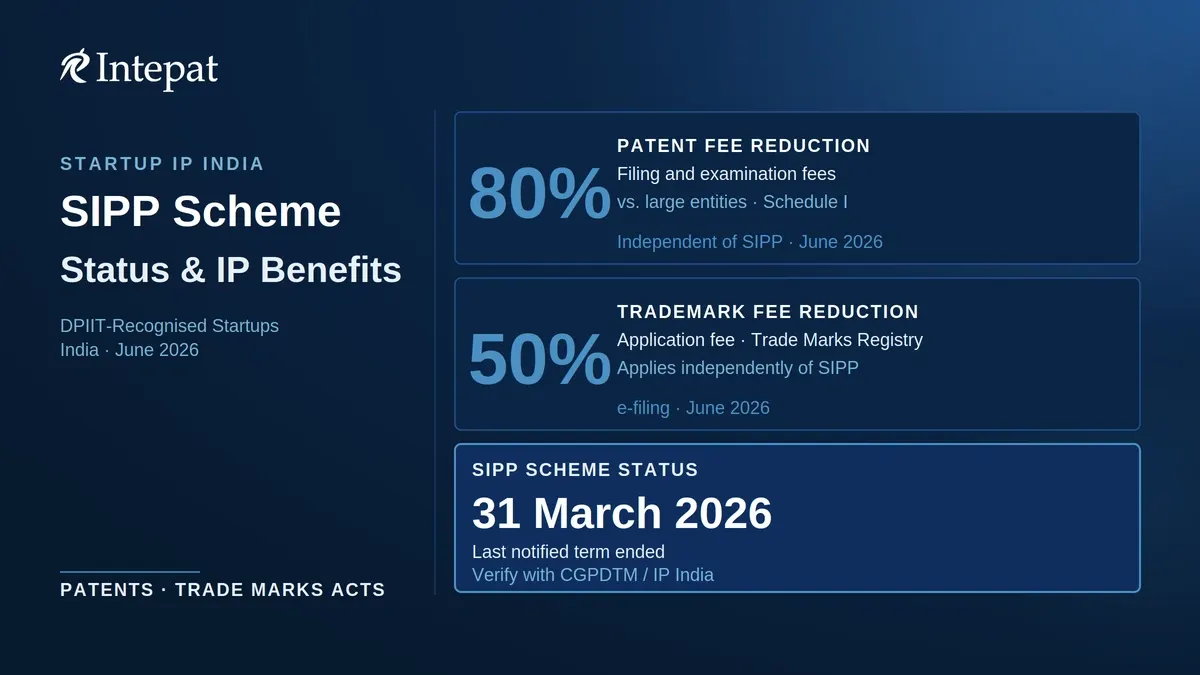
Last notified SIPP extension: 1 April 2023 to 31 March 2026.
Current status: IP India SIPP page shows no extension. Startup India June 2026 Schemes Playbook still lists SIPP. Verify directly with CGPDTM before relying on scheme availability.
Continuing benefits: Lower Patent Office fees and 50% lower trademark application fee continue independently of SIPP. Expedited examination (Form 18A, Rule 24C) remains available.
Scope: India. Patents Act, 1970. Trade Marks Act, 1999. Designs Act, 2000.
Founder Decision Table
Before reading further, here is the current position for founders making IP filing decisions.
| Founder question | Current position |
| Can I still file under SIPP? | Last notified term ended 31 March 2026. Verify current acceptance of fresh claims with CGPDTM or IP India. |
| Do startups still get government fee benefits? | Yes. Lower Patent Office fees and a 50% lower trademark application fee continue independently of SIPP. |
| Does the government pay my IP practitioner now? | Not safe to assume. Confirm current SIPP facilitator reimbursement availability before relying on it. |
| What should I budget for? | Statutory fees (at the lower startup rate) plus professional fees, unless a verified active subsidy applies. |
Is the SIPP Scheme Still Active?
The last notified SIPP extension ran from 1 April 2023 to 31 March 2026. The IP India SIPP page does not show a further extension notification. The Chambers & Partners analysis published 3 June 2026 noted that as of May 2026 no official announcement of an extension, renewal, or replacement had been made.
At the same time, the Startup India Schemes Playbook dated June 2026, published by DPIIT, includes SIPP in its list of current startup-specific schemes and refers applicants to the CGPDTM. That Playbook carries its own disclaimer noting that schemes “may not be active or open for applications at a particular point in time” and directing readers to verify with the implementing agency.
The position as of June 2026 is therefore: the last notified SIPP term has ended, no extension notification is visible on the IP India SIPP page, but the current status of fresh facilitator reimbursement claims has not been officially confirmed as closed by CGPDTM. Startups should contact the CGPDTM or check the IP India SIPP page directly before assuming the scheme is either active or definitively closed.
What Was the SIPP Scheme?
The Scheme for Facilitating Startups Intellectual Property Protection, referred to as SIPP, was administered by the Office of the Controller General of Patents, Designs and Trade Marks (CGPDTM) under DPIIT. It launched in January 2016 as part of the Startup India Action Plan.
The scheme addressed a specific cost problem: engaging a qualified IP practitioner to draft and prosecute a patent, trademark, or design application can run to tens of thousands of rupees, which places professional IP filing out of reach for many early-stage founders. SIPP solved this by empanelling registered IP professionals as facilitators and paying their fees from government funds. The startup paid only the mandatory statutory fees to the relevant IP office; the facilitator’s professional charges were reimbursed by the government through the CGPDTM.
A facilitator was an IP professional empanelled by the CGPDTM. The startup worked with the facilitator, but the professional fee was paid by the government through the CGPDTM, not by the startup.
How the Scheme Ran Over Time
SIPP began as a one-year pilot from January 2016. It was then extended:
- From 1 April 2017 to 31 March 2020 (first three-year extension).
- From 1 April 2020 to 31 March 2023 (second three-year extension, during which usage grew significantly: by October 2022, more than 7,400 patent applications and 28,700 trademark applications had been processed under the scheme, per the Ministry’s PIB press release dated October 2022).
- From 1 April 2023 to 31 March 2026 (third three-year extension, the most inclusive version).
The 2023-2026 version was the broadest in scope. Eligibility was extended beyond DPIIT-recognised startups to include individual innovators accessing IP filing through Technology and Innovation Support Centres (TISCs), eligible educational institutions under the Patents Rules, 2003, and Indian applicants filing international patent applications under the Patent Cooperation Treaty (PCT) where India served as the International Searching Authority. Facilitator remuneration was also increased during this period. The requirement for Inter-Ministerial Board certification was removed, making access simpler.
Who Qualified for SIPP?
To use the scheme, an entity needed to be recognised as a startup by DPIIT under the Startup India framework. The 2023 SIPP scheme referred to startups recognised under DPIIT’s recognition notification “as may be amended from time to time.”
DPIIT issued Gazette Notification G.S.R. 108(E) on 4 February 2026, approximately seven weeks before the last notified SIPP term ended on 31 March 2026. That notification updated the recognition thresholds. Under the current DPIIT recognition framework (G.S.R. 108(E) dated 4 February 2026), the thresholds for a standard startup are:
- Incorporated or registered in India as a Private Limited Company, Limited Liability Partnership, Partnership Firm, or Cooperative Society.
- Not more than ten years from the date of incorporation.
- Annual turnover not exceeding Rs 200 crore in any financial year since incorporation.
- Working towards innovation, development, or improvement of products, processes, or services, or operating a scalable business model with high potential for employment generation or wealth creation.
- Not formed by splitting up or reconstruction of an existing business.
For deep tech startups, a category introduced by the 2026 notification, the recognition period is extended to twenty years and the turnover limit is raised to Rs 300 crore.
Prior to the 2026 notification, the recognition framework under G.S.R. 127(E) dated 19 February 2019 set the turnover threshold at Rs 100 crore. Because the 2023 SIPP scheme applied to startups recognised under the framework “as may be amended from time to time,” the updated 2026 thresholds applied during the final weeks of SIPP’s notified term.
Beyond DPIIT recognition, SIPP in its final version also required that the startup had not received similar benefits from any other government scheme to pay for facilitator fees for the same application.
What Did a SIPP Facilitator Do?
Facilitators were IP professionals empanelled by the CGPDTM. They were not permitted to charge the startup directly; all remuneration came through the CGPDTM. The functions assigned to facilitators covered the full lifecycle of an IP application:
- General advisory on intellectual property rights, provided on a pro bono basis.
- Information on protecting and promoting IP in other countries, also on a pro bono basis.
- Preparation and filing of patent, trademark, and design applications at the relevant national IP office.
- Drafting of provisional and complete patent specifications.
- Preparation of responses to examination reports and replies to queries and notices from the IP office.
- Representation at hearings scheduled by the IP office.
- Contesting oppositions filed by third parties, where applicable.
- Ensuring final disposal of the IP application.
The facilitator claimed fees from the relevant IP office at each stage of work completed. If an application was withdrawn or abandoned before final disposal, the facilitator was entitled to the filing-stage fee only, not the disposal-stage fee.
Who Could Be a Facilitator?
The CGPDTM empanelled the following categories as facilitators:
- Patent agents registered with the CGPDTM.
- Trademark agents registered with the CGPDTM.
- Advocates entitled to practice law under the Advocates Act, 1961, as per the rules of the Bar Council of India, who were actively involved in filing and disposal of IP applications.
- Government departments, organisations, agencies, and Central Public Sector Undertakings, such as TIFAC, NRDC, BIRAC, MeitY, and CSIR, through an authorised representative.
Not every registered patent or trademark agent was automatically a facilitator. Only those specifically empanelled by the CGPDTM appeared on the official list.
What IP Could Be Filed Under SIPP?
Patents. The startup selected a patent facilitator from the CGPDTM’s empanelled list. The facilitator assessed patentability under the Patents Act, 1970, then prepared and filed the application at the appropriate patent office.
Trademarks. Trademark applications were filed by empanelled trademark facilitators under the Trade Marks Act, 1999. The facilitator handled the application, examination report response, and prosecution through to final disposal.
Designs. Design applications were filed through empanelled facilitators following the Designs Act, 2000, and associated rules.
In each category, the startup bore the statutory fees payable to the IP office. Only the facilitator’s professional charges were covered by the government.
What IP Fee Benefits Still Exist for Startups?
The statutory fee reductions that benefit DPIIT-recognised startups are independent of SIPP and remain in force regardless of the scheme’s status (verified as of June 2026).
Patent Filing Fee Reduction
DPIIT-recognised startups fall within the lower Patent Office fee category under the First Schedule of the Patents Rules, 2003. Individual fees vary across different patent-related forms, so founders should check the current Schedule I fee table. The three most commonly used fees are set out below.
| Form / Fee | Startup (Rs) | Large entity (Rs) | Ratio |
| Form 1 — Patent application (e-filed) | 1,600 | 8,000 | 1:5 |
| Form 18 — Ordinary examination (Rule 24B) | 4,000 | 20,000 | 1:5 |
| Form 18A — Expedited examination (Rule 24C) | 8,000 | 60,000 | 1:7.5 |
Source: First Schedule, Patents Rules, 2003. Verified June 2026.
Trademark Filing Fee Reduction
DPIIT-recognised startups are eligible for a 50% reduction on trademark application fees at the Trade Marks Registry. The startup pays half the standard e-filing fee per application.
Expedited Patent Examination
Startups may file a request for expedited examination in Form 18A under Rule 24C of the Patents Rules, 2003, on the ground that the applicant is a startup. The expedited examination fee is Rs 8,000 for a startup applicant (versus Rs 60,000 for large entities). Applicants must provide evidence of DPIIT recognition when filing Form 18A.
Technology and Innovation Support Centres (TISCs)
TISCs, developed in collaboration with the World Intellectual Property Organization (WIPO), continue to offer prior art searches, IP guidance, and advisory services. Individual innovators and startups can access TISC services independently of the SIPP scheme.
State-Level IP Assistance
Several Indian states maintain their own startup-focused IP support programmes, which may include reimbursements, grants, or advisory services. Eligibility and benefit amounts vary by state. Founders should check the current position with their state’s startup or industry department.
What Startup Founders Should Do Before Filing IP Now
The most significant practical change, if SIPP is no longer accepting fresh claims, is the return of professional fee costs as a direct startup expense. If that is no longer available for new filings, founders need to plan accordingly.
For startups at an early stage, the practical steps are:
- Verify SIPP status directly with the CGPDTM or the IP India SIPP page before assuming the scheme is closed.
- If no current facilitation subsidy is available, engage a registered patent agent or trademark attorney and budget for professional fees in addition to the reduced government fees.
- Approach a TISC for prior art search and basic advisory support before committing to a full filing.
- For PCT filings and international coverage, note that the 2023-2026 SIPP version covered certain PCT applications; verify whether that support continues before planning international filings.
- Startups that initiated applications under SIPP before 31 March 2026 should confirm the status of government reimbursement for pending prosecution work directly with their facilitator and the relevant IP office.
File before disclosing. Under Indian law, public disclosure before filing can affect the patentability of an invention. The grace period provisions in the Patents Act are narrow. The general principle is to file before pitching to investors, presenting at conferences, or publishing.
Trademark registration protects brand investment. A startup building on a brand name should consider trademark registration early. Registration gives the owner exclusive rights to the mark in the relevant classes.
Design registration is often overlooked. If the startup’s product has a distinctive visual appearance, a design registration under the Designs Act, 2000, provides time-limited protection against copying of the visual features.
Frequently Asked Questions
The last notified SIPP term ended on 31 March 2026. The IP India SIPP page does not show a further extension notification, but the Startup India June 2026 Schemes Playbook still lists SIPP and directs applicants to the CGPDTM. Startups should verify directly with the CGPDTM whether fresh facilitator reimbursement claims are currently being accepted before relying on scheme availability.
DPIIT-recognised startups continue to benefit from lower Patent Office fees and a 50% reduction on trademark application fees, independently of SIPP. For the ordinary patent filing fee and ordinary examination request, startups pay one-fifth of the large-entity rate. Expedited examination under Rule 24C is also available on Form 18A at the startup fee rate.
Under DPIIT Gazette Notification G.S.R. 108(E) dated 4 February 2026, a startup is an entity incorporated in India, not more than ten years from incorporation, with annual turnover under Rs 200 crore in any financial year, working towards innovation or a scalable business model. Deep tech startups may qualify for twenty years and a Rs 300 crore turnover limit.
SIPP covered only the facilitator’s professional charges. The statutory fees payable to the IP office, including the filing fee and examination request fee, were borne by the startup. The lower Patent Office fee category and 50% trademark fee reduction apply to those statutory fees separately and independently of SIPP.
SIPP covered patents, trademarks, and designs filed at the national IP offices under the CGPDTM. In each case the startup paid only the statutory government fees; the facilitator’s professional charges were reimbursed by the government. The 2023-2026 version also extended support to certain PCT international patent applications where India served as the International Searching Authority.
The Electronic Register of Patent Agents is publicly accessible at iprsearch.ipindia.gov.in/AgentRegister and lists registered patent agents by name and location. Trademark agents are searchable through the Trade Marks Registry portal. Startups should verify the agent’s registration number and experience in the relevant technology field before engaging.
No. The scheme documents are explicit that the facilitator and the government have no claim on the intellectual property of the startup. The government’s role was limited to reimbursing the facilitator’s professional charges. Full ownership of any patent, trademark, or design filed under SIPP rests with the startup.
Disclaimer: This article describes the SIPP scheme and the current Indian IP support framework for startups as at June 2026 and is for general information only. It is not legal advice. Government schemes, fees, and procedures change; confirm the current position with the CGPDTM or IP India before acting. For advice on your specific situation, consult a registered