




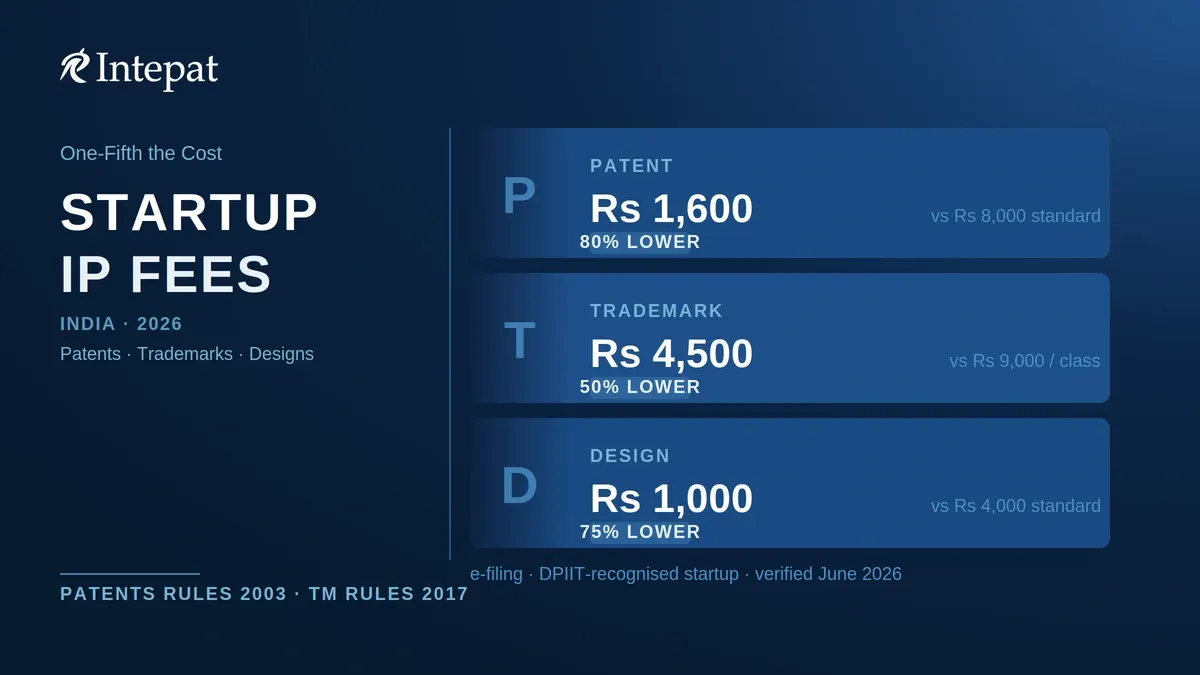
A DPIIT-recognised startup in India pays Rs 1,600 to file a patent application and Rs 4,500 per trademark class on e-filing: statutory rates in the Patents Rules 2003 and Trade Marks Rules 2017. Understanding those figures, and the IP assets most likely to generate a return, is the first practical financial decision a founder faces. Scope: India only.
Note on fees in this article
The figures below are the official IP filing fees payable to the Patent Office and Trade Marks Registry. Professional fees for drafting, searching, filing, prosecution responses, and hearings are separate and depend on the type of filing and the work involved. This article covers statutory fees only, not the full service cost. Until 31 March 2026, the SIPP scheme covered professional fees for eligible startups; that scheme has now expired.
Quick Answer
– A DPIIT-recognised startup pays one-fifth of the standard patent filing fee and half the standard trademark filing fee. For patent filings, startup status is supported by filing Form 28 (the startup status declaration form). For trademark filings, the startup rate is claimed through the applicant-category field in Form TM-A (the standard trademark application form); Form 28 does not apply to trademark filings.
– Expedited patent examination (a faster examination track) under Rule 24C of the Patents Rules 2003 is available to startups as a statutory right, filed on Form 18A by e-filing only.
– The SIPP professional-fee-reimbursement scheme expired on 31 March 2026. The statutory fee discounts in the Patents Rules and Trade Marks Rules remain in force independently of SIPP.
What DPIIT Recognition Means for Your IP Filing Costs
The Patents Rules 2003 place natural persons, startups, small entities, and educational institutions in the lower fee column, with all other applicants in the higher column. The Trade Marks Rules 2017 use a similar structure, but the lower trademark-fee category covers individuals, startups, and small enterprises. For a DPIIT-recognised startup, the practical result is the same: materially lower statutory filing fees for core patent and trademark filings. DPIIT recognition is obtained through the Startup India portal (startupindia.gov.in) before filing.
For patent filings, every fee-bearing patent document must be accompanied by Form 28 (the startup status declaration form) to claim the startup rate. Form 28 carries no fee of its own. For trademark filings, no equivalent of Form 28 exists: the concessional rate is claimed by selecting the Individual/Startup/Small Enterprise applicant category in the TM-A or TM-M filing at the time of submission.
One practical protection is built into the Patents Rules: if a startup loses that status during prosecution because the recognition period lapses or the turnover threshold is crossed, the difference in fees already paid is not recovered from the applicant. A filing made at startup rates retains those rates for its prosecution lifecycle.
Patent Fees a DPIIT-Recognised Startup Actually Pays
The startup patent filing fees below are drawn from the First Schedule of the Patents Rules 2003, e-filing column, and are verified as at June 2026.
| Step | Form | Startup (e-filing) | Other applicant (e-filing) |
| Patent application (up to 30 pages, 10 claims) | Form 1 | Rs 1,600 | Rs 8,000 |
| Each additional sheet over 30 | Form 1 | Rs 160 | Rs 800 |
| Each additional claim over 10 | Form 1 | Rs 320 | Rs 1,600 |
| Request for examination | Form 18 | Rs 4,000 | Rs 20,000 |
| Expedited examination | Form 18A | Rs 8,000 | Rs 60,000 |
Verified as at June 2026. For most forms, physical filing is permitted at approximately 10% higher rates. Form 18A (expedited examination) does not permit physical filing for any applicant category. Check the First Schedule of the Patents Rules 2003 for current figures before filing.
The application fee of Rs 1,600 is exactly one-fifth of the standard Rs 8,000 rate. A specification that exceeds 30 pages or 10 claims attracts per-unit surcharges that add up; the table above shows the startup and standard rates for each.
Expedited examination under Rule 24C of the Patents Rules 2003 is one of the more significant practical advantages available to recognised startups. Startup status is an express eligible ground under Rule 24C(1), and the request must be filed on Form 18A by e-filing only; physical filing of Form 18A is not permitted. Once the request is admitted, the examiner’s report is due within one month from the date of reference (not exceeding two months), and the Controller then acts on that report within one month. This is substantially faster than the ordinary examination queue. The startup-rate expedited examination fee of Rs 8,000 compares to Rs 60,000 for a large corporate applicant.
A further protection in Rule 24C applies specifically to startups and small entities: a request for expedited examination that has been filed is not called into question merely because the startup later ceases to hold that status during prosecution. For more detail on the overall patent filing process, see what a startup should know before filing a patent and the complete breakdown of patent fees and costs in India.
Trademark Fees and What the 50% Concession Covers
For trademark applications, the First Schedule of the Trade Marks Rules 2017 sets the fee for Form TM-A (the standard application form) at Rs 4,500 per class per mark on e-filing for individuals, startups, and small enterprises, against Rs 9,000 per class per mark for all other applicants. Physical filing costs Rs 5,000 and Rs 10,000 respectively.
Each class is a separate fee line. A startup filing a brand name in three classes pays Rs 13,500 on e-filing; a large company filing the same mark in the same three classes pays Rs 27,000. The concession is per-class and per-mark, so multi-class protection is proportionately discounted at every class.
For applicants who need faster resolution, the Trade Marks Rules 2017 also provide for expedited processing under Rule 34 using Form TM-M. The e-filing fee for individuals, startups, and small enterprises is Rs 20,000 per class per mark; for other applicants it is Rs 40,000. Physical filing of Form TM-M is not permitted for any applicant category.
The filing date is the point at which your priority in the mark is established. Under section 23 of the Trade Marks Act 1999, once registration is granted, the mark is registered as of the application date. The right to sue for trademark infringement, however, arises on registration, not on application: section 27(1) of the Act bars any infringement proceeding for an unregistered mark, and section 28(1) makes the exclusive right to bring an infringement action a consequence of registration. Before registration issues, the available remedy is passing off, which requires proving goodwill, misrepresentation, and damage; an early-stage startup with limited trading history is in a weaker position to make that case. Filing early fixes the priority date; registration converts that date into an enforceable right. For the full analysis of trademark registration strategy for startups, see trademark registration for startups in India.
Designs and Copyright: Smaller Concession, Still Relevant
Design filings are not outside the startup-fee framework. Under the Designs Rules 2001, the First Schedule sets the fee for a design application (Form 1) at Rs 1,000 for natural persons, startups, and small entities, against Rs 4,000 for other applicants. Startup status for a design filing is supported by Form 24, which carries no fee of its own. The absolute saving is Rs 3,000 per application, smaller in rupee terms than the patent and trademark concessions, but the concessional tier applies.
Copyright registration through the Copyright Office uses a fee structure based on the type of work and does not provide a startup-specific concession. Copyright also subsists automatically on creation of an original work, so registration is an evidential step rather than a rights-creation step.
The practical sequencing point for product and hardware startups is that a design application needs to be filed before the product is publicly shown or marketed; the cost of registration is lower at startup rates, and prior public disclosure can destroy registrability, subject only to narrow statutory exceptions such as convention priority or notified-exhibition provisions. For what each right covers and when each clock starts running, see intellectual property rights for startups in India.
The SIPP Scheme Ended: What That Means for a New Filing
The Scheme for Facilitating Startups Intellectual Property Protection (SIPP) was a DPIIT-administered programme under which eligible startups could access government-empanelled IP facilitators at no professional charge. The startup paid only the statutory filing fees; the facilitator’s fees were reimbursed directly by the government through the office of the Controller General of Patents, Designs and Trade Marks. The scheme covered patents, trademarks, and designs.
The notified version of the scheme ran for three years from 1 April 2023 and expired on 31 March 2026. As at June 2026, no official announcement of an extension, renewal, or replacement had been made. Startups that did not initiate a filing before that date cannot currently access the professional-fee benefit; verify current status with DPIIT or IP India before relying on it.
The statutory fee concessions in the Patents Rules and Trade Marks Rules are entirely separate from SIPP. Those rates sit in the fee schedules of the operative Rules and remain in force. A startup filing today pays the concessional statutory fees regardless of whether SIPP is active. For the full history of the scheme and what it covered, see the SIPP scheme article.
How IP Assets Affect Valuation and Investor Due Diligence
A filed patent application, a registered trademark, or a registered design is a documented intangible asset. At pre-Series A due diligence, institutional investors and acquirers review IP position as part of standard commercial review. The questions are practical: does the startup own what it says it owns, is the ownership chain documented, are key assets protected, and are there pending third-party claims or gaps in coverage that create uncertainty?
A pending patent application establishes a priority date but confers no granted exclusivity. A trademark registration converts brand goodwill into an enforceable statutory right; without registration, brand enforcement means arguing passing off, which requires proving goodwill through evidence of prior use.
The cost arithmetic is relevant here. A startup that files a patent application at Rs 1,600 and a trademark application at Rs 4,500 in the same quarter has spent Rs 6,100 in statutory fees to establish two documented IP positions before a first external pitch. The same two filings cost a large corporate Rs 17,000. The concessional rates exist precisely because the government recognises that early-stage IP investment is proportionately expensive relative to a startup’s resources, and that filing before disclosure is the filing that matters.
IP decisions made at the founding stage, before the first investor meeting, before the product launch, and before the brand name is used publicly, are the decisions that determine what a startup actually owns. For guidance on timing those decisions, see what is the right stage for filing a patent.
Frequently Asked Questions
A DPIIT-recognised startup pays Rs 1,600 to file a patent application on e-filing under the First Schedule of the Patents Rules 2003, compared to Rs 8,000 for other applicants. Additional fees apply for sheets over 30 (Rs 160 each) and claims over 10 (Rs 320 each). The request for examination costs Rs 4,000, and expedited examination under Rule 24C costs Rs 8,000.
Under the First Schedule of the Trade Marks Rules 2017, a startup, individual, or small enterprise pays Rs 4,500 per class per mark on e-filing for a standard TM-A application, against Rs 9,000 for other applicants. Each additional class is a separate fee at the same rate. Expedited processing under Rule 34 costs Rs 20,000 per class per mark for eligible applicants.
No separate discount application is required. For patent filings, the startup rate is claimed by filing Form 28 (the startup status declaration form) with the relevant fee-bearing patent document. For trademark filings, the applicant selects the Individual/Startup/Small Enterprise category in Form TM-A or TM-M at the time of filing. The startup must hold valid DPIIT recognition when claiming the concession.
Expedited examination is a procedure under Rule 24C of the Patents Rules 2003 that accelerates the examination timeline. Startup status is an express eligible ground under Rule 24C(1). The request is filed on Form 18A by e-filing only; physical filing is not permitted. The examiner’s report is due within one month of the reference date, not exceeding two months.
The most recent notified version of SIPP, which covered the professional fees of government-empanelled IP facilitators for eligible startups, expired on 31 March 2026. As at June 2026, no extension or replacement had been announced by DPIIT. Startups cannot currently access the professional-fee-reimbursement benefit for new filings. The statutory filing fee discounts, that is, the concessional rates in the Patents Rules, Trade Marks Rules, and Designs Rules, are separate from SIPP and remain in force independently of the scheme’s status.
Yes. The First Schedule of the Designs Rules 2001 sets the fee for a design application at Rs 1,000 for natural persons, startups, and small entities, against Rs 4,000 for other applicants. Startup status for a design filing is supported by Form 24, which carries no fee. The absolute saving of Rs 3,000 is smaller than the patent and trademark concessions in rupee terms, but the concessional tier applies across patents, trademarks, and designs.
DPIIT recognition is a certificate issued by the Department for Promotion of Industry and Internal Trade under the Startup India initiative. A startup that holds this recognition qualifies for the concessional fee column in the Patents Rules 2003 and Trade Marks Rules 2017. Recognition is applied for through the Startup India portal at startupindia.gov.in. Without it, the standard fee rates apply.
This article explains Indian IP law as at June 2026 and is for general information only. It is not legal advice. Fees, rules, and scheme status change over time; verify current figures against the operative Rules and official DPIIT communications before relying on them for a filing decision. For advice on your specific situation, consult a qualified IP practitioner.