




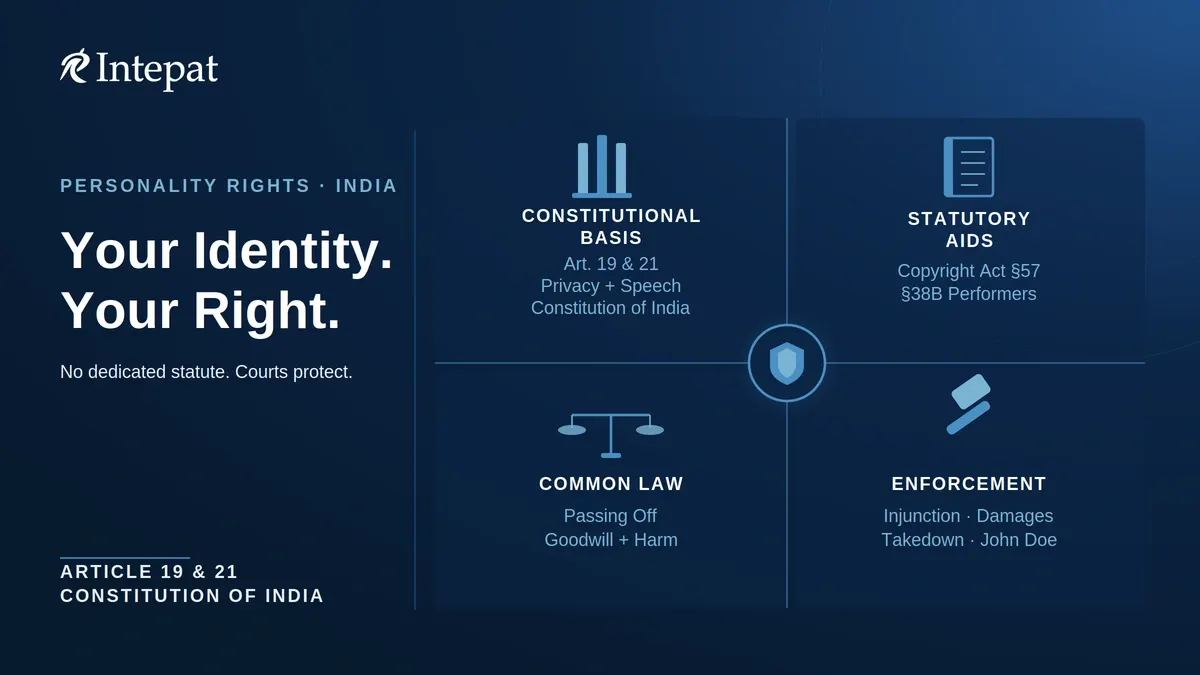
Personality rights in India protect a person’s ability to control the unauthorised commercial use of their name, image, voice, likeness, and other identity attributes. India does not have a standalone personality rights statute. Courts have developed protection by drawing from constitutional privacy principles, passing off, copyright provisions, and equitable remedies.
Quick Answer
• No dedicated personality rights statute exists in India. Protection flows from constitutional principles (Articles 19 and 21), IP statutes, and judicial precedent.
• Courts have protected names, images, voices, catchphrases, mannerisms, and AI-generated likenesses.
• Remedies include interim injunctions (including John Doe orders with liberty to implead newly discovered infringers), damages, and content takedown directions.
• Satire, parody, news reporting, and scholarship may be protected where the use is genuinely expressive and not a disguised commercial exploitation.
Do you have a personality rights issue? Consider four questions:
• Is the person clearly identifiable by name, image, voice, likeness, catchphrase, or style?
• Is the use commercial, promotional, misleading, or connected to fraud?
• Was consent or a licence obtained?
This article covers the legal position in India as at June 2026.
What Are Personality Rights?
Personality rights are the legal entitlements that allow a person to control the commercial use of attributes that make them identifiable. These attributes include a person’s name, photograph, voice, signature, mannerisms, catchphrases, and distinctive style.
The concept has two branches. The first is the right of privacy, which protects a person from unwanted intrusion into their personal life; for example, publication of private personal information without consent may raise privacy concerns. The second is the right of publicity, which protects the commercial value of a person’s identity and prevents others from using it for profit without consent; for example, a fake advertisement using a singer’s voice raises publicity concerns. Indian courts have treated the right of publicity as an extension of the right of privacy, grounding both in the constitutional guarantee of life and personal liberty.
The kinds of use that most commonly attract enforcement include fake endorsement advertisements, AI-generated voice clones used to promote products, merchandise bearing a person’s image without consent, and deepfake videos depicting a person in misleading or harmful contexts. By contrast, news coverage, fan tributes, and satire are treated differently, as discussed below.
While personality rights are most often invoked by celebrities, the principle is not inherently limited to film actors or singers. A claimant should ordinarily be able to show that they are identifiable, that their persona has acquired commercial value or goodwill, and that the unauthorised use causes or is likely to cause harm. In a May 2026 Delhi High Court order, entrepreneur Aman Gupta (co-founder of boAt and a public figure from Shark Tank India) secured an injunction against 44 defendants for misusing his name, image, and likeness through fake endorsements and AI-generated deepfakes, confirming that personality rights protection can extend to startup founders and business personalities.
How Indian Law Protects Personality Rights
India does not have a dedicated personality rights statute. Protection comes from multiple legal sources that together form a workable framework.
The Constitution. The right to privacy, recognised as implicit in Article 21 of the Constitution, forms the doctrinal foundation from which courts draw when fashioning relief in personality rights cases. The Supreme Court in K.S. Puttaswamy v. Union of India (2017), through a nine-judge bench, confirmed that privacy is a constitutionally protected right encompassing informational privacy, bodily autonomy, and the right to control one’s personal identity. Article 19(1)(a), which guarantees freedom of speech and expression, operates as the counterbalance, limiting personality rights where free speech interests apply. These constitutional provisions supply the reasoning courts use when granting relief; the cause of action itself typically proceeds through civil suit (passing off, copyright infringement, or the common law tort of misappropriation of personality).
The Copyright Act, 1957. The Copyright Act does not create a general personality right over a person’s name, face, or identity. However, it may assist authors and performers where the misuse involves a protected work or performance. Section 57 grants authors “special rights” (commonly called moral rights), including the right to claim authorship and the right to prevent distortion, mutilation, or modification of their work that would harm their honour or reputation. These rights survive even after the author assigns their copyright. Section 38B extends similar moral rights to performers, giving them the right to be identified as the performer and to prevent modifications of their performance that would be prejudicial to their reputation. These provisions may be relevant in cases involving manipulated performances, false attribution, or AI-based distortion of a performer’s voice or recorded performance.
The Trade Marks Act, 1999. Where a person’s name, likeness, or persona has acquired goodwill in connection with goods or services, the law of passing off (a legal claim requiring proof of goodwill, misrepresentation, and likely damage) provides a remedy. The Trade Marks Act expressly preserves the right to bring a passing off action, even when no trademark is registered. Courts have applied passing off principles where a celebrity’s image is used in advertising without consent in a way that misleads consumers into believing there is an endorsement, association, or commercial connection.
Common law and tort. Beyond statute, Indian courts have developed a body of case law recognising a common law tort of misappropriation of personality. Courts have drawn on English and American precedent, adapting these principles to Indian constitutional values.
Key Court Decisions on Personality Rights in India
Indian courts, particularly the Delhi High Court, have built the personality rights framework through a series of decisions spanning three decades.
R. Rajagopal v. State of Tamil Nadu (1994). The Supreme Court recognised the right to privacy as implicit in the constitutional guarantee of life and personal liberty. While the case involved press freedom and a prisoner’s autobiography, the court’s observations on the right to control personal information laid the groundwork for later personality rights claims.
ICC Development v. Arvee Enterprises (2003). The Delhi High Court, in what is widely considered the first express recognition of personality rights in India, held that the right of publicity has evolved from the right of privacy and can inhere only in an individual or in any indicia of an individual’s personality, including their name, personality trait, signature, and voice. The court held that any effort to take away publicity rights from individuals to a non-human entity would violate the constitutional guarantees under Articles 19 and 21.
Titan Industries v. Ramkumar Jewellers (2012). The Delhi High Court restrained a jeweller from using photographs of well-known actors without consent. The court defined the right of publicity as the right to control the commercial use of human identity and held that when a prominent person’s identity is exploited in advertising without their permission, the objection is not that no one should commercialise their identity, but that the right to control when, where, and how it is used should rest with that person.
Shivaji Rao Gaikwad v. Varsha Productions (2015). The Madras High Court stayed the release of the film “Main Hoon Rajnikanth” after the actor argued that the film copied his distinctive style and that certain objectionable content could tarnish his image.
K.S. Puttaswamy v. Union of India (2017). The nine-judge Supreme Court bench confirmed privacy as a fundamental right, significantly strengthening the constitutional basis for all subsequent personality rights claims.
Amitabh Bachchan v. Rajat Nagi (CS(COMM) 819/2022). The Delhi High Court issued a broad ex-parte injunction in the form of a John Doe order, restraining both named defendants and any future infringers from misusing the actor’s name (including variations such as “Bachchan,” “BigB,” and “AB”), voice, image, or any uniquely identifiable attribute. The case involved fake lottery scams using the actor’s association with a popular television show. For a detailed analysis, see our examination of publicity rights in the Amitabh Bachchan order.
Anil Kapoor v. Simply Life India (CS(COMM) 652/2023). The Delhi High Court expanded the scope of personality rights beyond physical likeness to include mannerisms, speaking style, gestures, dialogue delivery, and even signature catchphrases. The court granted an ex-parte injunction against AI-generated deepfake content and addressed, for the first time in significant detail, the risks posed by generative AI to personal identity.
Jackie Shroff v. The Peppy Store (CS(COMM) 384/2024). The Delhi High Court restrained commercial use of the actor’s name, voice, and image on e-commerce platforms and by AI chatbots. Notably, the court declined to grant relief against a YouTube creator whose “Thug Life” edit was found to be a tribute that embellished the actor’s existing public persona without introducing falsehoods, illustrating the court’s effort to balance personality rights with freedom of expression.
Arijit Singh v. Codible Ventures (2024 SCC OnLine Bom 2445). The Bombay High Court tackled AI voice cloning, where platforms were offering tools to replicate the singer’s distinctive voice. The court granted an injunction covering all media, including digital platforms and the metaverse, recognising that a performer’s voice is a protected personality attribute.
AI, Deepfakes, and New Threats to Identity
The rapid growth of generative AI has introduced threats to personal identity that did not exist even five years ago. AI tools can now clone a person’s voice, generate realistic video of a person saying things they never said, and create digital likenesses for use in advertising, merchandise, and entertainment, all without consent.
Indian courts have responded with notable speed. The Anil Kapoor order (2023) addressed AI-generated deepfakes directly, directing takedowns and restraining any use of the actor’s likeness through AI tools for commercial or any other purpose.
In 2024, the Bombay High Court in Arijit Singh v. Codible Ventures addressed AI voice cloning and granted an injunction covering all media including the metaverse. The WIPO Magazine has documented this case as a precedent for AI voice cloning disputes internationally.
The pace of judicial activity has only increased in 2025 and 2026. In Aishwarya Rai Bachchan v. Aishwaryaworld.com (CS(COMM) 956/2025), the Delhi High Court explicitly addressed misuse through AI, generative AI, machine learning, deepfakes, and face morphing, directing platform takedowns and URL blocking within 72 hours.
In Jubin Nautiyal v. Jammable Ltd. (CS(COMM) 166/2026), the Delhi High Court restrained AI voice models, synthesised voices, digital avatars, and deepfakes, covering online platforms, social media, and the metaverse. The Aman Gupta order (May 2026) extended similar protection to a startup founder, covering AI-generated deepfake content, fake endorsement advertisements, and impersonation bots.
The emerging position is that AI does not create a safe harbour for unauthorised identity exploitation. Courts have restrained unauthorised AI-generated likenesses, voice clones, deepfakes, fake endorsements, digital avatars, and persona-based commercial misuse. For content creators and brand owners, these decisions carry a practical message: if your voice, face, or persona is commercially recognisable, Indian intellectual property law provides a basis for action against AI-driven misuse, even in the absence of a specific deepfake statute.
When Free Speech Overrides Personality Rights
Personality rights are not absolute. Courts balance them against freedom of speech and expression under Article 19(1)(a) of the Constitution. The outcome of this balancing depends on the facts of each case.
News reporting, commentary, criticism, satire, parody, art, scholarship, and fan expression may be protected where the use is genuinely expressive and not misleading. However, courts are more likely to intervene where the use falsely suggests endorsement, is commercially exploitative, damages reputation, or crosses into fraud or deception.
The Delhi High Court articulated this balance in the Digital Collectibles v. Galactus Funware Technology case (2023), observing that use of celebrity names and images for lampooning, satire, parodies, art, scholarship, music, academics, and news would be permissible as facets of the right of free speech and expression, and would not amount to infringement of the right of publicity.
The Jackie Shroff decision (2024) applied this principle in practice. While the court restrained commercial exploitation, it specifically declined to restrain a YouTube creator whose “Thug Life” edit was found to be a tribute that embellished the actor’s existing public persona without falsehood.
The distinction that courts draw is between commercial exploitation (actionable) and expressive or informational use (generally permissible). Brand owners and content creators should understand that enforcing personality rights against every mention of their name or image is not what the law supports. Enforcement targets unauthorised commercial exploitation.
How to Protect and Enforce Your Personality Rights
Even without a dedicated personality rights statute, several practical steps can help protect your identity.
Register your trademarks. If your name, brand name, or logo functions as a source identifier for goods or services, registering it as a trademark strengthens your enforcement position significantly. A registered trademark provides statutory rights and simplifies infringement and passing off actions. For brand owners, a clearance search is an important first step before investing in a personal brand, and our trademark search guide covers the process.
Document your persona. Maintain records of how your identity attributes are used in commerce, including endorsement contracts, media appearances, and brand associations. These records establish the commercial value of your persona and support claims of goodwill in passing off actions.
Monitor for misuse. Regularly monitor online platforms, e-commerce sites, and social media for unauthorised use of your name, image, or voice. AI-generated content, fake endorsements, and unauthorised merchandise are the most common forms of personality rights violations today.
Act promptly. Courts have consistently granted interim relief, including ex-parte injunctions and takedown orders, where prompt action is taken. Delay can weaken your claim. The available remedies include civil suits for injunction and damages, content takedown requests to platforms, and, in cases involving fraud, criminal complaints.
Consider copyright registration. If you are a performer, author, or creator, registering your copyright provides an additional layer of protection. Moral rights under the Copyright Act protect against distortion and misattribution of your work or performance, and these rights remain with you even after you assign the economic rights.
Frequently Asked Questions
Personality rights are the legal entitlements that protect an individual’s name, image, voice, and other identity attributes from unauthorised commercial use. Indian courts have recognised these rights by drawing from the right to privacy under Article 21 of the Constitution, and have enforced them through passing off claims, copyright and performer-rights provisions, and common law remedies.
No. India does not have a dedicated personality rights statute. Protection is drawn from the Constitution (Articles 19 and 21), the Copyright Act 1957 (moral rights for authors and performers under Sections 57 and 38B), the Trade Marks Act 1999 (passing off), and judicial precedent developed primarily by the Delhi and Bombay High Courts.
Yes. Indian courts have granted injunctions against AI-generated deepfake content that uses a person’s likeness, voice, or persona without consent. Orders in the Anil Kapoor case (2023), the Arijit Singh case (2024), the Aishwarya Rai Bachchan case (CS(COMM) 956/2025), and the Jubin Nautiyal case (CS(COMM) 166/2026) have specifically addressed AI-driven violations and directed takedowns across digital platforms.
No. While most reported cases involve celebrities and public figures, the principle is not inherently limited to them. A claimant should ordinarily be able to show identifiability, goodwill or commercial value in the persona, unauthorised use, and harm or likely harm. In May 2026, startup founder Aman Gupta secured personality rights protection from the Delhi High Court, confirming that the protection can extend beyond traditional entertainment personalities.
Courts in India have granted interim injunctions (including John Doe orders with liberty to implead newly discovered infringers), permanent injunctions, damages, platform takedown directions, and orders to block infringing URLs. In cases involving fraud or deception, criminal remedies may also be available. Acting promptly strengthens the claim, as courts give significant weight to timely enforcement.
Courts balance personality rights against the freedom of speech and expression under Article 19(1)(a) of the Constitution. Uses such as news reporting, satire, parody, criticism, art, and scholarship may be protected where the use is genuinely expressive and not misleading. Courts are more likely to intervene where the use falsely suggests endorsement, is commercially exploitative, or crosses into fraud.
Disclaimer: This article explains the law on personality rights in India as at June 2026 and is for general information only. It is not legal advice. Personality rights law in India is largely judge-made and continues to evolve through court decisions. For advice on protecting your specific identity or brand, consult a qualified IP practitioner. Deadlines in enforcement proceedings are strict, and delay can weaken a claim. The positions described here are indicative and may change; do not rely on them for a specific enforcement action without confirming the current position and, where the stakes warrant it, taking professional advice.