




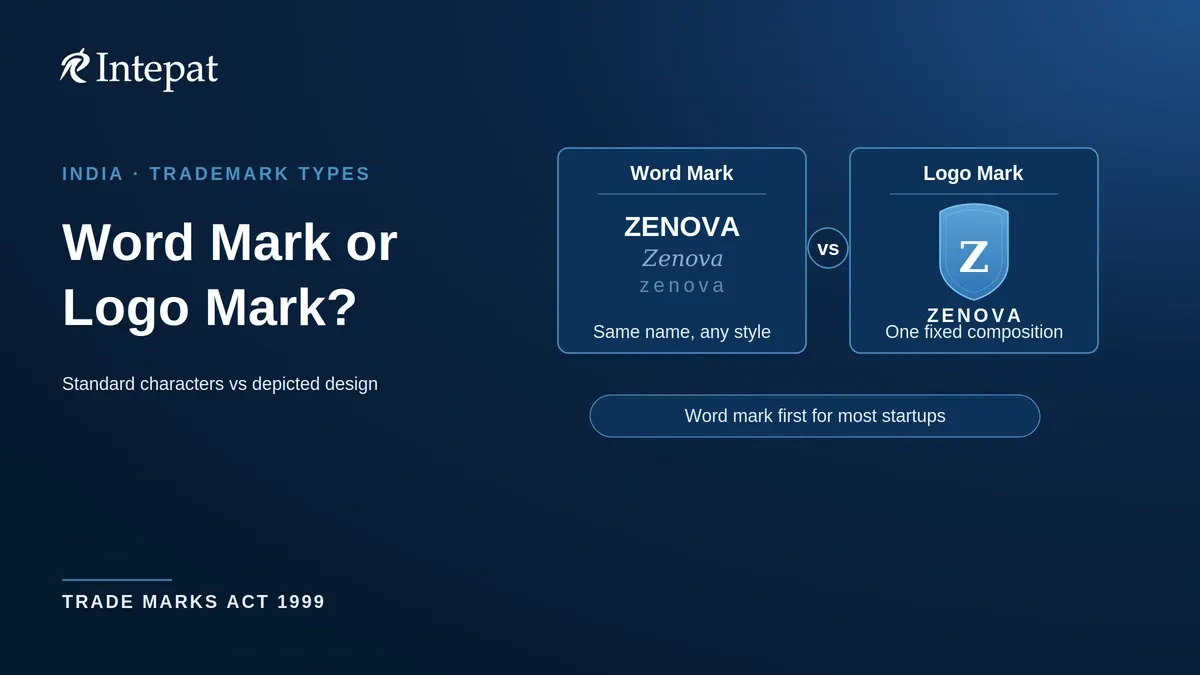
A word mark registers the name or words of a brand in standard characters, without specific font, colour, or design. A logo mark (device mark) registers a depicted visual composition. Under the Trade Marks Act 1999, a mark registered without colour limitation is deemed registered for all colours; this benefit is widest for word marks, which carry no design element.
This article covers Indian trademark law under the Trade Marks Act 1999 and the Trade Marks Rules 2017, with brief comparative notes on US and EU practice where relevant. Trademark rights are limited by the registered goods or services, conditions on the registration, prior-user rights, and statutory defences. Registration, or acceptance of an application, does not by itself eliminate infringement or passing-off risk arising from an earlier user or other earlier right.
| At a Glance |
| • A word mark registers the literal element in standard characters. It is not confined to a particular typeface or colour. • A logo mark (device mark) registers the depicted visual composition. Both types can be enforced against identical or deceptively similar marks. • A composite logo registration (a single registration combining words and design) confers exclusive rights to the mark “taken as a whole.” However, use of a word appearing in a composite mark may still amount to infringement if the competing mark, assessed as a whole, is identical with or deceptively similar to the registered composite. • For most startups and MSMEs where the name is sufficiently distinctive and reasonably clear of earlier rights: a word mark is usually the more useful first filing. File the logo separately if the design carries independent brand value. |
What Is a Word Mark Under Indian Trademark Law
A word mark is a trademark that consists solely of words, letters, or numerals, without any particular design element, stylisation, or colour claim. When you file a word mark application on Form TM-A, the Trade Marks Registry records the words themselves, not the way they look in any specific font or layout.
The Act defines “mark” to include a “word, letter, numeral” among other categories (Section 2(1)(m)). When a mark is registered as a word mark without a colour limitation, it is deemed registered for all colours (Section 10(2)). In practice, this means the registration is not confined to a particular font, size, or colour: use of the same or a deceptively similar word in another visual form may fall within the registration, subject to the infringement requirements and defences under the Act.
For a startup founder or MSME owner, the practical effect is significant. Once your word mark is registered, you can update your brand’s visual identity (fonts, colours, layout) without needing a fresh trademark application. The registration is unaffected by later changes to the business’s logo, provided it is renewed and remains otherwise valid. Non-use does not automatically cancel the registration, but it may expose it to a removal application under the conditions specified in Section 47.
In the United States, the USPTO refers to this as a “standard character” mark. The principle is the same: a standard character filing protects the words regardless of font, size, colour, or design. In the EU, the EUIPO categorises it as a “word mark” and applies equivalent treatment.
What Is a Logo Mark (Device Mark)
A logo mark, referred to in Indian practice as a “device mark,” is a trademark that includes a graphical design element. It may consist of a design alone, a design combined with words, or words presented in a specific stylised form with particular colours, fonts, or layout. On Form TM-A, a device mark is defined to include “any label, sticker, monogram, logo or any geometrical figure other than word mark.” Label is not a separate filing category; it falls within the device mark category.
When filing a device mark application, the applicant must provide a clear and legible representation of the design, not exceeding 8 cm x 8 cm (Rule 26(1) of the Trade Marks Rules 2017).
If the logo includes specific colours, Form TM-A contains an important presumption. Point 5(b) of Form TM-A states that where a trademark is submitted in a specific combination of colours other than black and white, it shall be presumed that distinctiveness is claimed in that combination, and the application will be considered accordingly. If colour is not intended to be a distinctive feature of the device mark, filing the representation in black and white avoids this presumption. If the mark is ultimately registered without a colour limitation, it is deemed registered for all colours, but the registration remains centred on the depicted visual composition.
This is where a common misconception arises. The earlier version of this article stated that if you file a logo in colour, “you will have to use the same colors throughout.” The reality is more nuanced: submitting a logo in colour triggers a presumption of colour-specific distinctiveness under Form TM-A, but colour limitation is an option under the Act, not an automatic consequence.
How the Registered Representation Affects Protection
The core practical difference between a word mark and a logo mark comes down to three things: what has been represented and registered on Form TM-A, how the Act treats composite marks, and how the infringement analysis works in enforcement.
A word mark is not confined to a particular font, size, or colour. Because the registration covers only the standard-character wording, with no design element tying it to a specific visual form, use of the same or a deceptively similar word in another presentation may fall within the registration, subject to the infringement requirements and defences under the Act. This is not a blanket monopoly over the name in all commercial fields; rights remain limited to the registered goods or services.
A logo mark is registered as a depicted visual composition. The Act provides that a composite mark registration confers exclusive rights to the mark “taken as a whole” (Section 17(1)). A composite registration does not ordinarily confer a standalone exclusive right in an unregistered constituent element.
However, this does not mean that copying a word from inside a composite logo can never amount to infringement. The Act expressly recognises that where the distinctive elements of a registered mark include words, the mark may be infringed by the spoken or visual use of those words (Section 29(9)). This provision clarifies how “use” is defined; the substantive infringement test still requires the competing mark, assessed as a whole, to be identical with or deceptively similar to the registered mark, with a likelihood of confusion where applicable (Section 29(1) and (2)). Courts compare marks as a whole but may give substantial weight to a distinctive or dominant word component. The outcome is always fact-specific.
Consider a practical example. A startup registers the name ZENOVA as a word mark. A competitor launches a product under the name ZENOVA in a different font, colour, and layout. The word mark registration covers the standard-character wording, so the proprietor can bring an infringement action based on the textual identity alone. If the startup had registered only a stylised ZENOVA logo, plain-text use of ZENOVA by the competitor could still amount to infringement; the court would compare the marks as a whole, consider whether ZENOVA is an essential or dominant distinctive element, and assess whether the overall use is likely to cause confusion. The enforcement route is more direct with a word mark, because there is no need to argue about which element dominates the composite.
This is why practitioners generally advise filing the word mark first where the name is distinctive and reasonably clear of earlier rights. The word mark registration gives protection to the name itself, independent of any particular design. If the logo also carries significant brand value, it merits a separate device mark registration, but the word mark provides the more straightforward enforcement path. If you currently hold only a logo registration, filing a separate word mark application for the brand name is worth considering to secure standalone protection for the textual element.
If only the logo is registered and the business later redesigns its visual identity, the Act allows alteration of a registered mark only where the change does “not substantially affect the identity” of the mark, and only with the Registrar’s leave (Section 59(1)). A significant redesign would require a fresh application.
Word Mark vs Logo Mark: Side-by-Side Comparison
| Factor | Word Mark | Logo Mark (Device Mark) |
| What is protected | The words, letters, or numerals in standard characters | The depicted visual composition (with or without words) |
| Position where registered without colour limitation | Deemed registered for all colours | Deemed registered for all colours; protection remains centred on the depicted composition and may extend to deceptively similar marks |
| Flexibility after registration | Not confined to a particular typeface or colour; the form used should preserve the registered word mark’s identity | Non-substantial variations may be accepted as equivalent use; a material redesign requires a fresh application or alteration with Registrar’s leave |
| Scope against competitors | Protection is centred on the registered wording rather than a particular visual presentation | Protects the depicted composition as a whole; use of a dominant word element may still amount to infringement if the competing mark is identical with or deceptively similar to the registered composite |
| Representation on Form TM-A | Wording represented in standard characters; no device artwork forms part of the mark | Clear and legible representation, not exceeding 8 cm x 8 cm (Rule 26(1)) |
When to Register a Word Mark First
Before considering which type to file, check two things. First, is your brand name distinctive enough to register as a word mark? A name that is descriptive of the goods or services it covers may face an absolute-ground objection, regardless of how it is presented visually. Second, is the name reasonably clear of earlier rights? A distinctive name can still be refused or commercially unsafe because of an earlier identical or similar registered mark, or because an earlier unregistered user has prior rights.
Where the name is sufficiently distinctive and a clearance assessment has not identified prohibitive earlier rights, a word mark is usually the more useful first filing for three reasons.
First, the name is typically the more durable brand element. Logos evolve as businesses grow, rebrand, or update their visual identity. A word mark registration survives a logo redesign because it protects the name, not the design. Where proof of use is required, the tribunal may accept use of the mark with additions or alterations not substantially affecting its identity as equivalent use (Section 55(1)). This principle applies to registered marks generally, not only word marks, but its practical significance is greatest for word marks because the registered element remains constant even as visual branding changes.
Second, the word mark provides a more direct enforcement path. A competitor using the same name in a different font or colour may be challenged on the strength of a word mark registration alone. A composite logo registration can also support enforcement where the word is a dominant distinctive element, but the argument is simpler with a standalone word mark.
Third, cost matters. Each trademark application on Form TM-A incurs a per-class fee (currently Rs 4,500 for individuals, startups, and small enterprises; Rs 9,000 for others, via e-filing). Where both marks are registrable, filing word and device marks separately requires separate per-mark, per-class fees. For a business with limited budget, the word mark offers the broader return on a single filing. Understanding the full trademark registration process in India can help you plan your filing sequence and budget.
A logo mark filing is worth the separate investment when the design itself has become a recognisable brand identifier independent of the name. If your logo functions as a standalone brand signal, a separate device mark registration protects that visual composition against identical or deceptively similar imitation. The guide to registering a logo as a trademark in India covers the specific procedural steps.
Before filing either type, businesses should run a pre-filing trademark search to check for conflicts. A clearance search for a composite logo should examine both the word elements and the figurative elements. Figurative elements may be searched using relevant Vienna Classification codes. A word that is clear of similar earlier word marks may still conflict with a device mark that incorporates the same word in a stylised form, and vice versa.
How to Decide Which Trademark to File
The decision is not an either/or question for most businesses. It is a sequencing question: which to file first, given budget, brand stage, distinctiveness, and clearance.
| Your situation | Recommended first filing | Reason |
| Early-stage startup; distinctive brand name chosen, logo still in development, name reasonably clear of earlier rights | Word mark | Protects the name immediately; logo can be filed later |
| Established business; both name and logo are in active use | Word mark first, then logo separately | Secures the more direct enforcement path first; logo adds design-specific coverage |
| The wording may be descriptive, but the composite presentation contains an independently distinctive device element | Consider a device-mark application after registrability and clearance assessment | The composite mark may be assessed as a whole, but registration will not necessarily confer exclusive rights in the descriptive wording |
| Design-led brand; the logo is the primary consumer identifier (no text) | Logo mark (device mark) | The design is the brand; a word mark would protect text that is not the primary asset |
| Budget allows only one filing, and the name is distinctive, commercially central and reasonably clear of earlier rights | Word mark | Broader scope per filing; no design dependency |
When filing a trademark in India, the application is submitted on Form TM-A under Section 18 of the Act. The form requires the applicant to specify the category of mark: Word mark, Device mark, Colour, Three dimensional trademark, or Sound.
If you hold a word mark registration and later want to file the logo, the logo application follows the same Form TM-A procedure with the addition of the graphical representation. The word mark and composite logo ordinarily require separate applications and result in separate registrations. Where the word mark is also a constituent part of the composite logo and separate rights are claimed in that part, the Act specifically recognises separate registration of the whole and the part (Section 15(1)), and provides for their association (Section 16(3)). Special statutory rules may require them to be recorded as associated trademarks where one is a separately registered part of the other.
Assessing whether your mark is distinctive rather than descriptive is an important step before filing, because the distinctiveness standard applies equally to word marks and device marks.
Ordinarily, one application seeks registration of one mark. The Act separately permits qualifying series marks to be included in a single application (Section 15(3)), but a word mark and a materially different composite logo will ordinarily require separate applications.
Understanding the different types of trademarks beyond word and device marks, including sound marks, shape marks, and colour marks, can help position a broader brand protection strategy. For a detailed treatment of how the Act treats composite marks, the Section 17 analysis covers the doctrine in full.
Frequently Asked Questions
A word mark registers the name, letters, or numerals of a brand in standard characters, without specific design. A logo mark (device mark) registers a depicted visual composition. Both can be enforced against identical or deceptively similar marks, but a word mark is not tied to any particular font, colour, or layout, usually giving greater flexibility as to visual presentation.
Yes. Separate word-mark and device-mark applications may be filed on Form TM-A under the Act. Where the word mark is also a constituent part of the composite logo, the Act recognises separate registration of the whole and the part. The two marks ordinarily result in separate registrations; in specified whole-and-part cases, the Act treats them as associated trademarks.
Where the brand name is distinctive and reasonably clear of earlier rights, a word mark is usually the more useful first filing; it is not confined to any particular font, size, or colour. If the wording is descriptive, a distinctive device presentation may be considered. If clearance identifies earlier rights, a device filing alone may not resolve the conflict.
A composite mark registration confers exclusive rights to the mark “taken as a whole.” It does not ordinarily confer standalone rights in unregistered constituent elements. However, use of a word from the composite may still amount to infringement if the competing mark, assessed as a whole, is deceptively similar to the registered composite and likely to cause confusion.
The Act permits alteration of a registered mark only where the change does “not substantially affect the identity” of the mark, and only with the Registrar’s leave. A significant redesign, changing the layout, shape, or core design elements, would require filing a fresh application on Form TM-A rather than seeking an amendment.
Once registered without a colour limitation, yes. The Act deems such a mark registered for all colours. This applies to all marks, but matters most for word marks because they carry no design element limiting scope. Filing in black and white, without claiming colour distinctiveness, avoids triggering the colour presumption on Form TM-A.
This article explains the law on word marks and logo marks in India as at July 2026 and is for general information only. It is not legal advice. Registry fees, forms, and timelines change; confirm current details with the Trade Marks Registry before you act. For advice on your specific mark, consult a trademark attorney.