




A trade name is the registered name of your company or LLP; a trademark protects your brand in the marketplace. In India they register with different authorities, under different laws, and give you different kinds of protection. Most founders assume one covers the other. It does not, and the gap can be costly.
| Quick Answer |
| • Your MCA-registered company name is your trade name. It stops another company or LLP from incorporating under the same name, but it does not protect your brand. |
| • A registered trademark protects your brand name, logo, or product name against any unauthorised person using it for the same or similar goods or services. |
| • Registering a company name does not stop a third party from selling under that same name. |
What Is a Trade Name or Company Name?
When you incorporate a company or LLP in India, the name you register with the Ministry of Corporate Affairs (MCA) is your trade name. MCA runs a name-availability check before approving it, and once approved, no other company or LLP can incorporate under the same name.
That is where the protection ends. A sole trader or partnership firm does not register with MCA, so they can begin trading under a name identical to yours without any MCA rule stopping them. MCA registration alone does not give you a trademark infringement action against a sole trader or partnership using the same name. You may still have a passing off remedy if you can prove goodwill, misrepresentation, and damage, but that is a separate and harder case to run.
It is also important to understand what MCA’s approval actually means. MCA name approval is not a substitute for trademark clearance. MCA may consider certain registered trademarks while examining company names, but its approval is only an administrative approval for incorporation. It does not confirm that the name is legally safe to use as a brand, nor does it give you trademark rights. A name can be approved by MCA and still create trademark infringement or passing off risk if it is used as a brand in the marketplace. Founders sometimes treat MCA approval as a green light to launch publicly. It is not.
What Is a Trademark?
A trademark is a word, logo, name, or any combination of these that identifies the source of specific goods or services. You register it with the Trade Marks Registry under the Trade Marks Act 1999. Once registered, no unauthorised person can use it as a brand for the same or similar goods or services.
A trademark operates in the marketplace. A trade name operates in a corporate register. They are not interchangeable, and one does not flow from the other.
The Gap That Catches Founders Off Guard
Here is the practical problem. You incorporate “Nova Foods Private Limited.” MCA approves the name. You spend a year building the brand. Six months after you launch, a sole trader starts selling snacks under the brand “Nova Foods.” Nothing in company law prevents that. The sole trader has not incorporated a company; MCA has no jurisdiction over them.
If you have a registered trademark for “Nova Foods” covering food products, that sole trader is infringing it and you can go to court for an injunction and compensation. A registered trademark does not stop every use of the same word in every context; it protects against unauthorised use as a brand for the same or similar goods or services. If you only have the MCA registration, your legal options are far narrower and more expensive to pursue.
The same gap applies the other way. A competitor who registered “Nova Foods” as a trademark before you incorporated could send you a cease-and-desist even though MCA approved your company name. MCA approval does not override an earlier trademark registration.
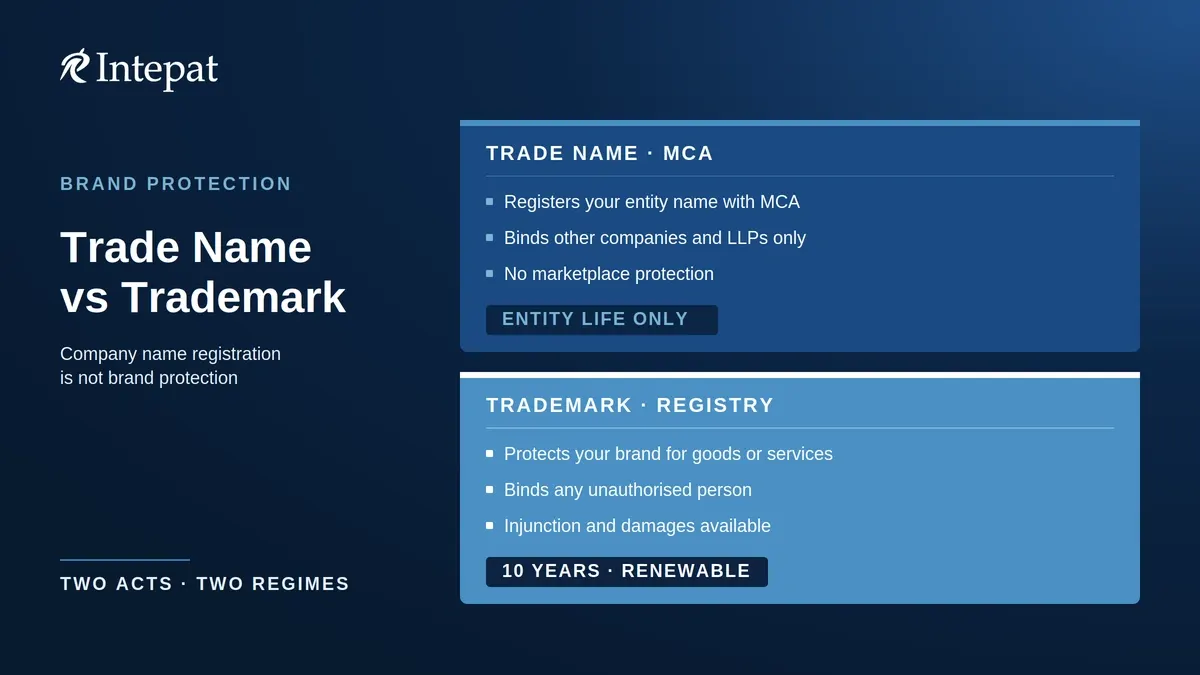
| Feature | Trade Name (MCA) | Trademark (Trade Marks Registry) |
| What it protects | Your company or LLP name | Your brand for specific goods or services |
| Who it binds | Other companies and LLPs only | Any unauthorised person |
| Marketplace protection | No | Yes |
| Duration | While entity exists | 10 years, renewable |
| Compensation route | Not through MCA registration; possible via passing off if goodwill established | Yes |
| Trademark clearance | Limited administrative check; not a full trademark clearance | Registry examines conflicting marks; not a substitute for independent clearance |
What About Passing Off?
If someone copies your brand but you have not registered a trademark, you are not completely without options. You can bring a passing off claim, which is a court action based on the goodwill or reputation your business has built up in the name.
To win, you need to show three things: that your business has genuine goodwill attached to that name, that the other party is misleading customers into thinking they are dealing with you, and that this is causing you real harm. Compensation is available if you prove all three.
The difference from a trademark infringement case is what you have to prove. With a registered trademark, your registration is itself the evidence of your right. You do not need to demonstrate goodwill built over years. Without registration, you do, and that adds time, cost, and uncertainty to every enforcement action. Early-stage businesses often struggle to prove substantial goodwill, which is precisely when they are most likely to face a copycat.
Practical takeaway Passing off is a real remedy and courts do award compensation through it. But it is harder and more expensive to run than a trademark infringement claim. Registration makes enforcement simpler from day one.
Can Your Company Name Also Be Your Trademark?
Yes, and for most brands it should be. Your company name is eligible for trademark registration if you use it to identify specific goods or services and it is distinctive enough to set you apart from competitors.
“Distinctive” is the key question. Purely descriptive names are harder to register. A company called “Fresh Juice Private Limited” would struggle because those words simply describe the product. A name like “Tropika” for the same business is more likely to pass the distinctiveness test because it is not a common word that competitors need to use. If your company name sits in the descriptive end of the spectrum, consider whether your product brand, logo, or a stylised version of the name would make a stronger trademark application.
Before applying, run a trademark clearance search to check no conflicting mark already exists on the register for the same or similar goods or services.
The two can also diverge. A company called Acme Goods Private Limited might sell products under the brand “NovaSpark.” The company name and the trademark are different; only the trademark protects the product brand. This is common among businesses that have multiple product lines or that have rebranded since incorporation without changing their company name.
Timing: When Should You Apply?
The earlier, the better. When a trademark is registered, the rights date back to the application date, not the date the certificate is issued. However, India also protects honest prior use. A business that started using the mark before another party’s first use of it, or before the date of that party’s registration, whichever is earlier, may retain rights even against a registered proprietor. This is why founders should both clear the mark before launch and file early: filing early secures your priority date, and using the mark consistently from the start builds the prior use record that matters if a dispute ever arises.
The practical implication: apply before you launch publicly if possible. Once your brand is out in the market, competitors can see it, and someone else could file for a similar mark. There is also a risk that a third party’s already-registered trademark could block your launch if you only discover the conflict after going public.
You do not need to have the trademark approved before you start trading. You may use the TM symbol when you claim trademark rights in a mark, including before you have filed an application. The ® symbol may only be used after the mark is registered. Registration typically takes one to two years from application to certificate, but if the application succeeds, your rights date back to the filing date.
Can MCA Approval Be Challenged Later?
Yes. MCA approval does not make your company name immune from challenge. If your company name conflicts with an existing registered trademark, the trademark owner may apply to the Central Government to require your company to change its name. Separately, MCA can direct a company to rename itself if the name is found to be undesirable.
This means a founder who incorporates first and researches trademarks later may still be forced to rebrand the company, update all materials, and start again with a new name. Running the trademark clearance search before incorporating avoids that risk entirely.
Do You Need Both?
For most businesses, yes. The question of company name vs trademark is not either/or; both serve distinct, non-overlapping purposes.
Your entity registration (company or LLP) is the legal structure through which you contract, hire, and own assets. Your trademark registration protects the brand those customers recognise and return to. Neither replaces the other.
A trademark can be owned by an individual, proprietorship, partnership, LLP, or company. Incorporation gives you a separate legal vehicle for contracts and operations; trademark registration protects the brand used by that vehicle or owner.
The order is simple: register the entity first to get a legal person in place, then apply for the trademark as early as possible. If budget is a constraint, prioritise the classes of goods or services that are central to your business and add other classes as you grow.
For detail on what you can recover when someone infringes your trademark, see Remedies for Trademark Infringement in India. If someone has registered a domain name using your trade name, see Passing Off and Domain Names. For a broader look at unregistered versus registered rights, see Registered vs Unregistered Trademark.
Before launching a brand name, work through this list:
- Check MCA name availability.
- Run a trademark search on the Trade Marks Registry database.
- Check domain and social media availability.
- File your trademark application before public launch.
- Use the same brand consistently on invoices, packaging, website, and marketing materials.
Frequently Asked Questions
A trade name is your company or LLP name registered with MCA. A trademark is your brand identifier, a word, logo, or name, registered with the Trade Marks Registry for specific goods or services. Different laws, different registries, different rights. MCA approval is an administrative clearance for incorporation, not a full trademark clearance.
No. Company name registration is with MCA under the Companies Act 2013 or LLP Act 2008. Trademark registration is with the Trade Marks Registry under the Trade Marks Act 1999. They are separate processes under separate laws, and each gives you different rights.
No. MCA registration stops another company or LLP from incorporating under the same name, but sole traders and partnerships are outside that system. MCA approval is an administrative clearance for incorporation; it is not a full trademark clearance and does not confirm that your name is free of third-party trademark rights. Only a registered trademark gives you enforceable rights against any unauthorised person using your brand for the same or similar goods or services. A separate trademark search on the Trade Marks Registry database is essential before you launch publicly.
Yes, through a passing off claim. You need to show that your business has real goodwill or reputation in the name, that the other party is misleading customers, and that harm is resulting. Compensation is available if you prove all three. A registered trademark makes enforcement significantly simpler because you do not need to prove goodwill each time.
Yes, if it is distinctive enough and you use it for specific goods or services. Descriptive names are harder to register. Run a clearance search before applying to confirm no conflicting mark already exists on the register.
That is trademark infringement. You can go to court for an injunction to stop them and claim compensation or an account of their profits.
As early as possible, ideally before you launch publicly. When a trademark is registered, the rights date back to the application date. The earlier you file, the stronger your position if someone else later tries to register a similar mark.
Yes, if they meet the registration requirements and you have not already filed. If they register it first, they may have grounds to object to your continued use of that name for the same goods or services. Prior continuous use may give you some protection, but that is a difficult and expensive case to run. Filing your own trademark application early is the cleaner solution.
Register the name your customers actually see and remember. Sometimes that is the same as your company name; sometimes it is a product brand, a logo, or a tagline that differs from your corporate registration. For example, if “ABC Foods Private Limited” sells snacks under the brand “Crunchora,” the trademark priority should usually be for “Crunchora,” because that is the name customers recognise. If your company name is descriptive and unlikely to pass the distinctiveness test, focus the trademark application on the brand element that is clearly distinctive.
For most businesses, yes. The entity registration gives you a legal structure. The trademark registration protects the brand your customers recognise. One does not substitute for the other.
This article is for informational purposes only and does not constitute legal advice. The law described is that in force as at June 2026. Please consult a registered trademark attorney for advice on your specific matter.