




Recent Indian pharmaceutical trademark rulings continue to apply heightened scrutiny to confusion involving medicines, while refining how that scrutiny operates at different procedural stages. Five High Court and Supreme Court rulings from February 2025 to July 2026 illustrate that shift.
This roundup of pharmaceutical trademark case India 2026 developments covers when a post-trial confusion analysis requires evidence beyond a bare comparison of marks, how a registration’s presumption of validity operates against a now-defunct rival registration, and when passing off remains available where an infringement claim against a fellow registered proprietor fails on the registration issue. Figures below are as reported in the cited orders and press coverage, verified as of August 2026.
| Quick answer: |
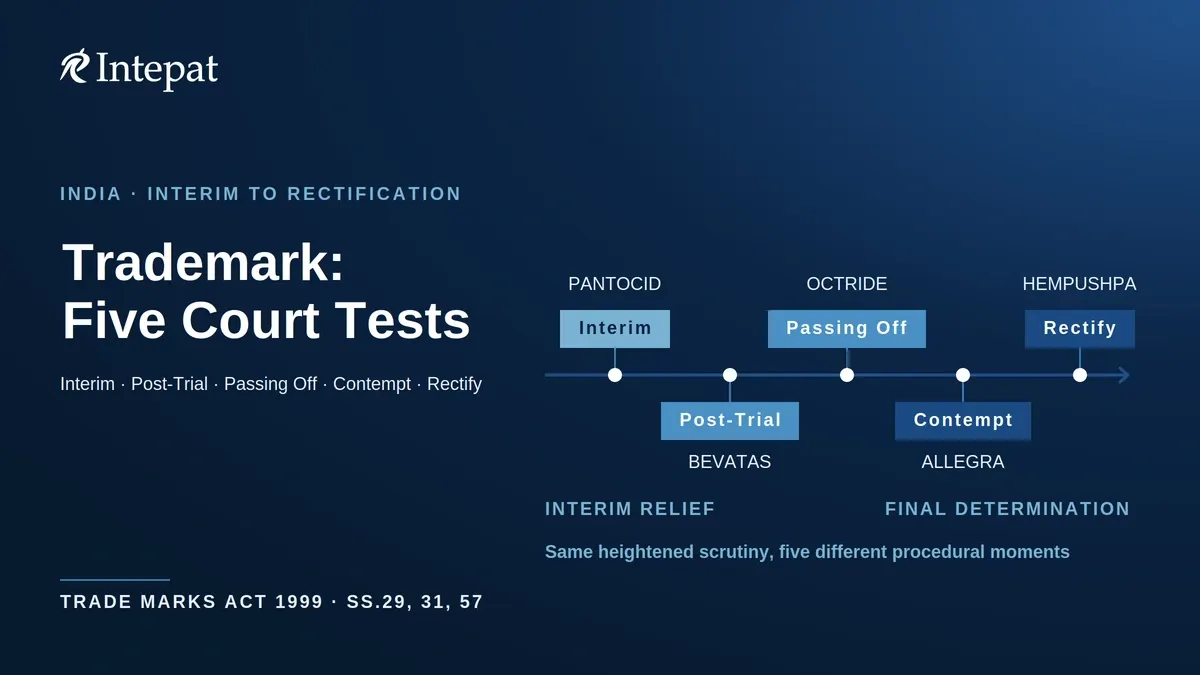
| Between February 2025 and July 2026, Indian courts decided five notable pharmaceutical trademark disputes. Two Delhi High Court Division Bench rulings (Sun Pharma v. Finecure on PANTOCID/PANTOPACID, and Intas v. Sun Pharma on BEVATAS/BEVETEX) turned respectively on the presumption of registration validity and on whether a post-trial confusion finding needed evidence beyond a bare comparison of the marks. A Bombay High Court order in Sun Pharma v. United Biotech (OCTRIDE/OTIDE) allowed a passing off claim to proceed even though infringement against a fellow registered proprietor failed on the registration issue. A Bombay High Court contempt order in Aventisub v. Healing Pharma (ALLEGRA) enforced the “safe distance” rule against a rebranded repeat infringer. A Delhi High Court order in Rajvaidya v. Karna Goomar (HEMPUSHPA/ACTIVEPUSHPA) cancelled a registration for deceptive similarity in ayurvedic medicine. |
Sun Pharma Laboratories Ltd. v. Finecure Pharmaceuticals Ltd.: a registration’s presumption survives a rival’s now-defunct registration
A Delhi High Court Division Bench held on 1 July 2026 that a registration’s statutory presumption of validity is not defeated by pointing to a rival registration that was itself removed from the register years earlier, and restored an interim injunction a Single Judge had refused despite finding infringement.
Sun Pharma has sold a Pantoprazole-based anti-acidity drug as PANTOCID since 1999; its registration application, filed in 1998, survived an opposition from Atlanta Pharma (Takeda’s successor), whose own competing registration for the same mark was later removed from the register in 2019. When Sun Pharma sued Finecure Pharmaceuticals in 2023 over PANTOPACID, PANTOPACID D, and PANTOPACID SR, a Single Judge found infringement on the facts in an August 2023 judgment but declined an interim injunction, reasoning that the Takeda history cast doubt on the validity of Sun Pharma’s own registration. The Division Bench held that once Takeda’s competing registration had been removed from the register in 2019, the ground for questioning Sun Pharma’s registration under Section 11(1)(a) of the Trade Marks Act, 1999 no longer existed, and the statutory presumption of validity under Section 31(1) could not be disregarded at the interlocutory stage on that basis. It found no suppression of material facts and held that delay alone does not defeat relief where infringement is otherwise clear.
For pharmaceutical brand owners, the case shows that a removed competing registration could not, on these facts, by itself displace the Section 31(1) presumption attaching to Sun Pharma’s registration at the interlocutory stage.
Intas Pharmaceuticals Ltd. v. Sun Pharma Laboratories Ltd.: post-trial confusion analysis must engage the evidentiary record
A Delhi High Court Division Bench reversed a permanent injunction on 29 May 2026: a post-trial infringement finding cannot rest on a bare structural or phonetic comparison alone. The Bench treated the claim under Section 29(2)(b); with the Section 29(3) presumption unavailable, likelihood of confusion had to be supported by the evidentiary record.
Intas launched its anti-cancer drug BEVATAS in 2016, coining the name from “Beva” (the molecule Bevacizumab) and “Tas” (its own corporate name). Sun Pharma, which markets a different anti-cancer drug under the registered mark BEVETEX (based on Paclitaxel, registered since 1983 but commercially used only from 2015), sued for infringement and passing off. A Single Judge decreed the suit in Sun Pharma’s favour, holding BEVATAS deceptively similar to BEVETEX based on a direct visual and phonetic comparison of the two marks. The Division Bench held that the burden of proving confusion rested entirely on Sun Pharma, since the Section 29(3) presumption of confusion for identical goods was unavailable on these facts, and Sun Pharma had produced no evidence from the relevant class of consumers or professionals and no instance of actual confusion despite years of concurrent use; the drugs contained different molecules, differed materially in therapeutic purpose, indications, dosage and administration, and were not therapeutic substitutes or interchangeable, evidence that went substantially unrebutted.
On its own comparison, the Bench found BEVATAS and BEVETEX neither visually, structurally, nor phonetically similar, treating “Bev”/”Beva” as publici juris for Bevacizumab-based drugs, and went on to hold that Sun Pharma’s suit itself was vexatiously filed and pursued to protect a commercial rather than a public interest. On appeal, the Supreme Court granted leave on 27 July 2026 and found no ground to interfere with the Division Bench judgment, except that it set aside paragraph 155(a) and paragraphs 158-159. This removed the finding in paragraph 155(a) that the specified causes of action had been vexatiously pleaded, together with the costs directions, while leaving the substantive infringement ruling undisturbed.
The decision is a reminder that a post-trial confusion finding under Section 29(2)(b) is an evidentiary question, not a purely visual one: the Division Bench compared BEVATAS and BEVETEX itself and found them dissimilar, but it did so as part of a fuller assessment of the therapeutic evidence, not in place of one.
Sun Pharma Laboratories Ltd. v. United Biotech Pvt. Ltd.: passing off stays open even where infringement is barred
The Bombay High Court held on 4 May 2026 that an infringement claim between two registered proprietors of resembling marks can fail at the threshold, while a passing off claim on the same facts can still succeed and support an interim injunction.
Sun Pharma’s application for OCTRIDE, used for an Octreotide Acetate injection, was filed in 2003, claiming use from 30 September 1998. United Biotech held two registrations of its own: OTIDE (application/registration dating from 2003, with commercial use proved from 2006) and a separate, unused OCTIDE registration. Because United Biotech was itself a registered proprietor, Sections 28(3) and 30(2)(e) of the Trade Marks Act, 1999 prevented Sun Pharma from succeeding on infringement merely on the strength of its own registration. Applying the rule the Bombay High Court’s Full Bench laid down in Lupin Ltd. v. Johnson & Johnson for an infringement action against a fellow registered proprietor, the Court held that going behind United Biotech’s registration required a showing that it was ex-facie illegal or fraudulent, of the requisite exceptional character; that threshold was not met, and Sun Pharma had not filed a rectification application. The Court accordingly rejected the infringement claim.
The Court nonetheless held that a passing off action remains independently maintainable under Section 27(2) regardless of registration status on either side. Applying Cadila’s heightened scrutiny for medicinal marks, the phonetic similarity between OCTRIDE and OTIDE was treated as sufficient. Comparing goodwill at the point United Biotech’s use was actually proven (2006), Sun Pharma’s turnover of roughly Rs 7 crore against United Biotech’s roughly Rs 27 lakh favoured Sun Pharma, and United Biotech’s delay defence was rejected on the footing, drawn from the Supreme Court’s ruling in Wockhardt v. Torrent Pharmaceuticals, that mere delay does not amount to acquiescence. The Court granted an interim injunction restraining United Biotech from using OTIDE, OCTIDE, or any mark deceptively similar to OCTRIDE.
The case illustrates a distinct route through the same public health concern: where an infringement claim against a fellow registered proprietor fails on the registration issue, passing off remains open, and Indian courts have shown a willingness to grant relief through that route specifically because the goods are medicines.
Aventisub LLC v. Healing Pharma India Pvt. Ltd.: a rebrand is not a safe harbour
The Bombay High Court held the defendants guilty of wilful contempt on 3 February 2025, applying the “safe distance rule”: a party once found to have infringed a mark cannot escape a repeat finding merely by adopting a new name if the packaging and trade dress still track the original too closely.
Aventisub discovered in October 2020 that Healing Pharma India and DM Pharma were selling antihistamines under the mark ALLERGEGRA, in the same variants as Aventisub’s established ALLEGRA brand, with closely matching packaging and colour scheme. An ex parte injunction followed, and the parties reached a consent decree in March 2021 under which the defendants undertook to stop the infringing use. In 2022, Aventisub found the same defendants marketing a differently named product, ALGREAT, with packaging that again closely resembled ALLEGRA’s; a contempt petition followed, and the defendants did not file proof of compliance until 2024. The Court imposed a cost of Rs 500,000 with imprisonment in default of payment, holding that a change of name alone does not satisfy the safe-distance obligation where the packaging, colour scheme, and overall trade dress continue to point toward the restrained mark.
The case shows how the same comparison used at the interim stage, name, get-up, and colour scheme together, resurfaces at the enforcement stage: renaming a product is not a defence to contempt if everything else about its presentation still points toward the mark the defendant was already restrained from using.
Rajvaidya Shital Prasad and Sons v. Karna Goomar: a dominant shared element can support rectification despite the anti-dissection rule
The Delhi High Court cancelled a rival’s registration on 24 December 2025: “Pushpa” was not descriptive, generic, or common to trade on these facts, but a dominant, source-identifying part of the earlier mark, given the respondent’s prominent display of that word, identical goods and trade channels, long goodwill, and dishonest adoption.
Rajvaidya Shital Prasad and Sons has sold an ayurvedic tonic for women’s health as HEMPUSHPA since 1933, registered in Class 5. It sought rectification under Section 57 of the Trade Marks Act, 1999 to cancel a later registration for ACTIVEPUSHPA, held by Karna Goomar for similar ayurvedic products, arguing that the shared element “Pushpa” was a dominant feature likely to cause confusion. Karna Goomar countered that “Pushpa” is a generic, descriptive term common to women’s health products and could not be monopolised by a single trader. The Court did not accept that characterisation: it held that HEMPUSHPA’s ninety years of extensive, continuous use made it “very obvious” that Karna Goomar’s adoption of a mark sharing that dominant word was deceptively similar, that phonetic similarity was independently satisfied, and that Karna Goomar was guilty of dishonest adoption likely to cause passing off and consumer confusion. It directed cancellation of the ACTIVEPUSHPA registration under Sections 9, 11, 12, 18, 34, 47, 57, and 125 of the Act. The judgment does not confer a monopoly over “Pushpa” in the abstract; the Court’s holding turned on the specific combination of prominent display, identical goods and trade channels, established goodwill, and dishonest adoption before it.
The decision reads as a fact-specific dominant-feature and bad-faith rectification ruling. Although the Court declined to confer exclusivity over “Pushpa” in the abstract, it ultimately held that Pushpa was a dominant part of HEMPUSHPA requiring protection and, on the record before it, was not descriptive, generic, or common to trade.
The pharmaceutical trademark case India 2026 pattern: what these five rulings add up to
Across these five rulings, courts applied heightened scrutiny for medicinal marks through different substantive and procedural routes. In Intas specifically, the Division Bench held that the post-trial Section 29(2)(b) determination on those facts required an evidence-based assessment rather than a bare structural or phonetic comparison.
Appellate courts are pushing back on findings built on a bare comparison of the marks alone: a post-trial infringement finding must rest on the evidentiary record the case actually requires, not a judge’s own side-by-side reading of two names (Intas v. Sun Pharma). A registration’s presumption of validity holds up against a rival’s now-defunct registration (Sun Pharma v. Finecure), while passing off remains available where infringement relief against a fellow registered proprietor is unavailable because the threshold for going behind the rival registration has not been met, a threshold that comes from judicial doctrine rather than the bare statutory text (Sun Pharma v. United Biotech).
At the enforcement end, courts are treating cosmetic rebranding as no defence to contempt where the overall trade dress still tracks the original mark (Aventisub v. Healing Pharma), and a shared element can still emerge as a dominant, protectable feature where the fuller picture, prior goodwill, identical goods, prominent display, and dishonest adoption, establishes deceptive similarity, without that holding conferring a monopoly over the word itself (Rajvaidya v. Karna Goomar). For related reading, see Understanding the Anti-Dissection Rule in Trademarks on the doctrine at issue in the Rajvaidya rectification, Remedies for Trademark Infringement on the relief available once infringement is shown, and Trademark Opposition vs Rectification in India on the route used in that same case.
This article explains the position in India as at August 2026 and is for general information only. It is not legal advice. Laws, fees, and procedures change; verify the current position before you act. For advice on your specific matter, consult a qualified IP professional.
Sources
- Sun Pharma Laboratories Ltd. v. United Biotech Pvt. Ltd., Bombay High Court, IA(L) 19536/2025 in Commercial IP Suit(L) 19268/2025, Neutral Citation 2026:BHC-OS:11436, order dated 4 May 2026 (full order text).
- Intas Pharmaceuticals Ltd. v. Sun Pharma Laboratories Ltd., Delhi High Court Division Bench, RFA(OS)(COMM) 10/2026, judgment dated 29 May 2026; reported by LiveLaw Biz, 6 June 2026, and Informist Media, 1 June 2026.
- Sun Pharma Laboratories Ltd. v. Intas Pharmaceuticals Ltd., Supreme Court of India, order dated 27 July 2026, granting leave and disposing of the civil appeal against RFA(OS)(COMM) 10/2026; reported by Business Standard, 27 July 2026.
- Sun Pharma Laboratories Ltd. v. Finecure Pharmaceuticals Ltd. & Ors., Delhi High Court Division Bench, FAO(OS)(COMM) 200/2023, order dated 1 July 2026; Single Judge judgment dated 16 August 2023, Neutral Citation 2023:DHC:5755; reported by LiveLaw Biz, 3 July 2026, and Mondaq, 27 July 2026.
- Aventisub LLC & Anr. v. Healing Pharma India Pvt. Ltd. & Ors., Bombay High Court, Contempt Petition (L) No. 21571 of 2022 in Commercial IP Suit No. 139 of 2021, order dated 3 February 2025; reported by World Trademark Review, February 2025.
- Rajvaidya Shital Prasad and Sons v. Karna Goomar & Anr., Delhi High Court, C.O. (COMM.IPD-TM) 385/2021, order dated 24 December 2025, Neutral Citation 2025:DHC:11881; reported by LiveLaw, 2 January 2026, and Verdictum, 5 January 2026.
- Trade Marks Act, 1999, Sections 27(2), 28(3), 29, 30(2)(e), 31(1), 57.