




Most businesses understand that trademark registration involves examination and possible objections. Trademark opposition and trademark rectification are two distinct remedies operating at different points in a mark’s lifecycle. A conflicting trademark can be challenged at two entirely separate points in its lifecycle, each governed by different rules on who can file, what must be proved, and what the outcome can be.
Trademark watch is widely understood as a pre-registration tool: monitor the Journal, catch a conflicting application, file an opposition in time. That understanding is incomplete. A properly structured watch programme also monitors the Register after registration, identifying marks that have fallen into non-use, were obtained through misrepresentation, or remain on the Register despite failing the original conditions for registration. The remedy in those cases is rectification, not opposition, and no statutory limitation period is prescribed for most grounds.
The two remedies serve different functions in the same exercise: opposition prevents an invalid right from forming, rectification removes one that has already formed. Understanding both, and the procedural rules that distinguish them, is essential for any brand owner.
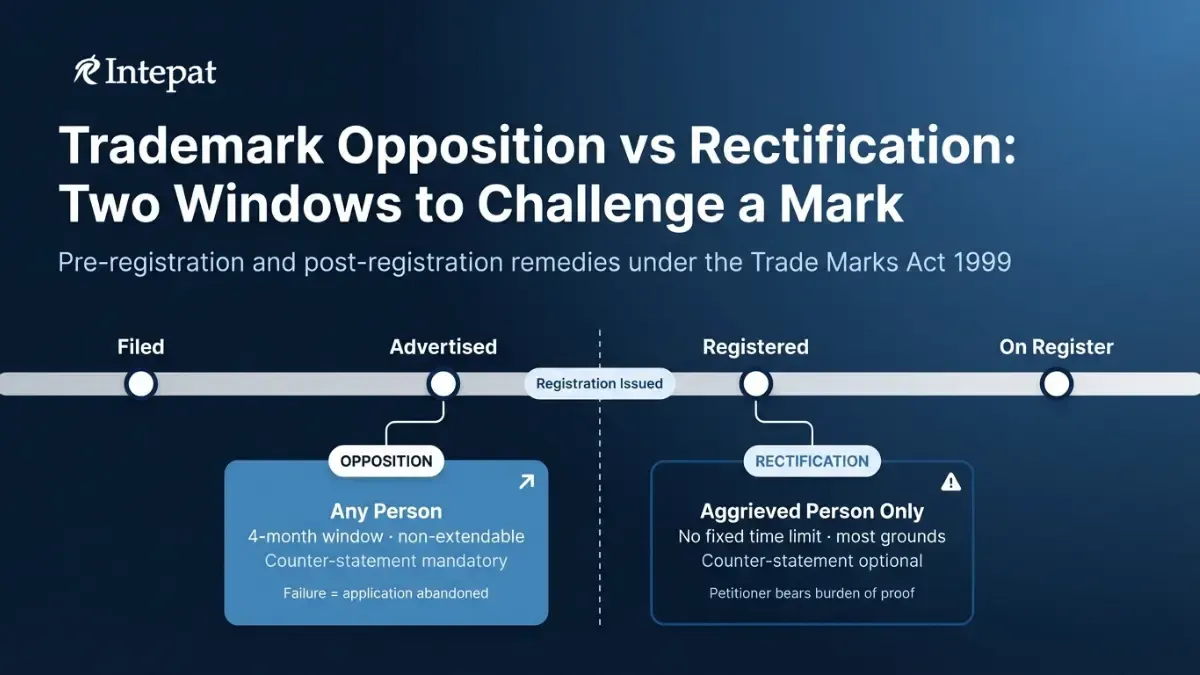
What Is the Difference Between Trademark Opposition and Trademark Rectification?
Both remedies exist under the Trade Marks Act, 1999 to challenge a mark, but they apply at different points in the registration lifecycle and carry materially different procedural requirements, including who may file and what the burden of proof requires.
Opposition operates between advertisement under Section 20 and registration under Section 23. Any person can challenge a mark that has been advertised in the Trade Marks Journal, by filing a notice of opposition within four months of the advertisement date. That window is non-extendable. The right to oppose is conferred by Section 21 of the Trade Marks Act, 1999, and filing within it suspends the registration process until the opposition is resolved.
Rectification under Sections 47 and 57 of the Trade Marks Act, 1999 is a post-registration remedy. It applies after a registration certificate has been issued. Only an aggrieved person, meaning someone with a direct and genuine commercial interest in the outcome, has locus standi to file. For most grounds there is no fixed time limit, though the non-use ground under Section 47 requires that the mark has not been in genuine commercial use in India for a continuous period of five years and three months preceding the petition date.
| Parameter | Trademark Opposition | Trademark Rectification |
| Stage | Pre-registration: after advertisement in the Trade Marks Journal | Post-registration: after the registration certificate is issued |
| Who can file | Any person | An aggrieved person with a direct commercial interest |
| Time limit | Four months from advertisement date; not extendable | No fixed limit for most grounds; five years and three months of non-use required for Section 47 |
| Counter-statement | Mandatory — failure within two months results in the application being treated as abandoned | Not mandatory — the proprietor may respond but failure to do so does not result in automatic cancellation |
| Evidence stage | Each party must file evidence by affidavit or send written intimation of reliance on pleadings; taking no action results in abandonment | Each party must file evidence by affidavit or send written intimation of reliance on pleadings; taking no action results in abandonment |
| Burden of proof | Applicant bears the burden to establish registrability once opposed; opponent must still establish the grounds of opposition | On the petitioner to overcome the mark’s presumption of validity |
| Outcome | Registration refused or allowed to proceed | Entry in the Register cancelled, removed, or amended |
Grounds for Trademark Opposition
A notice of opposition can be filed on the absolute grounds in Section 9 and the relative grounds in Section 11 of the Trade Marks Act, 1999. The four most commonly invoked grounds are:
- Lack of distinctiveness. Under Section 9, a mark that is purely descriptive of the character, quality, or geographical origin of the goods or services cannot be registered. A mark that every competitor needs to use to describe their offering cannot be monopolised by one applicant.
- Likelihood of confusion with an earlier mark. Where the applied-for mark is deceptively similar to an existing registration or application, opposition lies under Section 11. The test is whether an average consumer exercising ordinary care would be confused as to trade origin.
- Bad faith. Bad faith filings, where an applicant registers a mark knowing of an existing user’s prior rights and intending to free-ride or block that user, are a ground of opposition under Section 11(10), assessed at the date of application.
- Public morality and prohibited symbols. Marks likely to hurt the religious susceptibilities of any class or section of the public, or that are inconsistent with the Emblems and Names (Prevention of Improper Use) Act, 1950 are barred from registration under Section 9.
Grounds for Trademark Rectification
Rectification allows an aggrieved person to petition the Registrar, or in contested matters the jurisdictional High Court, to cancel, remove, or amend a registration already on the Register. For this purpose, an aggrieved person is a person whose legal or commercial interests are affected by the continued presence of the mark on the Register. The principal grounds are non-use under Section 47 and fraud or statutory non-compliance under Section 57.
- Non-use. Under Section 47, a registered mark can be removed from the Register if it has not been put to genuine commercial use in India for a continuous period of five years and three months before the petition date. Non-use as a ground of revocation is the most frequently relied-upon basis for clearing the Register of dormant registrations that are blocking active users.
- Consequences of non-use. A registered mark that has not been used becomes vulnerable to rectification once the five-year and three-month threshold is met, and enforcement of the mark becomes precarious: the proprietor may be required to establish use to sustain any relief claimed.
- Absolute or relative grounds not satisfied at registration. If a mark was registered despite failing the conditions in Sections 9 or 11 of the Trade Marks Act, 1999, a rectification petition can be filed on those statutory grounds to remove it from the Register.
- Fraud and misrepresentation. A registration obtained through a false declaration of use, concealment of material facts, or any misrepresentation made to the Registry may be cancelled under Section 57. There is no limitation period for this ground.
- Likelihood of confusion on the Register. Where a mark’s continued presence on the Register generates confusion in the market, the Registrar has the power to order its removal or amendment under Section 57. Rectification is also frequently invoked alongside infringement proceedings under Section 124, where the defendant challenges the validity of the registered mark as part of the infringement defence.
Procedure for Trademark Opposition
Opposition proceedings run through five stages under Rules 42 to 50 of the Trade Marks Rules, 2017. The counter-statement stage is the most consequential: missing it ends the application by default.
- Notice of Opposition (Form TM-O). The opponent files Form TM-O within four months of the advertisement date, setting out the legal grounds. Evidence is filed separately during the evidence stages under Rules 45 to 47, not with the notice itself. The prescribed fee must accompany the form.
- Counter-statement. This step is mandatory. The applicant has two months from receipt of the Registrar’s copy of the notice of opposition to file a counter-statement. If the applicant fails to file within that period, the application is treated as abandoned and registration is refused without a hearing. The default is treated as fatal under the Rules, with extremely limited scope for revival.
- Evidence stage. Under Rules 45 and 46, each party must either file evidence by way of affidavit or send written intimation to the Registrar that they intend to rely on their pleadings. The opponent acts first under Rule 45, the applicant replies under Rule 46, and the opponent may file evidence in reply under Rule 47. Failure by either party to take either step results in abandonment of the opposition or application. Documentary evidence establishing prior use, turnover, and brand reputation is annexed to the affidavits.
- Oral hearing. The Registrar conducts a hearing at which both parties argue their positions based on the evidence on record.
- Final order. The Registrar passes an order on the merits. A successful opposition results in refusal of the application. A dismissed opposition clears the way for registration to proceed.
Procedure for Trademark Rectification
Rectification petitions are filed before the Registrar or, in contested matters, the jurisdictional High Court. Unlike opposition, the counter-statement is not mandatory, but both parties must either file evidence by affidavit or send written intimation of reliance on their pleadings; taking no action results in abandonment, and the petitioner bears the burden of proof throughout.
- Statement of case. The petitioner files Form TM-O together with a statement setting out the nature of the applicant’s interest, the material facts, and the specific remedy sought, whether cancellation, removal, or amendment of the Register entry.
- Notice to the registered proprietor. The Registry serves formal notice on the registered proprietor of the mark setting out the proposed grounds.
- Counter-statement (optional). Unlike opposition, the registered proprietor is not required to file a counter-statement to avoid a default order. The proprietor may respond within two months, extendable by one further month, but failure to file does not result in automatic cancellation. If no counter-statement is filed within three months, the petitioner proceeds to the evidence stage under Rule 98 and the matter may proceed without defence and be decided on the petitioner’s evidence alone. The petitioner still bears the burden of proof, but an undefended petition significantly increases the risk of cancellation.
- Evidence stage. Both parties submit evidence by affidavit under Rules 45 to 51 of the Trade Marks Rules, 2017 as applied mutatis mutandis by Rule 98. This stage applies regardless of whether the proprietor filed a counter-statement. Each party must either file evidence by affidavit or send written intimation of reliance on their pleadings; taking no action constitutes a failure to defend. The petitioner bears the burden of proof throughout and must produce evidence sufficient to overcome the mark’s presumption of validity.
- Hearing and decision. After the close of evidence, the Registrar lists the matter for oral arguments and issues the decision with reasons to both parties in writing.
How Trademark Watch Enables Both Opposition and Rectification
A trademark watch service monitors the Trade Marks Journal for new applications that resemble a client’s registered mark or pending application. When a conflicting application appears in the Journal, the watch service alerts the brand owner in time to file a notice of opposition within the four-month window. Most businesses understand watch in exactly these terms: a pre-registration surveillance tool.
That understanding covers only one of the two remedies that watch enables. A comprehensive watch programme also monitors the Register itself after registration, and for good reason.
A registered mark dormant for the requisite period is a candidate for removal on non-use grounds. Competitors who maintain a watch on the Register can identify those marks, assess whether the owner has resumed bona fide use, and file a rectification petition at the appropriate time. Removal through rectification is often more targeted and cost-effective than infringement litigation, because the non-use threshold is objective and requires no proof of confusion or damage.
Watch on the Register also surfaces marks registered through misrepresentation or that have become deceptive. For those grounds, no statutory limitation period is prescribed, and a business that discovers a competitor’s mark was obtained through a false prior-use declaration is not time-barred, regardless of how long the mark has been on the Register.
A properly structured trademark watch programme covers two databases: the Trade Marks Journal for pre-registration conflicts and the Register of Trade Marks for post-registration vulnerabilities. A programme covering only the Journal leaves the rectification remedy unused.
When to Challenge a Mark: Pre-Registration or Post-Registration?
Choosing between opposition and rectification is in most cases determined by where the mark sits in its lifecycle at the time the conflict is discovered, not by strategic preference alone. A registered mark carries a statutory presumption of validity under Section 31 of the Trade Marks Act, 1999, and that presumption is a central factor in how the two remedies differ in practice.
Opposition is the preferred remedy where it is available. No legal presumption of validity applies because the right has not yet formed, standing is open to any person, and the burden of establishing eligibility falls on the applicant. Stopping a registration before it issues is less costly than unwinding one after the fact.
Rectification is used where the mark is already registered and the opposition window has closed, or where the ground for challenge arose only after registration. The most common scenario is a competitor’s dormant registration blocking a new application. Once the non-use threshold is met, the petitioner must prove non-use; the registered proprietor cannot rely on the presumption of validity to resist a petition supported by clear evidence of absence of genuine commercial use.
Where a mark was registered through fraud or misrepresentation, rectification under Section 57 is the only available remedy. There is no limitation period. The aggrieved person must demonstrate the misrepresentation to the satisfaction of the Registrar or the High Court, but can bring the challenge at any time after registration.
Scope of filing: the dynamic effect principle. In Girdhari Lal Gupta v. K. Gian Chand & Co. (AIR 1978 Delhi 146), the Delhi High Court held that a rectification petition is maintainable before any High Court in whose jurisdiction the dynamic effect of the trademark is felt. A petitioner does not need to file only before the High Court overseeing the Registry office where the mark is registered. It is sufficient to show that the mark creates a commercial effect in the jurisdiction where the petition is brought. With the growth of online markets and e-commerce, this principle has taken on added significance: a brand that trades nationally may be challenged before multiple High Courts depending on where the impact of its registration is felt.
Opposition or Rectification: How to Choose the Right Remedy
Trademark opposition and trademark rectification are not interchangeable remedies. Opposition is preventive: it must be filed within four months, is open to any person, and a missing counter-statement ends the application by default. Rectification is corrective: restricted to aggrieved persons, the counter-statement is optional but evidence is compulsory and the petitioner faces a presumption of validity.
The broader point is that trademark watch enables both remedies, not just one. Monitoring the Trade Marks Journal catches conflicts before registration and enables opposition within the prescribed window. Monitoring the Register identifies marks vulnerable to rectification on non-use, fraud, or statutory grounds. A brand protection programme that treats watch as only a pre-registration function forfeits the rectification remedy and leaves the Register unmonitored for dormant or invalid registrations.
Businesses uncertain whether a competing mark is still opposable or requires a rectification petition should assess the mark’s publication date, registration date, and use history before choosing a course of action, and seek qualified IP counsel to evaluate the specific facts.
Frequently Asked Questions
Yes. Once a notice of opposition is accepted by the Registry, the registration process is suspended. The application cannot proceed to grant while the proceedings are pending. The suspension ends only when the Registrar passes a final order.
The application is treated as abandoned and registration is refused. This is one of the most consequential procedural distinctions between the two remedies. In opposition, the counter-statement is mandatory and the two-month deadline cannot be extended. Missing it ends the application without a hearing. In rectification, the registered proprietor may choose not to respond, but that choice alone does not result in cancellation: the petitioner must still discharge the burden of proof.
Evidence must be filed by affidavit. To establish prior use and goodwill, opponents typically rely on commercial invoices, GST records, advertising materials, and a chartered accountant certificate confirming turnover attributable to the mark. To establish likelihood of confusion, evidence of brand reputation, media coverage, and digital presence is relevant. Where the opposition is based on an international registration, foreign certificates of registration and evidence of use in the relevant jurisdiction may also be filed.
Yes, on several grounds. Non-use under Section 47 requires that the mark has not been in genuine commercial use for five years and three months before the petition date, measured back from the date of filing. The five-year period does not run from the date of registration but from the period immediately preceding the petition. Grounds of fraud, misrepresentation, or the mark having become deceptive carry no limitation period whatsoever.
Not necessarily. If the mark has been on the Register without genuine commercial use for more than five years and three months, a non-use rectification petition is available. If the original registration involved a false declaration or misrepresentation, there is no time bar. The correct starting point is to assess the mark’s use history and the circumstances of its original registration before deciding which ground to pursue.
Yes. Any person aggrieved by an order of the Registrar may appeal to the High Court having jurisdiction. Following the abolition of the Intellectual Property Appellate Board by the Tribunals Reforms Act, 2021, all such appeals lie before the appropriate High Court under Section 91 of the Trade Marks Act, 1999.
This article reflects the position under the Trade Marks Act, 1999 and the Trade Marks Rules, 2017 as at March 2026 and is intended for general informational purposes only. Readers should seek specific legal advice based on their factual situation.