




India protects traditional knowledge through four interlocking legal mechanisms: Section 3(p) of the Patents Act 1970 bars patents on traditional knowledge; the Biological Diversity Act 2002 controls access to biological resources; the Traditional Knowledge Digital Library (TKDL) serves as a prior art database for patent offices worldwide; and the Geographical Indications of Goods Act 1999 protects place-linked traditional products.
Four Tools at a Glance
| Tool | Role |
| Patents Act, Section 3(p) | Bars claims that are, in effect, a repackaging of traditional knowledge |
| Biological Diversity Act 2002 | Controls who can access Indian biological resources and on what terms |
| TKDL | Gives patent examiners worldwide searchable prior art drawn from Indian traditional texts |
| GI Act 1999 | Protects the registered names and authorised use of place-linked traditional goods |
How India Protects Traditional Knowledge
Traditional knowledge is the body of knowledge, practices, and skills that communities have developed, maintained, and passed down across generations. It typically covers medicinal uses of plants, agricultural techniques, and ecological practices linked to a community’s natural environment.
WIPO describes traditional knowledge in a specific sense as “knowledge, know-how, skills and practices that are developed, sustained and passed on from generation to generation within a community, often forming part of its cultural or spiritual identity.” India’s own systems (Ayurveda, Unani, Siddha, Sowa Rigpa, and Yoga) are among the world’s richest repositories of such knowledge.
Because traditional knowledge is generated collectively and over long periods, it does not fit easily into standard intellectual property frameworks designed for individual inventors and fixed creation dates. This mismatch is precisely what allowed foreign patent applicants to claim ownership over knowledge that Indian communities had practised freely for centuries.
Why Traditional Knowledge Needs Protection: Three Landmark Cases
Biopiracy is the misappropriation of traditional knowledge or biological resources, typically through a patent, without the consent of the originating community and without sharing any benefit with them.
Three cases from the 1990s brought this into sharp focus for India.
Turmeric
US Patent No. 5,401,504 was granted covering the use of turmeric powder in wound healing. CSIR challenged the patent, submitting documentary evidence including ancient Sanskrit texts demonstrating that turmeric’s wound-healing properties had been practised and documented in India for centuries. The USPTO revoked the patent in 1997 on prior art grounds, finding that the claimed use was already known. This was among the first successful reversals of a biopiracy patent.
Neem
The European Patent Office granted Patent No. EP 436257 B1 in 1994 to W.R. Grace (US) for a method of controlling fungi on plants using extracted neem oil. Neem had been used in India as a natural pesticide for centuries. A coalition including environmental researcher Vandana Shiva challenged the patent. The opposition division revoked it in May 2000 for lack of novelty. On appeal by the then-patent holder Thermo Trilogy Corporation, the EPO Technical Board of Appeals dismissed the appeal in March 2005, upholding revocation on the ground that the reformulated claim lacked inventive step.
Basmati Rice
The USPTO granted a patent to RiceTec Inc. (Texas) in September 1997 covering a strain of basmati rice. India challenged the patent. RiceTec ultimately withdrew or amended a significant number of its claims by 2002, and the word “Basmati” was removed from the patent title.
Each battle was expensive and drawn out. The disparity in cost and effort between these defensive actions directly motivated India to build a systematic prior art database so that patent examiners worldwide could find Indian traditional knowledge before grants were made, not after.
The International Framework
India is a signatory to the United Nations Convention on Biological Diversity (CBD, 1992). Article 8(j) of the CBD recognises, as far as possible and as appropriate and subject to national legislation, the role of indigenous and local communities in preserving biological diversity through traditional practices and the entitlement of such communities to share in the benefits arising from the use of that knowledge. The Nagoya Protocol on Access and Benefit Sharing, adopted in October 2010 as a supplementary agreement to the CBD, strengthened these commitments by creating binding rules on access and benefit sharing when biological resources and associated knowledge are utilised commercially.
Section 3(p): Why Traditional Knowledge Claims Are Not Patentable
One of the most direct protections against biopiracy sits in India’s own patent law. Section 3 of the Patents Act 1970 lists what is not an invention for the purposes of the Act. Section 3(p) provides that the following is not an invention:
“an invention which, in effect, is traditional knowledge or which is an aggregation or duplication of known properties of traditionally known component or components.”
Indian patent law therefore does not permit claims that are, in effect, traditional knowledge, or that merely aggregate or duplicate the known properties of traditionally known components. An examiner at the Indian Patent Office can reject such an application on this ground. The IPO’s examination guidelines for traditional knowledge applications apply this provision: where a claimed composition or process is derived from or equivalent to a known traditional use, the claim falls within Section 3(p).
A TK-linked invention is not automatically excluded merely because it uses a traditional ingredient. The claimed contribution must go beyond the known traditional use and still satisfy novelty, inventive step, industrial applicability, and the other requirements of the Act. Where an applicant demonstrates a genuine, non-obvious advance that produces a result a skilled person would not have expected from the traditional knowledge alone, the application may be considered on its merits; the full list of patentable subject matter under Indian law is set out in our guide on what can be patented in India.
Biological Diversity Act 2002: NBA Approval, Registration and Benefit Sharing
India enacted the Biological Diversity Act 2002 (Act No. 18 of 2003) to fulfil its obligations under the CBD. The Act’s three stated objectives are: conservation of biological diversity; sustainable use of its components; and fair and equitable sharing of the benefits arising from the use of biological resources.
The Act establishes a three-tier institutional structure.
National Biodiversity Authority (NBA)
A statutory autonomous body headquartered in Chennai, established in 2003 under the Ministry of Environment, Forests and Climate Change. The NBA handles requests from foreign entities, oversees transfer of research results abroad, administers benefit sharing, and is required to take steps to oppose the grant of IP rights abroad based on Indian biological resources or associated traditional knowledge without proper disclosure and consent.
State Biodiversity Boards (SBBs)
Established by state governments to regulate access to biological resources by Indian citizens for commercial purposes.
Biodiversity Management Committees (BMCs)
Constituted by local bodies to document and conserve local biological diversity, including through People’s Biodiversity Registers.
Key Access Obligations
Under Section 3, foreign individuals, non-resident Indians, foreign companies, and foreign-controlled Indian entities cannot obtain Indian biological resources or knowledge associated with them for research, commercial utilisation, bio-survey, or bio-utilisation without prior written approval from the NBA. Under Section 6, such persons must also obtain NBA approval before any intellectual property right based on those resources or that knowledge is granted, whether in India or abroad.
Indian Entities
Indian nationals and entities covered under Section 7 who seek an IPR (in India or abroad) for an invention based on Indian biological resources or associated traditional knowledge must register with the NBA before the IPR is granted. Where such an entity proceeds to commercialise an IPR based on those resources or that knowledge, NBA approval is required at the point of commercialisation.
The 2023 Amendment
The Biological Diversity (Amendment) Act 2023 (No. 10 of 2023) received presidential assent on 3 August 2023 and came into force on 1 April 2024. The amended Section 7 exempts from the prior intimation requirement: codified traditional knowledge, cultivated medicinal plants and their products, local people and communities of the area including growers and cultivators of biodiversity, and vaids, hakims, and registered AYUSH practitioners practising indigenous medicines as a profession. For Indian entities, the prior NBA approval requirement before seeking an IPR was replaced with a registration requirement with the NBA, retaining oversight while reducing procedural burden.
TKDL: India’s Defensive Prior-Art Database
Why It Was Created
The turmeric, neem, and basmati cases revealed a structural problem. India’s traditional knowledge existed in ancient texts written in Sanskrit, Hindi, Arabic, Persian, Urdu, and Tamil, in formats that patent examiners at international offices could not access or search. Without prior art in a usable format, patents on already-known knowledge kept being granted. The TKDL was India’s solution.
What It Is
The Traditional Knowledge Digital Library was established in 2001 jointly by the Council of Scientific and Industrial Research (CSIR) and the Ministry of AYUSH. Its primary objective is to prevent the erroneous grant of patents on Indian traditional knowledge by making that knowledge accessible as prior art (evidence of existing public knowledge) to patent examiners worldwide.
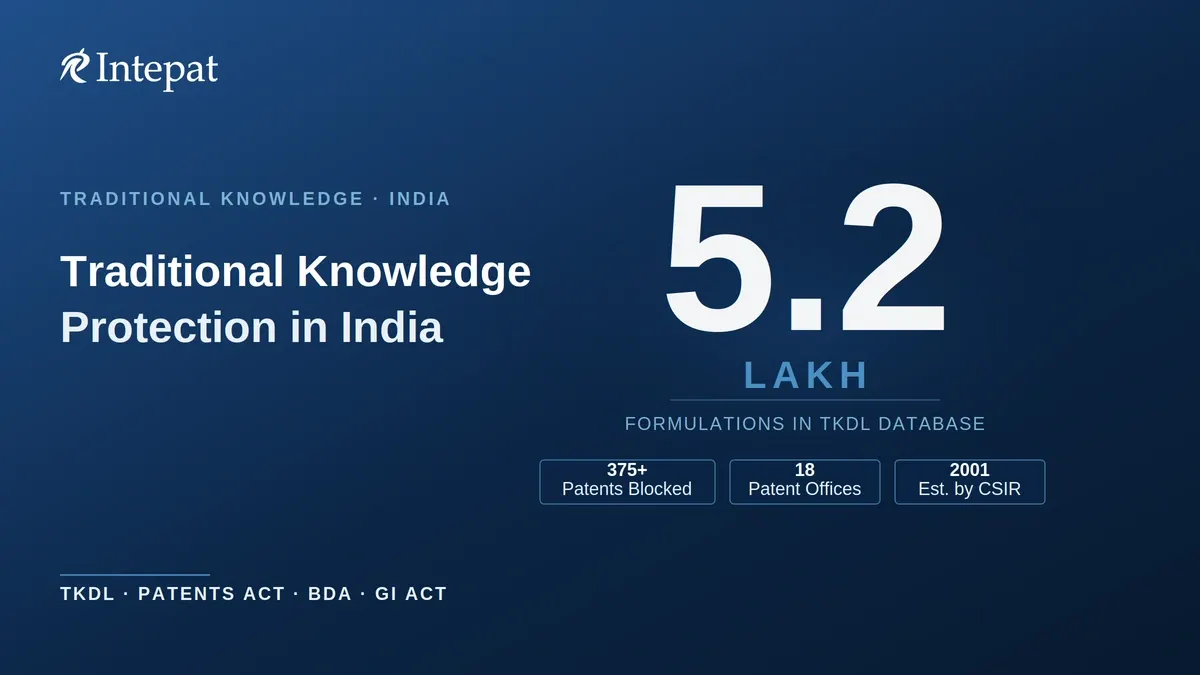
The TKDL currently contains, according to CSIR, over 5.2 lakh (520,000) formulations and practices drawn from Indian systems of medicine: Ayurveda, Unani, Siddha, Sowa Rigpa, and Yoga, sourced from over 270 authoritative traditional texts. The knowledge is translated and structured in five international languages: English, German, French, Japanese, and Spanish. It is classified using the Traditional Knowledge Resource Classification (TKRC), a purpose-built system built on the structure of the International Patent Classification (IPC) with approximately 25,000 subgroups, allowing patent examiners to search TKDL content using the same IPC codes they use for conventional prior art.
How It Works
The TKDL database is made available to patent offices through TKDL Access (Non-Disclosure) Agreements. Under these agreements, patent examiners may use the database for search and examination purposes only and may not disclose its contents to third parties, except where necessary to cite the prior art in an examination report or opposition.
As of February 2026, 18 patent offices globally have signed such agreements with CSIR, including the European Patent Office, the USPTO, the Japan Patent Office, the United Kingdom Intellectual Property Office, the Canadian Intellectual Property Office, the German Patent Office, the Indian Patent Office, the Russian Patent Office, and Brazil’s National Institute of Industrial Property (INPI), whose agreement was signed in February 2026.
Over 375 patent applications worldwide have been revoked, rejected, amended, withdrawn, or abandoned on the basis of TKDL prior-art evidence. Where a patent is nonetheless granted and infringement arises, separate enforcement routes apply; our guide on patent infringement in India covers the remedies available.
A representative version of the database, containing approximately 1,200 listings, is publicly accessible at tkdl.res.in. The full database is restricted to patent examiners at signatory offices.
Expanding Access
In August 2022, the Union Cabinet approved a policy to extend TKDL access beyond patent offices alone. Under a paid subscription model being phased in, the database will become accessible to Indian and international businesses in herbal healthcare, pharmaceuticals, nutraceuticals, and personal care; to research and educational institutions; to ISM practitioners; and to knowledge holders and their legal representatives. This expansion means the TKDL will serve a constructive role in research and product development, not only a defensive role against biopiracy.
GI Tags and Traditional Products
The Geographical Indications of Goods (Registration and Protection) Act 1999 came into force on 15 September 2003. It protects products whose qualities, reputation, or characteristics are linked to a specific geographical origin and to the traditional production methods associated with that origin.
Once a GI is registered, only authorised users from the designated geographical region may use the GI label on their products in relation to qualifying goods. Darjeeling Tea became India’s first GI-tagged product in 2004-05; our article on geographical indications in tea and coffee covers how that protection works in practice. Basmati Rice is also registered as a GI. A registered GI is valid for ten years and must be renewed to remain in force.
GI protection protects the registered indication and its authorised use; it does not protect the underlying traditional knowledge itself and does not regulate access to biological resources or impose benefit-sharing obligations. It prevents unauthorised parties from commercially exploiting the geographical and traditional reputation of the product. Ayurveda products often benefit from both GI and trademark coverage; trademarks and geographical indications in Ayurveda sets out how the two regimes interact. For enforcement options available to GI holders, see geographical indication protection.
WIPO Treaty 2024: What Changes Internationally
For decades, India and other biodiversity-rich countries argued that international patent law did not require applicants to disclose the use of genetic resources and traditional knowledge in their applications. An applicant could obtain a patent abroad based on Indian traditional knowledge without ever mentioning that connection.
After nearly 25 years of negotiations within WIPO’s Intergovernmental Committee on Intellectual Property and Genetic Resources, Traditional Knowledge and Folklore, member states adopted the WIPO Treaty on Intellectual Property, Genetic Resources and Associated Traditional Knowledge on 24 May 2024. The treaty is not yet in force: it requires 15 eligible parties to deposit instruments of ratification or accession, and as of June 2026 only two countries (Malawi and Uganda) have done so.
Once it enters into force and is implemented by a contracting party, the treaty requires patent applicants in that jurisdiction to disclose the country of origin or source of genetic resources, or the indigenous peoples or local community that provided associated traditional knowledge, where the claimed invention is based on such resources or knowledge.
Two important limitations define the treaty’s practical effect. First, patent offices are not required to verify the authenticity of the disclosure (Article 3.5). Second, under Article 5.3, no contracting party shall revoke, invalidate, or render unenforceable a granted patent solely on the basis of a failure to make the required disclosure. Except where fraudulent conduct or intent is involved, applicants must first be given an opportunity to rectify any failure to disclose before sanctions or remedies are applied. The treaty is also non-retroactive: no obligations apply to patent applications filed before the treaty’s entry into force in a contracting party’s jurisdiction.
For India, the treaty complements but does not replace the existing domestic framework. Section 3(p) and the TKDL address examination in India and prior art access internationally. The WIPO treaty, once operational, will address the disclosure gap at the filing stage in implementing jurisdictions.
Does This Apply to Me?
| Reader | What to Check |
| Foreign researcher or company | NBA approval required before accessing Indian biological resources or associated knowledge for research or commercial use |
| Indian company using biological resources commercially | Prior intimation to State Biodiversity Board required; exemptions apply for codified TK, cultivated medicinal plants, local communities, and registered AYUSH practitioners |
| Patent applicant in India | Section 3(p) applies; TKDL prior art will be cited against applications that repackage TK; BDA compliance required if invention involves Indian biological resources |
| Indian entity seeking an IPR abroad on Indian biological resources | Registration with NBA before grant; NBA approval at commercialisation; disclose origin in implementing jurisdictions once WIPO treaty is in force |
| GI producer or producer association | GI registration and renewal under the 1999 Act; enforcement against unauthorised use in India and relevant export markets |
Frequently Asked Questions
What is Section 3(p) of the Patents Act?
Section 3(p) of the Patents Act 1970 bars, as not being an invention, any claim that is, in effect, traditional knowledge or that merely aggregates the known properties of traditionally known components. An examiner at the Indian Patent Office can reject an application on this ground. A genuine inventive advance that goes beyond what the traditional knowledge teaches, and satisfies novelty and inventive step, may still be considered.
Is traditional knowledge always unpatentable in India?
No. Section 3(p) bars claims that merely repackage or aggregate traditional knowledge. It does not bar all patents that involve a traditional ingredient or practice. Where the applicant demonstrates a non-obvious inventive contribution beyond the known traditional use, and satisfies novelty, inventive step, and industrial applicability under the Patents Act, the application remains eligible. The line is between claiming traditional knowledge itself and claiming a genuine advance over it.
When is NBA approval required under the Biological Diversity Act?
Foreign entities and non-resident Indians need NBA approval before accessing Indian biological resources or associated knowledge, and before any resulting IPR is granted. Indian nationals and entities must register with the NBA before IPR grant and obtain NBA approval at commercialisation. The 2023 amendment exempts codified traditional knowledge, cultivated medicinal plants, local communities, and registered AYUSH practitioners from the prior intimation requirement.
What is the TKDL and who can access it?
The Traditional Knowledge Digital Library (TKDL), established in 2001 by CSIR and the Ministry of AYUSH, contains over 5.2 lakh traditional Indian formulations covering Ayurveda, Unani, Siddha, Sowa Rigpa, and Yoga in five international languages. As of February 2026, 18 patent offices hold access under non-disclosure agreements. A Cabinet decision in 2022 approved extension of access to researchers and businesses under a paid subscription model.
What is the difference between TKDL and GI protection?
The TKDL is a prior art database: it gives patent examiners evidence to reject applications that claim already-known traditional knowledge. GI protection (GI Act 1999) protects the registered name and authorised use of goods whose reputation is linked to a specific geographical origin. The TKDL operates in patent examination; GI protection operates in the marketplace. Neither replaces the other, and neither replaces the Biological Diversity Act’s access and benefit-sharing framework.
Has the WIPO 2024 Treaty on traditional knowledge entered into force?
No. The treaty was adopted on 24 May 2024 but requires 15 eligible parties to deposit ratification or accession instruments before it enters into force. As of June 2026, only Malawi and Uganda have deposited. Until the threshold is met and implementing parties adopt national measures, the treaty creates no operative patent disclosure obligations for applicants.
Disclaimer: This article is for general information only and does not constitute legal advice. The law in this area continues to develop, particularly following the Biological Diversity (Amendment) Act 2023 and the WIPO Treaty on IP, Genetic Resources and Associated Traditional Knowledge (adopted May 2024, not yet in force). You should obtain professional advice for your specific situation.