




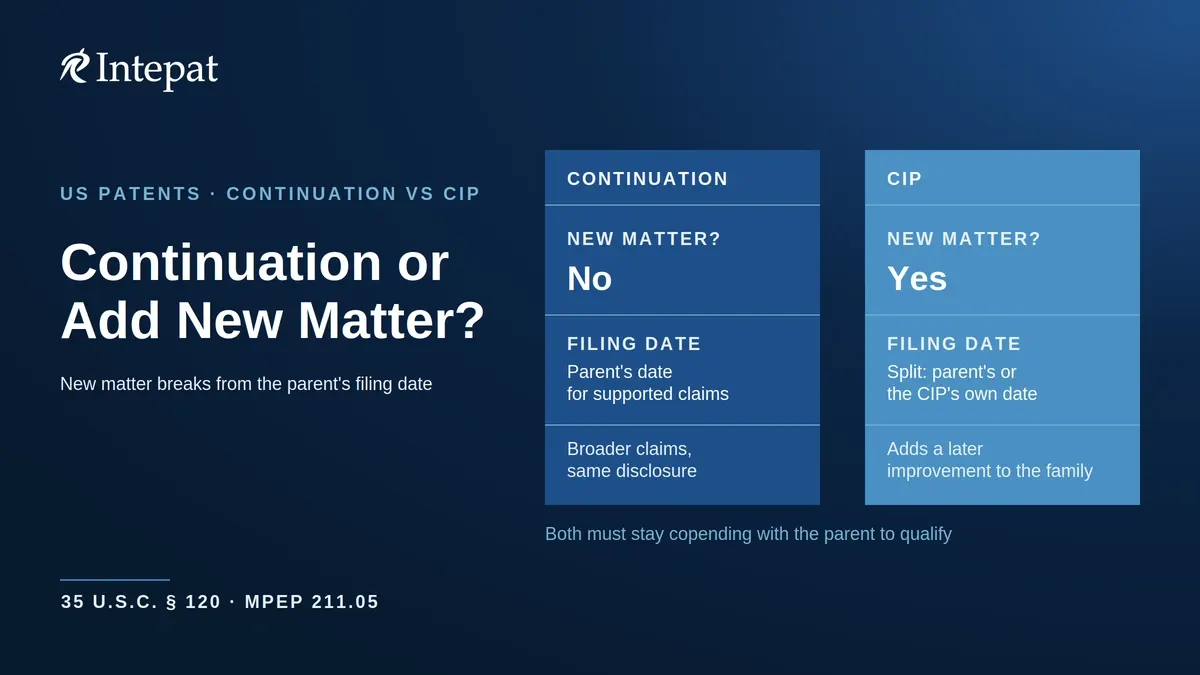
A continuation application refiles a pending US patent application’s original disclosure with a new set of claims and adds no new technical content. A continuation-in-part (CIP) does the opposite: it keeps the original disclosure but adds new matter, and only the new-matter claims lose the parent’s earlier filing date.
This continuation vs continuation-in-part distinction arises under US patent law and USPTO examining procedure, including for Indian companies and inventors pursuing US patents, a scenario covered separately below. India’s Patents Act 1970 has no continuation or continuation-in-part category; the nearest Indian mechanisms are the divisional application and the patent of addition (used for an improvement to an already-granted invention), and both work differently from a US continuation or CIP.
Quick answer
| Continuation | Continuation-in-Part (CIP) | |
| New matter allowed? | No | Yes |
| Filing date for claims | Parent’s filing date, for claims the parent’s disclosure supports | Split: parent’s date for supported claims; the CIP’s own date for new-matter claims |
| Typical use | New or broader claim scope on the same disclosure | Folding a later improvement or new data into the same family |
| Must be copending (still pending) with parent? | Yes; filing on the parent’s own issue date still counts | Yes; the same same-day exception applies |
| USPTO base fee, current (excludes attorney/agent fees) | $2,000 large / $730 small if e-filed, $1,000 if not / $400 micro | Same base rate as a continuation |
| Continuing Application Fee, if filed 6+ years after earliest benefit date | $2,700-$4,000 large / $1,080-$1,600 small / $540-$800 micro | Same rule; the fee is not CIP-specific |
Entity size in the table above (large, small, or micro) is a USPTO-specific test based on the applicant’s own size and ownership; it is separate from any Indian classification such as DPIIT startup recognition or MSME registration, and does not follow automatically from either. The FAQ below explains how it is determined.
What Is a Continuation Application?
A continuation application asks the USPTO to examine a new set of claims drawn from a prior-filed, still-pending application, without adding anything to the underlying disclosure. It is filed as a new nonprovisional application (the US equivalent of an Indian complete specification), names at least one inventor common to the parent, and cannot introduce new matter: everything the continuation claims must already be disclosed in the parent as filed. That description covers the application as a whole; whether any individual claim actually reaches back to the parent’s filing date is a narrower, separate question. A claim gets the parent’s filing date only if the parent’s disclosure genuinely supports that specific claim, the continuation is filed while the parent is still pending, and the continuation properly references the parent application.
Being still pending has one asymmetry worth flagging: filing on the same day the parent patent issues still counts, but if the parent is instead abandoned or its proceedings otherwise end without issuing, the continuation must be filed strictly before that happens (the FAQ below covers this split in more detail). An identical specification does not automatically carry every claim either: a broader or newly drafted claim can still fail to be supported by the parent’s disclosure even where the disclosure itself has not changed.
In practice, applicants often file a continuation to pursue claim scope an examiner did not allow in the parent, for example broader claims after narrower ones issue, or claims aimed at a competitor’s product identified after allowance. Where the parent instead received a restriction requirement (the examiner’s demand to elect one of several distinct inventions in the parent for examination), the invention that was not elected is pursued through a divisional, not a continuation, described next.
A divisional application is a related but distinct third option worth flagging here. Like a continuation, a divisional adds no new matter. Unlike a continuation, it is carved out to pursue an independent or distinct invention the parent already disclosed, typically after a restriction requirement, rather than to change claim scope on the same invention.
What Is a Continuation-in-Part Application?
A continuation-in-part repeats a substantial part of the parent’s disclosure but adds matter the parent never disclosed, commonly a later improvement, additional test data, or a new embodiment developed while the parent was pending. The new matter is what defines a CIP: it is filed the same way as a continuation, but the filing itself states that it is a continuation-in-part of the parent, and, as with a continuation, at least one inventor must carry over and the CIP must be filed while the parent is still pending.
The consequence that separates a CIP from a continuation shows up in the claims, not the filing mechanics. Claims fully supported by the parent’s original disclosure keep the parent’s filing date. Claims that rely on the newly added matter are entitled only to the CIP’s own filing date. A single CIP can therefore carry two different effective filing dates across its claim set, a mechanic covered in more detail below.
Continuation vs Continuation-in-Part: The Core Difference
The test that separates the two is simple to state and harder to apply in the moment: does the new application disclose anything beyond what the parent already discloses? If no, whatever new claims are filed remain a continuation, however different the claim language looks from the parent’s claims. If yes, even by one additional example, a new range, or a modified component, the filing is a continuation-in-part. That label describes the application as a whole; which individual claims still reach back to the parent’s filing date is then a separate, claim-by-claim question, covered next.
A common real-world trigger for a CIP is a change made after the parent was filed: a new excipient in a pharmaceutical formulation, an additional sensor in a device, or test data supporting a broader range than the parent disclosed. Any of these can be added through a CIP, but none through a continuation, however the claims are reworded, because a continuation cannot introduce anything that would count as new matter relative to the parent’s specification.
This is also why a continuation cannot fix a disclosure problem. If the parent’s specification does not support broader claim language, filing a continuation will not cure that; the application still cannot claim more than the parent disclosed. A CIP can add the missing support, but only at the cost of a later effective filing date for the claims that rely on it.
One scope note applies to both: a first nonprovisional that simply claims the benefit of an earlier US provisional is not itself a continuation or a CIP, even though it follows an earlier filing in the same family. The rules here concern a continuing relationship to a qualifying earlier nonprovisional or international application, not a benefit claim to a provisional.
Why the Priority-Date Split Matters for a CIP’s New Claims
Because new-matter claims in a CIP carry only the CIP’s own filing date, prior art that surfaced between the parent’s filing date and the CIP’s filing date becomes available against those claims, even though it could not have been used against the same claims had they been entitled to the parent’s earlier date. Claims fully supported by the parent’s original disclosure are unaffected; they keep the earlier date and the narrower prior art window that comes with it.
This is a live consideration in fast-moving fields. A competitor’s publication or an intervening sale that lands between the two filing dates can be cited against the new-matter claims. The applicant’s own public disclosure of the improvement may also count, though US law gives inventors a one-year grace period that can exclude their own disclosure if it falls within a year of the CIP’s own filing date, so this is fact-specific rather than automatic. Indian practice has a narrower parallel, not a general equivalent: a single Indian convention application can claim multiple priorities from two or more earlier applications, provided the inventions are related enough to count as one invention, but this route is specific to convention filings and is not a general Indian substitute for a CIP’s claim-by-claim split.
Patent Term: Why a CIP Does Not Reset Your 20-Year Clock
Patent term is 20 years from the US filing date, or, if the application formally references an earlier-filed application in the same family, 20 years from the date the earliest application in that chain was filed. This rule looks at the application as a whole, not at the individual claim. A CIP that references a parent filed two years earlier has its entire term, including the term covering its new-matter claims, measured from the parent’s filing date, not from the CIP’s own, later filing date.
The result is easy to miss when the new matter feels like a separate invention: the newly added claims do not get a fresh 20-year run just because their subject matter is new. For those specific claims, a CIP provides no earlier effective filing date than a standalone application (one that does not reference the parent at all) filed that same day would, since the new matter was never in the parent’s disclosure for the claim to reach back to. The trade runs the other way at the patent level: a standalone application’s term would run from its own, later filing date, while the resulting CIP patent’s term, covering every claim in it, is anchored to the parent’s earlier filing date. New matter filed through a CIP can end up worse off than the same matter filed standalone, not better off, once filing date and term are counted together. Whether that trade-off matters typically turns on how much of the parent’s term has already elapsed and how commercially important the new matter is expected to be over the years that remain.
One further consequence typically follows: a continuation, and a CIP whose claims are not patentably distinct from the parent’s, commonly draws an obviousness-type double patenting rejection against the parent, since they share its disclosure and priority date. Overcoming it takes a terminal disclaimer, which caps the new patent’s expiration to match the parent’s and keeps both enforceable only while commonly owned. A divisional has a statutory shield from this comparison; a continuation or CIP does not.
This does not apply to ordinary foreign priority. A US application claiming priority to an earlier Indian filing under the Paris Convention still has its term measured from its own US filing date; foreign priority is excluded from the term calculation. The term rule above is specific to continuations, CIPs, divisionals, and similar filings that formally reach back to an earlier US or international application in the same family.
Continuation or CIP vs a Request for Continued Examination
A continuation and a CIP are both new applications, each with its own application number and its own filing fee. A request for continued examination (RCE) is neither. An RCE reopens prosecution in the same application after it has closed, typically after a final rejection or a notice of allowance, on payment of a fee. No new application is created, no new filing date arises, and the application’s place in the priority chain does not change.
An RCE can carry claim amendments of its own, so claim scope alone does not decide between the two. What it cannot do is add new matter or create a second, copending application in the family, which is why a continuation or CIP is the route when new matter is needed or an application must stay pending alongside a related one heading toward issuance.
Cost flips with rounds, though the comparison depends on whether the Continuing Application Fee is in play. A first RCE is cheaper: $1,500 large / $600 small / $300 micro, against $2,000 / $730 e-filed ($1,000 paper) / $400 for a fresh continuation or CIP with no Continuing Application Fee due. A second or later RCE costs $2,860 / $1,144 / $572, still more than that same CAF-free continuation or CIP at every entity size, but once the Continuing Application Fee applies to the continuation or CIP, the comparison reverses and the second RCE becomes the cheaper option at every entity size. This comparison is fee-only: an RCE filed after a notice of allowance also generally stops patent term adjustment from accruing until the RCE is filed, a term cost a continuation or CIP filed instead does not carry. Applicants weighing another RCE against a continuing application typically work through that when preparing the office action response itself.
USPTO Filing Costs for a Continuation or CIP
The USPTO does not publish a separate base fee schedule for continuations or CIPs; they are filed, and charged, as ordinary utility nonprovisional applications. Under the USPTO fee schedule effective 19 January 2025, the combined basic filing, search, and examination fee is $2,000 for a large entity, $730 for a small entity that files electronically, and $400 for a micro entity.
| Fee | Large entity | Small entity | Micro entity |
| Basic filing fee | $350 | $140 ($70 if e-filed) | $70 |
| Search fee | $770 | $308 | $154 |
| Examination fee | $880 | $352 | $176 |
| Combined | $2,000 | $730 e-filed / $1,000 paper | $400 |
Verified as of August 2026. These figures cover only the USPTO’s own base fees; they exclude attorney or agent fees and any excess-claims or application-size fees, which apply the same way to a continuation or a CIP as to any other utility filing. A small entity that files electronically through the USPTO’s compliant e-filing system pays a reduced $70 basic filing fee rather than the standard $140, bringing the combined total to $730; filing on paper instead adds a separate $200 non-electronic filing fee, bringing a small entity’s paper-filed total to $1,000. The same paper-filing surcharge applies at every entity size ($400 large, $200 micro), though electronic filing is standard practice and avoids it.
One fee is not shared with an original filing, though. A continuation or CIP filed more than six years after the earliest US benefit date in its chain also owes a Continuing Application Fee: $2,700 large / $1,080 small / $540 micro for a six-to-nine-year gap, rising to $4,000 / $1,600 / $800 beyond nine years. Only benefit properly claimed to an earlier US or international application in the family starts this clock; an earlier provisional or foreign priority filing does not. Worth checking before filing late in a family’s life, since an original application never pays it. Confirm current figures with the USPTO before filing.
Filing Strategy for Indian Applicants Pursuing US Patents
An Indian company or inventor reaches this decision against a US filing that is already pending, whether filed through the Paris Convention route, as a PCT national phase entry, or filed directly from a pending international application without first entering the US national phase; the earlier application a continuation or CIP builds on can be a US nonprovisional or a qualifying international filing that named the United States. Where the applicant is resident in India, that US filing itself must first clear India’s foreign filing licence requirement: a resident generally cannot file the same invention abroad without the Controller’s written permission, unless a corresponding Indian application was filed at least six weeks earlier and no secrecy direction is then in force against it. An exception applies where the invention was first filed outside India by an applicant resident outside India, relevant where a foreign co-applicant is involved. Getting this sequence wrong carries real consequences: the Act treats an application filed abroad without the required clearance as grounds to deem the corresponding Indian application abandoned, exposes any resulting Indian patent to revocation, and is a criminal offence for the person responsible.
Because a CIP by definition adds subject matter beyond its parent application’s disclosure, that added material needs its own check against the Indian filing and clearance position before it goes into a US filing; clearance obtained for the original invention does not automatically extend to what the CIP adds. If the corresponding Indian application is still pending when the continuation or CIP is later filed in the US, a separate, ongoing duty applies: the Act requires the applicant to keep the Controller informed of that later foreign filing for as long as the Indian application remains pending. The continuation-versus-CIP choice itself sits entirely within the US prosecution that follows, and is governed by the US rules described above regardless of where the applicant is based.
What changes for an Indian applicant is coordination, not the substantive test. The decision to file a continuation or a CIP is typically made together with the US-licensed attorney or agent handling prosecution, informed by input from the Indian patent agent who manages the domestic filing, alongside whoever handles the foreign filing licence where that applies. Building that coordination in early, particularly before a new development is folded into a CIP, helps avoid a mismatch between what the Indian specification supports and what the US claims eventually rely on.
Choosing Between a Continuation and a Continuation-in-Part
The decision runs through two separate questions, not one. First: does the new application add any disclosure beyond what the parent already contains? That question is answered once, for the application as a whole, and determines whether the filing is a continuation or a CIP. Second, and separately: which claims are entitled to the parent’s filing date? That question is answered claim by claim, regardless of which type the application turns out to be.
If every claim the applicant wants to pursue can be supported by the parent’s existing disclosure, a continuation preserves the parent’s filing date at the standard utility filing cost. If new material is genuinely needed, a CIP keeps the supported claims on the parent’s date while adding the new material, which a wholly new application cannot do. But the new-matter claims themselves are not better off for having been filed as part of a CIP rather than a fresh application: they take only the CIP’s own, later filing date for prior-art purposes, while the resulting patent’s 20-year term still runs from the parent’s earlier filing date, because term is calculated for the application as a whole, not claim by claim. The new matter picks up a later priority date without any offsetting extension of term. Whether a CIP or a standalone application is the better route turns on which claims actually qualify for the parent’s date, how much prior art surfaced in between, and how much of the parent’s term has already run, not on a general preference for keeping one family together.
Where the underlying disclosure is strong and only the claim scope needs to change, an RCE or a continuation is typically the lower-cost path. Where a genuine improvement needs to be captured and kept in the same family, a CIP is the tool built for that, provided the applicant accepts that the new-matter claims gain nothing in filing date while the patent as a whole keeps running its term from the parent’s earlier filing. The right choice depends on facts specific to the invention, the competitive landscape, and how much of the parent’s term has already run, which is why this is typically worked through with the attorney or agent prosecuting the case rather than decided from the definitions alone.
Frequently Asked Questions
Generally not, but the cutoff depends on how the parent closes. Filing the same day the parent patent issues still counts; if it is abandoned or terminated without issuing instead, the continuation must be filed before that event. A reissue application may later fix a genuine defect, but it cannot add new matter or replace a missed continuation.
Yes. A continuation-in-part must name at least one inventor in common with the parent, the same rule that governs a continuation. The CIP can add joint inventors for the newly contributed matter, since new subject matter may involve people who did not work on the original disclosure.
USPTO rules require the reference within four months of the later filing or sixteen months of the parent’s, whichever is later. Missing it waives the benefit claim, though a petition can revive it with the fee and a delay statement; USPTO now wants more detail once the gap passes one year, tightened from two years in August 2026.
No. A patent’s 20-year term runs from the earliest US application in its priority chain that it formally references, not from the continuation or CIP’s own filing date. Filing one to keep prosecution alive never adds years to the resulting patent.
Large entity is the default. Small entity status covers independent inventors, small businesses, and nonprofits; micro entity status adds income and prior-filing limits, or a higher-education affiliation. The eligibility test is the same for any application type, but status is not automatic: a continuation or CIP needs its own new assertion or certification, even if the parent already had one.
Not at the USPTO fee counter. Both are filed as ordinary utility applications, so the same fees apply to each: currently $2,000 combined for a large entity, $730 for a small entity filing electronically ($1,000 on paper), and $400 for a micro entity. Any cost gap between the two usually comes from attorney time, not a USPTO fee.
Mainly timing. A continuation lets the applicant keep pursuing claims on the same disclosure post-allowance, without giving up the parent’s filing date. It uses a new application number and pays its own filing fee; each claim receives the parent’s filing-date benefit only to the extent the parent’s disclosure actually supports that claim, and the usual filing requirements are met.
This article explains US patent law on continuation and continuation-in-part applications as at August 2026 and is for general information only. It is not legal advice. USPTO fees, forms, and procedures change; confirm current figures with the USPTO before you file. For advice on your specific application, consult a US-licensed patent attorney or agent, coordinating through your Indian patent agent where a parallel Indian filing is involved.
Deadlines in this area are strict, and missing one, particularly the copendency and specific-reference deadlines described above, can result in the permanent loss of the parent’s filing date. The figures and timelines here are indicative and change; do not rely on them for a specific filing without confirming the current position and, where the stakes warrant it, taking professional advice.