




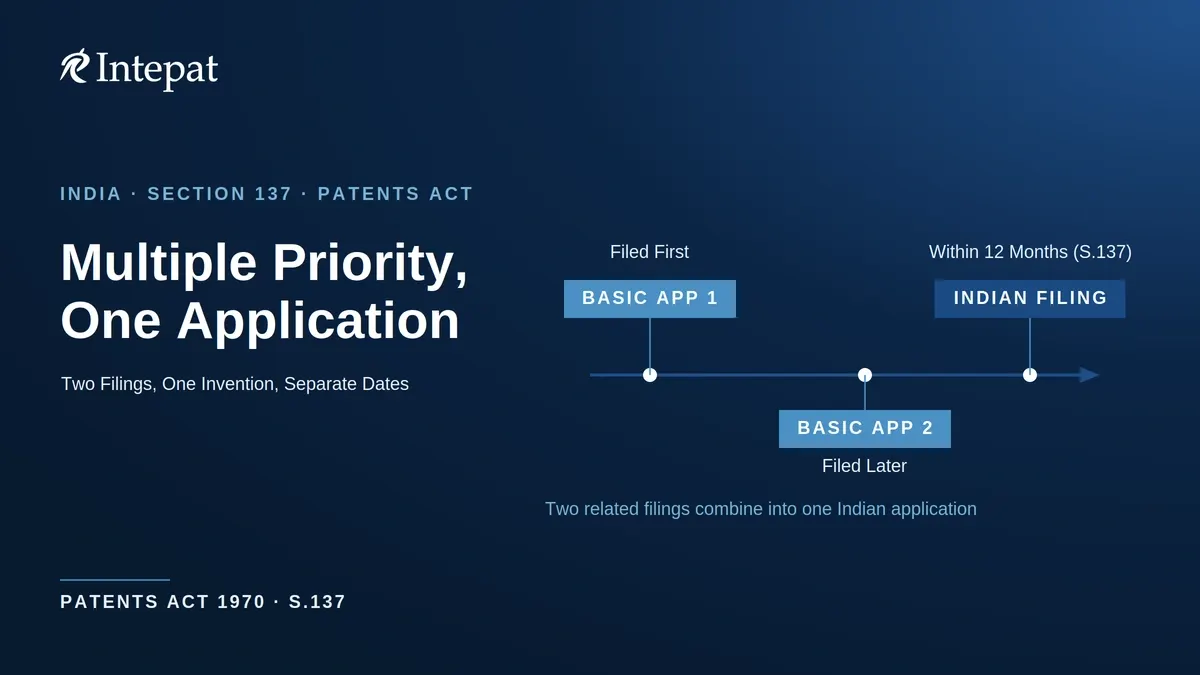
A multiple priority patent application under Section 137 combines two or more earlier applications, filed abroad, into one Indian convention application, where the inventions are related closely enough to form one invention. Each claim then takes its priority date from whichever earlier application first disclosed the matter that claim relies on.
This is a convention application in India under Chapter XXII of the Patents Act, 1970, and Section 137 Patents Act mechanics shape how the complete specification gets drafted, so the analysis below works from the operative sections rather than general Paris Convention theory.
| Quick answer: |
| Section 137 lets an applicant combine two or more related basic applications, filed in one or more convention countries, into a single Indian application within 12 months of the earliest of them. Each claim’s priority date is fixed at the date the matter that claim relies on was first disclosed in whichever basic application discloses it, provided the inventions are related closely enough to constitute one invention. A claim covering a new combination not disclosed as such in any single basic application does not get a blended earlier date from this section. |
What Counts as a Multiple Priority Patent Application Under Section 137
A multiple priority patent application arises under Section 137(1): two or more applications for patents made in one or more convention countries, for inventions “so related as to constitute one invention.” An applicant meeting this test may file one Indian application within 12 months of the earliest basic application.
This is narrower than simply citing more than one prior filing. Inventions that are not related closely enough to constitute one invention do not qualify for Section 137 by being bundled into one Indian filing. A narrower, related category, cognate inventions or one a modification of another, has its own route under Section 135(2), covered below; genuinely unrelated inventions fit neither provision and cannot be combined into a single convention application under either one.
How the Priority Date Is Fixed When a Claim Draws on More Than One Basic Application
Section 137(2) fixes the priority date for each claim once a Section 137 application is filed: the date the matter that claim relies on was first disclosed, in whichever basic application discloses it. This works claim by claim.
Different claims in the same specification can draw their priority date from different basic applications, as long as each claim’s own matter is actually disclosed in the application it draws from. What the section does not say is that a single claim covering a new combination gets split into per-feature dates. A combination is one piece of matter; if no single basic application discloses that combination as such, the claim does not automatically inherit an earlier date from either application.
Section 137(3) defines when matter is treated as disclosed in a basic application: it must have been claimed or disclosed in that application itself (other than by way of disclaimer or acknowledgment of prior art), or in a document the applicant submitted abroad in support of, and at the same time as, that application. That timing is fixed: a supporting document submitted after the basic application does not qualify, regardless of when its copy later reaches India. What can follow later is only the copy: a copy of that contemporaneous supporting document must reach the Indian patent office with the convention application, or within the period prescribed for that purpose, or no account is taken of the disclosure it contains.
Section 11(6) confirms that this is not a side rule: in cases not otherwise governed by section 11’s other subsections, a claim’s priority date is the date of filing of the complete specification, “subject to the provisions of section 137.” Where Section 137 is engaged, it displaces that default for the claims it covers.
Section 137 vs Section 135(2): One Invention Built from Filings, or Several Inventions in One Application
Section 137 and Section 135(2) both let an applicant combine more than one convention filing into a single Indian application within 12 months, and the two get conflated in practice, but they answer different questions and change how the specification should be drafted.
Section 135(2) covers a different situation: applications for protection made in one or more convention countries for two or more inventions that are cognate, or where one is a modification of another. Here, a single convention application may bundle them within 12 months of the earliest filing, but the inventions remain separately identifiable, subject to Section 10 (unity of invention), and the proviso to Section 135(2) charges fee as if separate applications had been filed for each invention, with Section 136(1)(b)’s date-and-country disclosure requirement applying separately to each.
Section 137 is not about bundling separate inventions. It is one invention, meeting Section 137(1)’s own relatedness test, whose complete specification draws on matter disclosed across different basic applications. Section 135(2) is not a fallback for whatever fails that test: it applies specifically to cognate inventions or a modification of another, and stays subject to Section 10’s unity requirement regardless of which route is used.
Getting this wrong at drafting stage matters at examination. A specification drafted as if it fell under Section 137 when the subject matter is really two cognate inventions can draw a unity objection under Section 10; conversely, treating genuinely interlinked subject matter as separate inventions under Section 135(2) can lose the earlier priority date for claim elements that were, in fact, disclosed earlier in a different basic application. For a broader look at how filing choices at this stage affect prosecution and cost, see our guide on types of patent applications in India.
The 12-Month Deadline and the “One Invention” Requirement
The 12-month period under Section 137(1) runs from the date the earlier or earliest of the related basic applications was made, the same trigger used for ordinary convention applications under Section 135(1). There is no separate, longer window for multiple priority applications; combining basic applications does not extend the clock.
The Act does not define “so related as to constitute one invention” with a numeric test, and Section 137(1) does not cross-reference Section 10(5)’s “single inventive concept” language for unity of invention; the two provisions use different words, and nothing in the Act establishes them as the same test. What is certain is that a Section 137 filing’s claims remain independently subject to Section 10 at examination, regardless of how the Section 137(1) relatedness question is resolved. Applicants assembling a Section 137 filing from basic applications in more than one country should assess relatedness before filing: a defective combination is not a guaranteed fix later, since a divisional under Section 16 is available only before grant and cannot introduce matter beyond what the parent specification already discloses. Our guide to the PCT route for filing in India covers the alternative path where the applicant wants to defer this assessment through the international phase.
Government Fee for Each Additional Priority Claimed
The government fee for a multiple priority patent application carries a multiplier under the current First Schedule, Table I, Entry 1: natural persons, startups, small entities, and educational institutions pay a multiple of Rs 1,600 for every multiple priority on e-filing; other applicants pay a multiple of Rs 8,000.
Physical filing multiplies Rs 1,750 and Rs 8,800. Verified as of August 2026.
This is a single combined fee tier for natural persons, startups, small entities, and educational institutions at e-filing, not three separate rates. For the full fee schedule this multiplier sits within, see our guide to patent costs in India.
Worked Example
An applicant files two related applications: a European application disclosing and claiming feature A, and a French application, filed a few months later, disclosing and claiming feature B, where A and B are part of one overall invention meeting the Section 137(1) relatedness test.
The applicant files a single Indian application within 12 months of the European filing, with claim 1 drawn to feature A and claim 2 drawn to feature B.
Under Section 137(2), claim 1 takes the European filing date as its priority date, since feature A was first disclosed there, and claim 2 takes the French filing date, since feature B was first disclosed there. Each claim’s priority date tracks the basic application that actually discloses what that claim covers. A claim combining A and B into one new claim would be a different question: unless that specific combination is itself disclosed in one of the basic applications, it does not automatically inherit either date under Section 137(2), and would need to rely on a later disclosure date or the complete specification’s filing date.
For the general filing mechanics that this fits into, our step-by-step guide to patent filing procedure in India covers the surrounding process from specification to e-filing.
Frequently Asked Questions
Yes. Section 137(1) applies where the basic applications were made “in one or more convention countries,” so combining filings from different countries into one Indian application is expressly within scope, as long as the inventions are related closely enough to constitute one invention rather than two separate ones.
No. The 12 months under Section 137(1) runs from the date the earlier or earliest basic application was made. Combining more than one basic application does not add time; it uses the same trigger date as an ordinary convention application.
Section 137(3) fixes that timing at the basic application stage; it cannot be cured later. A copy of the document may reach the Indian patent office later, with the convention application or within the prescribed period, but only if the original was contemporaneous. Matter failing this test falls back to a later disclosure date or the specification’s filing date, subject to Section 11.
No. That situation, two or more cognate inventions or one being a modification of another, is governed by Section 135(2), which remains subject to the unity-of-invention requirement in Section 10 and charges fee as if separate applications had been filed. Section 137 concerns one invention whose claims draw on matter first disclosed across different basic applications.
This article explains the law on multiple priority patent applications in India as at August 2026 and is for general information only. It is not legal advice. Government fees, forms, and procedures change; confirm current figures with the Indian Patent Office before you file. For advice on your specific invention, consult a registered patent agent.