




| Quick answer |
| You do not need to register copyright for your website to be protected. Indian copyright subsists automatically from creation under Section 13 of the Copyright Act 1957. Registration is evidentiary; it makes infringement easier to prove, not the right to sue possible. The larger practical issue is usually ownership: if an agency or freelancer built the site, you need a written assignment under Section 19, not just an invoice. Copyright in an original website subsists automatically under Section 13 of the Copyright Act 1957 from the moment of creation. Registration is not required for copyright to exist, and it is not a precondition to suing for infringement in India. What registration does is provide a useful evidentiary advantage in litigation. |
What a website actually contains as copyright subject matter
A website is not a single copyright work. It is a layered bundle of works, and each layer is protected as a different category under Section 13 of the Act. The legal consequences flow from the category, not from “the website” as a whole.
Source code, including front-end markup, scripts, server-side logic, and database schemas, is a “literary work”. Section 2(o) provides that literary work includes computer programmes, tables, and compilations including computer databases. Visual design, illustrations, icons, photographs, and original graphic elements are “artistic works” under Section 2(c). Written content (product descriptions, blog posts, FAQs, terms of service) is an original literary work in the ordinary sense. Embedded videos are “cinematograph films” under Section 2(f); embedded audio and podcasts are “sound recordings” under Section 2(xx). Each layer carries its own copyright with its own term and first owner, set out in our overview of Indian copyright law.
The layered analysis matters because protection is asserted layer by layer. An infringer who lifts your blog content has copied a literary work; an infringer who rehosts a video has copied a cinematograph film. Remedies converge, but pleadings, evidence, and any registration certificates are layer-specific. One carve-out: under Section 15(2), if a design capable of being registered under the Designs Act 2000 is applied to an article and reproduced industrially more than fifty times, copyright in that design ceases. This rarely bites for a typical website, but it matters where the site doubles as a catalogue for industrially produced articles.
Who owns the copyright in a website built by someone else
Many businesses do not ask this question early enough, and it is more important than registration. Section 17 makes the author the first owner. The provisos carve out two routes by which someone other than the author becomes first owner. Both are narrower than commercial intuition assumes.
Section 17(c) covers work made in the course of the author’s employment under a “contract of service or apprenticeship”. “Contract of service” is the labour-law term for employment, not the broader idea of paid engagement. An employee on payroll developing the website as part of their job falls within Section 17(c); the employer is first owner without any further document, subject to any contrary agreement.
A freelancer, agency, or independent contractor engaged on a contract for services does not. For most website deliverables (code, written content, UI copy, layouts, bespoke design) they retain first ownership, even after full payment and delivery. An invoice marked “full payment”, a non-disclosure agreement, or an oral assurance does not move ownership. One statutory exception runs the other way: under Section 17(b), the first owner of a photograph, painting, portrait, engraving, or cinematograph film made for valuable consideration at someone’s instance is that person, unless the contract says otherwise. Commissioned product photography and commissioned video for the website therefore default to the business, not the studio.
The route by which ownership passes from a contractor to the business that paid them is Section 19, which requires a written instrument signed by the assignor, specifying the work, the rights assigned, the duration, the territory, and the consideration. A clause inside a master services agreement can satisfy Section 19, but the clause has to be there and it has to be signed; the mechanics of a compliant assignment are in our guide to copyright assignment agreements. A business that commissioned a website without a Section 19 assignment later finds that the agency owns assets the business has been treating as its own. Auditing the assignment chain is the first thing to fix on a website IP review; it sits ahead of any registration question.
A practical website-ownership checklist runs as follows:
- Developer or agency master services agreement with a copyright assignment clause satisfying Section 19
- Employee IP clause confirming Section 17(c) ownership for in-house build work
- Freelance designer assignment for layouts, UI, and bespoke graphics
- Photographer assignment or licence for product and editorial photography
- Videographer assignment for commissioned video content
- Stock image, stock video, and music licences retained, with permitted-use scope verified
- Font licences appropriate to web embedding
- Git or version-control records of authorship and commit dates
- Content author records (CMS user logs, draft files, editorial credits) for written content
What copyright registration changes, and what it does not
Registration under Section 45 of the Act and Rule 70 of the Copyright Rules 2013 is voluntary. The Indian position differs sharply from the US position that some older online guides assume.
What registration does, under Section 48, is make the Register of Copyrights prima facie evidence of the particulars entered. The registered owner has a useful evidentiary advantage in court because the entries are presumed correct. The presumption is rebuttable, and a defendant can still challenge originality, authorship, ownership, or date of creation on the facts; what registration removes is the foundational proof burden that an unregistered owner would otherwise carry to set up the claim.
What registration does not do is create copyright. Section 13 confers copyright on every original literary, dramatic, musical, and artistic work, every cinematograph film, and every sound recording that meets the Section 13(2) conditions. Copyright exists from the moment a website’s code, design, and content come into being. No formality is required.
Registration is also not a precondition to suing for infringement. Indian courts have consistently treated the right to sue under Sections 51 and 55 as independent of prior registration. Older articles that say “registration is mandatory to file an infringement suit” import the US rule under 17 USC 411, which has no Indian equivalent. Two further US positions should also be set aside: there is no Indian equivalent of statutory damages, and no five-year evidentiary window of the kind 17 USC 410(c) creates around timely registration. Civil damages in Indian copyright cases are compensatory, calibrated to actual loss or accounts of profits under Section 55.
When registration is worth the cost
The decision turns on three factors. Litigation likelihood: a site hosting substantial original content the business expects to enforce (course material, proprietary editorial, distinctive UI design, original photography) gets real value from the Section 48 prima facie effect; a brochure-style site with thin original content gets less. Evidentiary durability: internal authorship records (commit logs, design files with metadata, dated drafts) are vulnerable to challenge if the business itself controls them; a registration certificate, issued after the 30-day objection window under Rule 70(10), is independent third-party evidence with a fixed date. Source-code disclosure trade-off: under Rule 70(5) of the Copyright Rules 2013, an application for registration of a computer programme must be accompanied by at least the first 10 and last 10 pages of source code, or the entire source code if less than 20 pages, with no blocked-out or redacted portions; businesses whose code embodies real competitive value should consider whether code is better held as a trade secret while only the artistic and literary content is registered. The source-code question is covered more fully in our note on copyright protection for app developers and software.
The table below maps the common situations to a decision:
| Website type or asset | Register? | Reason |
| Brochure site, standard layout, thin original content | Usually not essential | Internal evidence is adequate; the Section 48 benefit is modest |
| Site with substantial original articles, courseware, or editorial | Yes, register the content | Easier enforcement against scrapers and republishers |
| Custom software platform or SaaS front end | Selective | Weigh the Rule 70(5) source-code deposit against trade-secret protection |
| Original product photography or distinctive design assets | Consider registration | Useful for platform takedown and infringement suits |
| Site built by agency without a Section 19 assignment | Fix the assignment first | Registration in the agency’s name complicates later enforcement |
The fee is modest. Item 9 of the Second Schedule sets the application fee at Rs 500 per work for a literary, dramatic, musical, or artistic work, and Rs 2,000 per work where an artistic work is used or is capable of being used in relation to goods or services, which catches logos and trademarks expressed as artistic works. The full schedule is in our cost of registering copyright in India guide.
How website registration works in practice
The procedure is set by Rule 70 of the Copyright Rules 2013. The application is filed in Form XIV, online through copyright.gov.in or in person at the Copyright Office in New Delhi. Each application is in respect of one work only (Rule 70(2)), so a website registered comprehensively typically uses separate applications for the source code (literary work), the visual design (artistic work), and the original written content (literary work).
The application is signed by the applicant, who may be the author or the owner of the right. Where the applicant is the owner rather than the author, a no-objection certificate from the author is enclosed under Rule 70(3). For unpublished works, two copies of the work accompany the application under Rule 70(4). For computer programmes, the source-code deposit under Rule 70(5) takes the format described above.
Once filed, the Registrar of Copyrights waits a mandatory thirty days under Rule 70(10) for any objections. If none arrive and the particulars are correct, the entries are made in the Register. If objections are filed, the Registrar holds an inquiry under Rule 70(11) and the applicant has an opportunity of hearing before any rejection under Rule 70(12). The full procedural workflow is set out in our copyright registration procedure in India article.
The limits of copyright on a website
Copyright protects the expression, not the idea, not the function, and not the look-and-feel as such. The idea-expression dichotomy limits what a website owner can stop. A competitor who studies your site and builds a functionally similar product, with the same features, workflow, and business model, but with original code and original visual design, does not infringe your copyright. Functionality is unprotected. Conventional layouts (a horizontal navigation bar, a sticky CTA, a three-column features grid) are unprotected; only original creative choices are. Graphical user interface elements sit on contested ground, treated in our note on copyright in graphical user interfaces.
Two consequences follow. Copyright is one layer of a website’s IP protection, not the whole: distinctive brand names, logos, and source identifiers need trademark protection, and novel technical methods may, subject to the Section 3(k) exclusion for computer programmes per se, need patent analysis. Where a website’s visual identity is also being applied to goods or articles, the design route under the Designs Act 2000 may be the right register, with the Section 15(2) carve-out in mind.
Using the copyright notice on the website
The © notice in many website footers is not a precondition to copyright in India. Copyright exists whether the notice is displayed or not. The notice puts visitors on notice of the claim, supports the “knowingly” element in any later Section 63 prosecution, and answers a defendant’s plea of innocent infringement, which under the proviso to Section 55(1) limits remedies where the defendant proves no reasonable ground to believe copyright subsisted. A useful notice records the calendar year of first publication, names the owner, and reserves rights. Technological protection measures under Section 65A and Rights Management Information under Section 65B sit alongside the notice; circumvention of technological measures with infringing intent, and removal or alteration of RMI metadata, are independent offences with their own penalties.
Enforcement options when your website is copied
The remedies scale with the seriousness of the copying and the speed required. A cease-and-desist letter to the infringer and (where appropriate) to the hosting platform is the usual first step. For online copying, the fastest practical first move is often a platform IP complaint to the hosting provider, CDN, search engine, or social platform, with screenshots, URLs, ownership records, and a clear infringement comparison. The legal basis combines the platform’s own IP policy, the IT (Intermediary Guidelines and Digital Media Ethics Code) Rules 2021, and the safe-harbour conditions of Section 79 of the Information Technology Act 2000. After Shreya Singhal (2015), “actual knowledge” under Section 79 was read down for general intermediary content, but the Delhi High Court in MySpace v. Super Cassettes (2016) treated specific copyright notices differently; contested matters may still need a court order. Procedural detail is in our guide to website takedown actions against online IP infringement.
A civil suit under Section 55 provides injunction, damages or accounts of profits, and delivery up of infringing copies. Section 62 lets the suit be filed in the district court where the plaintiff resides or carries on business. Criminal proceedings under Section 63 are available for knowing infringement of copyright, with imprisonment from six months to three years and fines from Rs 50,000 to Rs 2 lakh. Section 63B is a narrower provision targeted at knowing use of an infringing copy of a computer programme on a computer; it bites where website source code has been copied and run as software. A systematically copied site often combines a platform IP complaint for immediate harm, a civil suit for injunction and damages, and a parallel criminal complaint where the infringement is knowing and commercial.
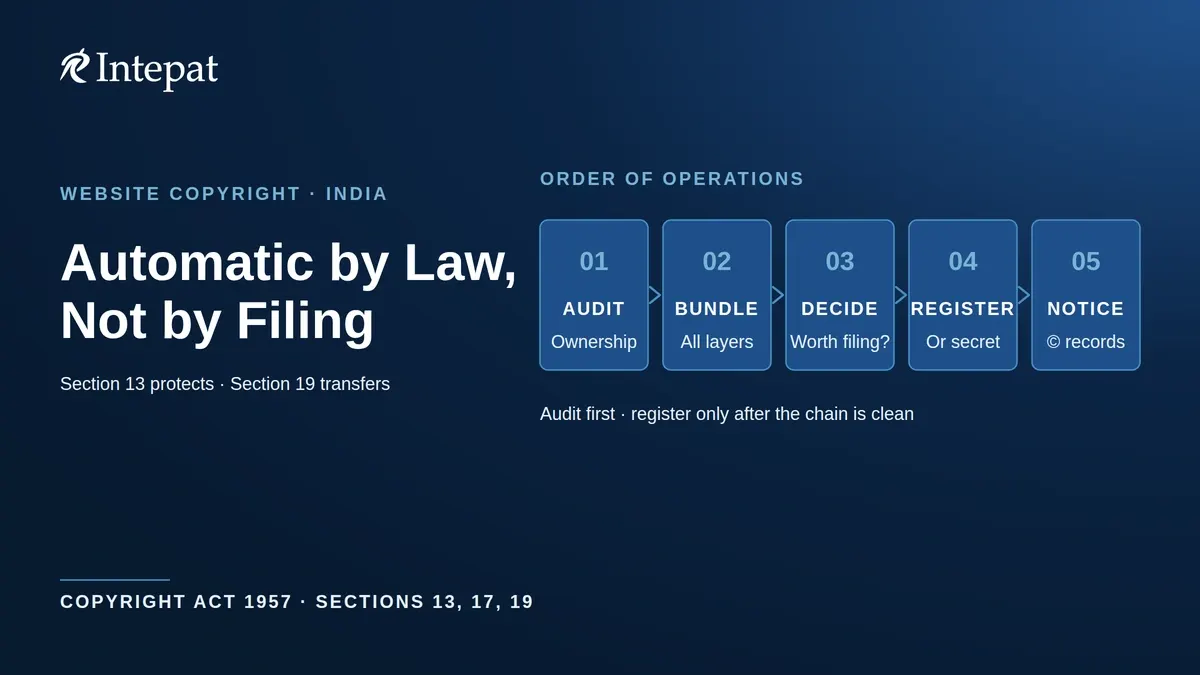
The order of operations for protecting a website
- Audit the ownership chain. If the site, or any layer of it, was built by an external party, look for a written assignment under Section 19. If it is missing, fix that before anything else. An assignment can be executed at any time, but waiting until a dispute arises is the wrong time to find the gap.
- Treat the site as a bundle of works. Code, design, and original content are different categories with different first owners, different terms, and different registration treatments.
- Decide on registration after the ownership chain is clean. Registration that names the wrong owner because the assignment was never executed creates a Register entry that misstates the position and can complicate later enforcement.
- Decide what to register and what to hold as a trade secret. The source-code deposit under Rule 70(5) is not trivial; a clear-eyed view of what is competitively sensitive should drive the decision.
- Put a copyright notice on the site and document the dates and authors of major iterations so the evidentiary record stands on its own even if registration is deferred.
- When copying happens, choose the remedy by the harm. Takedown for speed; civil suit for injunction and damages; criminal complaint where the infringement is knowing and commercial.
Frequently asked questions
No. Copyright in an original website subsists automatically under Section 13 of the Copyright Act 1957 from the moment of creation. Registration is voluntary and serves an evidentiary function under Section 48, making the Register prima facie evidence of the particulars entered. Registration is not a precondition to suing for infringement.
The agency or freelancer is the first owner under Section 17 of the Copyright Act 1957, because they work on a contract for services, not a contract of service. Payment of invoices does not transfer copyright. A written assignment under Section 19 of the Act, signed by the agency, is what transfers ownership to the business that commissioned the site.
A website is a bundle of works under Section 13 of the Copyright Act 1957. Source code, including front-end and back-end code, is a literary work under Section 2(o). Visual design, illustrations, and photographs are artistic works under Section 2(c). Written content is a literary work. Videos are cinematograph films; audio is a sound recording.
Under Item 9 of the Second Schedule to the Copyright Rules 2013, the application fee is Rs 500 per work for a literary, dramatic, musical, or artistic work, and Rs 2,000 per work where an artistic work is used or is capable of being used in relation to goods or services. A website registered as code, design, and content separately pays the fee per work.
No. Rule 70(2) of the Copyright Rules 2013 requires every application for registration to be in respect of one work only. A website is registered by filing separate applications for the source code (literary work), the visual design (artistic work), and the original written content (literary work). Each application has its own fee and certificate.
Under Section 22 of the Copyright Act 1957, copyright in literary, dramatic, musical, and artistic works published within the author’s lifetime subsists until sixty years from the beginning of the calendar year following the author’s death. Under Sections 26 and 27, copyright in cinematograph films and sound recordings subsists for sixty years from the year following first publication.
Disclaimer. This article explains the position on copyright protection for websites under the Copyright Act 1957 and the Copyright Rules 2013 in India, as at May 2026. Fees, forms, and Registry practice change from time to time; confirm current figures on the official Copyright Office website at copyright.gov.in before filing. This is general information, not legal advice. For advice on your specific facts, consult a qualified IP practitioner.