




Copyright registration fees in India are set by the type of work: Rs 500 for a literary, dramatic, musical, or artistic work; Rs 2,000 for a sound recording; and Rs 5,000 for a cinematograph film. These are government fees prescribed in the Second Schedule to the Copyright Rules 2013, charged per work, with no separate rate for companies or startups.
- Quick answer
- Literary, dramatic, musical, or artistic work: Rs 500 per work
- Sound recording: Rs 2,000 per work
- Cinematograph film: Rs 5,000 per work
- Artistic work used on goods or services (logo, label, packaging): Rs 2,000 per work, plus a mandatory trade-mark search certificate
- One work per application, one fee per work
- Registration is voluntary; copyright in an original work of the kind recognised by the Act exists from the moment of its creation
All figures in this article are government fees only. They exclude professional fees, the cost of obtaining a trade-mark search certificate for logo or artwork filings, and any costs that may arise if the Copyright Office raises a discrepancy or a third party files an objection.
This article covers government copyright registration fees in India under the Copyright Act 1957 and the Copyright Rules 2013. All figures are verified against the Second Schedule to the Copyright Rules 2013 as at June 2026.
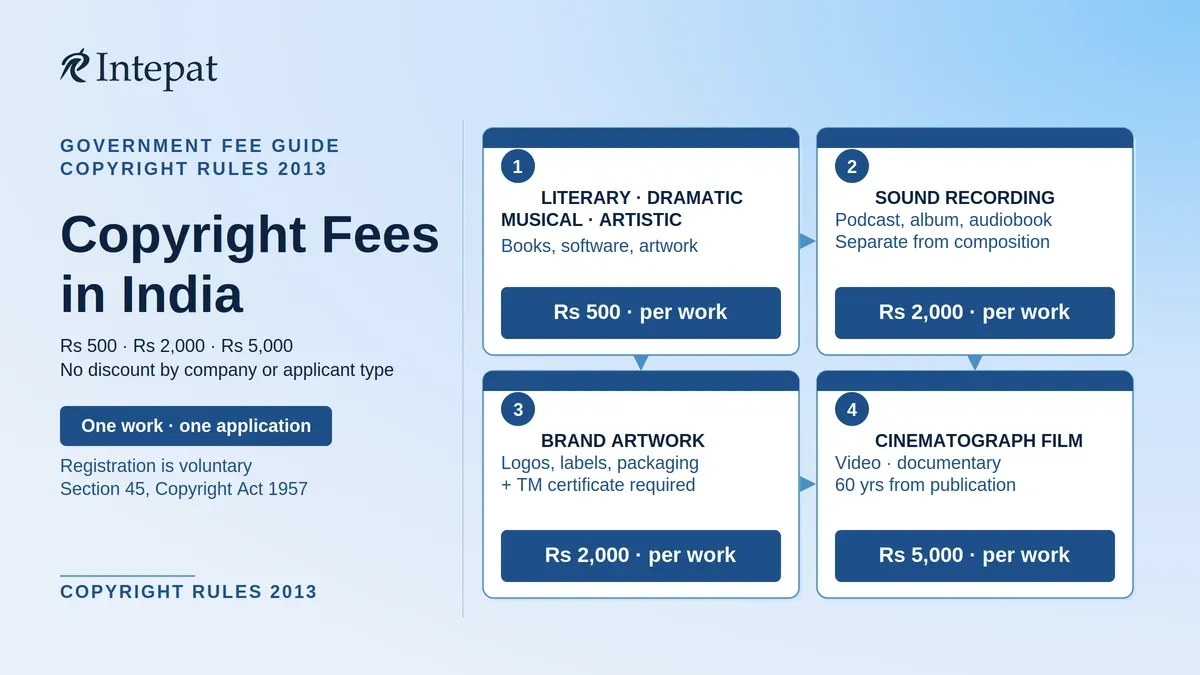
Copyright registration fees in India, by type of work
The government fee depends entirely on the category of work. The Second Schedule to the Copyright Rules 2013 prescribes the following fees for registration applications under Section 45 of the Copyright Act 1957 (verified as at June 2026):
| Work type | Government fee |
| Literary, dramatic, musical, or artistic work | Rs 500 per work |
| Artistic work used or capable of use with goods or services | Rs 2,000 per work |
| Sound recording | Rs 2,000 per work |
| Cinematograph film (any recorded moving-image work, including video films) | Rs 5,000 per work |
Each application must cover one work only; a separate application and a separate fee are required for each additional work.
Software is a “literary work” under the Copyright Act 1957 and registers at the Rs 500 rate. The application must include at least the first ten and last ten pages of source code, or the complete source code where it is fewer than twenty pages long, with no blocked-out or redacted portions. For a closer look at how copyright protects software and app code, see our guide to copyright protection for app developers and software.
Musical compositions and sound recordings are different works and attract different fees. A musical work is the composition itself, the melody and any graphical notation. A sound recording is the recorded performance. Registering both for a single song requires two separate applications: Rs 500 for the composition and Rs 2,000 for the recording. For a full breakdown of the rights in each, see our article on registering copyright in your musical work.
Why there is no company, startup, or MSME discount
A common question is whether companies pay more, or whether startups or MSMEs qualify for a reduced rate. Neither position is correct under the Copyright Rules 2013.
The official fee schedule sets the fee by type of work, not by the legal status or size of the applicant. A founder registering a novel and a large publisher registering the same category of work pay the same Rs 500. There is no startup concession, no MSME tier, and no individual-versus-entity split for copyright registration in India. This is different from the patent and trademark regimes, where the fee schedule expressly distinguishes between natural persons, startups, and companies.
The Rs 2,000 fee for an artistic work used on goods or services is also not a company rate. It is a separate substantive category triggered by the commercial use of the artwork, not by the type of applicant. A sole trader whose logo appears on product packaging pays Rs 2,000 for that registration, just as a corporation would.
For a comparison of how copyright costs and protection sit alongside trademark and patent, see the differences between trademarks, copyrights, and patents.
One work, one application, one fee, and how that adds up
Rule 70(2) of the Copyright Rules 2013 requires each application to be in respect of one work only. This rule matters practically when you hold multiple works.
A music producer who releases an album holds separate copyrights in the musical composition and in the sound recording of each track. Registering the composition and the sound recording are two distinct applications at two different fee rates: Rs 500 for the musical work and Rs 2,000 for the sound recording. An album of ten tracks where the producer wants both registered runs to twenty applications with a combined government fee of Rs 25,000, before any professional fees.
A startup with a website typically holds several separately copyrightable works: the written content (a literary work), the visual design (an artistic work), any original background music (a musical work), and promotional videos (cinematograph films). Each requires its own application and its own fee. Bundling them into a single filing is not permitted.
For the step-by-step process of preparing and filing each application, see our copyright registration procedure guide.
| Work out your copyright budget |
| Multiple works, different categories, one firm to handle them all. |
| Talk to us |
The extra cost hidden in logos and other artwork used on products
Registering a logo or label that appears on goods or services costs more than registering standalone artwork. The government fee is Rs 2,000 per work rather than Rs 500, and the application must meet an additional requirement.
Under Rule 70(6) of the Copyright Rules 2013, an application to register an artistic work that is used on, or is capable of being used on, goods or services must include a certificate from the Registrar of Trade Marks confirming that no identical or deceptively similar trade mark has been registered by any person other than the applicant. This requirement reflects the proviso to Section 45 of the Copyright Act 1957: an artistic work that could function as a trade mark receives closer scrutiny before registration is granted.
In practice, the applicant must apply to the Trade Marks Registry for the required certificate before filing the copyright application. The certificate is required even where the applicant has already registered the same logo as a trade mark, because the statutory check is not limited to the applicant’s own registration: the certificate must confirm that no identical or deceptively similar trade mark has been registered, or applied for, by any person other than the applicant. Where no such conflicting mark exists, the certificate is issued by the Registry on that basis.
For a detailed look at how copyright and trade-mark protection interact for logos and product branding, see the overlap of copyright and trade mark in product packaging.
A separate requirement applies where the artistic work is also capable of being registered as a design under the Designs Act 2000. In that case, Rule 70(7) of the Copyright Rules 2013 requires the application to be accompanied by an affidavit stating that the work has not been registered as a design and has not been applied to an article through an industrial process and reproduced more than fifty times. This applies to product artwork, surface patterns, and similar works where design registration is a realistic option alongside copyright.
What you pay later: changes, extracts, and certified copies
The Second Schedule also prescribes fees for actions taken after registration.
Changing registered particulars
If the details entered in the Register of Copyrights need to be updated, the application for change is made in Form XV under Rule 70(1) of the Copyright Rules 2013. The government fee is:
| Work type | Fee for change of particulars |
| Literary, dramatic, musical, or artistic work | Rs 200 per work |
| Artistic work used on goods or services | Rs 1,000 per work |
| Cinematograph film | Rs 2,000 per work |
| Sound recording | Rs 1,000 per work |
Extracts and certified copies
The Register of Copyrights is open to inspection at all reasonable times under Section 47 of the Copyright Act 1957. Anyone may take copies of, or make extracts from, the Register on payment of the prescribed fee. The Second Schedule prescribes Rs 500 per copy for a certified copy of an extract from the Register, and Rs 500 per copy for a certified copy of any other public document held by the Registrar of Copyrights.
These certified copies are useful when you need documentary proof of registration in a dispute or commercial transaction.
Government fee versus the real cost of registering
The government fee is the floor, not the ceiling.
Where you engage a copyright attorney or an IP firm to prepare and file the application, professional fees are charged on top. The scope of professional work typically includes classifying the work correctly, preparing the Statement of Particulars and Statement of Further Particulars (the two declaration forms submitted with Form XIV), uploading the required copies of the work, corresponding with the Copyright Office on any discrepancies, and tracking the application through the mandatory thirty-day objection period.
The thirty-day window matters practically. After an application is received and a diary number issued, the Copyright Office observes a thirty-day period during which any person with an interest in the work may file an objection. If no objection is received and the Registrar is satisfied with the particulars, the work is entered in the Register. Where an objection is filed, or the Registrar raises a discrepancy notice, the applicant is given an opportunity to respond before any final decision.
The government fee does not vary with the protection period. For a literary, dramatic, musical, or artistic work, copyright runs for the lifetime of the author plus sixty years from the calendar year following the year of the author’s death. For a cinematograph film or a sound recording, copyright runs for sixty years from the calendar year following the year of publication. A Rs 5,000 registration fee for a film is a one-time payment against a potentially long window of protection.
Registration is not a precondition for copyright protection. Section 45 of the Copyright Act 1957 uses the word “may,” and copyright subsists in an original work of the kind recognised by the Act from the moment of its creation without any formality. What registration gives you is prima facie evidence of ownership: the Register of Copyrights is admissible in court as evidence of the particulars entered in it, which can matter when asserting rights against an infringer.
To understand why registration remains worth doing even though it is voluntary, see whether your original work is automatically protected by copyright and our broader copyright law in India overview.
Frequently asked questions
The government fee for registering copyright in a literary, dramatic, musical, or artistic work is Rs 500 per work, as prescribed in the Second Schedule to the Copyright Rules 2013. This rate applies to books, articles, software, scripts, musical compositions, photographs, drawings, and other artistic works. Each work requires a separate application.
No. The Second Schedule to the Copyright Rules 2013 sets the fee by type of work, not by the legal status or size of the applicant. A company and an individual registering the same type of work pay the same government fee. There is no startup concession or MSME discount for copyright registration in India.
An artistic work used on, or capable of being used on, goods or services is a separate category under the Copyright Rules 2013, attracting a fee of Rs 2,000 per work instead of Rs 500. The application must also include a trade-mark search certificate from the Registrar of Trade Marks, as required by Rule 70(6) read with the proviso to Section 45 of the Copyright Act 1957.
The government fee for registering copyright in a cinematograph film is Rs 5,000 per work, and for a sound recording it is Rs 2,000 per work. Both figures are prescribed in the Second Schedule to the Copyright Rules 2013. Each film or recording requires its own application.
No. Section 45 of the Copyright Act 1957 uses the word “may,” making registration voluntary. Copyright subsists in an original work of the kind recognised by the Act from the moment of its creation. Registration is advisable because the Register of Copyrights serves as prima facie evidence of ownership under Section 48 of the Copyright Act 1957, which can assist in enforcement proceedings.
Copyright applications are filed in Form XIV, as required by Rule 70(1) of the Copyright Rules 2013. Applications to change registered particulars use Form XV. The Copyright Rules 2013 replaced the Copyright Rules 1958; the form numbers from the older rules no longer apply.
No. Rule 70(2) of the Copyright Rules 2013 requires each application to be in respect of one work only. A separate application and a separate government fee are required for every work you wish to register.
This article explains the law on copyright registration fees in India as at June 2026 and is for general information only. It is not legal advice. For advice on your specific work or dispute, consult a qualified IP practitioner. The figures and timelines here are indicative and subject to change; do not rely on them for a specific filing without confirming the current position.