




A graphical user interface (GUI) or icon may be registrable as a design in India when it is identified with an article, such as a phone or smartwatch, and meets the statutory requirements, including novelty or originality. IP India’s draft guidelines, with a notice listed on 1 October 2026, set out how GUI design registration in India is to be titled and drawn.
The draft applies to applications under India’s Designs Act 2000 and Designs Rules 2001. It follows a Calcutta High Court judgment of 9 March 2026 that found no blanket exclusion for GUIs, and IP India is taking comments on it within 30 days of its public notice.
| Quick answer: |
| Under the draft, a GUI or icon is registrable only as part of a named article. Where the novelty lies only in the interface, the application may be classed in Class 14-04 (screen displays and icons). Drawings show the GUI in solid lines, each frame of an animated GUI is filed as a separate design, and protection lasts ten years, extendable once by five. File before the interface goes public, because a launch or public beta can destroy novelty. The guidelines are still a draft. |
What the Draft GUI and Icon Guidelines Change, and What They Do Not
The draft is examination guidance, not new law. It tells applicants and examiners how GUI and icon applications are to be handled under the existing Designs Act and Designs Rules, and it states that it does not create, enlarge, restrict or otherwise modify the scope of what can be registered or protected.
It also states that it does not give effect to any proposed amendment to the Act, including the concept note of 23 January 2026 issued by the Department for Promotion of Industry and Internal Trade (DPIIT). Those proposals are covered in our note on the proposed amendments to the Designs Act. Where the guidelines conflict with the Act or the Rules, the Act and the Rules prevail.
The practical change is visibility. An applicant can now see the titles, classes and drawing conventions the Office proposes to accept, and the objections it lists as common, before deciding how to file.
The Calcutta High Court GUI Design Ruling Behind the Draft
The draft rests on a Calcutta High Court judgment of 9 March 2026 in five design matters decided together. As quoted in the draft, the Court held that there is “no per se exclusion for GUIs” under the definition of design in the Designs Act, and that the Controller’s contrary position was “legally untenable”.
The Court reasoned that a GUI is made up of iconography, layout, colour schemes, composition of lines and ornamentation, which are the kind of visual features the Act protects. Choices of arrangement, proportion, spacing and colour produce a visual impression “capable of being judged by the eye”. The Court also recorded a lack of clarity in the Designs Office on whether GUIs could be registered, noting that some had already been registered, and called for clarificatory guidance from the legislature or the Controller (the official who heads the Designs Office).
In the meantime, the Court said nothing prevents GUIs being registered case by case, provided they satisfy the Act’s definitions of article and design, are properly identified with an article, and are not purely function-driven. The draft describes itself as prepared having regard to that judgment and its directions.
Four Tests a GUI or Icon Must Pass
The draft lists four admissibility criteria and describes them as non-exhaustive. Under the draft, the GUI or icon must be applied to an article, visible during normal use, applied by an industrial process, and new or original. Each test is set out below with the draft’s position on it.
- Applied to an article. The GUI or icon must sit on an article such as a mobile phone, tablet, monitor, wearable or other display-enabled device. A standalone GUI or icon not associated with any article is not registrable.
- Visible in normal use. The GUI must be visually perceptible during normal use of the article. Being visible only when the device is powered on, being non-permanent or being non-tactile does not, by itself, count against it.
- Applied by an industrial process. Generating and displaying the GUI through electronic means and the execution of software is treated as sufficient.
- New or original. The draft points to the Act’s novelty rules, which bar a design that is not new or original, was disclosed to the public before the filing date (or the priority date of an earlier foreign filing that is claimed), or contains scandalous or obscene matter. The same rules also bar a design that is not significantly distinguishable from known designs or combinations of them, a ground the draft’s summary does not repeat.
Take a fintech startup with a distinctive payment dashboard. It can file the dashboard shown on a phone, titled “Mobile Phone with GUI”, but not as “GUI” alone. If the dashboard already appeared in app store screenshots or a public beta, that publication may be treated as prior disclosure, so the timeline needs checking first. Showing a design in confidence, for example to testers or investors under a non-disclosure agreement, does not invalidate a later registration. Our guides on which designs can and cannot be registered and on novelty and originality of a design explain these tests in more depth.
Choosing the Title and Class for GUI Design Registration in India
The title must name the article the GUI or icon sits on, and the application states one numbered product class. Where only the interface is new, the draft allows Class 14-04, “Screen displays and icons”, even if the device belongs to another class. Where the novelty lies mainly in the device, the device’s own class may be used.
Where both the interface and the device are new, there are two routes. One application can claim both, drawn entirely in solid lines with novelty in the “shape configuration and surface ornamentation”. Alternatively, the applicant may file two separate applications, one in Class 14-04 directed to the GUI and one in the device’s class directed to the device, so that each feature gets its own registration.
The class also matters after registration. The exclusive right covers applying the design to articles in the class in which it is registered, and the same design can be registered in more than one class only through a separate application in each. A dashboard that runs on phones, tablets and laptops therefore calls for a deliberate class choice, and the draft does not say how far a Class 14-04 registration reaches against copies on devices classed elsewhere.
The draft gives these example titles, which it describes as non-exhaustive:
| Title in the draft | Class-subclass in the draft | Title allowed under the draft |
| Touchscreen with Icons | 14-04 | Yes |
| Computer monitor with GUI | 14-04 | Yes |
| Mobile Phone with GUI | 14-03 | Yes |
| Screen Display on TV | 14-03 | Yes |
| Tablet with Icon | 14-02 | Yes |
| GUI on Speedometer | 10-04 | Yes |
| Activity trackers with GUI | 10-04 | Yes |
| Smart Watch with GUI | 10-02 | Yes |
| GUI | 14-04 | No |
| Icon | 14-04 | No |
| Graphic Symbol | 32-01 | No |
An allowed title does not by itself make a design registrable; the four tests still apply. The table’s phone and tablet classes also sit awkwardly with the 14-04 route for interface-only novelty, a point taken up in the open points below.
Two further points in the draft affect classification. A surface pattern or ornament applied to an identifiable article is classed by that article, not under the generic Class 32-01. And whatever class an application is filed in, the Office is to search Class 14-04 as well as the article’s own class wherever GUI features are disclosed, so an earlier screen design filed in 14-04 may be cited against a smartwatch or speedometer application.
Preparing Drawings and the Statement of Novelty
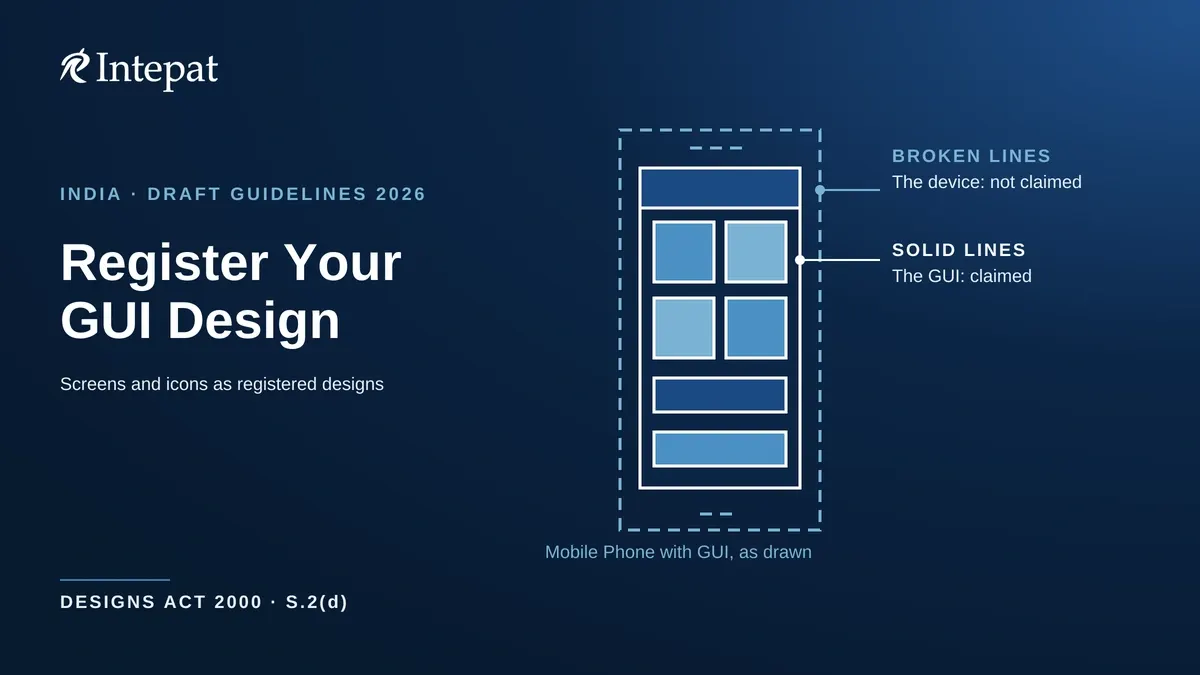
The drawings (called representations) must follow the Designs Rules and clearly show the GUI or icon on the article. The draft offers three ways to draw it, says a single front or perspective view will ordinarily be enough, and requires each frame of an animated GUI to be filed as a separate design.
The three drawing options are:
- the GUI or icon in solid lines and the parts not claimed, such as the device frame, in broken lines, which do not form part of the design;
- the whole design in solid lines, with the GUI or icon pin-pointed (marked with reference letters), following existing practice for other designs;
- everything in solid lines, where the design of the device is also claimed.
All views must be consistent, and views that vary materially may be treated as more than one design. The Rules also require words, letters or numerals that are not of the essence of the design to be removed from the drawings; where they are of its essence, the Controller may require a disclaimer of exclusive rights in them. That matters for interface drawings that show menu labels or sample data. Where real people’s names or pictures appear, for example in avatars or contact lists, the Controller may ask for their consent, so neutral placeholders are the safer choice.
The statement of novelty claims the feature for which registration is sought, and the draft says one must be included. The Rules themselves make the statement optional unless the Controller asks for it, but examiners are told to check for a properly structured statement, so in practice applicants include one. The draft’s model wording treats a new GUI or icon as the article’s surface ornamentation or surface pattern, for example: Novelty resides in the “surface ornamentation” of the Mobile Phone as illustrated. Standard disclaimers for broken lines, mode or principle of construction, functionality, numbers, letters, symbols and trade marks are added case by case.
Objections, Deadlines and the Protection You Get
The draft lists eight common grounds of objection, which it describes as illustrative and non-exhaustive. The applicant must remove an objection, or ask for a hearing, within three months of the objection letter, or the application is treated as withdrawn.
Objections must also be cleared within six months of filing, a limit that can be extended by up to three months on a request in Form 18, with the prescribed fee, made before the six months run out. Separately, an application not completed within six months because of the applicant’s default is treated as abandoned.
The eight grounds work as a pre-filing check: improper title; improper class; design not applied to an article; subject matter purely functional; lack of novelty or originality; inconsistent representations; unclear representations; and improper statement of novelty. Six of these are drafting choices an applicant controls before filing. The other two, novelty and functionality, turn on the design itself. Having redrawn sheets and revised wording ready to go shortens the response.
A registered GUI or icon design carries the same scope of protection, rights and term as any other registered design. Protection lasts ten years from the registration date, which is the Indian filing date or, where foreign priority is claimed, the earlier foreign filing date, and it can be extended once by five years on an application made before the ten years expire. Against a copier, the owner can sue for an injunction and damages, or instead recover up to Rs 25,000 per contravention as a contract debt, with a total cap of Rs 50,000 per design.
Filing is on Form 1 with the representations and the fee. The government fee is Rs 1,000 for natural persons, startups recognised by DPIIT and small entities (enterprises within the limits set for medium enterprises under the MSME law), and Rs 4,000 where any applicant falls outside those categories, even when filing jointly with one; the extension fee is Rs 2,000 and Rs 8,000 respectively (verified as of October 2026). Startups and small entities claiming the lower fee file Form 24 with the prescribed proof, such as the DPIIT recognition certificate or MSME registration; natural persons pay the lower fee without it. A wrong startup or small-entity claim leaves the filing without effect until the full fee is paid. Our guide to industrial design registration in India walks through the full filing process.
Open Points in the Draft and How to Comment
Comments go by email to controllerdesign.ipo@nic.in and cgoffice.in@gov.in within 30 days of the public notice. IP India’s news listing dates the notice 1 October 2026, which puts the close on or about 31 October 2026; confirm the date against the public notice before relying on it.
Read against its own text, the draft leaves several points open that a commenter may raise:
- Class for phones and tablets. The draft allows interface-only novelty to be classed in 14-04, yet its title table lists “Mobile Phone with GUI” under 14-03 and “Tablet with Icon” under 14-02, without saying which applies when the novelty lies only in the GUI.
- Animated GUIs. The draft requires each frame to be filed as a separate design and illustrates two numbering formats the applicant is at liberty to use, without explaining what each means for the number of applications and fees.
- Statement of novelty. The draft makes the statement mandatory for these applications, while the Rules leave it to the Controller to require one.
- Visibility. The draft does not say how “visually perceptible during normal use” applies to screens shown only in particular modes, such as setup or error screens.
Comments are easier to act on when they cite the paragraph of the draft concerned and propose replacement wording. The draft guidelines run to seven pages.
Filing Now or Waiting for the Final Guidelines
The draft does not change the law, and the Calcutta High Court has already said that nothing prevents GUIs being registered case by case where they meet the Act’s definitions, are identified with an article and are not purely function-driven. Whether to file now therefore turns mainly on disclosure timing rather than on when the guidelines become final.
A design must not have been disclosed to the public before its filing date, so a launch, app store listing or public demo before filing may count as prior disclosure. Where the current version is already public, a materially new screen or redesign that has not yet been shown may still be filed. Narrow exceptions exist: a design first filed in a convention country can be filed in India within six months claiming that earlier date; a showing at a government-notified exhibition is protected if the Controller is notified beforehand and the application follows within six months; and a disclosure by someone else in breach of good faith does not count against a later registration.
The design is published only after it is registered, so filing does not by itself reveal an unreleased interface. For an interface about to go public, filing first and drafting to the draft’s conventions keeps the application aligned with what examiners are being asked to look for. This form of icon design registration can be filed now; where launch is months away, an applicant can watch for the final text, which may differ from the draft on the open points above.
Frequently Asked Questions
No, not under the draft. An icon or GUI presented in isolation is listed as non-registrable because it does not constitute an article under the Designs Act. File it shown on a device, in Class 14-04 where only the interface is new or in the device’s class where the device is new.
Yes, under the draft, provided each frame showing the GUI is filed as a separate design. The draft lists dynamic, sequential, transformable and transitional GUIs and icons on a touch screen or mobile phone as admissible on that condition. It does not say how many applications or fees a multi-frame sequence requires.
Rights can cover different aspects, but not the same design twice: a design registered under the Designs Act is not protected by copyright under the Copyright Act. A logo-style brand icon raises a trademark question. Our article on the Supreme Court’s copyright and design twin test explains how the two divide, and our article on copyright in graphical user interfaces covers the copyright side.
Yes. The draft does not change the Act or Rules, and the Calcutta High Court has said nothing prevents GUIs being registered case by case where they meet the Act’s definitions, are identified with an article and are not purely function-driven. If the interface is about to go public, file first, because public disclosure before filing can bar registration.
Ten years from registration, which dates from the filing (or a claimed foreign priority date), extendable once by five years if applied for before expiry. The government filing fee is Rs 1,000 for natural persons, DPIIT-recognised startups and small entities and Rs 4,000 otherwise, with extension fees of Rs 2,000 and Rs 8,000 (verified as of October 2026).
This article explains the law on registering GUIs and icons as designs in India as at October 2026 and is for general information only. It is not legal advice. Government fees, forms, and procedures change; confirm current figures with the Patent Office (Designs Wing) before you file. For advice on your specific design, consult an IP professional. The guidelines described are a draft and may change before they are finalised.
Sources
- Draft Guidelines for Registration of Designs relating to GUI & ICON etc. under the Designs Act, 2000 and Designs Rules, 2001, Office of the Controller General of Patents, Designs and Trade Marks, 2026 (draft, 7 pages), ipindia.gov.in PDF: scope note; paras 2.3, 4, 5, 6, 7, 8 and 9.
- Public Notice, Draft Guidelines for Registration of Designs Relating to GUI & ICON etc., IP India, ipindia.gov.in/dynamic/news-details/145 (comment window and addresses).
- The Designs Act, 2000, sections 2(a), 2(c), 2(d), 4, 5(3), 5(5), 5(6), 7, 11, 16, 21, 22 and 44 (consolidated text as on 15 June 2026), official text at ipindia.gov.in/acts/designs-act-2000.
- The Designs Rules, 2001, rules 11, 12, 14, 18 and 21 (official e-version at ipindia.gov.in/acts/designs-rules-2001), and, as inserted or substituted by the Designs (Amendment) Rules, 2014, G.S.R. 925(E), and the Designs (Amendment) Rules, 2021, G.S.R. 45(E), 25 January 2021: rules 2(ea), 2(eb) and 10, the First Schedule (entries 1 and 3) and Forms 1 and 24.
- High Court at Calcutta, NEC Corporation v The Controller of Patents and Designs and Anr., IPDAID/21/2024, with IPDAID/22/2024, IPDAID/1/2025, IPDAID/2/2025 and IPDAID/3/2025 (appeals by NEC Corporation, ERBE Elektromedizin GmbH, Abiomed Inc and TVS Motor Company Limited; case numbers and parties from a third-party reproduction of the judgment on verdictum.in), judgment dated 9 March 2026, paras 25 and 26 as quoted in source 1, para 2.3 (where the first number is printed as “IPAID 21/2024”).
- The Copyright Act, 1957, section 15 (consolidated text as on 15 June 2026).