




The Kerala High Court has held that the Section 100 Patents Act power of government use lets the Central Government make a patented medicine and sell it non-commercially to patients, and should be invoked where the Government needs to intervene, such as when a drug is exorbitantly priced. It declined to order the Centre to use it.
The judgment was delivered in India on 28 September 2026 by Justice Harisankar V. Menon in W.P.(C) No. 18999 of 2022, In Re Exorbitant Pricing of Life Saving Patented Medicines (2026:KER:74251). It concerns Ribociclib, a breast cancer drug manufactured by Novartis under its patent, and turns on the government-use provisions in Chapter XVII of the Patents Act, 1970.
| Quick answer: |
| The court read “purposes of Government” in Section 100 to include manufacturing a patented medicine and selling it, on a non-commercial basis, to needy patients. It held the power should be invoked where the Government needs to intervene, such as when a patented medicine is exorbitantly priced, but left that decision to the Central Government after it collects affordability data. |
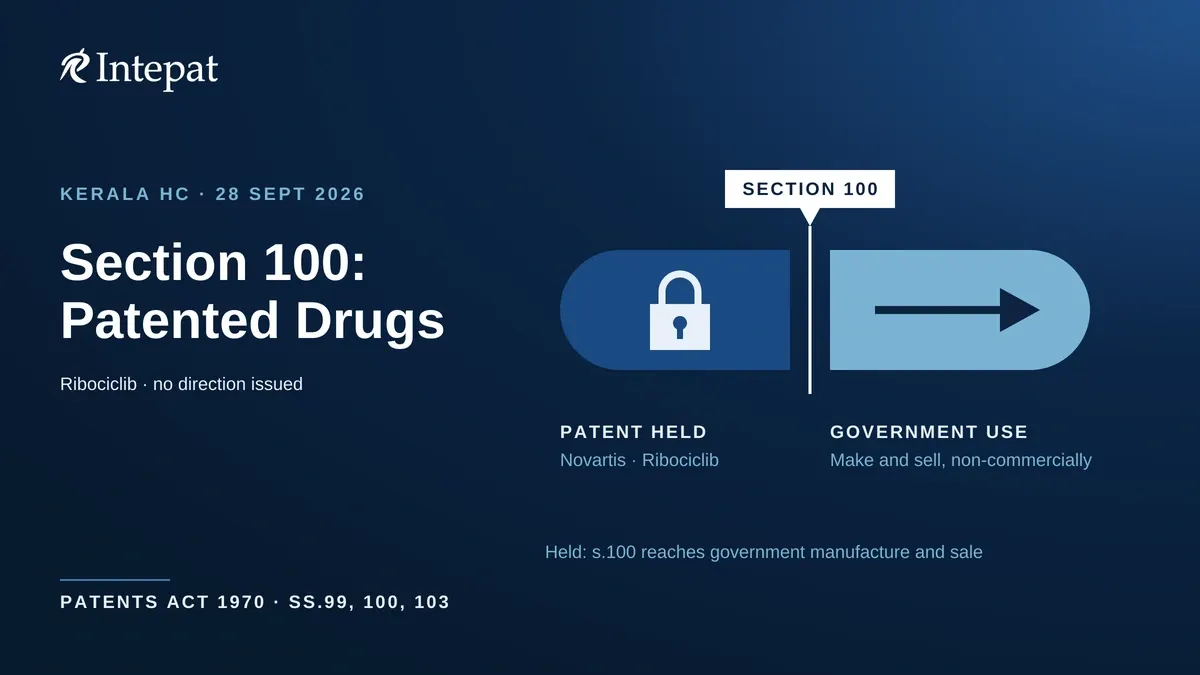
Section 100 Patents Act: what did the Kerala High Court decide?
The court disposed of the petition with three findings. Section 100 lets the Government manufacture a patented medicine and sell it to a person, including a needy patient, on a non-commercial basis. The power is to be invoked where the Government needs to intervene, such as an exorbitant price. The Government must collate data and decide.
The first finding is the legal holding. In the proceedings, the Union and both patentees argued that Section 100 can be invoked only for the purposes of Government and for no other reason, so it cannot reach supply to patients (paras 12, 15 and 26). The court rejected that reading.
The second and third findings work together. Section 100 “is required to be invoked in circumstances where the Government is required to intervene, such as an instance where a medicine manufactured on the basis of a patent is being sold at an exorbitant price”; whether a particular medicine is unaffordable, and whether to proceed, is for the Government to decide on data it collects. The court set no deadline and called for no compliance report. The practical result is a broad reading of the power and no direction to use it.
How did one patient’s petition become a suo motu case?
A retired bank employee with metastatic breast cancer filed the petition on 2 June 2022, seeking action under Section 92 or Section 100 over the price of Ribociclib. She died while the case was pending, and the court continued it suo motu, that is, on its own motion.
Her petition stated that Ribociclib, a CDK 4/6 inhibitor (a targeted cancer drug) used for her HR+/HER2- cancer, cost about Rs 58,140 for 21 days at three tablets a day. By an order of 16 September 2022 the court renamed the case In Re Exorbitant Pricing of Life Saving Patented Medicines and appointed Maitreyi Sachidananda Hegde as amicus curiae (an advocate appointed to assist the court). Eli Lilly, which manufactures the CDK 4/6 inhibitor Abemaciclib, and Novartis, which manufactures Ribociclib on the basis of its patent, were added as respondents in 2023. Supporters of the petition were impleaded as additional respondents, including the late petitioner’s husband and a breast cancer patient who said Ribociclib cost her about Rs 7.90 lakh a year (paras 4 and 11). In July 2026 the court added three cancer institutes and the Drug Controller General of India for expert input.
That expert input settled a threshold question. The Union had argued that Palbociclib, an off-patent alternative, was interchangeable with Ribociclib (para 6). The court relied on the Drug Controller General’s affidavit and the Regional Cancer Centre’s report to find that Palbociclib is used for advanced or metastatic disease while Ribociclib is also used for early breast cancer, so the two are “not interchangeable” (para 22). The Regional Cancer Centre listed both, with Abemaciclib, as the available medicines for stage IV disease (para 19); the gap is in early breast cancer. The finding also disposed, in effect, of Novartis’s alternative argument that the prayers were purely academic (para 15).
Two limits on scope matter. The amicus pressed Section 100 alone, because Section 92 needs a company to come forward to seek a licence and involves an adjudicating process (para 9(xi)). The judgment therefore says nothing about compulsory licensing, a licence granted to an applicant without the patentee’s consent, on the merits. And the Centre had already rejected the late petitioner’s representation by an order of 7 October 2022 (Ext.R1(b)), which the Additional Solicitor General said had considered Sections 92 and 100 in extenso (paras 9 and 12). The Union argued that the order was unchallenged and could not be set aside by moulding relief (para 13). The judgment does not revisit it.
Why did the Centre and the patentees say Section 100 did not apply?
The respondents argued that Section 100 must be read with Section 99, which defines use “for the purposes of Government” as making, using, exercising or vending an invention for the purposes of the Central Government, a State Government or a Government undertaking. On that reading the Government cannot manufacture a patented medicine and supply it to patients.
The respondents relied on Garware Wall Ropes, a single-judge decision of the Nagpur Bench of the Bombay High Court, for a restrictive meaning of “purposes of Government” (paras 15 and 28). Novartis also argued that Section 100 must be read with Section 156, under which, subject to the Act’s other provisions, a patent has the same effect against the Government as against any person (para 16).
The respondents also pointed to existing price controls. The Deputy Solicitor General said Ribociclib, a non-scheduled drug, is price-monitored under paragraph 20 of the Drugs (Price Control) Order, 2013, and that after basic customs duty on it was reduced in February 2026 the price of 21 tablets moved from Rs 24,355 to Rs 22,217.85, before it rose to Rs 22,335 in July (para 13; figures as recorded in the judgment). Those figures are per 21 tablets, a third of the 63 tablets behind the petition’s 21-day figure. Novartis cited a 30 per cent trade margin cap imposed by the National Pharmaceutical Pricing Authority and said it charges its lowest price in India (para 15).
Eli Lilly argued that its research investment deserved protection, pointing out that it applied for its patent in 2008 and obtained it only in 2018, leaving about ten years of protection (para 18). That point connects to a separate live issue: on 21 September 2026 the Supreme Court issued notice on a petition arising from a Calcutta High Court judgment on the filing-date rule, covered in our note on patent term from filing or grant.
How did the court read “purposes of Government”?
The court read Section 99 with sub-sections (4) and (6) of Section 100. As the court read it, sub-section (4) entitles the Government to authorise any person to make, use, exercise or vend the invention, and it expressly mentions a “medicine or drug”. Sub-section (6) adds the right to sell the goods made, non-commercially.
From those two sub-sections the court drew its central line: Section 100 imposes “no restriction on who the purchaser could be”, so the Government may manufacture the medicine and sell it non-commercially to “none other than the needy patient” (para 27). It treated the express mention of medicines in sub-section (4) as confirming the point. The Act does not define non-commercial; the dispute before the court was framed as supply to needy patients free of cost or at a subsidised price (para 26).
The court did not adopt the restrictive meaning it attributed to Garware Wall Ropes. It relied instead on that judgment’s own contrast between “merely of its own use” in Section 47 and “purposes of Government” in Sections 99 and 100, and held that the wider phrase includes vending articles made with the invention, as sub-sections (4) and (6) of Section 100 provide (para 28).
The court then layered constitutional and statutory context onto the text:
- the State’s duty to improve public health under Article 47, which it read into “purposes of Government” (paras 29 and 30);
- the Supreme Court’s 2021 pandemic ruling, In Re Distribution of Essential Supplies and Services During Pandemic, which the respondents had relied on but which the court read as requiring Section 100 to be enforced in the public interest, alongside the public health provisions of TRIPS Articles 7 and 8 (para 31);
- the Article 21 right to life line of cases (paras 32 to 34);
- the general principles in Section 83, including that patents should not impede public health and should make inventions available at reasonably affordable prices (para 35);
- the Lok Sabha debates on the Patents (Amendment) Bill, 2002, recording that the Government can use a patent “in the interest of the public health system” (para 36).
Why did the court stop short of ordering the Centre to act?
The court held that whether to invoke Section 100 is a policy decision for the Central Government. It gave weight to the protection a patent grant carries, including against the Government as the court read Section 156, and found that the data needed to decide whether Ribociclib is affordable was not on record.
On the grant itself, the court said that if patentees were not given that protection, no one would come forward to patent inventions, which would harm society at large (para 38). It then relied on the same Supreme Court pandemic ruling, which had treated whether and how far to use these provisions as a policy decision for the Central Government (paras 39 and 40). It added general policy-deference rulings: State of Punjab v. Ram Lubhaya Bagga, which keeps courts out of weighing policy except where it is arbitrary or violates a constitutional, statutory or other provision of law, and Siddharth Dalmia v. Union of India (paras 41 and 43).
The data point is the operative constraint. The court said the Government should collect data from hospitals on, among other things, the number of patients with the cancer type, the number taking the medicines, and the cases where patients go without because of the alleged exorbitant price (para 42). It should separately evaluate how many patients its subsidised-medicine schemes have helped and whether those schemes should be extended, given the price controls the Government and the companies relied on. The court also asked the Government to take note of a parliamentary committee’s call for affordability interventions “from both Government and private sectors” (para 44).
Two further points close the reasoning. The court noted that its reading of Section 100 would apply to several other life-saving drugs, while only two manufacturers were before it (para 42). And the amicus had urged that “may” in Section 100 be read as “shall” (para 9); the judgment does not adopt that reading and leaves invocation to the Government.
How does Section 100 differ from compulsory licensing and Section 47?
Section 100 is a government-use power. The Central Government, or a person it authorises in writing, uses the invention, and for use after grant remuneration is agreed or fixed by the High Court. A compulsory licence is granted by the Controller of Patents to an applicant, and Section 47 is a condition attached to every grant.
| Route | Who acts | When | Payment to patentee |
| Section 47(4) | Government imports a patented medicine for its own use or for distribution in government or notified hospitals and dispensaries | A condition of every patent grant | The section carries no payment provision |
| Section 84 | Any person interested applies to the Controller | After three years from grant, on grounds including that the invention is not available at a reasonably affordable price | Terms the Controller deems fit |
| Section 92 | Central Government notifies; any person interested then applies to the Controller | Any time after sealing (the formal grant), in a national emergency, extreme urgency or public non-commercial use | Terms aimed at the lowest prices consistent with the patentee deriving a reasonable advantage |
| Section 100 | Central Government, or any person it authorises in writing | Any time after the application is filed or the patent granted | For use after grant, or resulting from the patentee’s communication: agreed, or fixed by the High Court (Section 103), at not more than adequate remuneration; payment-free under Section 100(2) |
Chapter XVII also contains an acquisition power, which the court noted in passing (para 24) but did not examine. Under Section 102, the Central Government may, if satisfied it is necessary, acquire an invention or patent for a public purpose by notification in the Official Gazette, with compensation agreed or, failing agreement, fixed by the High Court having regard to the expenditure on the invention, the patent term, how it has been worked and the profits made.
The Section 84 route has its own case law, set out in our guide to compulsory licensing of patents in India. What sets Section 100 apart is that no application to the Controller and no three-year wait is involved.
What does the ruling mean for pharmaceutical patentees and generic manufacturers?
For patentees, the ruling rejects the argument that Section 100 cannot reach supply to patients, at least before the Kerala High Court. The protections that remain sit in the statute: remuneration, the High Court reference, and the Government’s own policy judgment, now to be exercised on data.
On remuneration, Section 100(3) requires that use after grant, or use resulting from communication of the invention, directly or indirectly, by the patentee or a predecessor in title, be on agreed terms or, failing agreement, terms fixed by the High Court, with the patentee paid “not more than adequate remuneration in the circumstances of each case, taking into account the economic value of the use of the patent”. Use may be free of any royalty or other remuneration where, before the priority date of the relevant claim, the invention had been duly recorded in a document, or tested or tried, by or on behalf of the Government or a Government undertaking, otherwise than as a result of its communication, directly or indirectly, by the patentee or a predecessor in title (Section 100(2)). The judgment does not discuss how remuneration would be measured for a medicine.
Three statutory features deserve attention in any risk assessment. The duty to notify the patentee of the use does not apply to non-commercial use (Section 100(5)), the kind of use the court’s reading contemplates. Either party may refer to the High Court any dispute as to the exercise of the Section 100 power itself, not only its terms, except disputes over inventions made by a person who, at that time, served the Central or a State Government or a Government undertaking, where the subject matter is certified as connected with that person’s normal duties; the Central Government decides those after hearing the patentee (Section 103(1) and (6)); in fixing terms, the court must have regard to any benefit or compensation the patentee, or anyone from whom it derives title, has received or is entitled to receive for that use (Section 103(4)). And where the Central Government is a party to that reference, it may put the patent’s validity in issue and, if the patentee is a party, counterclaim for revocation (Section 103(2)), so a remuneration dispute can become a validity dispute.
Licensing arrangements are affected too. Terms in a licence or assignment that restrict government use, or provide for payments in respect of it, have no effect against such use (Section 101(1)). An exclusive licensee authorised under its licence to use the invention for government purposes may share in any Section 100(3) payment, in proportions agreed with the patentee or fixed by the High Court having regard to the licensee’s expenditure (Section 101(3)), and is entitled to the same notice as the patentee (Section 100(7)).
Two features of the record are worth noting for patentees’ files. The exhibits included Form 27 working statements (the statement of how a patent is worked in India, filed once for every three financial years since the March 2024 amendment) for Novartis’s Indian Patent No. 283133: the petitioner produced copies of the statements for 2018 to 2021, and Novartis produced one filed in September 2022. These public filings can become evidence in pricing and access disputes. And the court did not treat existing price caps as settling the question; it asked the Government to evaluate its subsidy schemes against them (para 42).
For generic manufacturers, Section 100(4) allows authorisation of any person, whether or not authorised by the applicant or patentee. A manufacturer may ask the Central Government for authorisation, but Section 100 prescribes no application procedure and confers no entitlement; authorisation is the Government’s decision, in writing, and would follow the policy decision the court left to the Centre. The applicant-initiated routes are compulsory licences under Section 84, after three years from grant, and under Section 92, once the Government issues a notification; the judgment decides neither on the merits. Section 107A(a) separately exempts specified acts done solely for uses reasonably related to developing and submitting information required under a law regulating the product, explained in our note on the Bolar exemption under Section 107A.
As a single-judge decision, the ruling binds courts subordinate to the Kerala High Court, is persuasive elsewhere, and can be revisited in appeal or by a larger bench. Readers following the wider pharmaceutical patent debate may also find our piece on evergreening in the pharmaceutical industry useful context.
Frequently Asked Questions
Section 100 lets the Central Government, or a person it authorises in writing, use a patented invention for the purposes of Government without the patentee’s consent. The Kerala High Court held this includes making a medicine and selling it to patients non-commercially. The patentee is ordinarily entitled to remuneration for use after grant, agreed or fixed by the High Court.
No. The court disposed of the petition with findings and declined to direct the Government to invoke Section 100. It said the power should be invoked where the Government needs to intervene, such as when a patented medicine is exorbitantly priced, but left that decision to the Central Government once it collects affordability data, and set no deadline for it.
Ordinarily yes, for use after grant or following the patentee’s communication, on terms agreed or fixed by the High Court, at not more than adequate remuneration. The narrow exception is Section 100(2): prior recording in a document, or testing or trial, by or for the Government or a Government undertaking before the relevant claim’s priority date, not resulting from communication by the patentee or a predecessor.
A manufacturer may ask the Central Government for written authorisation, but Section 100 prescribes no application procedure and confers no entitlement to it. The applicant-initiated routes are compulsory licences: under Section 84, after three years from grant, or under Section 92, once the Government issues a notification. Each has its own conditions.
Not as a direct result. The court made no order on price or supply. The Central Government must first collect data on affordability and decide whether to use Section 100. The price measures recorded in the judgment, a trade margin cap and a customs duty cut, are unaffected, and the court asked the Government to evaluate its subsidy schemes.
The court said its reading would apply to several other life-saving drugs, though only two manufacturers were before it. As a single-judge ruling it binds courts subordinate to the Kerala High Court and is persuasive elsewhere. Whether to invoke Section 100 for any medicine remains the Central Government’s decision after it collects data.
Intepat IP’s patent team, led by Senthil Kumar, reviews the status, renewal position and product coverage of pharmaceutical patent holdings in India through its patent portfolio audit service.
This article explains the law on government use of patents under Section 100 in India as at October 2026 and is for general information only. It is not legal advice. Government fees, forms, and procedures change; confirm current figures with the Indian Patent Office before you file. For advice on your specific invention, consult a registered patent agent. This analysis is based on the full text of the decision cited; it is a summary for general information and not a substitute for reading the order in your own matter.