




On 4 May 2026 the Delhi High Court set aside the refusal of Syngenta’s Indian application for a monohydrate polymorph of a fungicide. It held that, for this agrochemical, stability that keeps the compound sprayable at high field temperatures is an enhancement of efficacy under Section 3(d) of the Patents Act, 1970.
The ruling bears on Section 3(d) agrochemical claims and on any applicant in India whose new form of a known substance is not a medicine, because the Patent Office had applied the therapeutic efficacy test from the Supreme Court’s 2013 decision in Novartis. This analysis reads the full judgment and separates what the court settled from what it sent back to the Patent Office.
| Quick answer: |
| Outside medicines, the court measured “efficacy” by the product’s function, so stability that keeps a fungicide usable in Indian field heat counted. It is a single-judge decision on its own facts. The whole application goes back to the Controller: inventive step is decided afresh, while the court’s opinion on Section 3(d) is already fixed. |
What the Delhi High Court Decided in Syngenta
The court set aside the Controller’s refusal of 21 July 2023 and sent the application back for a fresh hearing. The remand is split. On inventive step the Controller decides afresh, uninfluenced by the court’s observations. On Section 3(d) the court recorded that it had formed a clear opinion, and it directed a decision within six months.
| Point | Detail |
| Case | Syngenta Participations AG v Controller of Patents Designs, C.A.(COMM.IPD-PAT) 49/2023 |
| Court and judge | Delhi High Court, Justice Tushar Rao Gedela |
| Dates | Reserved 9 March 2026; delivered 4 May 2026 |
| Application | 201617031900, filed in India on 19 September 2016; PCT filing 24 February 2015; UK priority 27 February 2014 |
| Refused on | Lack of inventive step (Section 2(1)(ja)) and Section 3(d) |
| Outcome | Refusal set aside; remanded for a fresh hearing; decision within six months |
Six months from 4 May 2026 runs to 4 November 2026. The court also directed that a copy of the order be brought to the notice of the Controller General for necessary administrative action.
What Syngenta Claimed and Why the Office Refused
Syngenta claimed a monohydrate polymorph of a known fungicidal compound (4.3 ± 0.2% w/w water), identified by its powder X-ray diffraction pattern, with a dependent lattice-parameter claim and an agricultural composition claim. The Office accepted that none of the cited documents (D1 to D4) disclosed the monohydrate. Syngenta argued both grounds on lowered phytotoxicity.
The court identified the compound as benzovindiflupyr. The specification explained the problem the form solves. In a suspension concentrate, a formulation with the solid active ingredient suspended in liquid, an unstable form can convert and grow crystals, thickening the product and blocking spray nozzles.
The Controller refused on two grounds. On inventive step, the Office said there was no evidence of a surprising effect over the anhydrous forms in D1 to D4. It said the evidence needed was comparative data on lowered phytotoxicity, which Syngenta had not supplied. It also treated the diffraction pattern as characterisation data rather than a technical feature, and said the composition claim added only conventional carriers. On Section 3(d), which the Office applied to claims 1 and 2, it treated the monohydrate as a new form of a known substance without enhanced efficacy, and argued that for agrochemicals, as for medicines, efficacy must be measured as therapeutic efficacy.
Why the Inherent Property Reasoning Failed
This reasoning sits under the inventive step ground (Section 2(1)(ja)). The Controller had stated that thermal stability is an inherent property of polymorphs (paragraphs 32 and 41). The court rejected that for two reasons: no source was cited, and the literature it reviewed describes polymorph behaviour as unpredictable.
On the first reason, the court applied its earlier decision in AGFA NV v Assistant Controller (2023). Common general knowledge relied on to refuse an application must be identified by its source, the source must predate the priority date, and the claim that something is common knowledge must be substantiated, for example by references to textbooks, research articles or standard documents (AGFA, paragraphs 33 to 35). A Controller cannot invoke it unsourced.
On the evidence (paragraphs 46 to 54), the court relied on data in the specification itself. Example 3 used slurry experiments to plot a phase diagram showing that temperatures above 60°C would be needed to dehydrate the hydrate at normal ambient humidity. In Example 5, a suspension concentrate of the anhydrous form seeded with 5% of the hydrate and cycled between 0°C and 40°C had converted fully to the hydrate when inspected after two weeks, with substantial crystal growth. These are laboratory results; the judgment does not report any field trial.
Two points of method follow. The court agreed with the Office that the expert affidavit filed for Syngenta, whose wording (“might be advantageous”) allowed no specific conclusion, should not be taken into consideration “at this stage” (paragraph 53); the specification’s own examples carried the case. And part of the reasoning rests on presumption: although the Office’s position was that Syngenta had supplied no comparative phytotoxicity data (paragraph 43), the judgment records that reduced phytotoxicity was presumed because the suspension concentrate uses fewer chemicals, and states that improved thermal stability “can be presumed” to be the technical effect (paragraphs 50 and 54). It held the Controller’s order vitiated because the submitted data were set aside “without any sufficient reasoning” and existing knowledge was relied on without a source, deciding that “without going into the merits” of D1 to D4 and the other cited documents (paragraph 71).
The court restated the structured obviousness enquiry from F. Hoffmann-La Roche v Cipla and the three elements a refusal must address from Agriboard v Deputy Controller (Syngenta, paragraphs 57 and 58), and held that the Controller had not followed them. It nonetheless left inventive step for the Controller to decide afresh on remand.
How the Court Read Efficacy for Section 3(d) Agrochemical Claims
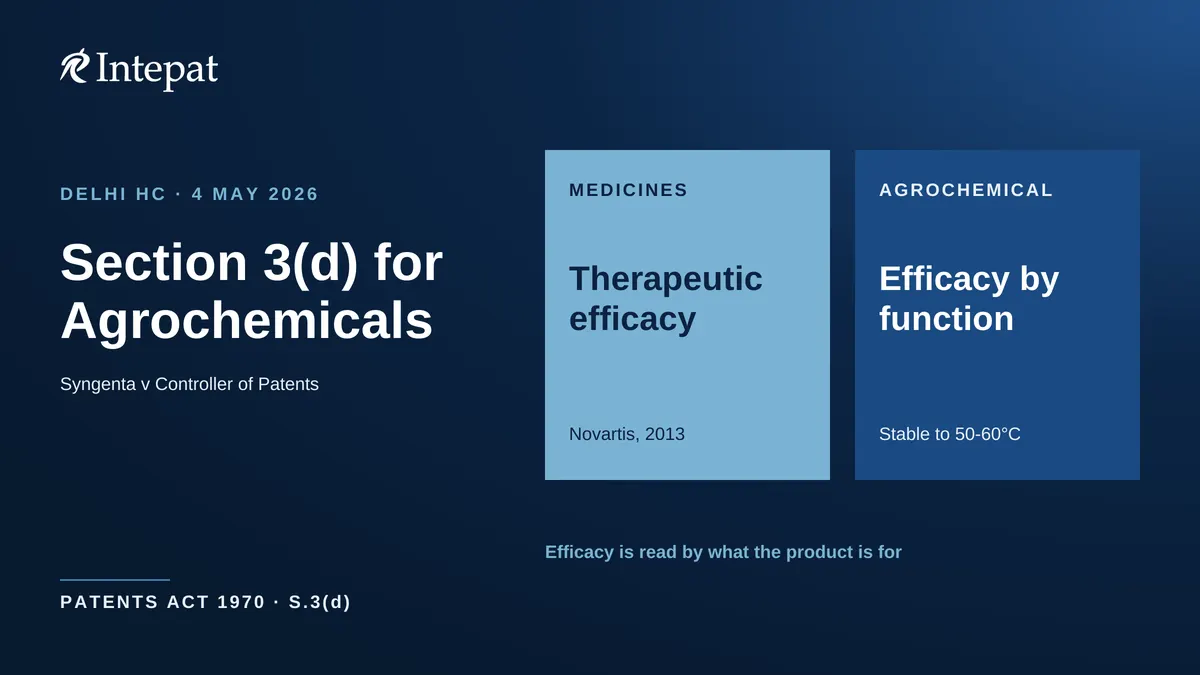
In Novartis the Supreme Court said the test of efficacy depends on the function, utility or purpose of the product, and for a medicine can only be therapeutic efficacy (paragraph 180). The Delhi High Court read the therapeutic test as tied to medicines, and held that for this agrochemical, stability at high temperatures counts as efficacy.
Section 3(d) excludes “the mere discovery of a new form of a known substance which does not result in the enhancement of the known efficacy of that substance”. Its Explanation treats polymorphs and other derivatives as the same substance “unless they differ significantly in properties with regard to efficacy”. Novartis held that the flow properties, thermodynamic stability and hygroscopicity of the beta crystalline form of imatinib mesylate cannot be taken into account, because they have nothing to do with therapeutic efficacy (paragraph 187).
The court reasoned that the agricultural sector in India lies largely in regions where temperatures ordinarily run above 35°C to 48°C to 50°C, and that a polymorph which stays stable at 50°C to 60°C, without crystallising and clogging spray equipment, can be used where temperatures ordinarily exceed 40°C. Making the fungicide usable in those conditions was, in its view, an enhancement of efficacy. It drew support from the Madras High Court in Novozymes v Assistant Controller (2023), which held that the improved thermostability of a phytase variant, allowing pelleting without loss of enzymatic activity, enhanced the known efficacy of the enzyme.
This sits against the Office’s own examination texts. The 2019 Manual (paragraph 09.03.05.04) reproduces the Novartis passage excluding better thermodynamic stability, and the Controller applied the Novartis reasoning here to an agrochemical. The 2014 pharmaceutical guidelines also quote Novartis for a further point: that properties inherent to a form, such as hygroscopicity to a polymorph, do not qualify as “enhancement of efficacy”. The guidelines are framed for medicines; Syngenta supplies a High Court reading for a product that is not one.
What the Judgment Does Not Settle
Syngenta is a decision of a single judge of the Delhi High Court, expressed “in the context of present agro chemical” and “the present polymorph”. It does not hold that thermal stability is enhanced efficacy for every agrochemical, does not touch the therapeutic efficacy test for medicines laid down by the Supreme Court, and leaves the inventive step objection open.
The court also had to deal with Novartis passages that point the other way: a “second tier” of standards for chemical substances (paragraph 87) and a narrow reading of efficacy for chemical substances, “especially medicine” (paragraph 157). It treated the Supreme Court’s references to agrochemicals as made “in the passing” (paragraph 64). Novozymes, on which the court relied, is also a single-judge decision, of the Madras High Court. The draft pharmaceutical examination guidelines that IP India published on 7 October 2026 address medicines; our note on the 2026 draft pharmaceutical guidelines sets out what they do and do not change.
Two citation points for counsel. First, the judgment numbers the Novartis paragraphs it quotes as 87, 157 and 164, while the Supreme Court’s own copy numbers the same passages 103, 180 and 187, as the Office texts do (the 2014 guidelines cite 103 and 180, and the 2019 Manual cites 187). Use the Supreme Court’s numbering in counsel-facing pinpoints. Second, a different Syngenta v Controller ruling, decided by a Division Bench of the Delhi High Court on 13 October 2023, concerns divisional applications; cite the 2026 judgment by its case number.
What Applicants Outside Pharma Should Do Now
Syngenta won on Section 3(d) because comparative stability data sat in the specification, tied to a field problem the Office did not dispute (paragraph 67). Where the Office disputes the effect, presumption may not carry an applicant. Applicants with new forms outside medicines should build that link at drafting and keep expert evidence definite.
- Put comparative data in the specification where you can. The Manual says the complete specification shall bring out how the claimed subject matter differs significantly in properties with regard to efficacy from the known substance, at the time of filing or later by amendment under Section 59. Section 59 limits an amendment to matter in substance disclosed, so filing the data at the start is prosecution-risk advice, not a rule that every case requires it.
- Tie the property to the product’s function. Stability mattered here because it decided whether the fungicide could be sprayed in Indian field temperatures, not as a laboratory figure.
- Make expert evidence commit. An affidavit that a form “might be advantageous” was not taken into consideration; a declaration should state the problem, the result and the comparison.
- Answer “inherent property” and common general knowledge objections by asking for the source; this sourcing rule applies in every field, medicines included. Ask also for reasons: the Controller must explain why submitted data are insufficient (paragraphs 54 and 71). Our guides on inventive step in Indian patents and on responding to a First Examination Report cover the reply stage.
- Keep the appeal window in view. A refusal under Section 15 is appealable to the High Court under Section 117A within three months of the decision, or such further time as the High Court allows under its rules.
For medicines, nothing here displaces Novartis, although the rule that common general knowledge must be sourced applies there too; the background is in our article on evergreening of pharmaceutical patents.
Frequently Asked Questions
No. The Delhi High Court read the Supreme Court’s therapeutic efficacy test as the test for a medicine that claims to cure a disease, and applied a function-based measure only because the product was an agrochemical. For pharmaceutical new forms, flow, stability and hygroscopicity still do not count as therapeutic efficacy under Novartis.
Not as a rule. The opinion is for the present agrochemical and polymorph, resting on laboratory stability data, the Office’s non-dispute that stability prevents clogging, and Indian field heat (paragraph 67). Another applicant should be ready to show, preferably with comparative data, how its property improves the product’s function; that is practice, not a statutory format.
Yes. The clause covers any new form of a known substance, and its Explanation lists polymorphs. Syngenta did not exempt agrochemicals; it applied the enhanced efficacy test and measured efficacy by the fungicide’s function. An agrochemical new form without a significant difference in efficacy-related properties remains open to objection.
In Syngenta’s own application the Controller must act on the court’s stated Section 3(d) opinion (paragraph 73), and the order was to be brought to the Controller General’s notice (paragraph 74). Beyond that, the majority in East India Commercial Co (Supreme Court, 1962) held that a High Court’s declared law binds authorities under its superintendence.
Applicants should prepare comparative data against the known form, preferably in the specification: stability under the conditions of use, formulation behaviour such as crystal growth, and the field consequence. Syngenta’s slurry phase diagram and temperature-cycling test carried the case, while a non-committal expert affidavit was not taken into consideration.
The Controller must give Syngenta a fresh hearing and decide the application within six months of 4 May 2026. Inventive step will be decided afresh, uninfluenced by the court’s observations; on Section 3(d) the court has stated its opinion. The court directed that a copy of the order be brought to the notice of the Controller General.
Intepat’s patent prosecution team, working through registered patent agents, prepares examination replies and hearing submissions on Section 3(d) and inventive step objections; our patent prosecution services set out the scope.
This article explains the law on Section 3(d) and agrochemical new forms in India as at October 2026 and is for general information only. It is not legal advice. Government fees, forms, and procedures change; confirm current figures with the Indian Patent Office before you file. For advice on your specific invention, consult a registered patent agent. This analysis is based on the full text of the decision cited; it is a summary for general information and not a substitute for reading the order in your own matter.
Sources
- Syngenta Participations AG v Controller of Patents Designs, C.A.(COMM.IPD-PAT) 49/2023, Delhi High Court, judgment of 4 May 2026, paragraphs 1 to 75: judgment PDF, Delhi High Court
- The Patents Act, 1970, as amended to 1 August 2024, sections 2(1)(ja), 3(d), 15 and 117A: IP India
- Manual of Patent Office Practice and Procedure, version 3.0 (26 November 2019), paragraph 09.03.05.04, Office of the Controller General of Patents, Designs and Trade Marks
- Guidelines for Examination of Patent Applications in the Field of Pharmaceuticals (October 2014), paragraphs 10.4 to 10.9, Office of the Controller General of Patents, Designs and Trade Marks
- Novartis AG v Union of India, Civil Appeal Nos. 2706 to 2716 of 2013, Supreme Court of India, judgment of 1 April 2013, paragraphs 103, 180 and 187 (copy on WIPO Lex)
- Novozymes v Assistant Controller of Patents and Designs, (T) CMA (PT) No. 33 of 2023, Madras High Court, Senthilkumar Ramamoorthy J., judgment of 20 September 2023, paragraph 22 (copy of the judgment hosted by SpicyIP); also cited in source 1 (paragraph 68)
- AGFA NV v Assistant Controller of Patents and Designs, C.A.(COMM.IPD-PAT) 477/2022, Delhi High Court, Amit Bansal J., judgment of 2 June 2023, paragraphs 33 to 35 (copy of the judgment hosted by LiveLaw); also cited in source 1 (paragraph 40)
- F. Hoffmann-La Roche Ltd v Cipla Ltd, RFA(OS) 92/2012, Delhi High Court, Division Bench, judgment of 27 November 2015, 2015:DHC:9674-DB (Delhi High Court). Agriboard International LLC v Deputy Controller of Patents and Designs, C.A.(COMM.IPD-PAT) 4/2022, Delhi High Court, Prathiba M. Singh J., judgment of 31 March 2022, paragraphs 24 and 25 (the three elements), cited in source 1 (paragraph 58)