




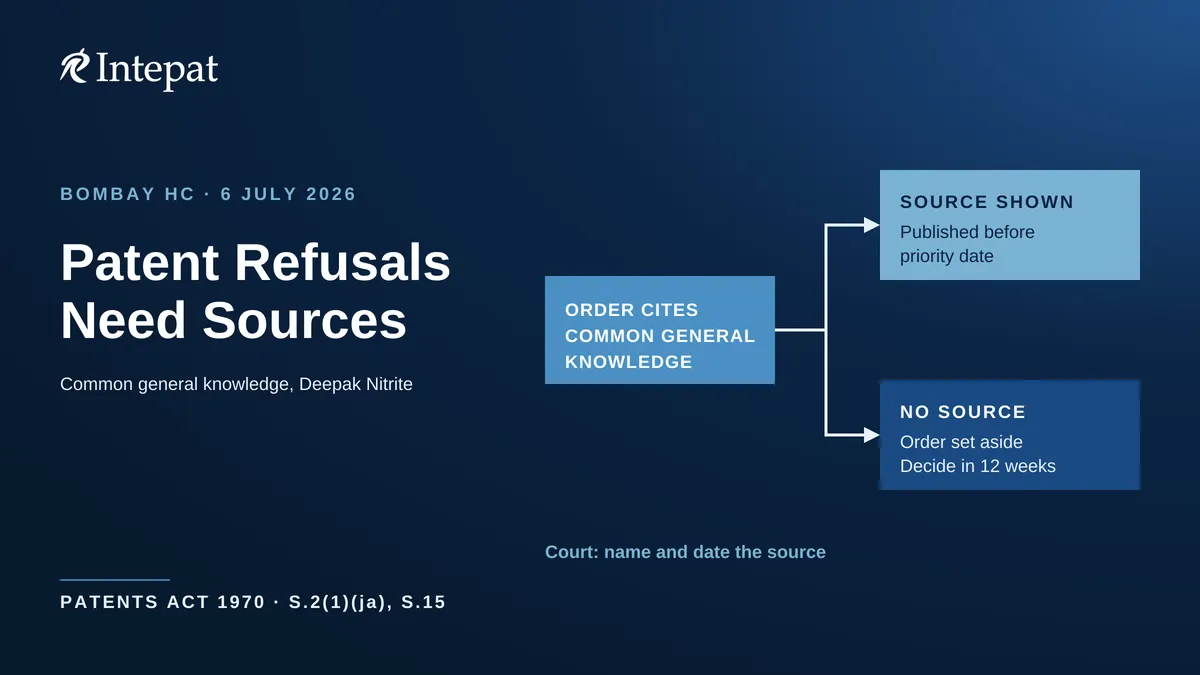
On 6 July 2026 the Bombay High Court set aside the Patent Office’s refusal of an Indian application for food-grade sodium nitrite and sent it back. For the product claims, the refusal rested on the statement that no compound is ever 100% pure, which the court held could not stand without an identified source.
The ruling matters in any common general knowledge patent refusal where the Patent Office relies on that knowledge to sustain an inventive step refusal. It is a single-judge Bombay decision applying the Delhi High Court’s 2023 AGFA rule. This analysis reads the published judgment and separates what the court decided from what it left for the Controller.
| Quick answer: |
| The Bombay High Court held that the Controller cannot treat “common general knowledge” as a self-sufficient ground of refusal without setting out and substantiating its sources, applying the Delhi High Court’s AGFA rule (2023). It is a single-judge decision, not a new national rule. The court remanded the application without ruling on the merits, with a twelve-week limit. |
What the Bombay High Court Decided in Deepak Nitrite
The court set aside the refusal order of 2 March 2023 and directed the Controller to decide application 202021019409 afresh, after complying with paragraphs 15 and 16 of the judgment, within twelve weeks of a copy of the order being communicated. It held that common general knowledge cannot be a self-sufficient ground of refusal without stated sources.
| Point | Detail |
| Case | Deepak Nitrite Limited v The Assistant Controller General of Patents and Designs, Commercial Miscellaneous Petition No. 107 of 2025 |
| Court and judge | Bombay High Court, Arif S. Doctor J. |
| Dates | Refusal order 2 March 2023; reserved 8 May 2026; pronounced 6 July 2026 |
| Application | 202021019409, “A Free-Flowing Food Grade Sodium Nitrite and Production Method Thereof” |
| Refused on | Section 15, for claims 1 to 8 as amended not meeting Section 2(1)(ja) (inventive step) |
| Outcome | Refusal set aside; decision afresh within twelve weeks of communication of the order |
The twelve weeks run from the date a copy of the order is communicated to the Controller, not from 6 July 2026. The Controller’s counsel also told the court that remanded files now go to a Controller other than the one who passed the refused order. The court accepted the statement without a separate direction and called it a positive step, though one that “does not take care of the endemic problem” of orders reproducing objections without thought (paragraph 13). The judgment does not disclose the date on which the order was communicated to the Controller.
What Deepak Nitrite Claimed and Why the Office Refused
Claims 1 to 3 cover a sodium nitrite said to differ from the prior art in its impurity profile. Claims 4 to 8 cover a process. Independent claim 4 recites six steps: dissolving the powder in water, heating the liquor, evaporating to a slurry, centrifuge filtration, drying with a cold zone, and coating with a food-grade anti-caking agent.
For the product claims, the Controller held that “reduction in impurities” cannot be inventive because it is common general knowledge that no compound is ever 100% pure. The applicant said the order named no source for that knowledge, did not ask whether the claimed impurity profile appears in the prior art, and did not address its submission about food-grade, free-flowing material (paragraph 3).
For the process claims, the applicant said the contribution lies in the combination and sequence of the steps. The Controller isolated the filtration step as commonly done in laboratories and did not assess the process as a whole (paragraph 4).
Why Unsourced Common General Knowledge Patent Refusals Fail
The court called it wholly impermissible, in a quasi-judicial order under Section 15, to treat common general knowledge as a self-sufficient ground of refusal without setting out and substantiating its sources (paragraph 10). A bald assertion of common general knowledge, with no identifiable source or stated basis, is arbitrary and contrary to natural justice (paragraph 11).
The court applied the Delhi High Court’s decision in AGFA NV v Assistant Controller of Patents and Designs (2023). Under it the Controller must identify the source of the asserted knowledge and show it was published before the priority date. AGFA asks for more than a date. Citing Terrell, it records that publication of a patent specification is “far from complete proof” of common general knowledge, and it treats the material as common general knowledge only if it is common knowledge in the field, supported by evidence such as references to textbooks, research articles or standard documents (paragraphs 33 to 35 of AGFA). Without a stated source, the court said, the Controller decides on his own say-so or on undisclosed personal knowledge, and the applicant is left without reasons to challenge.
The point was tested at the hearing. Asked what the common general knowledge was and where the record showed it, the Controller’s counsel could not answer (paragraph 9). For the product claims he had argued that the impurity difference was in any event covered by common general knowledge, and the remand covered those claims too.
The statutory test is the one Section 2(1)(ja) sets: inventive step means “a feature of an invention that involves technical advance as compared to the existing knowledge or having economic significance or both and that makes the invention not obvious to a person skilled in the art”. Read with that definition, an assertion about what the skilled person knows is a factual premise of the obviousness enquiry, and the court’s holding is that the premise needs a stated source. Our guide to inventive step in Indian patents sets out the test itself.
How the Court Treated the Process Claims and the Wider Pattern
On the process claims the applicant relied on F. Hoffmann-La Roche v Cipla (2015 SCC OnLine Del 13619), among other cases, for a structured analysis: identify the skilled person and the inventive concept, impute common general knowledge at the priority date, identify the differences, and consider the invention as a whole (paragraph 5).
The Controller’s counsel defended the order as made after due examination and argued that missing analysis does not by itself make the conclusion wrong. He accepted that the order did not contain analysis in the form Roche lays down, a form this court had already followed in Navya Network (15 April 2026). Without conceding infirmity, he accepted that it would have been more appropriate to consider the invention as a whole, and agreed that claims 4 to 8 could be remanded (paragraphs 6 to 8). The court did not decide whether the process is inventive.
The court then widened the lens. It listed recent Bombay High Court decisions setting aside Patent Office orders (Amogreentech, Navya Network, JFE Steel and Medipack Global Ventures) and described a recurring failure to apply existing standards, not a lack of them (paragraphs 14 and 15). It cited the Delhi High Court’s Huhtamaki decision (2023) on the same complaint (paragraph 13), and our note on the IP Lex August 2026 compilation records further Delhi orders set aside for want of reasons.
The court listed the infirmities that recur in such orders (paragraph 14):
- deficiencies in examination, including denial of a fair chance to respond to objections;
- failure to consider the applicant’s submissions and evidence;
- no reasoned findings on statutory objections;
- weak claim construction and inventive step analysis;
- hindsight or unsupported common general knowledge;
- improper combination of prior art;
- mechanical reproduction without independent reasoning, and non-speaking orders that hinder appeal.
Paragraph 15 adds that such orders lack adequate reasoning, analysis of the parties’ submissions, discussion of the prior art and statutory provisions, objective findings tied to the record, and a clear chain of reasoning. Paragraph 16 then states what a speaking order (a reasoned order) must do. It must show independent application of mind, and address the objections, the applicant’s replies and the prior art relied on. Reproducing the examination report, the hearing notice or a list of cited documents, or recording bare findings of no novelty or no inventive step, does not qualify. The remand direction requires the Controller to comply with paragraphs 15 and 16.
What the Judgment Does Not Settle
Deepak Nitrite does not decide that the sodium nitrite or its process is inventive. The court set the refusal aside for defects in the order; the Controller may still refuse the application after a reasoned decision. Paragraph 15 makes the general observation that a remanded order’s conclusion may survive proper analysis.
It is a decision of a single judge of the Bombay High Court. It does not say that an impurity profile can never be common general knowledge, only that the Controller must show the source and date of what is asserted. Deepak Nitrite itself does not define what counts as an acceptable source beyond requiring that it be identified and shown to predate the priority date. The twelve-week period starts on communication to the Controller, so the exact date of the new decision depends on when that happens.
Nor does it replace the examination reply. The applicant still has to show how the claimed profile differs from the cited prior art. The judgment records the applicant’s case on food-grade, free-flowing material, but the court made no finding on it.
What Applicants Should Do Now
At the reply and hearing stages, treat an unsourced common general knowledge assertion as a procedural defect to raise early, in writing, and tie the request to the court’s own wording. Our guide on responding to a First Examination Report covers the reply stage.
- Ask for the source and its date, in the reply and at the hearing. Request the document, its publication date and the passage relied on, and record that none was given if the next order is silent. An order that says no compound is ever fully pure, with no document cited, is the pattern the court rejected.
- Put the invention as a whole in front of the Controller. For a process, argue the combination and sequence of steps, not each step alone.
- Set out the difference from the cited documents in the reply and at the hearing, so a later court can see the point was made.
- Quote paragraphs 15 and 16 when an order only reproduces the examination report or lists documents without reasoning.
- Keep the appeal window in view. A Section 15 refusal is appealable to the High Court under Section 117A within three months of the order, or such further time as the High Court allows under its rules.
Frequently Asked Questions
Common general knowledge can support an inventive-step refusal, but the order must identify and substantiate its source and show it was published before the priority date (Deepak Nitrite, paragraphs 10 and 11, applying AGFA). AGFA adds that the material must be common knowledge in the field. An unsourced assertion is not enough on its own.
No. The court set aside the refusal and sent the application back for a fresh decision. It did not rule on inventive step on the merits. The Controller may grant or refuse after a reasoned order that complies with paragraphs 15 and 16 of the judgment.
The judgment binds the parties. Under East India Commercial Co v Collector of Customs (1962), the majority held that law declared by a High Court binds authorities and tribunals under its superintendence, so Controllers acting under the Bombay High Court’s superintendence should follow it. Elsewhere it is persuasive, and Delhi’s AGFA decision supports it.
The Controller must decide afresh within twelve weeks of the order being communicated to the Controller, complying with paragraphs 15 and 16. Counsel said remanded files go to a different Controller, which the court accepted. The court gave no view on the merits, so grant and refusal both remain open.
Intepat’s patent prosecution team, working through registered patent agents, prepares examination replies and hearing submissions on inventive step objections; our patent prosecution services set out the scope.
This article explains the law on common general knowledge in patent refusals in India as at October 2026 and is for general information only. It is not legal advice. Government fees, forms, and procedures change; confirm current figures with the Indian Patent Office before you file. For advice on your specific invention, consult a registered patent agent. This analysis is based on the published text of the decision cited; it is a summary for general information and not a substitute for reading the order in your own matter.
Sources
- Deepak Nitrite Limited v The Assistant Controller General of Patents and Designs, Commercial Miscellaneous Petition No. 107 of 2025, Bombay High Court, judgment of 6 July 2026, paragraphs 1 to 17: judgment PDF as hosted by LiveLaw Biz
- The Patents Act, 1970, as amended to 1 August 2024, sections 2(1)(ja), 15 and 117A: IP India
- AGFA NV v Assistant Controller of Patents and Designs, C.A.(COMM.IPD-PAT) 477/2022, Delhi High Court, judgment of 2 June 2023, paragraphs 33 to 35 (cited in source 1 as 2023 SCC OnLine Del 3493, paragraphs 5 and 10): Indian Kanoon
- F. Hoffmann-La Roche Ltd v Cipla Ltd, RFA(OS) 92/2012, Delhi High Court, Division Bench, judgment of 27 November 2015, 2015:DHC:9674-DB (cited in source 1 as 2015 SCC OnLine Del 13619, paragraphs 5 and 7): Delhi High Court
- East India Commercial Co Ltd v Collector of Customs, Calcutta, 1962 AIR 1893, Supreme Court of India, judgment of 4 May 1962 (law declared by the High Court binds authorities and tribunals under its superintendence): Indian Kanoon