




The Madrid System amendments 2026 were adopted by the Madrid Union Assembly in July and take effect on 1 November 2026. Four rules change. Cancelling a recorded representative moves onto an official form, and changes to a holder’s or representative’s email address become expressly recordable under Rule 25, with that recording withheld from the national offices you designated.
Nothing falls due from a holder on 1 November 2026, so this is not a compliance deadline. For an Indian holder, or an Indian agent running a client’s portfolio, the work is bringing your own records straight before the new position starts producing gaps. India is heavily designated, and Indian law has contact requirements of its own.
Quick answer: From 1 November 2026, cancelling a recorded representative requires the official form. A change to the holder’s or the representative’s email address becomes recordable, and the International Bureau, which is WIPO’s Madrid office, then informs the holder alone rather than the designated offices.
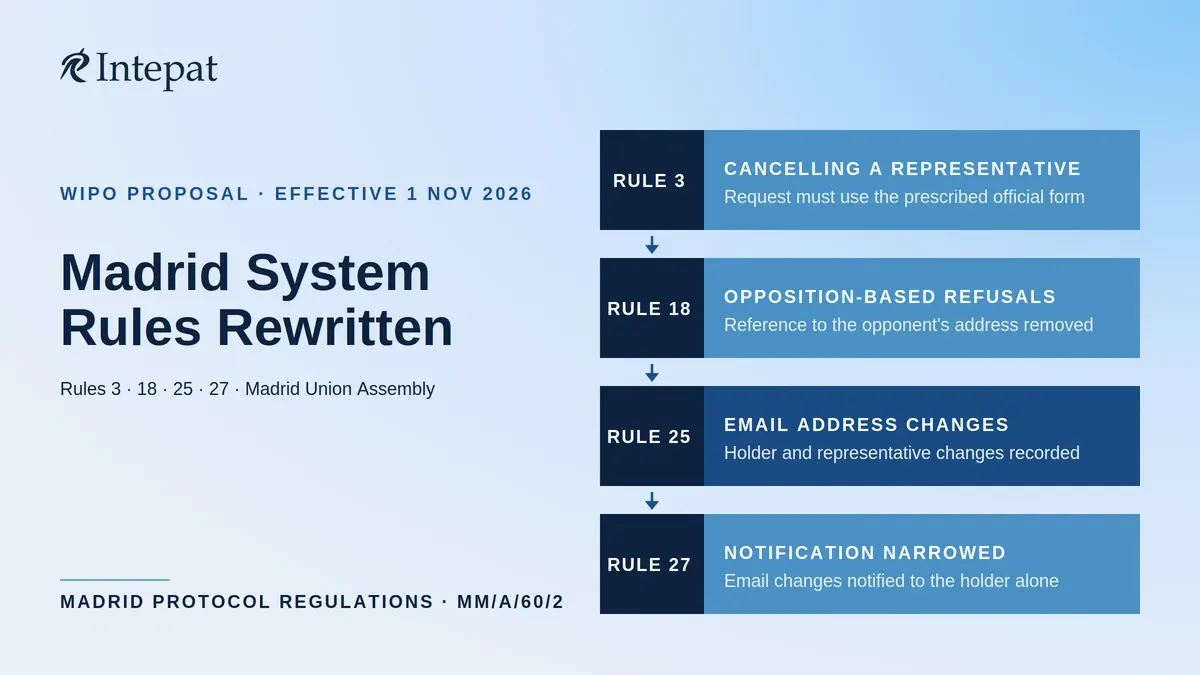
What the Madrid System Amendments 2026 Actually Change
The Assembly adopted the amendments at its sixtieth session in Geneva, held from 7 to 15 July 2026, and set 1 November 2026 as the commencement date. Four rules are amended, across six provisions, set out in two annexes to the Assembly document, one marked up and one clean.
| Provision | Now | From 1 November 2026 |
| Rule 3(6)(a) | Cancellation of a recorded representative is requested “in a communication signed by the applicant, holder or representative” | Requested “in the relevant official form signed by the applicant, holder or representative” |
| Rule 18(1)(c)(vi) | A notification of provisional refusal is irregular if it omits, “where applicable, the name and address of the opponent and the indication of the goods and services on which the opposition is based” | The words “and address” are deleted; the opponent’s name and the goods and services remain |
| Rule 25(1)(a)(iv) | Recordable: a change in the name or address of the holder | Recordable: “a change in the name, address or electronic mail address of the holder” |
| Rule 25(1)(a)(vi) | Recordable: a change in the name or address of the representative | Recordable: “a change in the name, address or electronic mail address of the representative” |
| Rule 25(2)(a)(vii) | The request states the amount of the fees being paid and the method of payment | The words “where applicable” are added before that requirement |
| Rule 27(1)(a) | Recordings are notified to the offices of the designated Contracting Parties in which the recording has effect, and the holder is informed at the same time | Added: for a change in the electronic mail address of the holder or the representative, “the International Bureau shall inform only the holder” |
Nothing here touches substantive law. Grounds of refusal, the scope of protection in each designated territory, classification, and the procedure for answering a provisional refusal all stand unchanged. These Madrid Protocol rule changes govern how a small set of administrative requests is made, recorded and circulated.
Rule 3: Cancelling a Representative Moves Onto an Official Form
Until 1 November 2026, cancellation of a recorded representative succeeds on any signed communication. After that date a requested cancellation must be made on the relevant official form. The International Bureau’s stated reason is that forms, and online forms in particular, have reduced processing times and errors.
Two compliant routes will exist. The online request already available in eMadrid, which is free of charge and lets a user appoint, cancel, replace or update a representative; and a new official form in PDF format that the International Bureau said it would introduce for this purpose. The PDF version had not been published as at 28 September 2026, so a cancellation that has to travel on a wet-signed client instruction should be timed around its release.
The requirement bites only on a cancellation that somebody requests. Where a new representative is appointed, or where a change in ownership is recorded and the new holder appoints nobody, the International Bureau cancels the existing recording of its own motion and no request or form is involved. A holder may in any event have one representative only.
The trap in a handover sits elsewhere. Where the outgoing representative is the party requesting cancellation, it takes effect on the earlier of a new appointment or the expiry of two months from receipt of the request, and until then WIPO addresses communications to both the holder and the outgoing representative. Plan a portfolio move around that, and around eMadrid’s rule that a request left unsigned for fourteen days is cancelled.
Rules 25 and 27: Email Changes Become Recordable, and Stay Private
A change of email address becomes expressly recordable for the holder and for the representative. The International Bureau already processes such requests, so what is new is the formal recording status, not the ability to make the change. It carries no fee, and the paired amendment informs only the holder.
The change is also kept out of the public record. WIPO’s stated position is that these recordings concern how the International Bureau communicates with holders and representatives, so they “would not be notified to the Offices of the designated Contracting Parties, as they would not have any effect in the latter”, and that they “would not be published in the WIPO Gazette of International Marks” either. There is therefore no public trace of an email change to reconcile against, and the check has to be run inside eMadrid, registration by registration.
That produces a quiet gap rather than a conflict. Each designated office keeps working from the contact details furnished to it under its own law, and nothing in the amended rules propagates a corrected email into that second set of records or tells the holder to. Correcting the address at WIPO is one step; correcting it in each territory that matters is a separate one, and each office has its own procedure, so budget instructed local counsel where the territory warrants it.
There is one point for recorded agents to watch. The operative text informs the holder alone, even where the change is to the representative’s own address, but the Assembly document’s explanatory paragraph describes notification as going to “the holder or their representative, where one has been appointed”. Until WIPO publishes an implementing notice, a firm should confirm its own recording in eMadrid rather than wait to be told.
| Transaction | Fee |
| Appoint, replace or cancel a representative | Nil |
| Change of email address, holder or representative | Nil |
| Change of name or address of the representative | Nil |
| Change of name or address of the holder (item 7.4) | 150 Swiss francs |
| Total or partial transfer of a registration (items 7.1 and 7.2) | 177 Swiss francs |
Fee amounts verified as of September 2026.
Rule 18: A Tidy-Up to the Irregularity Check, Not to Your Deadline
This amendment is the narrowest of the four and the easiest to overstate. It edits the list of defects that make a notification of provisional refusal irregular, deleting the reference to the opponent’s address. Oppositions, grounds and the holder’s response period are left as they were.
An earlier amendment, in force from 1 November 2023, made the opponent’s address conditional rather than absolute: an office must still indicate it wherever possible and is exempted only where it cannot, for example because of privacy laws or because the data is unavailable. The International Bureau has since treated a notification that omits the address as regular, and described the surviving reference as obsolete. Because the omission was already not an irregularity, deleting the words removes no live ground, and the amendment is described as editorial and without impact on users, offices or the International Bureau. Read the rest of the irregularity procedure separately, though: where a notification is irregular the International Bureau invites a rectified one, and a rectified notification must, where the applicable law so permits, indicate a new time limit for review, appeal or response.
Read it as housekeeping. A provisional refusal against an international registration designating India is still answered through the Indian Registry within the period the notification states.
What This Means If You File From India or Designate India
India sits on both sides of this. It is an office of origin for outbound international applications, and a heavily designated territory: WIPO put designations of India at an estimated 12,297 in 2025, out of an estimated 64,150 international applications filed worldwide that year. So the email gap lands on a large Indian book of work.
Indian law already fixes the contact position independently, which is what makes the gap manageable and also what makes ignoring it expensive.
| Indian provision | What it does |
| Rule 17(1), Trade Marks Rules 2017 | Requires an address for service in India “comprising of a postal address in India and a valid e-mail address” |
| Rule 17(3) | Absent that address the Registrar need send no notice, and “no subsequent order or decision in the proceedings shall be called in question on the ground of any lack or non-service of notice” |
| Rule 18(2) | A communication is deemed served “at the time of sending the email” |
| Rule 64 | Notices on an international registration designating India “shall be issued by the Registrar only in electronic form, and any response thereto shall also be received likewise” |
| Rule 68(1) | The Registrar enters particulars in the Record of Particulars of International Registration, and “any change in the particulars as and when received from the International Bureau shall be entered in the said record” |
| Rule 68(2) | An entry in that record has the same effect as if recorded in the Register |
| Rule 67 | A handling fee under the First Schedule is payable for certification and transmittal of an outbound international application |
Two consequences follow. The Registrar enters changes in the particulars as they are received from the International Bureau, so a recorded change of name or address still reaches India; an email change will not arrive that way once it is notified to the holder alone, which leaves the Indian contact position to be checked and refreshed with the Registry directly. The Indian route for that refresh is Form TM-P, the official application for post-registration changes, which lists the address for service among the details it amends. Because a designation of India sits in the Record of Particulars rather than the Register itself, confirm with the Registry that it accepts that route here. Separately, notices on a designation of India issue only electronically and responses are received the same way, and the general service rules deem a communication served when the email is sent. Put together, a dead recorded address is not untidy data but a broken channel through which a period can run and expire.
If you are weighing the international route against filing country by country, the comparison of the Madrid route with direct national filing sets out the cost and dependency trade-offs, and the Madrid Protocol guide for Indian applicants covers eligibility and process.
Your Madrid Records Checklist for 1 November 2026
The work these amendments expose is clerical rather than legal, and none of it stops being worth doing after the commencement date. Run the review against the register itself rather than internal file notes, because the two drift apart in exactly the fields these amendments touch.
- Check the recorded email addresses first. eMadrid relies on the recorded addresses of holders and representatives, with a WIPO Account, both to grant access and to authenticate requests, so a dead address can block every other item on this list.
- Pull the current representative recording for every international registration and confirm the recorded firm is still instructed. The eMadrid search walkthrough shows how to read register entries.
- From 1 November 2026, record any corrected email address at WIPO, which costs nothing.
- Separately, identify the designated territories whose own office relies on an address for service or a contact address, check the local procedure for updating it, and start with those carrying a live provisional refusal, a pending opposition or a renewal due within twelve months.
- Route a requested cancellation of a representative through eMadrid rather than a letter, and plan the handover timing around the two-month effect where the outgoing agent makes the request.
- Confirm that a live Indian address for service, postal and electronic, is on file for each designation of India and each Indian proceeding you are concerned in, and use Form TM-P where an entry needs altering. It is an Indian requirement in its own right and is not updated from the WIPO record.
How the review is run depends on the size of the book. A single registration is a ten-minute check a business owner can do alone, or hand to the agent who filed it. A few hundred registrations is a data exercise: export the holdings, reconcile the recorded representative and address fields against your own matter records, and work the exceptions rather than opening every entry. An agent reviewing client records should also ask clients to copy the firm on any change they make at WIPO themselves, because the new notification goes to the holder.
Where a portfolio has been quiet for a few years, treat the representative and email fields as suspect until checked. The recurring mistakes at the application stage are catalogued in common errors under the Madrid System; these amendments move the same discipline to the maintenance stage.
Frequently Asked Questions About the 2026 Madrid Amendments
They are final. The Madrid Union Assembly adopted the amendments to Rules 3, 18, 25 and 27 as set out in Annexes I and II to document MM/A/60/2, with 1 November 2026 as the date of entry into force. Commentary describing them as proposals predates that decision.
You stop receiving what WIPO sends, including provisional refusals forwarded from designated offices, and you may lose eMadrid access, since the recorded address is part of how requests are authenticated. For a designation of India, correspondence runs electronically only and is deemed served when sent.
No. From 1 November 2026 a recorded email change is notified to the holder alone, so nothing reaches a designated office. WIPO already processed email updates before that date, and those were not circulated either. Check and refresh the Indian address for service with the Registry directly.
The online request in eMadrid satisfies the new requirement, so a firm already using it needs to change nothing. A separate official form in PDF format is to be introduced, and had not been published as at 28 September 2026. Check for an implementing notice before relying on a paper version.
No. Email address changes carry no fee, and neither does a change to a representative’s name or address, which is why the fee indication in a request becomes required only where applicable. A change to the holder’s own name or address does carry a fee of 150 Swiss francs.
No. The amendments govern how requests are made and recorded from 1 November 2026, and filings already accepted stay valid. The exposure is not retrospective invalidity but stale data: recorded representatives who no longer act, and email addresses nobody reads.
This article explains the adopted amendments to the Regulations under the Madrid Protocol as at September 2026 and is for general information only. It is not legal advice. Fees, forms and procedures change, and WIPO had not published a consolidated amended text or an implementing notice at the date of writing; confirm the current position with WIPO and with the Indian Trade Marks Registry before acting. For advice on a specific international registration, consult a registered trademark agent.
Sources
- MM/A/60/2, Proposed Amendments to the Regulations Under the Protocol Relating to the Madrid Agreement, WIPO, 31 March 2026, paras 3 to 8 and Annexes I and II.
- MM/A/60/3, Report adopted by the Assemblies, Madrid Union Assembly, sixtieth (34th extraordinary) session, WIPO, 25 September 2026, para. 41.
- MM/LD/WG/23/3, Proposed Amendments to the Regulations, WIPO, 18 July 2025, paras 4, 9, 18, 21, 22 and 24.
- MM/LD/WG/23/14, Summary by the Chair, twenty-third session of the Working Group, WIPO, 26 September 2025, para. 11(i).
- Regulations under the Protocol Relating to the Madrid Agreement, text in force, WIPO Lex.
- Information Notice No. 26/2023, amendments in force 1 November 2023 and 1 November 2024, WIPO, paras 15 and 16.
- Madrid System, Manage your Representative, WIPO.
- Madrid System, Schedule of Fees, WIPO, items 7.1, 7.2 and 7.4.
- Madrid Yearly Review 2026, Executive Summary, WIPO, 2025 reference year.
- The Trade Marks Rules 2017, India, WIPO Lex, rules 17, 18, 64, 67 and 68.
- Form TM-P, application for post-registration changes, Office of the CGPDTM, Government of India.
- Madrid System Information Notices, 2026 series, WIPO, checked 28 September 2026.