




Trademark Registry to seek protection in multiple member jurisdictions through a single filing. India acceded to the Protocol with effect from 8 July 2013. A single application paid centrally in Swiss francs can cover multiple markets, but that international registration and its designated protections remain dependent on your Indian home mark for five years.
This article covers the Madrid Protocol as it operates under Indian law: Chapter IVA of the Trade Marks Act 1999 (inserted by Act 40 of 2010, effective 8 July 2013) and Chapter IV of the Trade Marks Rules 2017.
| Before You File: Four Things to Know |
| Eligibility prerequisite: You must hold a live Indian trademark application or registered mark before filing internationally. There is no international route without an Indian basic mark. The central risk: If your Indian basic mark fails within five years of the international registration date, protection ceases in every designated member for the affected goods or services. A contested home mark is a single point of failure for the entire structure. Indicative fees (verified July 2026): Indian Registry handling fee: Rs 5,000 (e-filing only). WIPO basic fee: 653 CHF for a non-colour mark covering up to three classes. Where applicable: supplementary fee of 100 CHF per class beyond three (unless only individual-fee members are designated); complementary fee of 100 CHF per designated member not charging individual fees; individual fee per designated member using the individual-fee system. Key timelines in India: Examination ordinarily within 2 months of WIPO advice; advertisement ordinarily within 6 months; examination-based provisional refusal period 18 months (India has declared that opposition-based provisional refusals may be notified after 18 months); opposition window 4 months after advertisement. |
What Is the Madrid Protocol?
The Protocol relating to the Madrid Agreement Concerning the International Registration of Marks, commonly called the Madrid Protocol, is administered by the World Intellectual Property Organization (WIPO) from Geneva. It allows a trademark owner to seek protection in multiple jurisdictions through a single application filed in one language, with fees paid centrally to WIPO.
As of July 2026, WIPO lists 117 Madrid System members covering 133 countries. Saudi Arabia’s accession to the Madrid System takes effect 8 October 2026 and was not open for designation as of the article date. India acceded to the Madrid Protocol with effect from 8 July 2013; Chapter IVA was inserted into the Trade Marks Act 1999 by the Trade Marks (Amendment) Act 2010 to give domestic effect to the Protocol’s provisions. Indian trademark owners thereby gained access to this network without having to file and manage separate national applications in each country.
One point worth keeping clear from the outset: the Madrid Protocol does not create a single trademark valid in all designated members. It creates a bundle of national or regional protections, each governed by the domestic law or regional framework of the jurisdiction where protection is sought. The single application is the mechanism; the resulting rights are national or regional. For more on how WIPO administers this system, see the WIPO Madrid System page.
Who Can File from India?
To file an international application through the Indian Trademark Registry, you need two things: a qualifying connection to India, and a live basic mark in India.
Connection to India. Section 36B of the Trade Marks Act 1999 recognises three grounds. You may be an Indian citizen, domiciled in India, or have a real and effective industrial or commercial establishment in India. That last ground matters for a foreign company that operates a branch, representative office, or other direct presence in India through which bona fide commercial activity takes place. The Act defines a real and effective establishment as any establishment where bona fide industrial or commercial activity takes place; it does not need to be the principal place of business.
A basic mark in India. You must hold either a pending trademark application under Section 18 of the Trade Marks Act 1999, or a registered trademark under Section 23, before you can file internationally. If you have not yet applied for trademark registration in India, that is the starting point: see our trademark registration in India service or file directly through the trademark registration tool. The international application must cover the same mark as your Indian basic mark, and can only claim goods or services within the scope of that basic mark.
How the Madrid System Works: Step by Step
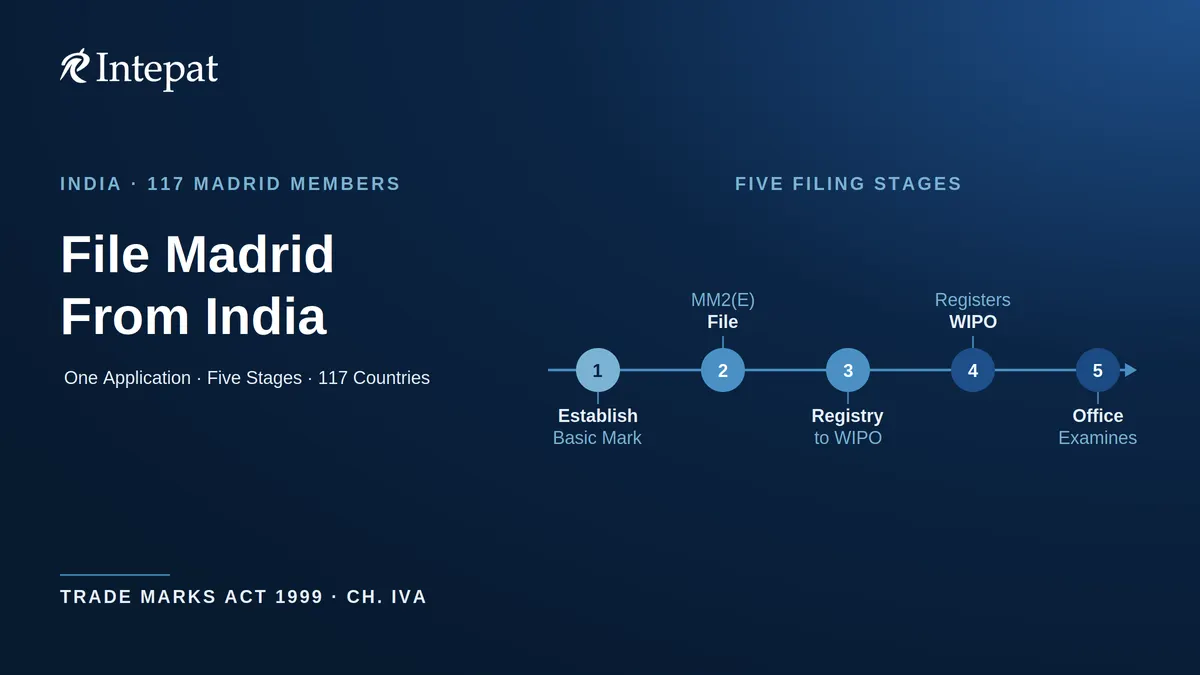
Filing under the Madrid Protocol from India follows five stages.
- Establish your Indian basic mark. Confirm that your Indian trademark application or registration is in force and that its specification covers the goods and services you intend to protect internationally.
- File the international application electronically. All international applications must be filed electronically through the Trade Marks International Application System; physical filing is not permitted (Rule 65, Trade Marks Rules 2017). The Indian Registry acts as the Office of Origin and certifies the application on WIPO Form MM2(E). A handling fee of Rs 5,000 is payable electronically at this stage (First Schedule, Entry 23, Trade Marks Rules 2017). To avoid errors at this stage, review the common errors to avoid when filing under the Madrid system before submitting. The Madrid application assistant can also help you prepare.
- The Registry forwards to WIPO. Where the application is compliant, the Registrar must forward the certified application to the International Bureau within two months of receipt (Rule 66(2), Trade Marks Rules 2017). Deficient applications are retained by the Registry until any irregularity is remedied (Rule 66(3), Trade Marks Rules 2017).
- WIPO registers and notifies. WIPO examines the application for formal compliance. If it passes, WIPO records the mark in the International Register and notifies each designated Office.
- Examination in each designated Office. Each designated Office examines the mark under its applicable domestic law or regional framework. The designated Office has a fixed window, typically 12 or 18 months depending on its declaration, to issue a provisional refusal. India’s examination refusal period is 18 months under Section 36E(2) of the Trade Marks Act 1999. India has also declared under Article 5(2)(c) of the Madrid Protocol that opposition-based provisional refusals may be notified after the 18-month period has expired. For certainty as to the protection status of a designation, verify the current status on the WIPO International Register rather than relying solely on elapsed time.
For assistance with the full filing process, see our Madrid Protocol filing service.
The Five-Year Dependency Risk
The five-year dependency risk carries a structural consequence that shapes how any Indian applicant should think about their international portfolio. It is the feature that, if underestimated, exposes the entire international structure to a single point of failure.
What the law says. Section 36D(5) of the Trade Marks Act 1999 provides that if, at any time before the expiry of five years from the date of international registration, your Indian basic mark is withdrawn, cancelled, expired, or finally refused in respect of all or some of the goods or services listed in the international registration, the protection flowing from that international registration ceases to have effect to the corresponding extent.
The proviso to Section 36D(5) adds an important qualification: proceedings affecting the Indian basic mark that begin before the expiry of the five-year dependency period may result in cancellation of the international registration even where the final decision issues after that period. Section 36D(5) must be read together with Article 6(3) of the Madrid Protocol; the precise scope of the proviso in any specific case requires professional advice.
| Central Attack: The Structural Risk |
| If your Indian trademark application is refused or your registration is cancelled within five years of the international registration date, protection ceases in every designated member for the affected goods or services. Proceedings affecting the Indian basic mark that begin before expiry of the five-year dependency period may result in cancellation of the international registration even where the final decision issues later. Section 36D(5) must be read together with Article 6(3) of the Madrid Protocol. Do not build an international portfolio on a home mark that is under serious challenge. |
Transformation remedy. Where the international registration is cancelled at the request of the Office of origin following failure of the Indian basic mark, Article 9quinquies may permit the former holder to file separate national or regional applications in the affected designated members within three months of cancellation. Each application must concern the same mark and may cover only goods or services protected by the relevant designation. Subject to local requirements and fees, it retains the international-registration date or, where applicable, the subsequent-designation date, together with any priority enjoyed by the international registration. The application must be filed within the three-month period prescribed by Article 9quinquies.
What this means in practice. That international registration and its designated protections are only as secure as the Indian basic mark for the first five years. If a competitor successfully opposes your Indian trademark application, or obtains cancellation of your Indian registration through a third-party rectification action, every international designation is affected to the extent the goods and services overlap. This is commonly referred to as central attack: a single successful challenge at the Indian Trademark Registry can collapse the international structure built on that mark.
Multiple triggers apply. The protection ceases if the basic mark is voluntarily withdrawn, if it is cancelled through a third-party rectification action, or if it is finally refused following examination or hearing. Failure to renew the Indian basic registration can also trigger dependency consequences if it ultimately causes the registration to expire or be removed during the five-year period.
The reverse position. Section 36E(8) of the Trade Marks Act 1999 applies where India is the designated member rather than the Office of Origin. If a foreign applicant has designated India through an international registration and the basic mark in their home jurisdiction fails within five years, the protection in India ceases to have effect. This provision is directly relevant to any foreign rights-holder reviewing the security of an India designation they hold; it is less directly at issue for an Indian applicant building outward.
What to assess before filing. A pending opposition or material vulnerability in the Indian basic mark increases the dependency risk and should be assessed before relying on it for an international filing. Where specific markets are critical to the business, direct national filings in those jurisdictions provide protection that is structurally independent of the Indian basic mark. For a detailed analysis of when Madrid is the right choice and when direct national filing in each jurisdiction offers more structural security, see our comparison of Madrid Protocol versus direct national filing in India.
How India Examines Designated Applications
When India is designated in an international registration, the International Bureau sends advice to the Indian Trademark Registry. From that point, India’s domestic trademark law applies to the designation, with the adaptations required by the international context, as it applies to a direct application filed under Section 18.
Intention to use. India requires a declaration of intention to use the mark in India as a condition of designation, under Rule 7(2) of the Common Regulations of the Madrid System. This declaration must be included in the international application when India is among the designated contracting parties.
Examination and advertisement timeline. The Registry examines the application ordinarily within two months of receiving WIPO’s advice (Rule 69(1), Trade Marks Rules 2017). If the mark clears examination, it is advertised in the Trade Marks Journal, ordinarily within six months of receiving WIPO’s advice (Rule 69(3), Trade Marks Rules 2017).
Provisional refusal. The provisions of Sections 9 to 21 of the Trade Marks Act 1999, covering absolute grounds, relative grounds, and related requirements, apply to an international registration designating India as they apply to domestic applications, with the adaptations required by the international context (Section 36E(4)). If the mark is objectionable on any of those grounds, the Registrar must communicate a provisional refusal to WIPO before the expiry of the 18-month refusal period (Section 36E(2)). India has also declared under Article 5(2)(c) of the Madrid Protocol that a provisional refusal based on an opposition may be notified after the 18-month period. If the Registrar does not issue a provisional refusal within 18 months, protection in India is deemed extended under Section 36E(5); however, given India’s Article 5(2)(c) declaration, the absence of a refusal within 18 months does not conclusively confirm protection where an opposition may still be pending.
Opposition. Once the mark is advertised in the Trade Marks Journal, any person has four months to file an opposition under Section 21(1) of the Trade Marks Act 1999 (applied via Section 36E(4)). An opposition results in a provisional refusal being notified to WIPO, and the matter proceeds in the same way as a domestic opposition.
Effect once protection is granted. The protection of the trademark in India is the same as if the mark had been registered in India (Section 36F(1), Trade Marks Act 1999). The holder has the same infringement rights as a domestic registrant.
If you receive a provisional refusal against an India designation, see our provisional refusal response service and the detailed guidance in our article on responding to a provisional refusal under the Madrid Protocol.
What You Actually Pay
Madrid Protocol fees come from two sources: the Indian Trademark Registry and WIPO. The total amount depends on the number of classes covered and the members designated.
Outward filing fees (Indian applicant filing through India as Office of Origin)
| Fee component | Basis | Amount | Source |
| Indian Registry handling fee | Per application | Rs 5,000 (e-filing only) | First Schedule, Entry 23, TMR 2017 |
| WIPO basic fee, non-colour mark | Per application, up to 3 classes | 653 CHF | WIPO Schedule of Fees, eff. 1 Feb 2023 |
| WIPO basic fee, colour mark | Per application, up to 3 classes | 903 CHF | WIPO Schedule of Fees, eff. 1 Feb 2023 |
| WIPO supplementary fee | Per class beyond 3, per application, unless only individual-fee members are designated | 100 CHF per class | WIPO Schedule of Fees, eff. 1 Feb 2023 |
| WIPO complementary fee | Per designated member not charging an individual fee | 100 CHF per designated member | WIPO Schedule of Fees, eff. 1 Feb 2023 |
| Individual fee | Per designated member that has notified individual fees, per their schedule | Varies by member | WIPO Individual Fees page |
Three notes on the fee structure. First, the supplementary fee applies to the application as a whole for each class beyond three, unless every member designated in the application charges individual fees. If any designated member does not charge individual fees, the supplementary fee may apply. Second, the complementary fee is charged separately for each designated member that has not notified individual fees; members using individual fees pay those fees instead. Third, an Indian applicant whose Office of Origin is India cannot designate India in their international application under Article 3bis of the Madrid Protocol. India’s individual fee of 83 CHF per class applies when India is designated by a foreign-origin international registration; verify the operative effective date at wipo.int before advising clients.
Example. An Indian applicant filing a non-colour mark in two classes and designating five members: because the application covers only two classes, no supplementary fee arises. The applicant pays the WIPO basic fee of 653 CHF, plus the applicable individual fee for each designated member that uses the individual-fee system, or the complementary fee of 100 CHF for each designated member that does not. The Rs 5,000 Indian Registry handling fee is paid separately.
Note on prosecution costs. The fees above cover the initial filing costs only. If any designated Office issues a provisional refusal, a substantive response is required, prepared in accordance with that Office’s applicable domestic law or regional framework, ordinarily through local counsel. For markets with rigorous examination standards, founders should budget for these additional costs in their international trademark strategy.
Renewal. The international registration is renewed centrally through WIPO every ten years (Section 36G(1), Trade Marks Act 1999). A six-month grace period is available, subject to a surcharge (Section 36G(2)). There is no need to renew separately in each designated member.
All Indian Registry fees and WIPO fees are verified as of July 2026. WIPO fees and individual fees for designated members are subject to change; confirm current figures at wipo.int before filing. WIPO fees are denominated in Swiss francs; the rupee equivalent varies with the prevailing exchange rate at the time of payment.
To calculate the exact fees for your mark, classes, and designated members, use the Madrid fee calculator guide.
Madrid Protocol India: Advantages and Practical Limitations
Advantages. One application, filed in one language and paid centrally, can seek protection across all 117 Madrid System members through a single filing. For a trademark owner whose mark and goods or services are consistent across markets and who is covering multiple jurisdictions, a single Madrid filing can be more cost-effective than managing separate national applications, depending on the number of members designated. Post-grant changes such as a change of ownership or a change of name are managed centrally through WIPO and take effect across designated members per the Madrid Protocol’s common regulations, subject to any declarations made by individual contracting parties; India has declared that the recordal of a licence in the International Register has no effect in India, so licence arrangements for the Indian designation require compliance with India’s domestic law on licensing.
Limitations. The five-year dependency risk, described above, is a structural constraint that affects every designated member simultaneously. Beyond that, the specification filed internationally is fixed to the scope of the Indian basic mark. In markets where a different or narrower specification would improve registrability, the system’s inflexibility becomes a disadvantage.
Some designated Offices apply rigorous substantive examination standards. Where a provisional refusal issues in a key market, it requires a substantive response prepared in accordance with that Office’s applicable domestic law or regional framework, ordinarily through local counsel, which adds both cost and complexity to the filing. If several key markets are likely to raise objections, the initial cost savings of a single filing may be offset by the cost of managing multiple provisional refusal proceedings simultaneously.
For a structured comparison of when Madrid Protocol filing and direct national filing each make more strategic sense, see the Madrid versus direct filing trade-off analysis.
Frequently Asked Questions
The Madrid Protocol is an international treaty administered by WIPO that allows a trademark owner to seek registration in multiple jurisdictions through a single international application. As of July 2026, WIPO lists 117 Madrid System members covering 133 countries; Saudi Arabia’s accession takes effect 8 October 2026. India acceded to the Protocol with effect from 8 July 2013, giving Indian trademark owners access to this network.
Under Section 36B of the Trade Marks Act 1999, the applicant must be an Indian citizen, domiciled in India, or hold a real and effective industrial or commercial establishment in India. A qualifying establishment is one where bona fide industrial or commercial activity takes place; it does not need to be the principal place of business.
Under Section 36D(5) of the Trade Marks Act 1999, if your Indian basic mark is withdrawn, cancelled, expired, or finally refused within five years of the international registration date, the resulting international protection ceases to that extent. The proviso to Section 36D(5) provides that proceedings affecting the Indian basic mark that begin before expiry of the five-year dependency period may result in cancellation of the international registration even where the final decision issues after that period; Section 36D(5) must be read together with Article 6(3) of the Madrid Protocol. Where the international registration is subsequently cancelled, Article 9quinquies may permit the former holder to file separate national or regional applications in the affected designated members within three months of cancellation, retaining the original international registration date and any applicable priority.
Under Section 36G(1) of the Trade Marks Act 1999, an international registration has a term of ten years, renewable for successive ten-year periods. Renewal is managed centrally through WIPO and covers all designated members where protection remains in force. A six-month grace period applies on payment of a surcharge under Section 36G(2).
The Indian Trademark Registry applies Sections 9 to 21 of the Trade Marks Act 1999 to the designation, with the adaptations required by the international context. Examination ordinarily takes place within two months of receiving WIPO’s advice (Rule 69(1), Trade Marks Rules 2017). Examination-based provisional refusals must be communicated to WIPO within the 18-month period under Section 36E(2). India has declared under Article 5(2)(c) of the Madrid Protocol that opposition-based provisional refusals may be notified after the 18-month period, so the absence of a refusal within 18 months does not conclusively confirm protection.
The Indian Registry charges a handling fee of Rs 5,000, payable electronically (First Schedule, Entry 23, Trade Marks Rules 2017). WIPO charges a basic fee of 653 CHF for a non-colour mark covering up to three classes, a supplementary fee of 100 CHF per class beyond three where applicable, a complementary fee of 100 CHF per designated member not charging individual fees, and individual fees for each designated member that uses the individual-fee system. Indian applicants cannot designate India in their international application and therefore do not pay India’s individual WIPO fee. All figures are verified as of July 2026.
WIPO’s international fees carry no startup or MSME concession. WIPO’s 90% reduction of the basic fee applies where the applicant’s country of origin is classified as a least-developed country under the applicable United Nations list; India does not fall within that category. The Indian Registry’s handling fee is prescribed by Entry 23 of the First Schedule of the Trade Marks Rules 2017 as a flat Rs 5,000, with no startup or MSME tier.
Disclaimer: This article is a general overview of the Madrid Protocol as it applies under Indian law. It is not legal advice and does not account for changes to WIPO fee schedules, individual fees for designated members, or amendments to the Trade Marks Act 1999 or Trade Marks Rules 2017 after July 2026. Intepat IP Services recommends obtaining qualified legal advice before filing an international trademark application. Fees and timelines are subject to change; verify current figures at wipo.int and ipindia.gov.in before filing.