




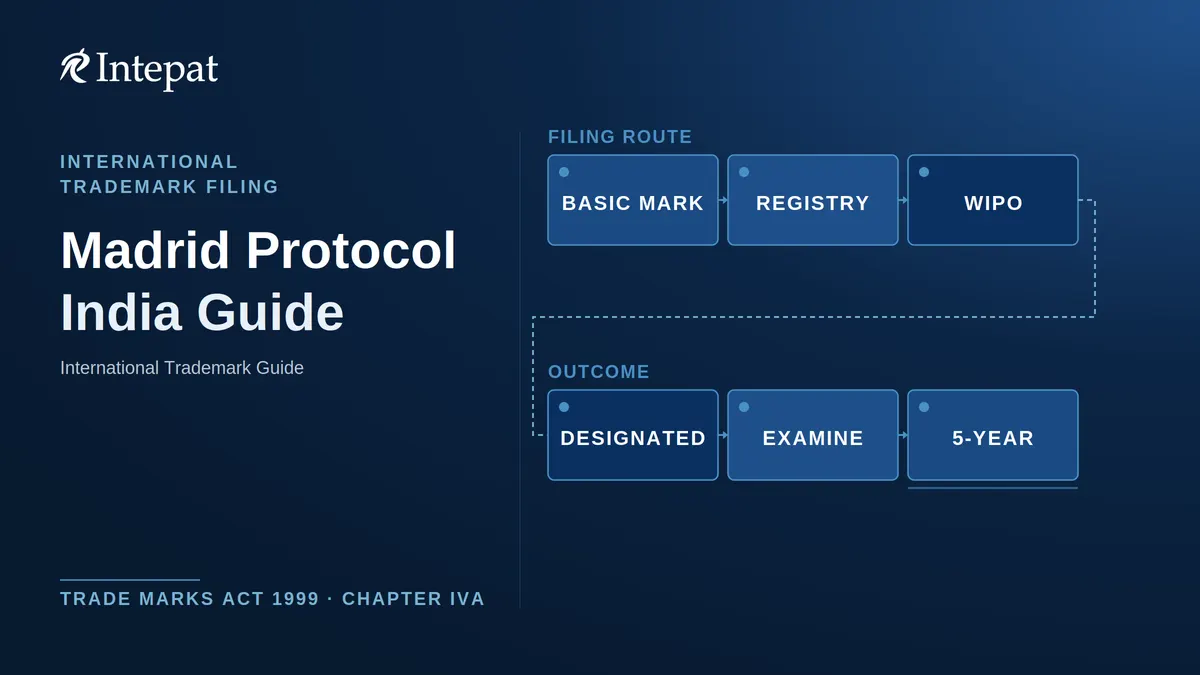
The Madrid Protocol India route lets an eligible trademark owner seek protection across multiple markets through one international application filed via the Indian Registry. The Madrid System covers 116 members and 132 countries (as of July 2026), but it does not create one worldwide trademark. Each designated office applies its own law and may accept, limit, or refuse protection.
| At a glance |
| ● A pending Indian trademark application or registration must exist as the basic mark. ● The international applicant must qualify through Indian nationality, domicile, or a real and effective industrial or commercial establishment in India. ● The application is filed electronically through the Indian Registry, which certifies and forwards it to WIPO. ● The Indian handling fee is Rs 5,000, in addition to WIPO fees in Swiss francs. ● The international registration depends on the Indian basic mark for its first five years. |
Is the Madrid Protocol India route right for your brand?
The main filing decision is not whether Madrid is available, but whether it fits the condition of the Indian basic mark and the markets being entered. A Madrid application from India may suit a business seeking protection in several member jurisdictions with a mark and specification that can remain broadly consistent across them.
The applicant must be the person in whose name the pending Indian application or registration stands under the Trade Marks Act 1999. That person must qualify to use India as the Office of origin (the national Registry through which the application is filed) through at least one connection: Indian nationality, domicile in India, or a real and effective industrial or commercial establishment in India. These are alternative connecting factors, not cumulative requirements.
The Indian filing is the basic mark. It may be a pending application under Section 18 or a registration under Section 23 of the Trade Marks Act 1999. A granted Indian registration is therefore not required, but an application facing a serious objection, opposition, ownership defect, or non-renewal exposure can place every Madrid designation within the five-year dependency mechanism.
Before selecting countries, conduct a trademark search and clearance in the priority markets. Clearance in India does not establish that the mark is available in the United States, European Union, United Kingdom, or another designated jurisdiction.
| Decision factor | Madrid Protocol filing | Direct national or regional filing |
| Markets required | Often suitable for several Madrid members | Often suitable for one or two priority markets |
| Dependence on Indian filing | Applies for the first five years | No dependence on the Indian basic mark |
| Specification | Must remain within the basic mark’s goods and services | Can be adapted to local filing practice |
| Administration | One international record for renewal and central changes | Separate records and renewals in each jurisdiction |
| Local counsel | Usually engaged if an objection, opposition, or local action arises | May be required at filing or during prosecution |
| Non-member jurisdiction | Madrid cannot be used | Direct filing remains available |
Direct filing may be preferable where the Indian basic mark is vulnerable, the target jurisdiction needs materially different specification wording, or only one commercially important market is involved. A mixed filing plan is also possible: Madrid for selected members and direct filings for non-members or markets needing a different strategy.
How to file a Madrid application from India
1. Confirm the basic mark and applicant
The international application must correspond to the Indian basic mark at the time of certification. The applicant, mark representation, and goods or services must match the Indian record. The international specification may be narrower, but it cannot extend beyond the basic application or registration.
A business without an Indian basic mark must first file a trademark application in India. Where a group has related entities in different countries, confirm that the entity filing internationally is also the applicant or proprietor of the Indian basic mark and satisfies a connecting factor with India.
2. Select the designated members
The application should designate the members where commercial protection is required. WIPO currently lists 116 members covering 132 countries (verified July 2026). An Indian-origin application can request protection in other members, including regional systems where available, but cannot use Madrid for a country outside the System.
Selection should follow launch, manufacturing, licensing, distribution, and enforcement plans. Each designation adds an official fee and may bring local examination, opposition, use, representation, or maintenance requirements. A United States designation also requires a declaration of intention to use the mark, made in Form MM18 under the WIPO Common Regulations (verify current requirements at the USPTO and WIPO before filing).
3. File electronically through the Indian Registry
Rule 65 of the Trade Marks Rules 2017 requires an international application originating from India to be filed electronically through the Trade Marks International Application System. It is not filed directly with WIPO. The Rs 5,000 handling fee must be paid electronically with the application under Rule 67 and Entry 23 of the First Schedule.
4. Obtain certification and transmission
The Registrar checks whether the international application corresponds to the Indian basic mark. A compliant application is certified in Form MM2(E) and forwarded to WIPO within two months of receipt under Rule 66.
The two-month transmission period affects the international-registration date under Article 3(4) of the Madrid Protocol. Where the Registrar certifies and forwards a compliant application within two months and WIPO receives it within that period, the international-registration date is the Indian Registry’s receipt date. If WIPO receives the application after that period, the international-registration date becomes WIPO’s own receipt date.
5. Complete WIPO formal examination
WIPO checks formal requirements, classification, designated members, and payment. Under the WIPO filing process, if the application complies, WIPO records the mark in the International Register, publishes it in the WIPO Gazette of International Marks, notifies the designated offices, and issues an international registration certificate.
The certificate confirms international recordal. It does not confirm that every designated office has accepted the mark. Distinctiveness, conflict with earlier rights, opposition, and other substantive grounds are decided separately under each designated member’s law.
6. Complete examination in each market
Each designated office examines the designation as though protection had been sought under its domestic or regional system. The ordinary refusal period is 12 months, or 18 months where the member has made the applicable declaration. An opposition-based refusal can be notified later where the Madrid Protocol and the member’s declaration permit it.
A foreign office may grant protection, issue a partial or total provisional refusal, or allow protection to take effect without a refusal being notified within the applicable period. Any provisional refusal must be answered before the office that issued it, under its law and within the period stated in the notification. Local representation may then be required.
What does a Madrid application cost?
Fees verified on 19 July 2026. WIPO fees and individual designation fees may change. Confirm the filing estimate with the WIPO Madrid Fee Calculator before submission.
| Fee component | Current amount | Paid to | What affects it |
| Indian Registry handling fee | Rs 5,000 | Indian Trade Marks Registry | Fixed electronic filing fee for certification and transmission |
| WIPO basic fee, black-and-white mark | CHF 653 | WIPO | Basic international application fee |
| WIPO basic fee, colour mark | CHF 903 | WIPO | Applies where the representation is in colour |
| Designation and class fees | Variable | WIPO | Members selected, individual or standard fee system, and classes |
| Local prosecution fees | Variable | Foreign counsel or designated office | Objection, opposition, hearing, evidence, or other local action |
The official WIPO fee page confirms that the basic fee is only one part of the filing cost. The Indian basic application or registration also has its own official and professional costs. Intepat’s guide to trademark registration fees in India explains those domestic charges separately.
How the five-year dependency affects protection
For five years from the international-registration date, the international registration depends on the Indian basic application or registration. Under Section 36D(5) of the Trade Marks Act 1999, if the basic application or registration is withdrawn, cancelled, expires, or is finally refused during that period, the protection resulting from the international registration ceases to have effect to the corresponding extent. The cessation is a statutory consequence of the trigger event, not a discretionary WIPO act; upon notification from the Registrar under Section 36D(7), the International Bureau updates the International Register accordingly.
The effect can be partial. If the Indian basic mark fails only for particular goods or services, the international registration is cancelled only for the corresponding scope. The term central attack is often used, but dependency-based cancellation can result from Registry action, voluntary withdrawal, non-renewal, opposition, or rectification of the Indian basic mark, among other events affecting that mark.
The five-year cut-off does not protect the registration from proceedings begun within that period. An appeal against refusal, an action seeking withdrawal or cancellation, or an opposition started before the fifth anniversary can produce a later cancellation under Article 6 of the Madrid Protocol. A withdrawal or renunciation after five years can also remain relevant where such a proceeding was already pending.
| Dependency check |
| Review examination objections, oppositions, ownership, renewal status, and the specification of the Indian basic mark before filing. A weak basic mark can convert one Indian proceeding into a multi-country loss of protection. |
Transformation after dependency-based cancellation
Transformation is available where WIPO cancels the international registration under Article 6(4), including at the request of the Office of origin. Article 9quinquies of the Madrid Protocol permits the former holder to file national or regional applications in affected designated members within three months of cancellation (verify the current period at WIPO before relying on this figure).
The transformed application must concern the same mark, and its goods or services must remain within the scope previously covered for that member. Subject to local requirements and fees, it can retain the international-registration or subsequent-designation date and any valid priority. Rule 71 applies this remedy where India was one of the designated members.
Transformation is a remedial route involving separate national proceedings and additional cost. It is not a substitute for reviewing the Indian basic mark before filing.
What happens after a country is designated?
For an original designation, protection has the same effect as a national application from the international-registration date, subject to the designated office’s right to notify a refusal. For a subsequent designation, the relevant date is the date WIPO records that designation. If no permitted refusal is notified in time, the designation takes effect from the applicable date rather than only from expiry of the refusal period.
A missed refusal period does not prevent every later challenge. National rules on invalidation, cancellation for non-use, infringement, or other post-registration proceedings continue to apply. Madrid centralises the international record, but the scope and continued validity of protection remain subject to each designated jurisdiction.
When India is designated
Where India is designated, the Registrar examines the international registration under Indian law, ordinarily within two months of WIPO’s advice. If no refusal ground is found, the mark is ordinarily advertised within six months. Any person may oppose within four months from publication in the Trade Marks Journal, and Rule 69(5) applies Rules 42 to 51 to the opposition.
India has declared an 18-month refusal period under Section 36E(2) and also permits an opposition-based refusal after that period where the Article 5(2)(c) conditions of the Madrid Protocol are met. Section 36E(4) applies Sections 9 to 21, 63 and 74 to the designation.
Under Section 36E(5), where protection has not been opposed and the opposition period has expired, the Registrar shall notify WIPO of acceptance within 18 months of receipt of advice; if the Registrar fails to notify within that period, protection is deemed extended. A holder who receives no refusal or opposition notification should verify the designation’s status through WIPO’s records (using the WIPO Madrid Monitor at madrid.wipo.int) before treating it as confirmed.
A further dependency applies in reverse. Under Section 36E(8), where the basic application or registration in a Contracting Party other than India is withdrawn, cancelled, expires, or is finally refused within five years of the international registration, the protection of that registration in India ceases to have effect to the corresponding extent. Foreign applicants designating India should therefore monitor the health of their basic mark for the first five years.
If India issues a provisional refusal, the holder must respond before the Indian Trade Marks Office within the notice period. The separate guide on responding to an India Madrid provisional refusal explains that procedure.
How to maintain and expand the registration
An international registration remains valid for ten years and can be renewed through WIPO for further ten-year periods. A six-month grace period is available subject to the prescribed surcharge. Renewal through WIPO does not cure cancellation for non-use or another defect arising under a designated member’s law.
Changes to the holder’s name or address, ownership, limitation of goods or services, and renewal can generally be recorded centrally. National requirements may still apply to use, evidence, licences, enforcement, or local proceedings. Intepat’s trademark renewal service covers the separate Indian renewal position.
Additional members may be added later through a subsequent designation. That designation takes effect from its recordal date, not the original international-registration date. A conflicting right may therefore arise in the interval, so commercially important markets should be considered at the original filing stage.
Checks to complete before filing
Confirm that the applicant and basic-mark owner are the same person, and that at least one Indian connecting factor is satisfied. Review the Indian application for objections, opposition, ownership defects, renewal exposure, and goods or services that may be vulnerable to limitation.
Prepare market-specific clearance results and a country list tied to actual commercial plans. Check whether local specification wording, use declarations, individual fees, or representation requirements make direct filing preferable in any priority jurisdiction.
Finally, calculate both the initial filing cost and the likely cost of foreign prosecution. The Madrid System from India reduces central administration, but it does not remove national examination or the expense of answering a refusal.
Frequently asked questions
The Madrid Protocol is a WIPO-administered treaty that provides one filing channel for requesting trademark protection in several member jurisdictions. The application is filed through the applicant’s Office of origin, but each designated office decides protection under its own law. The resulting international registration is therefore a coordinated filing and administration system, not one worldwide trademark right.
No. A pending Indian trademark application under Section 18 may serve as the basic mark, so the applicant need not wait for registration under Section 23. The international applicant must be the person named on that Indian filing and must qualify through Indian nationality, domicile, or a real and effective industrial or commercial establishment in India.
The Madrid System currently has 116 members covering 132 countries (as of July 2026). An eligible Indian applicant may designate other Madrid members where protection is required, subject to the available regional and national routes. The final coverage depends on the members selected and the result of examination in each jurisdiction, not merely on WIPO recording the international registration.
The Indian Registry should forward a compliant application to WIPO within two months. After WIPO records the international registration, each designated office generally has 12 or 18 months to notify a refusal, although a permitted opposition-based refusal may arrive later. The time to a settled outcome therefore varies by jurisdiction and by whether objections or oppositions arise.
Under Section 36D(5), if the Indian basic application or registration is withdrawn, cancelled, expires, or is finally refused within five years of the international registration, the protection resulting from that registration ceases to have effect to the same extent. Proceedings begun during the five-year period can produce cessation later, even after the fifth anniversary has passed.
A provisional refusal means a designated office has objected to protection wholly or partly under its domestic law. The holder must respond before that office within the deadline stated in the WIPO notification, usually through local counsel where required. The refusal affects that designation only and does not by itself determine the outcome in other designated jurisdictions.
No. Madrid can reduce filing and portfolio-administration work across several members, but the total depends on designation fees, classes, objections, oppositions, and local counsel. Direct filing may cost less for one or two markets, and it may be strategically safer where the Indian basic mark faces serious dependency exposure or requires a different specification.
This article states the Madrid Protocol position relevant to India as verified on 19 July 2026. It provides general information and is not legal advice. Membership, official fees, declarations, filing systems, and procedural deadlines may change. Confirm the current WIPO and Trade Marks Registry requirements and obtain advice on the basic mark and target jurisdictions before filing.