




The Patent Cooperation Treaty (PCT) is a 1970 treaty, in force in 158 contracting states as of March 2026, that lets you file one international patent application and defer country-by-country filing decisions. The Patent Cooperation Treaty in India is administered through the Indian Patent Office, which acts as Receiving Office, International Searching Authority, International Preliminary Examining Authority, Designated Office, and Elected Office. India acceded on 7 December 1998.
This guide covers the Patent Cooperation Treaty as it operates for India. The treaty itself applies to all 158 contracting states; the procedural detail in this article reflects the Patents Act 1970, the Patents Rules 2003 as amended through 15 March 2024, and the PCT Regulations in force from 1 January 2026. Where the article describes international-phase mechanics, the framing is jurisdiction-neutral; where it covers India-specific entry, filing, and forms, the framing is India-specific.
For Indian inventors, startups, foreign IP counsel, and in-house teams managing Indian patent portfolios, this article is the practical lifecycle reference for the Patent Cooperation Treaty as it operates for India.
Quick Reference
- 158 PCT Contracting States as of March 2026; India acceded 7 December 1998.
- Priority deadline: 12 months from first filing.
- Restoration of priority in the international phase: up to 14 months.
- India PCT deadline (PCT national phase India entry): 31 months from priority date (the PCT 31 month deadline India applies to both routes into national phase).
- Request for Examination on Form 18: 31 months from priority for applications filed on or after 15 March 2024.
- PCT Rule 49.6 India: no reinstatement of rights at national phase.
- Indian Patent Office is RO/IN, ISA, IPEA, Designated Office, and Elected Office.
- Filing fee anchors: INR 1,600 (electronic, natural person / startup / small entity / educational institution); INR 8,000 (electronic, other applicants).
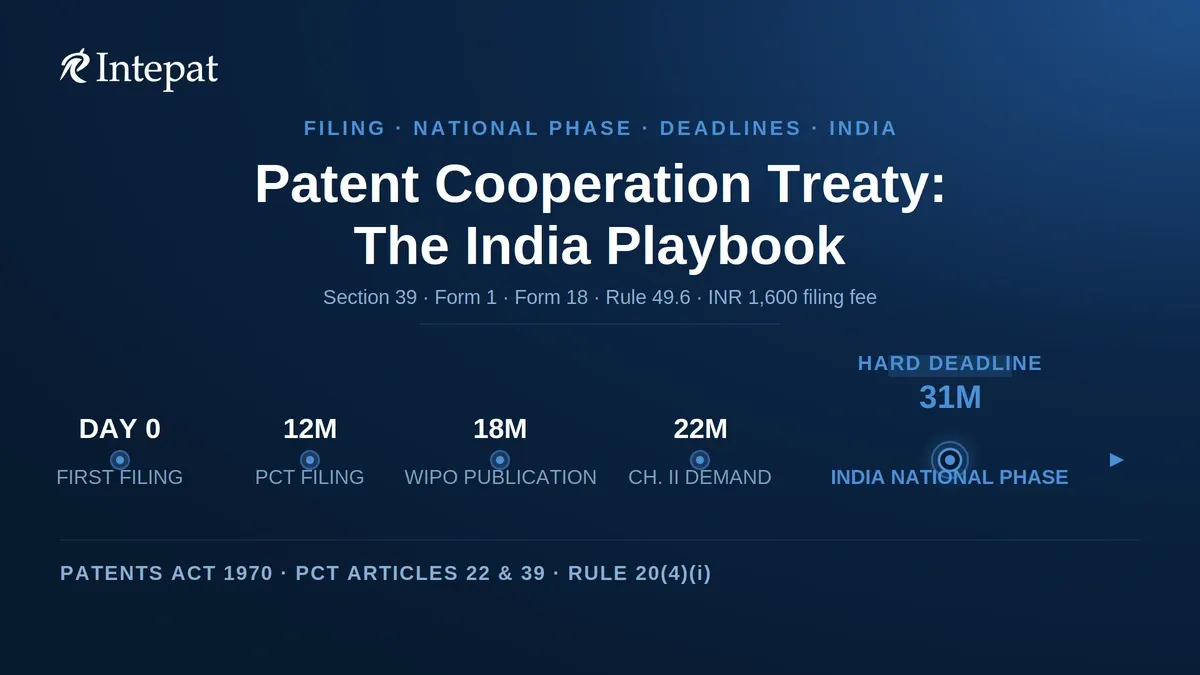
Lifecycle at a glance
| Stage | Deadline / trigger | India relevance |
| First filing | Day 0 | Priority date starts running |
| PCT international filing | 12 months from priority (Paris Convention period) | International application filed at RO/IN or RO/IB |
| WIPO publication | 18 months from priority | International application published |
| Article 19 amendment | 2 months from ISR transmittal or 16 months from priority, whichever is later | Claim amendments only |
| Chapter II Demand | 3 months from ISR transmittal or 22 months from priority, whichever is later | Optional preliminary examination |
| India national phase entry | 31 months from priority (Rule 20(4)(i)) | Indian application forms, fees, English translation |
| Indian RFE on Form 18 | 31 months from priority (Rule 24B(1)(i)) for applications filed on or after 15 March 2024 | Required to begin substantive examination |
How the PCT works: international phase to national phase
The Patent Cooperation Treaty creates a single procedural track that sits between an applicant’s first filing and the patent granted in each country where protection is finally sought. There is no “international patent” at the end of it; the PCT does not grant a patent. What it does is consolidate the early steps, so that the country-by-country filing decision can be deferred for 18 or 19 months beyond the 12-month Paris Convention priority window. The applicant gets one international search, one international publication, and one optional preliminary examination, and uses that consolidated record to decide which national markets justify separate national prosecution.
The lifecycle has two phases. The international phase begins when an applicant files an international application with a Receiving Office. From the international filing date, the application has the effect of a regular national application in each designated state. An International Searching Authority conducts a prior-art search, issues an International Search Report (ISR), and gives a written opinion on patentability. WIPO publishes the application at 18 months from the priority date. Once the ISR is transmitted, the applicant has two months (or until 16 months from priority, whichever is later) to amend the claims with the International Bureau under PCT Article 19.
A Demand for international preliminary examination may be filed by the later of three months from ISR transmittal or 22 months from the priority date. A Demand triggers a further round of substantive examination by an International Preliminary Examining Authority and a further opportunity to amend the description, claims, and drawings. The IPER (International Preliminary Examination Report) issued by the IPEA travels with the application into the national phase.
There are two routes into the national phase. If no Chapter II Demand is filed, the applicant enters national phase in every designated state. If a Demand is filed and elections are made, entry proceeds in every elected state. India’s national-phase deadline is 31 months from the priority date under both routes, fixed by Rule 20(4)(i) of the Patents Rules 2003. The operational difference between the two routes is what the applicant carries into national phase: ISR and written opinion on the first route, ISR and IPER on the second. The deadline arithmetic is identical for India. Our explainer on the international and national phases covers the jurisdiction-neutral mechanics of how the two phases work.
The PCT operates alongside several regional patent systems, including the European Patent Convention, the African Regional Intellectual Property Organization (ARIPO) Harare Protocol, the Eurasian Patent Convention, and the African Intellectual Property Organization (OAPI) Bangui Agreement. A PCT international application may designate a regional patent system rather than (or in addition to) individual national designations. India is not party to any regional patent system, so designating India in a PCT request is always a national designation processed by the IPO.
The national phase begins when the applicant enters each desired country, supplies the prescribed national fee, files any required translation, and submits the country’s prescribed national-phase forms. From this point onward, examination, prosecution, grant, and post-grant procedures are governed by national law. Substantive examination begins only when a Request for Examination has been filed and the Controller refers the application to an examiner. For the broader context of how Indian law treats patent applications generally, our overview of patent law in India is the starting reference.
India’s five roles in the PCT
The Indian Patent Office’s place in the PCT system is unusual in that the same office acts in five distinct capacities depending on the applicant’s choices and the procedural posture. Foreign counsel coming into India for the first time often encounter the IPO only as the Designated Office at national phase entry, and miss that the same office also serves as the Receiving Office for Indian-resident applicants and as a competent ISA and IPEA for international-phase work.
1. Receiving Office for India (RO/IN). The IPO acts as the Receiving Office for international applications filed by residents and nationals of India. An Indian-resident applicant has the choice of filing the international application at RO/IN or at the International Bureau in Geneva (RO/IB), subject to the Section 39 foreign-filing-licence requirements covered below.
2. International Searching Authority (ISA). The IPO has been appointed by the PCT Assembly as a competent International Searching Authority. Whether IPO is selected as the ISA in a given international application depends on the Receiving Office’s competent-authority list. For an Indian-resident application filed at RO/IN, the IPO is one of the available ISAs alongside other appointed authorities.
3. International Preliminary Examining Authority (IPEA). Where an applicant files a Chapter II Demand, an IPEA conducts the international preliminary examination and issues the IPER. The IPO is an appointed IPEA. The choice of IPEA, like the choice of ISA, depends on the competent-authority list applicable to the case.
4. Designated Office. Where an international application designates India and the applicant enters Indian national phase under the standard route, the IPO acts as Designated Office. Under Section 7(1A) of the Patents Act 1970, every PCT international application designating India is treated as an application under the Patents Act once the applicant completes Indian national phase entry within the prescribed timeline. The title, description, claims, abstract, and drawings of the international application become the complete specification for purposes of Indian law, and the international filing date becomes the filing date of the Indian application.
5. Elected Office. Where the applicant has filed a Chapter II Demand and elected India, the IPO acts as Elected Office at national phase entry. The Indian deadline is 31 months from the priority date under both routes; the only operational difference at entry is whether the applicant carries the IPER alongside the ISR and written opinion.
The combined effect is that, once the corresponding national-phase application is on file at the IPO, the application processed in India carries the international filing date as its actual filing date in India, the international application’s contents as the complete specification, and the priority claim made in the international phase. The IPO does not re-examine the formality requirements that were settled internationally. What the IPO does examine is the substantive patentability under Indian law, the formality requirements specific to Indian filings, and any divisional or amendment filings made after entry.
Designating India is not the same as filing in India.
A common misconception among foreign applicants is that designating India in the PCT request, by itself, secures patent rights in India. It does not. The Section 7(1A) deeming provision (the statutory rule treating a designating PCT international application as an application under the Patents Act) activates only when the applicant completes Indian national phase entry before the Controller within the 31-month deadline. Without that entry, the effect of the international application in India ceases automatically.
Practically, this means three things. First, the 31-month deadline is the activation deadline, not a procedural courtesy. Second, the international filing date is preserved in India only where the corresponding national-phase application is filed in time and in proper form. Third, the contents of the international application become the Indian complete specification only after national-phase filing; before filing, India is merely a designated state on the WIPO record.
For the institutional roles described above, the WIPO PCT Applicant’s Guide India chapter is the authoritative source.
Plan your India entry now.
Use the PCT national phase deadline calculator to compute the 31-month deadline and the IPO fees for a specific case in seconds.
Filing PCT from India
For Indian residents, PCT filing from India begins with two distinct decisions: where to file the international application, and whether the Indian foreign-filing-licence regime requires action before any filing outside India.
Indian-resident PCT filings typically start from a first filing already made in India. The PCT international application is then filed within the 12-month Paris Convention priority period, claiming priority from the first Indian filing. Where there is no first filing in India and the applicant intends to file PCT directly, the foreign-filing-licence requirement is engaged at the international filing stage rather than retrospectively.
Foreign-filing licence. Under Section 39 of the Patents Act 1970, no person resident in India may make a patent application outside India unless an application for the same invention has been filed in India at least six weeks earlier (with no secrecy direction in force) or the Controller has granted written permission. The “outside India” framing reaches a PCT international application filed at the International Bureau in Geneva (RO/IB), so the compliance question arises whenever an Indian resident considers filing PCT directly with WIPO instead of with RO/IN. In practice, this analysis should be completed before selecting RO/IN or RO/IB, because Indian-resident PCT filing raises foreign-filing compliance questions that are better resolved before the international filing is made. Our foreign filing licence guide walks through the full procedure including the Form 25 permission route.
Choice of Receiving Office: RO/IN or RO/IB. Once the foreign-filing licence question is cleared, the applicant chooses where to file. For an Indian-resident applicant, both RO/IN and RO/IB are competent Receiving Offices, and the applicant may elect either at the time of filing. The choice has practical consequences: the language of filing, the available ISAs, the fee currency, and the routing of the priority document. Our PCT filing from India guide covers the comparative analysis of RO/IN versus RO/IB in detail.
International Searching Authority selection. The Receiving Office’s competent-authority list determines the ISAs available to the applicant. For an Indian-resident filing at RO/IN, the IPO is one of the available ISAs alongside others appointed for India. Each ISA has different fee structures, search practices, and turnaround characteristics. The choice influences both cost and the substantive value of the ISR for downstream prosecution in target jurisdictions. Our India as ISA designation guide covers the practitioner-grade analysis of choosing IPO as the ISA from India.
Article 19 amendments to claims. Once the ISR is transmitted, the applicant has two months (or until 16 months from priority, whichever is later) to amend the claims with the International Bureau under PCT Article 19. The amendments are limited to the claims and may be accompanied by a brief explanatory statement; they are published with the international application. Our Article 19 versus Article 34 amendment guide compares the claim-only Article 19 route with the broader amendment route available under Chapter II.
Chapter II Demand and broader amendments. Where the written opinion of the ISA raises objections the applicant wishes to address before national phase, a Chapter II Demand may be filed. The deadline is the later of three months from ISR transmittal or 22 months from priority. The Demand triggers an international preliminary examination by the chosen IPEA and opens up amendments to the description, claims, and drawings during the preliminary examination. The IPER is then transmitted to elected offices and travels with the application into national phase. Our Chapter II Demand strategy guide covers the decision-frame on when a Demand is worth filing and which IPEA fits a given case.
Strategy in summary. The international phase work an Indian-resident applicant does between filing and national-phase entry shapes the downstream prosecution. A favourable ISR with no amendments creates a different prosecution profile from a negative written opinion that is reshaped by Chapter II amendments. The intermediate decisions (where to file, which ISA, whether to amend, whether to Demand Chapter II) are connected and benefit from being made together rather than in sequence. PCT applicants who select India as the ISA or IPEA also become eligible to request expedited examination in India at national phase entry, which can compress the wait for the First Examination Report substantially.
Entering India via PCT national phase
Foreign applicants enter Indian national phase under the PCT by filing the corresponding national-phase application before the 31-month deadline from the priority date, paying the prescribed national fee, and supplying any required translation. The IPO acts as Designated Office (or Elected Office, where a Chapter II Demand has been filed and India elected) and processes the application as if it had been filed nationally on the international filing date. The full mechanics of PCT national phase entry in India, including entry forms, document requirements, and prosecution practice, are covered in the linked guide.
The entry filing requires the standard suite of Indian application forms: the application, the Section 8 statement and undertaking, the declaration as to inventorship, the Request for Examination, and (where an agent is appointed) the authorisation of patent agent. If the international application was not filed in English, a verified English translation of the description, claims, abstract, and any text matter in drawings is required at entry.
India does not permit reinstatement at national phase under PCT Rule 49.6. The WIPO PCT Applicant’s Guide India chapter answers “No” to the question of whether the office permits reinstatement of rights at this stage. The Indian late-entry routes depend on a discretionary extension regime that is covered in the missed-deadlines section below.
Three adjacent topics arise frequently at Indian national phase entry and are covered in dedicated guides: PCT national phase amendments in India for permitted amendment routes after entry; unity of invention and divisionals at Indian national phase where the international application covers multiple inventions; and responding to a negative PCT written opinion at the FER stage where the international-phase examination flagged patentability concerns.
Practitioner note: link the entry deadline and the RFE deadline.
For India, docketing should treat the 31-month national phase entry deadline and the Request for Examination deadline (also 31 months for applications filed on or after 15 March 2024) as linked critical dates. Where both deadlines fall together, the examination request is best prepared alongside the entry documents rather than treated as a later prosecution step.
Choosing your route: PCT or Paris Convention
An applicant with a first filing in one country has two routes to seek patent protection in another. Under the Paris Convention for the Protection of Industrial Property, a separate national application may be filed in any other Paris country within 12 months of the first filing, claiming priority from that first filing. Under the PCT, a single international application is filed within the same 12-month priority period, and the applicant then has up to a further 18 or 19 months to enter national phase in the desired countries.
The decision turns on three considerations: the number of countries under serious consideration, the cash-flow profile the applicant prefers, and the value of the international search and optional preliminary examination as inputs to the eventual national-phase decision. A small number of well-defined target countries can often be served efficiently by direct Paris filings; a broad or undecided set of countries is typically better served by the PCT. The PCT’s deferred-decision feature has cost: an applicant who would otherwise file in only one or two countries adds the international fees and ISA fees on top of the eventual national costs. The default heuristic: direct Paris filings often come out lower-cost where the target list is one or two well-defined countries, while the PCT’s deferred-decision option typically justifies the additional international and ISA fees where the target list is three or more or geography remains undecided. The Paris Convention versus PCT comparison guide sets out the cost arithmetic and the practical considerations in detail.
Missed deadlines and risk in PCT for India
Three deadlines are critical to PCT applications involving India, and each has a distinct restoration regime.
Missed 12-month priority deadline. Where the international application is filed after the 12-month priority window, the applicant may request restoration of the right of priority from the Receiving Office under PCT Rule 26bis.3, provided the international application is filed within 14 months from the priority date and the failure to meet the 12-month deadline was unintentional or occurred in spite of due care (the applicable standard varies by Receiving Office). Our missed 12-month PCT deadline guide covers the restoration mechanism and the unintentional vs due-care standards in detail.
Missed 31-month national phase deadline (India). India does not permit PCT Rule 49.6 reinstatement. Any delayed national phase filing arguments under Indian law are highly fact-specific and have been litigated under Rule 22 and Rule 138 of the Patents Rules 2003, with key decisions in Nokia (2010), Tryton (2014), Diebold (2022), and Humanity Life Extension (2023). Applicants should treat the 31-month deadline as a hard deadline. Our late PCT national phase entry in India guide covers the doctrinal analysis and the practical filing path; for cross-jurisdictional context covering automatic-extension countries, petition-based reinstatement countries, and no-late-entry countries, see our global late national phase entry framework.
Common procedural mistakes at filing and at national phase. Beyond deadline-driven risk, foreign-applicant national-phase filings often see procedural errors in the statement of corresponding foreign applications, in the verified-translation requirement, and in entity-classification fees. Each error has a specific cure with a distinct cost. Our PCT filing mistakes in India guide catalogues the common errors and their cures.
How much PCT filing costs in India
The cost of PCT national phase entry in India is set by the Indian Patent Office fee schedule and is sensitive to the applicant’s category, the filing mode (electronic versus paper), and the number of claims and specification pages.
For an application up to 30 pages with up to 10 claims, the filing fee anchors are: INR 1,600 for electronic filing by a natural person, startup, small entity, or educational institution; INR 1,750 for paper filing in the same category; INR 8,000 for electronic filing by other applicants; and INR 8,800 for paper filing by other applicants. Each additional sheet beyond 30 and each additional claim beyond 10 carries a separate per-unit charge, with sequence-listing pages charged differently and capped. The Request for Examination carries a separate prescribed fee. Our PCT national phase fees in India guide covers the worked scenarios, entity-classification analysis, and surcharge tables; for the broader context of patent filing and prosecution costs in India outside the PCT route, see our overview of patent filing and prosecution costs in India.
The official First Schedule of fees is published by the Indian Patent Office. Verified as of April 2026. Fees should always be verified against the latest First Schedule and WIPO fee schedules before filing.
Related PCT guides
Pre-PCT decision: Paris Convention vs PCT comparison, Foreign Filing Licence under Section 39, Patent law in India: overview.
International phase strategy: International phase vs national phase, India as ISA, PCT amendment strategy, Chapter II demand strategy.
Filing PCT from India: PCT international filing from India.
Entering India via PCT: PCT national phase entry in India, PCT national phase amendments, Unity of invention and divisionals, Negative PCT Written Opinion at FER.
Examination acceleration: Expedited patent examination in India.
Deadlines and risk: Missed 12-month priority deadline, Late national phase entry global framework, Late national phase entry in India, Common PCT filing mistakes.
Cost: PCT national phase fees in India, Patent filing and prosecution costs in India. Tool: PCT national phase calculator.
Frequently asked questions about PCT in India
The Patent Cooperation Treaty (PCT) is an international treaty concluded in 1970 and administered by WIPO that allows an applicant to file a single international patent application with effect in 158 contracting states, as of March 2026 per the WIPO contracting states list. The PCT does not grant patents; it consolidates the early procedural steps and defers the country-by-country decision.
A PCT international application designating India is treated under Section 7(1A) of the Patents Act 1970 as deemed to be an application under the Act, on the condition that a corresponding application is filed before the Controller within 31 months from the priority date. The IPO then processes the application as Designated Office (or Elected Office, where Chapter II elections were made).
The Paris Convention requires separate national applications in each desired country within 12 months of the first filing. The PCT allows a single international application within the same 12-month priority period, with national-phase entry deferred to 30 or 31 months. For the cost arithmetic and use-case comparison, see our Paris versus PCT comparison guide.
The deadline for entering Indian national phase is 31 months from the priority date, fixed by Rule 20(4)(i) of the Patents Rules 2003 read with PCT Article 22(3). The 31-month deadline applies under both Article 22 and Article 39 entry routes. For the entry mechanics and document requirements, see our PCT national phase India guide.
The Indian filing fee for a national-phase application up to 30 pages with up to 10 claims is INR 1,600 for electronic filing by a natural person, startup, small entity, or educational institution, and INR 8,000 for electronic filing by other applicants, per the First Schedule of the Patents Rules 2003. For exact computation, use the PCT deadline calculator.
Yes, but only after Section 39 compliance. Under Section 39 of the Patents Act 1970, an Indian resident must either file the same invention in India at least six weeks before any foreign filing, or obtain a written permit from the Controller on Form 25. For the depth, see our foreign filing licence guide.
If the 31-month deadline is missed, India does not provide PCT Rule 49.6 reinstatement. Any possible recourse under Indian law is exceptional, fact-dependent, and should be assessed immediately with reference to Rule 22, Rule 138, and the relevant case law. See our late PCT national phase entry in India guide for the doctrinal analysis.
Yes. The Indian Patent Office has been appointed by the PCT Assembly as a competent International Searching Authority, and is also a competent International Preliminary Examining Authority for Chapter II work. Whether IPO is selected as the ISA in a given case depends on the Receiving Office’s competent-authority list. See our India as ISA guide.
The PCT had 158 contracting states as of 1 March 2026, per the WIPO contracting states list. India acceded to the PCT on 7 December 1998. The list is updated whenever a new state deposits its instrument of accession; check the WIPO list for the current count.
The international phase is the period between the international filing date and the deadline to enter national phase, during which a single international search and an optional Chapter II preliminary examination occur. The national phase is the per-country prosecution that follows, where the patent is actually granted or refused under national law. See our phases explainer.
Yes. Under PCT Article 19, the applicant may amend the claims once after the ISR is transmitted, within the time limit set by Rule 46.1. Under PCT Article 34, the applicant may amend the description, claims, and drawings during Chapter II preliminary examination. Each route has different timing and effect. See our Article 19 versus Article 34 guide.
Disclaimer
This article is general practitioner guidance for the Patent Cooperation Treaty as it operates for India. It is not legal advice. Statutory references are correct as of April 2026; the PCT Regulations apply as in force from 1 January 2026. For case-specific advice, consult a registered Indian patent agent.