




There are 9 types of patent applications in India. Form 1 asks you to tick a route, ordinary, convention or PCT national phase (a fourth box, PPH, is not counted here), then whether it is a divisional or a patent of addition, which give the nine. Filing under the wrong type can cost the priority date, which cannot be restored.
Which type applies depends on one key question: where was the invention filed first? If India is the first filing country, the application follows the ordinary route (Part A). If an earlier application exists in a convention country, the application follows the conventional route (Part B). If the invention was filed internationally through the Patent Cooperation Treaty (PCT), the WIPO-administered system for filing one international application that can later be taken into many countries, the application enters India through the PCT national phase route (Part C). Each route contains three application types: the primary application, a type for protecting improvements (Patent of Addition), and a type for separating multiple inventions (Divisional application).
The structure can therefore be understood as a simple 3×3 framework: three filing routes, each containing three application types. Once the correct filing route is identified, selecting the correct type of patent application follows directly.
This guide explains all 9 types of patent applications in India, what each one is used for, who should file it, and the key deadlines that apply. For the full step-by-step filing process, see Patent Filing Procedure and Process in India. To confirm your invention qualifies first, see What Can Be Patented in India.
Quick answer: Pick the route by where the invention was filed first (India, a convention country, or a PCT application), then pick the type within that route: a first filing, a patent of addition for an improvement, or a divisional to split inventions. Every route carries a hard deadline, and for applications filed on or after 15 March 2024 the request for examination is due within 31 months of the priority or filing date, whichever is earlier.
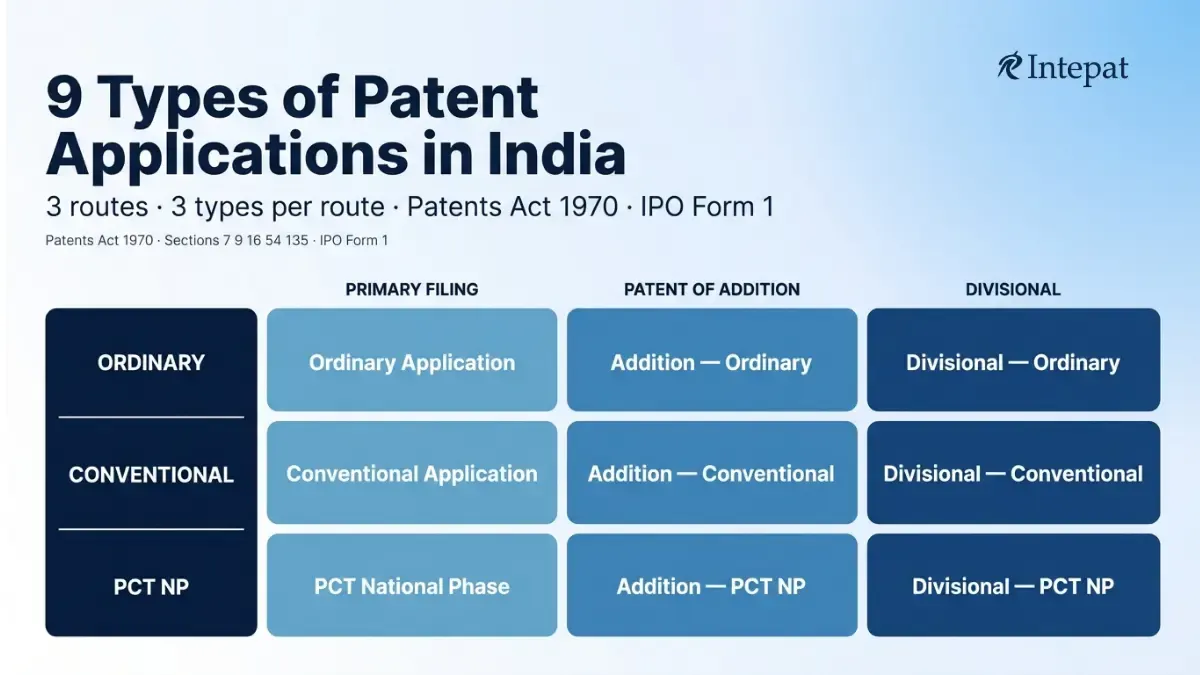
The 9 Types at a Glance: A 3×3 Map
The structure resolves quickly once you see it: three routes, three types per route, nine in total. The two sub-types in each route (Patent of Addition and Divisional) are variations on the primary application in that route, not separate routes of their own.
If you know which row applies to you, the column tells you the exact type you need.
| Primary Route | Patent of Addition (for improvements) | Divisional Application (for splitting inventions) |
| Type 1: Ordinary Application (India first-filing country) | Type 2: Patent of Addition for Ordinary | Type 3: Divisional Ordinary Application |
| Type 4: Conventional Application (prior convention country filing) | Type 5: Patent of Addition for Conventional | Type 6: Divisional Conventional Application |
| Type 7: PCT National Phase (prior PCT international filing) | Type 9: Patent of Addition for PCT National Phase | Type 8: Divisional PCT National Phase |
Note: the conventional route (Part B) and the PCT national phase route (Part C) both apply where the first filing was made outside India. Either route is open to Indian and foreign applicants alike. The difference is the filing mechanism and the window available: Part B is direct national entry within 12 months; Part C is entry through the PCT within 31 months.
Part A: The Ordinary Route (Types 1 to 3)
The ordinary route applies when India is your first filing country and you have no earlier foreign application to claim priority from. This section covers the three types of patent application in this route in order of complexity.
Type 1: Ordinary Application
Most common for Indian inventors
An ordinary application is the standard filing under the Patents Act for an invention first filed in India.
You file Form 1, with the specification on Form 2.
You may file a provisional specification first to secure a priority date for what it discloses, then follow up with a complete specification within 12 months. A later claim keeps that date only if it is fairly based on what the provisional disclosed.
The key deadline: if you file a provisional first, the complete specification must be filed within 12 months. On expiry of the 12 months the application is deemed abandoned. No extension. No revival. Priority date permanently lost.
Who uses it: Indian startups, MSMEs, and individual inventors filing for the first time in India with no prior foreign application.
The ordinary application is the most common type of patent application for Indian inventors. If your invention is fully documented, file a complete specification directly. If you are still refining it, the provisional specification option lets you secure a priority date now, without drafting claims, and finish the documentation within 12 months.
Provisional vs Complete Specification for an Ordinary Patent Application
Every ordinary application requires a specification, the technical document that describes your invention. Two options are available.
A provisional specification secures your priority date early while the invention is still being finalised. Claims are not required, and the complete specification must follow within 12 months. It attracts the same base application fee and, having no claims, no excess-claim fee; the excess-sheet fee still applies to a provisional running beyond 30 sheets. It suits an invention still being developed or refined.
A complete specification formally defines the invention and the scope of protection claimed. Claims are mandatory: they define exactly what is protected. Filing directly as complete sets no follow-up deadline for a further specification, although the Act does allow the reverse move on this route: within 12 months of filing you may ask the Controller to treat that specification as a provisional one and proceed on that basis. The base fee is the same, with excess fees only beyond 30 sheets and 10 claims. It suits an invention fully documented and ready to protect.
The key rule: once you file a provisional specification, the 12-month clock starts the same day. If the complete specification is not on file within 12 months, the application is deemed abandoned. No grace period. No revival. The priority date cannot be recovered.
For a complete walkthrough of the filing process, required forms, fees, and common mistakes, see How to File a Provisional Patent Application in India.
Plain-language tip: Think of the provisional specification as staking your claim on an invention date. The complete specification, filed within 12 months, then formally defines exactly what protection you are asking for.
Critical deadline: If you file a provisional specification today, set a hard reminder for 11 months from now, not 12. You need time to draft and review the complete specification before the window closes.
Type 2: Patent of Addition for Ordinary Application
For improvements on an existing ordinary application or patent
A patent of addition protects an improvement to your own invention. The parent is your own pending ordinary application or granted ordinary patent for the main invention; the addition is filed on or after the main filing date and is granted only after the main patent is granted.
Inventive step: it cannot be refused for lack of inventive step over your own main invention or your own earlier patents of addition. It must still be new, including over the main specification, and inventive over other prior art.
Renewal fees: none while it remains a patent of addition; a meaningful cost saving across the patent’s life.
Expiry: it runs with the main patent, ceasing when the main patent expires or lapses, and cannot outlive it. If the main patent is revoked, the patentee may ask the court or the Controller to order that the addition continue as an independent patent for the remainder of the main term; from that point ordinary renewal fees become payable.
Who uses it: Indian startups and MSMEs making iterative improvements to an already-filed or granted invention.
A patent of addition is best understood with an example. Suppose your main patent protects a new type of water filter. You later develop a better filter membrane. The membrane improvement may not qualify as a standalone patent because it lacks independent inventive step over your own earlier patent. It can, however, be protected as a patent of addition, with no separate renewal fees for the rest of the main patent’s 20-year life.
In practice: In Intepat’s recent prosecution experience, patent of addition filings are common in mechanical engineering, food processing, and consumer products, areas where incremental improvements are routine and the cost of maintaining a separate full patent for each iteration would be prohibitive.
Type 3: Divisional Ordinary Application
When your application covers more than one invention
A divisional application splits one application into two or more. The parent is a pending ordinary application whose specification discloses the invention to be divided out. A divisional may be filed voluntarily or to meet a Controller objection that the claims cover more than one invention.
The key deadline: it must be filed before the parent ordinary application is granted. Once the parent is granted, this window closes permanently.
Priority date: the divisional is treated as filed on the parent’s filing date; each claim takes the date of the specification in which its matter was first disclosed. No new technical matter may be introduced in the divisional.
Request for examination: the divisional needs its own RFE, within 31 months of the parent’s filing or priority date (48 months under the pre-2024 Rules where they still apply), or within 6 months of filing the divisional, whichever is later. Each divisional application attracts its own filing and examination fees independently.
Who uses it: applicants whose ordinary application received a unity of invention objection from the Controller, or who want to proactively separate multiple inventions.
An application is for one invention only, and the claims of a complete specification must relate to a single invention or to a group of inventions linked so as to form a single inventive concept. If the claims cover more than one invention, the Controller may raise an objection on that ground when the application is examined.
The solution is to file a divisional application before the parent is granted, splitting the inventions into separate applications while preserving the same priority date for both. Since 15 March 2024 the Rules confirm that a divisional may be filed in respect of an invention disclosed in the provisional specification, the complete specification, or an earlier divisional.
In practice: Do not wait for an objection. If you know your application covers more than one invention, consider filing the divisional proactively, before examination. This avoids the risk of missing the divisional window if the parent moves faster than expected.
Part B: The Conventional Route (Types 4 to 6)
The conventional route applies to any applicant, Indian or foreign, who has already filed a patent application in a convention country (a country party with India to a treaty, convention or arrangement that gives Indian applicants reciprocal privileges) and wants to carry that earlier filing date into India.
This is the direct national filing route: you file straight into the Indian Patent Office, claiming priority from your earlier application abroad. Convention-country status turns on India and the other country being parties to a treaty, convention or arrangement that gives Indian applicants privileges similar to those it gives its own citizens.
Conventional route vs PCT national phase: Both routes serve applicants who filed abroad first. The difference is the filing mechanism. If you filed a national application in a single convention country and are now entering India directly, use the conventional route; you have a 12-month window from that first filing. If you filed a PCT international application through WIPO designating multiple countries, use the PCT national phase route in Part C instead; that window is 31 months. An invention normally enters India once, by one route.
Type 4: Conventional Application
For applicants with a prior foreign filing
A conventional application carries an earlier foreign filing date into India. It gives each claim based on matter disclosed in the earlier application that application’s filing date as its priority date, provided the Indian applicant is the earlier applicant or that person’s assignee or legal representative. That priority date, not the Indian filing date, is the date against which those claims are assessed.
The key deadline: it must be filed in India within 12 months of the date of your first filing in any convention country. The clock starts from the very first filing, regardless of how many countries you file in subsequently.
A complete specification is mandatory; a provisional specification cannot be filed for a conventional application. A verified copy of the earlier foreign application must be furnished when the Controller requires it.
Who uses it: Indian or foreign applicants who have filed first in a convention country and want to extend protection to India within the 12-month priority window. Foreign companies entering India without a PCT filing use this route.
In practice: A company that filed a US patent application in March 2026 has until March 2027 to file a conventional application in India and claim the US filing date as its Indian priority date. Missing this window means any prior art published between the US filing and the Indian filing date can be used against the Indian application.
Type 5: Patent of Addition for Conventional Application
For improvements on an existing conventional application or patent
This is a patent of addition where the parent is your own pending conventional application or granted conventional patent in India, on the same conditions as Type 2. It cannot be refused for lack of inventive step over your own main invention; it must still be new and inventive over other prior art.
No renewal fees are payable while it remains a patent of addition. It runs with the parent conventional patent and cannot outlive it, subject to the revocation proviso noted under Type 2. Applicants holding a conventional patent in India who are developing improvements to the patented invention use this type.
This type of patent application works identically to the Patent of Addition for Ordinary Application. The only difference is that the parent patent entered India through the conventional route. The renewal-fee saving and the protection against inventive-step objections based on your own main invention apply equally.
Type 6: Divisional Conventional Application
When your conventional application covers more than one invention
This is a divisional where the parent is a pending conventional application in India whose specification discloses the invention to be divided out. It must be filed before the parent conventional application is granted.
Claims based on matter disclosed in the earlier convention filing keep that filing’s date, a critical protection when foreign priority is at stake. Applicants whose conventional application received a unity of invention objection, or who want to proactively split multiple inventions, use this type.
The mechanics are the same as the Divisional Ordinary Application. One additional point applies here: the preserved priority date is the original foreign filing date. When that foreign date gives your Indian application its competitive advantage, acting before parent grant becomes especially critical.
Part C: The PCT Route (Types 7 to 9)
The following three types apply when a patent applicant has filed a PCT international application through WIPO and is now entering the Indian national phase. They are primarily used by foreign applicants and international IP counsel managing multi-jurisdiction filings. Indian applicants whose first filing was a PCT application will also encounter these types.
All three PCT types depend on the same threshold being met first: the international application must enter the Indian national phase within 31 months from the priority date, which for this purpose is the filing date of the earliest application whose priority is claimed, or the international filing date where the application claims no priority. India has no late-entry provision as of right, and an application that misses it is deemed withdrawn. The divisional and the patent of addition are then filed against that Indian parent on their own timings.
One consequence of entering late in the international chain: the twenty-year term of an Indian patent granted on a PCT national phase application runs from the international filing date, not from the date you enter the Indian national phase.
Type 7: PCT National Phase Application
For foreign applicants entering India via PCT
A PCT national phase application is the Indian leg of a PCT international application. You file Form 1 together with the PCT documents. No separate complete specification is drafted: the title, description, drawings, abstract and claims filed in the international application are taken as the complete specification. A provisional specification cannot be filed for a PCT national phase application.
The key deadline is 31 months from the priority date, that is, the earliest priority claimed, or the international filing date where no priority is claimed. There is no standard late entry: an application that does not meet the entry requirements in time is deemed withdrawn. The 31-month period is expressly excluded from the Controller’s power to correct procedural irregularities; the only express route in the Rules is a discretionary request on Form 4 within six months of the expiry, which the Controller may grant or refuse, and whether a condonation displaces the withdrawal is not settled. No applicant should file on the assumption of it.
Documents required: a verified English translation of the PCT application (if not in English), the national phase entry fee for your entity classification, and, where the priority document was not already furnished or made available through the international phase, the priority document itself, which must reach the Indian office before the same 31 months expire.
Who uses it: foreign companies and inventors who filed a PCT international application and are designating India as a national phase country.
In practice: The 31-month deadline runs from the earliest priority date in the PCT chain, not from the PCT filing date if a priority claim was made. In practice, applicants managing multiple national phase entries should track the earliest priority date separately, as it is the date from which every designated office computes its own national phase deadline.
Type 8: Divisional PCT National Phase Application
When your PCT national phase application covers more than one invention
This is a divisional where the parent is a pending PCT national phase application in India whose specification discloses the invention to be divided out. It must be filed before the parent PCT national phase application is granted; once the parent is granted, this window closes permanently.
The divisional is deemed filed on the parent’s filing date, which for a PCT national phase application is the international filing date.
Each claim keeps the date on which its matter was first disclosed. No new technical content may be introduced: the divisional must be based entirely on subject matter already disclosed in the parent PCT application. Foreign applicants whose PCT national phase application in India received a unity of invention objection from the Controller, or who want to proactively split multiple inventions into separate Indian filings, use this type.
The unity of invention rules and divisional mechanics are the same as for ordinary and conventional divisional applications. Filing a divisional proactively, rather than waiting for an objection at examination, avoids the risk of the parent being granted before the divisional is filed.
Type 9: Patent of Addition for PCT National Phase Application
For improvements on an existing PCT national phase application or patent
This is a patent of addition where the parent is your own pending PCT national phase application or granted PCT national phase patent in India, on the same conditions as Type 2. It cannot be refused for lack of inventive step over your own main invention or your own earlier patents of addition. It must still be new, including over the main specification, and inventive over other prior art.
No renewal fees are payable while it remains a patent of addition, the same saving that applies to patents of addition for ordinary and conventional applications. It runs with the parent PCT national phase patent and cannot outlive it, subject to the revocation proviso noted under Type 2. Foreign applicants holding a PCT national phase patent in India who are developing improvements to the patented invention and want to protect those improvements without paying separate renewal fees use this type.
In practice: For foreign applicants managing an international patent portfolio, patents of addition in India offer the same renewal-fee saving as they do for Indian domestic applicants. Where the parent patent was granted via PCT national phase, the improvement is filed directly as a patent of addition with the Indian Patent Office; no fresh PCT filing is needed for it.
For the full PCT national phase filing procedure (required documents, official fees, examination timeline, and deadline management) see: PCT Patent in India
Which Patent Application Type Do You Need? Quick Reference
Match your situation to the correct type of patent application in India. Where a fixed date is shown, it cannot be extended as of right.
| Your situation | File this type | Critical timing |
| Filing in India first; invention still being refined | Ordinary Application (Provisional Specification) | File complete spec within 12 months of the provisional, no extension; the 31-month examination clock also runs from the provisional filing date |
| Filing in India first; invention fully documented | Ordinary Application (Complete Specification) | File Form 18 within 31 months of the filing or priority date, whichever is earlier (48 months if filed before 15 March 2024) |
| Improving an existing ordinary patent or application | Patent of Addition for Ordinary Application | No fixed deadline; filed on or after the main application’s filing date and granted only after the main patent |
| Ordinary application contains two or more distinct inventions | Divisional Ordinary Application | Before parent ordinary application is granted |
| Already filed in a convention country within the last 12 months | Conventional Application | 12 months from first convention country filing, strict |
| Improving an existing conventional patent or application | Patent of Addition for Conventional Application | No fixed deadline; filed on or after the main application’s filing date and granted only after the main patent |
| Conventional application contains two or more distinct inventions | Divisional Conventional Application | Before parent conventional application is granted |
| Entering India via PCT international application (foreign applicants / Indian PCT filers) | PCT National Phase Application (Type 7), see Part C of this guide | 31 months from the priority date, strict, no late entry as of right |
| PCT national phase application contains two or more distinct inventions | Divisional PCT National Phase Application (Type 8) | Before parent PCT national phase application is granted |
| Improving an existing PCT national phase patent or application | Patent of Addition for PCT National Phase Application (Type 9) | No fixed deadline; filed on or after the main application’s filing date and granted only after the main patent |
5 Patent Application Mistakes That Cost Inventors Their Priority Date
Mistake 1: Missing the 12-month deadline to complete an ordinary patent application
This is the most common and most costly error for Indian inventors. If you file a provisional specification and do not file the complete specification within 12 months, the application is deemed abandoned. The 12-month period cannot be extended, and there is no revival mechanism; the priority date is lost.
Post-dating can move a pending application’s filing date forward by up to six months, but only while the application is pending and at the cost of the original date, and the power is expressly subject to the provisions on provisional and complete specifications. Set the reminder on the day you file, for a date well inside the 12 months.
Mistake 2: Filing a provisional specification for the wrong application type
Provisional specifications are only available where the application is neither a convention application nor a PCT national phase application. A conventional application must be accompanied by a complete specification, and for a PCT national phase application the title, description, drawings, abstract and claims filed in the international application are taken as the complete specification. A divisional application of any type must also be accompanied by a complete specification. A provisional specification does not satisfy those requirements, so an application filed that way is defective from the outset.
Mistake 3: Missing the divisional window before the parent is granted
Once the Controller grants the parent patent, the window for this type of patent application closes permanently. If the Controller raised a unity of invention objection and you did not file a divisional before grant, the additional inventions cannot be protected with the parent’s priority date. Monitor examination status actively and act on unity objections before responding to the first statement of objections.
Mistake 4: Confusing the convention priority window with the RFE deadline for a conventional patent application
The 12-month convention priority window runs from your first foreign filing date and determines whether you can claim that date as your Indian priority date. The Request for Examination (RFE), which is made on Form 18, runs from the filing date of the application or the priority date, whichever is earlier: 31 months for applications filed on or after 15 March 2024, and 48 months for applications filed before that date. It determines whether your application proceeds to examination at all.
If the request is not filed in time the application is treated as withdrawn. The Controller’s general power to correct procedural irregularities cannot reach that period; the only express route in the Rules is a discretionary request on Form 4 within six months of the expiry, which the Controller may grant or refuse, and whether a condonation displaces the withdrawal is not settled. See the guide to the request for examination in India. These are entirely separate deadlines with entirely separate consequences.
Mistake 5: Introducing new matter in a divisional application
A divisional application must be based entirely on subject matter already disclosed in the parent application at the time of filing. New technical content cannot be added at the divisional stage, even if you have made further improvements. Any new material requires a separate application with its own priority date.
A Note on Filing Fees
Official government filing fees for each type of patent application depend on your entity classification: natural person, startup, small entity, educational institution, or others. The first four categories pay the same reduced fee, 80% below the rate for others (for example ₹1,600 against ₹8,000 for an e-filed application), under the fee schedule introduced by the Patents (Amendment) Rules, 2024.
The reduced rate applies only if every applicant is in one of the four categories; a joint application with any other entity pays the full rate, and startups, small entities and educational institutions file Form 28 with each fee-bearing document. Where physical filing is otherwise permitted, the higher fee the schedule prints for that mode applies (₹1,750 and ₹8,800). A patent of addition application is eligible for a 50% reduction in the application fee.
On e-filing, each sheet of specification beyond the first 30 costs ₹160 for the reduced categories and ₹800 for others, and each claim beyond the first 10 costs ₹320 and ₹1,600; the schedule prints higher figures for physical filing (₹180 and ₹880 per sheet, ₹350 and ₹1,750 per claim). The request for examination carries its own fee, ₹4,000 and ₹20,000 respectively by e-filing, payable again on every divisional. Verified as of September 2026.
Estimate current government fees for your specific type and entity class using the Intepat Patent Fees Calculator.
Choosing the Right Patent Application Type in India
Form 1 asks the applicant to tick the type of application, ordinary, convention or PCT national phase (a fourth box, PPH, is not counted here), and within each of those three routes a divisional box and a patent of addition box.
That is where the 9 types come from: in each route, a first-time filing, a patent of addition for improvements, and a divisional for splitting multi-invention applications.
The right choice across all nine types comes down to the same two questions asked for each route: where was the first filing made, and is this a first-time filing, an improvement, or a split?
Across all types of patent application, the pattern is consistent: deadlines cannot be extended as of right, specification choices should be settled at filing (the Act allows only limited later changes), and the divisional window closes the moment the parent is granted. Getting these decisions right before filing, not after, is what protects the priority date you have worked to establish.
For the full filing procedure, see Patent Filing Procedure and Process in India. For drafting guidance, see Understanding the Patent Specification of an Invention.
FAQs: Types of Patent Applications in India
Form 1 asks the applicant to tick the type of application: ordinary, convention or PCT national phase, and for each route whether the filing is a divisional or a patent of addition; that gives nine types across three routes. The same field carries a fourth box, marked PPH, which this guide does not count among the nine.
An ordinary application is for an invention first filed in India, with no earlier foreign priority. A conventional application claims priority from a filing made in a convention country within the past 12 months. A provisional specification is not available for a convention application, a PCT national phase application or a divisional application; each needs a complete specification.
No. Among the 9 types of patent applications in India, a provisional specification is not available for conventional applications, PCT national phase applications, or divisional applications of any type; each of these must be filed with a complete specification. An ordinary first filing may be made with a provisional specification; a divisional in that route may not.
The application is deemed abandoned on expiry of the 12 months. There is no grace period, no extension, and no revival mechanism, and the priority date established by the provisional filing is permanently lost. If a complete specification is not ready in time, take advice well before the deadline rather than after it.
A patent of addition protects an improvement to your own invention: it cannot be refused for lack of inventive step over it, carries no renewal fees, and runs with the main patent. A divisional splits an application covering two or more inventions, each taking the parent’s filing date, with each claim dated from the specification that first disclosed it.
No. A divisional application must be filed while the parent application is still pending, that is, before the parent patent is granted. Once the parent is granted, the divisional window is closed permanently and cannot be reopened, so act on any unity objection before you respond to the examination report.
The correct type is a conventional application. You have 12 months from the date of your first filing in any convention country to file in India and claim that date as your Indian priority date. You need a complete specification (a provisional is not available here) and a verified copy of that earlier application when the Controller calls for it.
Any person claiming to be the true and first inventor, that person’s assignee, or the legal representative of a deceased person so entitled, alone or jointly. The Act sets no nationality requirement, apart from a bar on nationals of countries the Central Government has notified as not according Indian citizens equal rights. An Indian address for service is required.
The deadline is 31 months from the earliest priority date in the PCT chain. India has no late-entry provision as of right. Where the PCT application claimed priority from an earlier national filing, the 31-month clock runs from that earlier priority date, not from the PCT international filing date; each designated office computes its own deadline from it.
Legal Disclaimer
This post is for informational purposes only and is not legal advice. Statutory provisions are cited for reference from the Patents Act, 1970 as amended to 1 August 2024 and the Patents Rules, 2003 as they stand at September 2026, verified against the instruments listed under Sources. The position stated was verified as current in September 2026. Laws and procedures may change; verify current requirements with a registered patent agent before acting.