




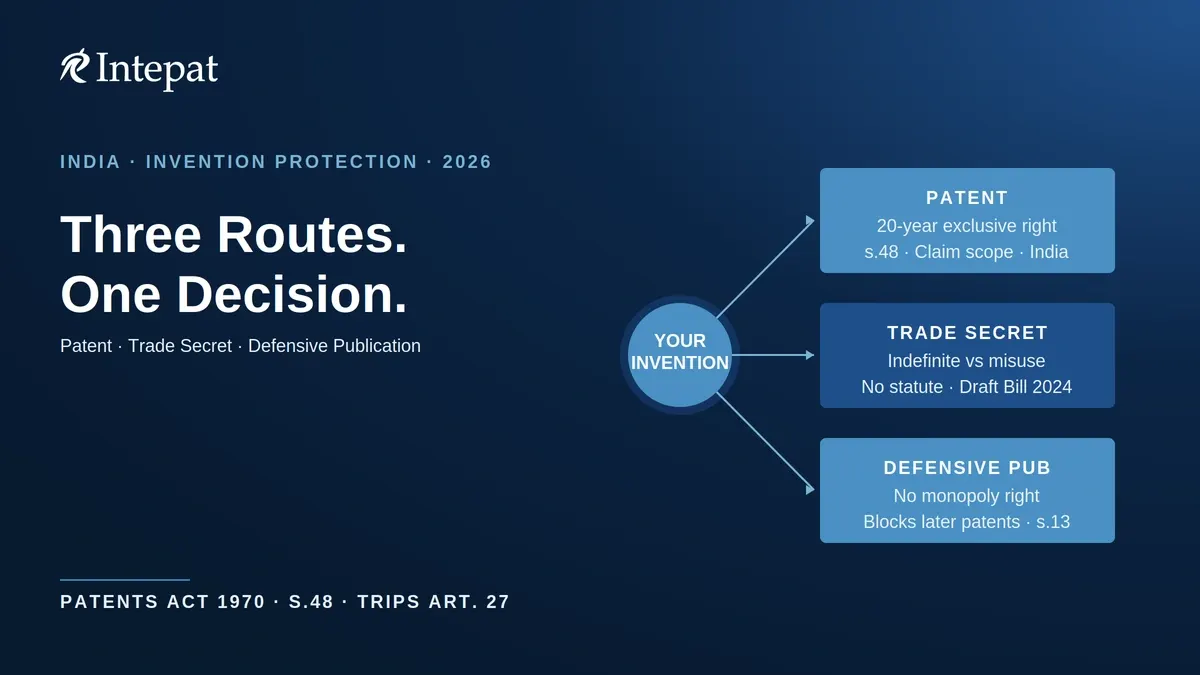
In India, patents, trade secrets, and defensive publication protect an invention against different risks. A patent gives an exclusive right against unauthorised making, use, and sale within the granted claims. A trade secret covers misappropriation but not independent discovery or lawful reverse engineering. A defensive publication blocks later patenting at no filing cost.
What you need to know
- Patent: file, disclose, and pay fees to get a 20-year exclusive right under Section 48 of the Patents Act 1970 to prevent third parties from making, using, or selling the claimed invention in India. Covers independent discovery and reverse engineering within the claim scope.
- Trade secret: keep confidential to get indefinite protection against misappropriation, breach of confidence, and breach of contract. Protection ends when the information enters the public domain. No protection against independent discovery or lawful reverse engineering.
- Defensive publication: disclose publicly to put the invention into the state of the art. Prevents later patenting of the disclosed subject matter, provided the publication is publicly accessible and earlier than any later application’s priority date. Gives no monopoly and no remedy against copying.
- The three approaches are not mutually exclusive. Combining them is common practice.
The Core Difference: Exclusive Rights, Secrecy, and the Public Domain
An inventor with a new idea has three distinct concerns: keeping competitors from copying the idea; keeping competitors from independently patenting it; and preserving the freedom to use the idea without restriction. No single option addresses all three at once.
A patent addresses both the copying concern and the independent-patenting concern, but only within the scope of what is claimed and only in India (unless parallel foreign applications are filed). Under Section 48 of the Patents Act 1970, subject to the conditions in Section 47, a patent confers on the holder the exclusive right to prevent third parties from making, using, offering for sale, selling, or importing the patented product or process in India. That right runs against all third parties regardless of how they arrived at the same idea, including through independent research. The price is full public disclosure in the specification and a filing and prosecution process.
A trade secret does not create an exclusive right against the world. It protects confidential information against misappropriation, breach of confidence, and breach of contract. What it does not cover is a competitor who independently develops the same information or lawfully reverse-engineers a product. A competitor who reaches the same idea through their own R&D, or by analysing a product they have lawfully purchased, commits no wrong under current Indian law.
A defensive publication addresses the independent-patenting concern without addressing the copying concern. Publishing the invention puts it into the prior art, so no later applicant can obtain a patent on the disclosed subject matter. But the publisher gains no right to enforce against a competitor who reads the publication and uses the idea freely.
The choice turns on which of these concerns matters most for the specific invention.
What a Patent Gives You, and What It Costs
Under Section 2(j) of the Patents Act 1970, an invention is a new product or process involving an inventive step and capable of industrial application. India’s patentability criteria align with Article 27 of the TRIPS Agreement, which requires patents to be available for inventions in all fields of technology that are new, involve an inventive step, and are industrially applicable. “Inventive step” under Section 2(ja) means a feature involving technical advance over existing knowledge, or economic significance, or both, making the invention not obvious to a person skilled in the art.
A granted patent, under Section 48 and subject to Section 47, confers on the holder the exclusive right to prevent third parties from:
- making, using, offering for sale, selling, or importing the patented product in India without consent; or
- using the patented process, or using, offering for sale, selling, or importing the product obtained directly by that process in India without consent.
The right operates within the scope of the granted claims and has effect throughout India under Section 46. Under Section 53, the term runs for 20 years from the filing date. For PCT applications, the term runs from the international filing date accorded under the Patent Cooperation Treaty.
The costs are threefold: full disclosure of the invention in the specification; the time and expense of filing, prosecution, and renewal; and territorial limitation, since a patent filed only in India provides no protection in other countries.
For advice on filing in India, see our patent filing services. For assessing whether an invention meets the patentability criteria before committing to a filing, see our patentability search services.
When a Trade Secret Is the Better Choice
A trade secret protects confidential information through the law of contract and the common law doctrine of breach of confidence. India has no dedicated trade secrets statute as at June 2026. The framework in force relies on non-disclosure agreements under the Indian Contract Act 1872, the breach-of-confidence doctrine developed in Indian courts, and general provisions of the IT Act 2000 and the Bharatiya Nyaya Sanhita 2023.
The protection lasts as long as the information stays secret. There is no registration, no filing fee, and no fixed term. The Coca-Cola formula is the commonly cited example of a trade secret that has outlasted multiple patent cycles.
Two limits define when a trade secret is inadequate:
Independent discovery. A trade secret provides no remedy against a competitor who develops the same information independently through their own research. The patent’s exclusive right runs against all third parties regardless of how they arrived at the idea; trade secret protection runs only against those who obtained the information through misappropriation, breach of confidence, or breach of a contractual obligation. Where a competitor can reach the same information through independent R&D, a trade secret provides no block.
Reverse engineering. A trade secret provides no protection against reverse engineering of a product that is lawfully obtained. The draft Protection of Trade Secrets Bill 2024 explicitly preserves reverse engineering as a lawful acquisition route and, if enacted, would codify the position already taken by Indian courts.
The result is that a trade secret suits inventions embedded in a process or formula that cannot practically be extracted from the finished product, and where the information is likely to remain secret. It does not suit inventions that a technically skilled competitor can reconstruct from a product on the market.
Protection ends when the information enters the public domain. A deliberate leak by an employee to a competitor does not automatically extinguish protection if the recipient knows the information is confidential and remains bound by that obligation. Full public entry, where anyone can freely access the information, is when trade secret protection ends.
For a full account of the current legal framework, see our article on trade secret protection in India. For the proposed statutory framework under the draft Bill, see our article on the Protection of Trade Secrets Bill 2024.
What Defensive Publication Does (and Does Not Do)
A defensive publication is a public disclosure of an invention made with the deliberate purpose of preventing anyone, including the disclosing party itself, from later obtaining a patent on the same subject matter.
Under the “new invention” definition in Section 2(l) of the Patents Act 1970, an invention qualifies as new only if it has not been anticipated by publication in any document anywhere in the world before the filing date of the patent application. A defensive publication, once public, enters the state of the art and would be treated as prior art where found in a search under Section 13. Any later application on the same subject matter may be refused at examination, opposed under Section 25, or revoked under Section 64, on the ground of anticipation by the prior publication, provided the publication is publicly accessible, carries a verifiable date earlier than the later application’s priority date, and discloses the relevant subject matter adequately.
What defensive publication does:
- Prevents later patenting of the disclosed subject matter, to the extent the publication discloses and anticipates that matter
- Costs nothing in Patent Office fees
- Takes effect immediately on publication in a publicly accessible, date-verifiable channel or repository
What defensive publication does not do:
- It gives the publisher no patent right or exclusive right of any kind
- It gives no remedy against a competitor who reads the publication and copies the idea
- It cannot be undone: once public, the information is permanently in the public domain
The timing of a defensive publication requires care. Publishing too early reveals strategic direction before the innovation is complete. Publishing too late risks a competitor having already filed a patent application on the same idea, in which case the defensive publication may not be earlier than that application’s priority date and may not function as prior art against it.
For a detailed account of how defensive publication works in India, see our article on defensive publication for innovation and inventions.
How to Choose: A Decision Framework
The three options map onto different profiles of invention and business need. The table below sets out the key decision variables.
| Question | Lean patent | Lean trade secret | Lean defensive pub. |
| Can a competitor reverse-engineer the invention from the finished product? | Yes | No | Either |
| Can a competitor independently develop the same idea? | Yes | Uncertain | Either |
| Is the commercial value likely to outlast a 20-year patent? | No | Yes | Either |
| Is full public disclosure acceptable? | Yes | No | Yes |
| Is the invention patentable (novel, inventive, industrially applicable)? | Yes | Not required | Not required |
| Is the primary goal freedom from competitor patents, not a monopoly? | No | No | Yes |
| Do you need to stop competitors from copying? | Best option | Only against misuse or breach | No |
| Is freedom to use your own idea the main concern? | Not necessary | Possibly | Best option |
In practice, the three options suit different types of technical information. A product’s visible geometry or mechanical structure that a competitor can measure and replicate is suited to patent protection. Manufacturing process parameters, operating temperatures, or input ratios that are not visible in the product and require specialist knowledge to reconstruct are suited to trade secret protection. A non-core improvement that is not commercially central enough to patent, but which a competitor could otherwise patent to create a blocking position, is suited to defensive publication.
Beyond the table, three practical tests are worth applying:
The leakage test. If the invention is likely to become known through employees, suppliers, or product analysis within two to three years, a trade secret offers weaker long-term protection than it appears. A patent filed before any disclosure captures the exclusive right; information that enters the public domain before filing cannot be patented.
The reverse-engineering test. If a technically skilled competitor can reconstruct the invention from a commercially available product, a trade secret gives no effective protection against that route. A patent is the only instrument that blocks reconstruction by right.
The deterrence test. If the goal is to prevent anyone from ever patenting the idea, defensive publication achieves that goal at the lowest cost, because it operates through the state of the art rather than through enforcement rights.
Combining the Three Approaches
The three options are not mutually exclusive. A common structure in technology-intensive companies is:
- Patent the core novel features of a product that are visible in the market, are reverse-engineerable, or are likely to be independently developed by a competitor.
- Trade secret the surrounding process know-how, proprietary data, manufacturing parameters, or algorithm variants that are not visible in the product and are difficult to reverse-engineer.
- Defensively publish peripheral innovations that do not meet the patentability threshold or are not commercially central enough to warrant the cost of patenting, but which could otherwise be patented by a competitor to create a blocking position.
This structure concentrates patent costs on the elements that most need the exclusive right, extends protection to non-reverse-engineerable know-how through trade secrecy, and closes off competitor blocking positions through defensive publication.
The decision on how to allocate a specific invention across these three categories turns on the technical facts of the invention, the competitive landscape, and the company’s IP budget. For a structured review, see our IP audit and strategy services.
Frequently Asked Questions
A patent confers under Section 48 of the Patents Act 1970 an exclusive right to prevent third parties, including an independent inventor, from making, using, or selling the claimed invention in India for 20 years. A trade secret gives no exclusive right against independent discovery or reverse engineering; it covers only misappropriation, breach of confidence, and breach of contract.
Not reliably. Public use or disclosure before filing may defeat novelty under Section 64(1)(e). Even secret commercial use in India before the filing date creates a separate revocation risk under Section 64(1)(l), subject to exceptions for reasonable trial under Section 64(3). Filing before any use or disclosure avoids both risks.
Under Section 2(j) of the Patents Act 1970, an invention must be a new product or process, involve an inventive step (technical advance or economic significance, not obvious to a person skilled in the art), and be capable of industrial application. Section 3 additionally excludes the formulation of an abstract theory, mathematical or business methods, and computer programmes per se.
A defensive publication is a public disclosure made to prevent later patenting. Under Section 2(l) of the Patents Act 1970, an invention is not new if anticipated by prior publication anywhere. Once public, it is prior art under Section 13, available to refuse, oppose, or revoke a later application, provided it is publicly accessible and pre-dates the later priority date.
Yes. A defensive publication gives the publisher no patent rights and no remedy against a competitor who copies the disclosed idea. It removes the patenting option permanently, including for the publisher. It prevents patenting, not copying. Where the concern is stopping competitors from copying rather than from patenting, a patent or trade secret is the appropriate instrument.
Combination suits inventions with visible and non-visible components. Visible aspects that a competitor can reverse-engineer from the product are suited to patent protection; a trade secret would not guard them in practice. Non-visible aspects, such as manufacturing parameters and algorithmic variants not accessible from the product, suit trade secrets, since patenting them requires disclosing them.
Disclaimer: This article explains the law on patents, trade secrets, and defensive publication in India as at (Article Update on )June 2026 and is for general information only. It is not legal advice. Government fees, forms, and procedures change; confirm current figures with the Indian Patent Office before you file. For advice on your specific invention, consult a registered patent agent.