




A college project can be patented in India if it is new, involves an inventive step, and is capable of being made or used in an industry. A student who is the true and first inventor may apply under the Patents Act 1970, alone or jointly with co-inventors, unless the rights have been assigned to another person or institution.
QUICK ANSWER
- Your college project can be patented if it is new, involves an inventive step, and has industrial applicability.
- A student who is the true and first inventor may apply under the Patents Act, alone or jointly, unless the rights have been assigned to another person or institution.
- Check your college’s IP policy before you file; some institutions claim co-ownership of student inventions developed using their facilities.
- Once you decide to file, act before publicly disclosing the invention, because India has no general grace period for prior disclosure.
IS YOUR PROJECT READY TO FILE? You are likely in a good position to proceed if: your project solves a technical problem in a non-obvious way, you have not yet publicly disclosed it, you can explain how it works in enough detail to write a description, and you have checked whether your college claims any IP rights. Get advice before filing if: the project is primarily software, AI, a diagnostic method, or biotech; it was already presented at a demo day, posted to GitHub, published in a journal, or shown at a conference; or your college has a sponsored-research or facilities-use agreement that may affect ownership.
What Makes a College Project Patentable?
The Patents Act 1970 defines an invention as “a new product or process involving an inventive step and capable of industrial application.” Three requirements flow from that definition, and your project must satisfy all three.
Novelty
The invention must not have been published in any document or used anywhere in the world before you file the patent application. A project you presented at a science fair, published in a college magazine, or demonstrated publicly may have lost its novelty. The Act’s definition of a “new invention” is global: prior use or publication anywhere, not just in India, counts against you.
Inventive Step
The Act requires a “feature of an invention that involves technical advance as compared to the existing knowledge or having economic significance or both and that makes the invention not obvious to a person skilled in the art.” The inventive step test compares your project against what any competent person in the relevant technical field would have arrived at without difficulty. A project that solves a known problem in a way that was not obvious, or that carries real economic value, has a better chance.
Industrial Applicability
The invention must be “capable of being made or used in an industry.” This is a broad test; it does not mean the invention must be in production. A working prototype, or a clear description of how the invention could be manufactured or applied, is generally sufficient. Most engineering, technology, and applied science projects will satisfy this requirement without difficulty.
Software, AI, and Computer-Related Inventions
If your project involves a mathematical method, a computer program as such, a business method, or a method of performing a mental act, it may fall within the categories excluded from patentability under Section 3 of the Act. However, a computer-related invention is not automatically excluded: if the substance of the invention involves a technical application or produces a technical effect, rather than being a computer program as such, it may still qualify. The Indian Patent Office’s examination guidelines for computer-related inventions draw this distinction expressly. A patentability search before filing will identify whether any exclusion applies to your specific project.
Can I Patent My Final-Year Project in India?
Yes, subject to the same patentability requirements described above. There is no distinction in the Patents Act between a final-year project, a research prototype, and any other invention. What matters is whether the invention is new, involves an inventive step, and is capable of industrial application. A student project that satisfies all three criteria, and for which the student is the true and first inventor, can be filed as a patent application in exactly the same way as any other Indian patent application.
The practical concerns specific to student inventors are ownership (does your college claim rights?) and timing (have you already disclosed the project?). Both are addressed below.
Who Owns the Patent: You or Your College?
The statute gives the right to the inventor. Under Section 6 of the Patents Act, an application may be made by any person claiming to be the true and first inventor, or by their assignee. A student who independently conceived and developed a project is the true and first inventor. The Act contains no provision that automatically transfers a student’s invention to an educational institution.
The college’s IP policy may say otherwise. Some institutions have adopted IP policies requiring students to assign inventions made using college facilities or under faculty supervision to the institution. These are contractual terms, not statutory ones. Whether such a policy is enforceable depends on the specific wording of the agreement, the circumstances of creation, and general contract law; that question is separate from the patent statute. Where a valid assignment does exist, the assignee may apply for the patent under Section 6 of the Patents Act, which permits filing by a person to whom the true and first inventor has assigned the right to apply. Read your student handbook before you file.
If a professor or colleague files first. A patent obtained by a person who is not entitled to apply, or wrongfully obtained in contravention of the rights of the true inventor, may be revoked under Section 64 of the Patents Act. Once revoked, Section 52 allows a court to direct that a fresh patent be granted to the true inventor. This is a litigation remedy: filing early and keeping dated records of your work is far more practical than pursuing it after the fact. Section 28 of the Act preserves your right to be named as the inventor even where someone else is the applicant, but any request to be mentioned as inventor must be made before the patent is granted, and being named as inventor under Section 28 does not in itself confer patent ownership.
Disclosing Your Project Before Filing: The Risk You Need to Know
India does not have a general grace period that protects an inventor who discloses an invention before filing a patent application. If you present your project at a seminar, upload it to a repository, or publish it in a journal before filing, that disclosure may form part of the prior art and destroy the novelty of your own invention.
The Patents Act provides a narrow saving under Section 31 for specific situations: where the invention was displayed at an industrial or other exhibition to which the Central Government has extended the provisions of that section, or where a paper describing the invention was read by the true and first inventor before a learned society or published with their consent in that society’s transactions. In either case, a patent application must be filed within twelve months of the opening of the exhibition or the reading or publication of the paper. If you intend to rely on Section 31, you must also file a separate application in Form 31 under Rule 29A of the Patents Rules, with the prescribed fee.
A separate but narrower saving under Section 32 means that publicly working an invention for the purpose of reasonable trial, where that public working was reasonably necessary given the nature of the invention, does not constitute anticipation if the working was carried out within one year before the priority date by the patentee or with their consent.
This saving is specific, not general. A poster presentation at an internal college symposium, a video demonstration uploaded online, or an abstract submitted to a conference will in most cases fall outside both sections, unless the event fits the learned-society or notified-exhibition conditions. Before you present or publish any aspect of your project, check whether you intend to file a patent application and, if so, file or at least file a provisional application first.
Filing a Provisional Application to Secure Your Date
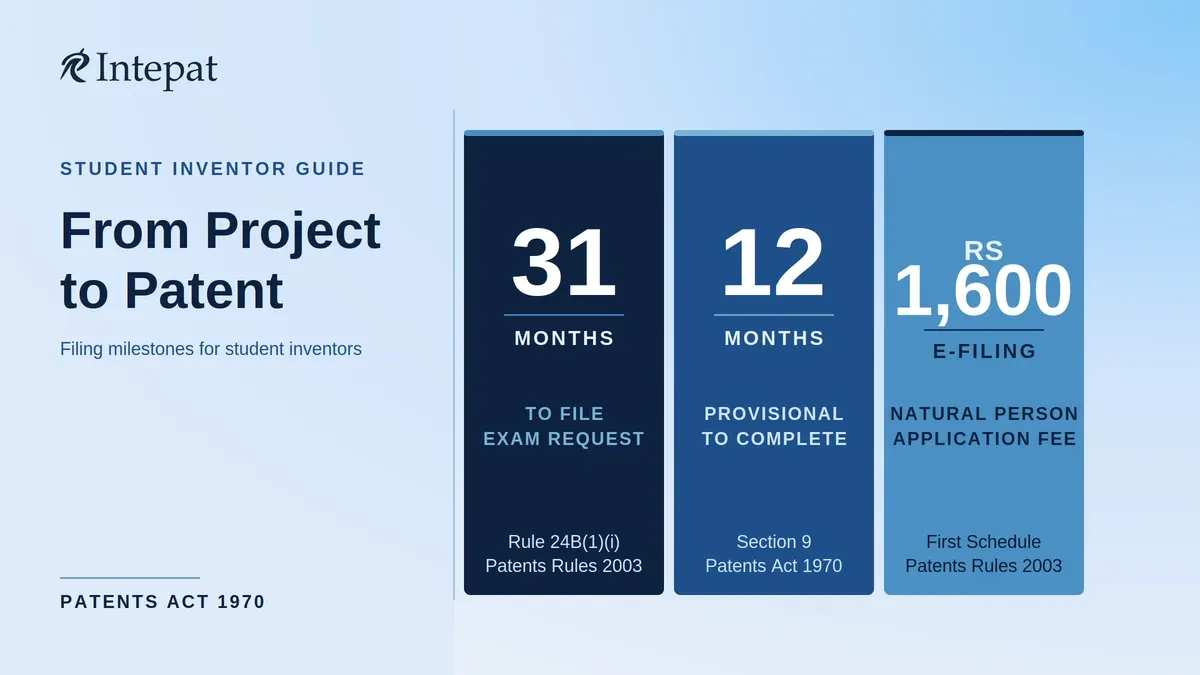
If your project is still being developed, a provisional application under Section 9 of the Patents Act lets you establish a filing date without submitting formal claims. The provisional specification must still describe the invention sufficiently; a bare title or vague outline will not meet the requirement under Section 10. Once filed, you have twelve months to file the complete specification with claims; if you miss that deadline, the application is treated as abandoned.
The complete specification is filed in Form 2 under Rule 13 of the Patents Rules 2003. Where required, a declaration as to inventorship is filed in Form 5. A request for examination (Form 18) must be filed within thirty-one months of your filing date or priority date, whichever is earlier (Rule 24B(1)(i), as amended by the Patents Amendment Rules 2024, verified as of June 2026); applications filed before the 2024 amendment took effect retain the deadline that applied under the previous rules.
Filing Fees for Students
Individual inventors filing as natural persons qualify for the reduced fee scale in the First Schedule to the Patents Rules 2003. The e-filing application fee is Rs 1,600 for a natural person, against Rs 8,000 for other applicants such as a company that does not qualify as a startup, small entity, or educational institution (verified as of June 2026). The request-for-examination fee is Rs 4,000 for a natural person, compared to Rs 20,000 for others. A 10% surcharge applies to physical filings.
If your college is a co-applicant, it may qualify for the same reduced fee scale if it meets the definition of “educational institution” under Rule 2(ca) of the Patents Rules: a university established or incorporated under a Central, Provincial, or State Act, or any other institution recognised by an authority designated by the Central or State Government. A qualifying college must file Form 28 to evidence that status at each stage. A student filing alone as a natural person does not need Form 28.
If you plan to file outside India, Section 39 of the Patents Act applies to all persons resident in India. You must either: (a) file in India first and wait at least six weeks, provided no secrecy direction is in force under Section 35; or (b) obtain a written permit from the Controller before filing abroad. Filing abroad without satisfying one of these two conditions risks the Indian application being treated as abandoned and any patent granted being liable to revocation.
Steps to Take Before You File
| Run a patentability search Use the Indian Patent Office’s patent search portal or WIPO’s PatentScope before you commit to filing. |
| Check your college’s IP policy Confirm whether the institution claims any rights over inventions made using its facilities or under faculty supervision. |
| Preserve dated records of your work Lab notebooks, design files, and email threads all help establish when the invention was first conceived and by whom. |
| Choose between provisional and complete A provisional application secures your filing date while you complete the invention; the complete specification follows within twelve months. |
| Consult a registered patent agent A patent agent can assess patentability, draft the specification, and manage the examination timeline. |
Frequently Asked Questions
Yes. Under Section 6 of the Patents Act 1970, any person who is the true and first inventor of an invention may apply. Being a student does not affect entitlement to file. The application may be made individually or jointly with co-inventors, including a co-student or a supervising faculty member who contributed to the invention.
No, not automatically. The Patents Act does not transfer a student’s invention to an educational institution by operation of law. Ownership rests with the true and first inventor unless the student has assigned or agreed to assign their rights under a college IP policy or another written agreement. Always check the institution’s IP policy before filing.
A patent wrongfully obtained by someone who is not the true inventor may be revoked under Section 64 of the Patents Act. Once revoked, Section 52 allows a court to direct that a fresh patent be granted to the true inventor. File your own application early and keep dated records of your work to support any inventorship dispute.
It may. India has no general grace period for prior disclosure, so a presentation at a seminar may count as prior art. Section 31 of the Patents Act provides a narrow saving for displays at Central Government-notified exhibitions and for papers read before a learned society, if you file within twelve months. Most college events fall outside it.
A student filing as a natural person qualifies for the reduced fee scale under the Patents Rules 2003. The application fee for e-filing is Rs 1,600 and the request-for-examination fee is Rs 4,000, both verified as of June 2026 from the First Schedule. These figures are subject to change; confirm current fees with the Indian Patent Office before filing.
No. Under Rule 7(2) of the Patents Rules 2003, Form 28 is required for small entities, startups, and educational institutions to claim the reduced fee scale. A student filing as a natural person is entitled to the natural-person fee rate without submitting Form 28. The natural-person rate is not a concession; it is the default for individuals.
File Before You Disclose
A college project that meets the patentability criteria is no different in law from any other invention. A student who is the true and first inventor may apply, alone or jointly with co-inventors, unless the rights have been assigned. The two decisions that most affect the outcome are: checking the college IP policy before you act, and filing before you disclose.
This article explains the law on patent filing in India as at June 2026 and is for general information only. It is not legal advice. Government fees, forms, and procedures change; confirm current figures with the Indian Patent Office before you file. For advice on your specific invention, consult a registered patent agent.