




The Delhi High Court has set aside an order deeming a patent application abandoned under Section 21(1) of the Indian Patents Act 1970, after Shiv Nadar University’s FER reply arrived four days past the extended deadline. The Court held the delay, which fell across a weekend, showed no intent to abandon the application.
The ruling came on 23 April 2026 in M/S Shiv Nadar (Institution of Eminence Deemed to be University) v. The Assistant Controller of Patents and Designs, C.A.(COMM.IPD-PAT) 33/2024, decided by a single judge of the Delhi High Court. The appeal challenged an order of the Assistant Controller of Patents and Designs, dated 29 January 2024, that had deemed patent application no. 201811034958 abandoned under Section 21(1). The application claims a glycoside-based anti-toxin for epsilon intoxication and its preparation method.
Quick answer: The Delhi High Court set aside a deemed-abandonment order and restored patent application no. 201811034958 to the Assistant Controller for consideration on merits, holding that a four-day delay in filing the FER reply, spanning a weekend and following the Controller’s own extension, showed no negligence or intent to abandon the application.
What the Delhi High Court Decided
Justice Jyoti Singh set aside the Assistant Controller’s order dated 29 January 2024 and restored patent application no. 201811034958 to its position before the deemed abandonment, directing the Controller to take the FER reply on record and examine the application on merits, while expressing no view on patentability.
The appeal was brought under Section 117A of the Patents Act 1970, the route the order itself records the Appellant as having used to challenge the Controller’s finding. Deemed abandonment is one of several ways a patent application can become inactive, alongside lapsing for non-payment of renewal fees or voluntary withdrawal, but only Section 21(1) deemed abandonment was in issue in this appeal. The Court’s order disposes of the appeal on the abandonment finding alone; it does not decide whether the underlying invention meets the Act’s requirements for grant.
How the Application Came to Be Deemed Abandoned
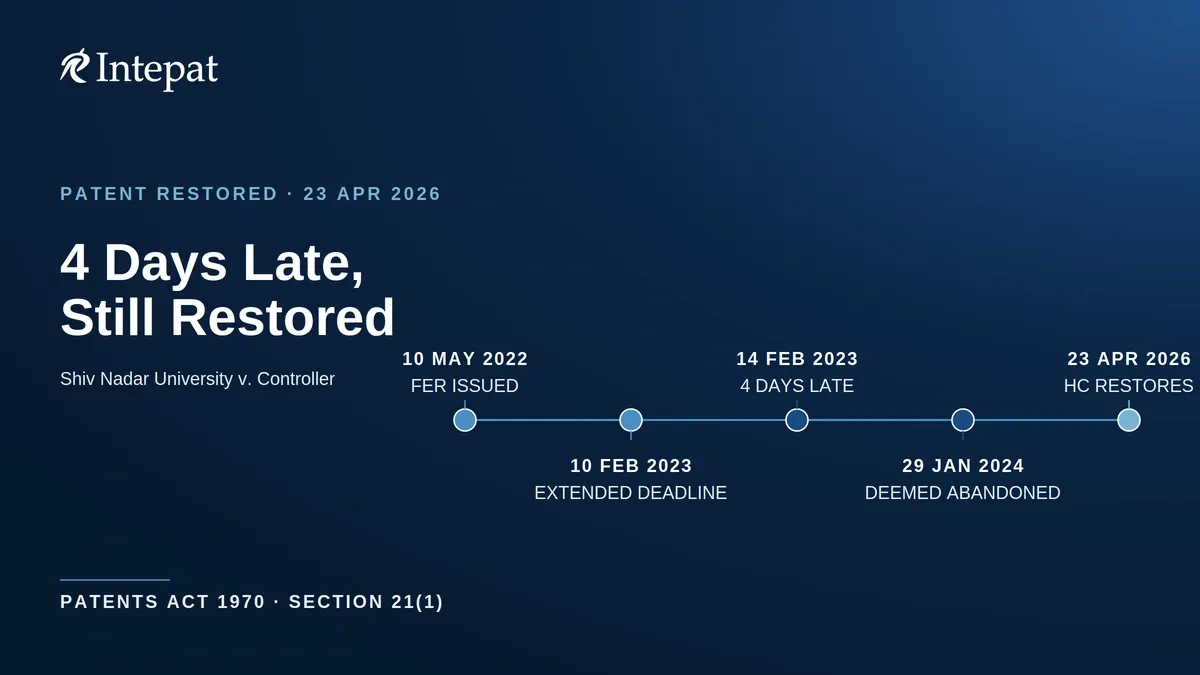
The application was filed on 17 September 2018, and the Assistant Controller issued the First Examination Report (FER) on 10 May 2022. Under the Patents Rules, an applicant then has a fixed period, extendable once, to put the application in order for grant before Section 21(1) treats it as abandoned.
The record in this case runs squarely up against that limit. Shiv Nadar University applied for an extension of time on 9 November 2022, and the Assistant Controller granted it up to 10 February 2023. The University approved the reply internally by the end of the day on 10 February 2023, but by the time it reached the patent agent for filing, the day had ended; 11 and 12 February 2023 fell on a Saturday and Sunday, and the reply was filed on 14 February 2023, four days after the extended deadline. The Assistant Controller declined to take that reply on record, issued a Hearing Notice on 22 December 2023, held a hearing on 12 January 2024, and deemed the application abandoned by order dated 29 January 2024.
Why the Controller Could Not Condone a Section 21(1) Delay
Rule 24B(5) of the Patents Rules 2003 gives an applicant six months from the FER to comply, and Rule 24B(6) allows the Controller to extend that period once, by three months, on a Form 4 request filed before the original period expires.
In this case that combined nine-month window ran from the FER on 10 May 2022 to the extended deadline of 10 February 2023 that the Assistant Controller had already granted; once it closed, no further extension was available on the same route. Section 21(1) itself provides that “an application for a patent shall be deemed to have been abandoned unless, within such period as may be prescribed, the applicant has complied with all the requirements imposed on him by or under this Act… from the date on which the first statement of objections to the application or complete specification or other documents related thereto is forwarded to the applicant by the Controller.”
The judgment itself does not cite a rule number for this; it records only that Respondent’s counsel submitted, and the Court accepted, that the Assistant Controller had no power or discretion to condone the delay (paras 6 and 10). That submission concerned the position between the FER deadline (February 2023) and the Controller’s order (29 January 2024). The current Rule 137(2), which excludes sub-rules (1), (5) and (6) of Rule 24B from the Controller’s general power under Rule 137(1), only came into force on 15 March 2024, the date the Patents (Amendment) Rules 2024 were published, which is after both those dates; it cannot itself be the legal basis the Assistant Controller relied on in January 2024, and this article does not treat it as one. The judgment does not identify what did apply, and the historical, pre-March-2024 text of Rules 137 and 138 is not among the sources this article draws on, so no historical rule citation is offered here. The order separately notes, citing the Court’s 2022 ruling in European Union v. Union of India, that patent deadlines fall into extendable and non-extendable kinds, and places the Section 21 deadline for putting an application in order for grant in the non-extendable category, even though Rule 24B(6) permits one capped extension of that same deadline.
For a reader facing this issue today, the current Rules matter more than the historical position. Rule 138, as substituted with effect from 15 March 2024, separately allows the Controller to extend time or condone delay by up to six months on a Form 4 request, “notwithstanding anything contained in these rules,” and Rule 137(2) does not exclude it. Section 21(2) and (3) of the Act also allow a further extension where an appeal to the High Court is pending on the application for the main invention or a patent of addition, on a request made before the Section 21(1) period expires. Shiv Nadar does not decide, and this article does not assert, whether either provision can revive an application after deemed abandonment under Section 21(1) has already taken effect; that question is open on the sources available.
Why the High Court Granted Relief the Controller Could Not Give
Although the Assistant Controller had no power to excuse the delay, the Delhi High Court held that this limit does not bind a court hearing an appeal under Section 117A.
Relying on its own ruling in European Union Represented by the European Commission v. Union of India and Others (2022 SCC OnLine Del 1793), where a delay of nearly a year in two FER replies was condoned on the same ground, the Court examined whether Shiv Nadar University’s conduct showed negligence or an intent to abandon.
The Court also drew on Ferid Allani v. Union of India and Others (2008 SCC OnLine Del 1756), which held that deemed abandonment deprives an applicant of valuable rights conferred on a patentee under Section 48 of the Act, and on the European Union ruling’s own reliance on Telefonaktiebolaget LM Ericsson (Publ) v. Union of India & Ors. (2010 SCC OnLine Del 1086) and the Madras High Court’s ruling in PNB Vesper Life Science Pvt. Ltd. v. Controller General of Patents, Designs & Trademarks (2022 SCC OnLine Mad 3190). This line of authority carries a caveat that the order itself records: a court must still examine the factual matrix in each case, treating negligence of the patent agent, a lack of diligence by the applicant, or a failure to follow up on the application as circumstances that can point the other way, toward an actual intent to abandon (para 9).
On the facts before it, Justice Singh found none of those warning signs. Shiv Nadar University had pursued the application since 2018, filed its request for examination on time, and applied for an extension before the original six-month period expired when it could not meet that deadline. The four-day delay that followed, which included a weekend, was held not to amount to negligence or an intent to abandon an application into which the University had invested resources, time and effort, and the impugned order was set aside on that basis.
What This Means for Applicants Who Miss the Extended FER Deadline
Missing the prescribed FER-compliance period triggers deemed abandonment under Section 21(1) automatically, by operation of law, the moment the prescribed period lapses; it is not a discretionary step the Controller separately decides to take.
Shiv Nadar shows that a High Court may still grant relief on an appropriate factual record, where the applicant’s conduct does not show negligence or an intention to abandon, even though Rule 24B itself gives the Controller no further extension to grant once the capped nine months run out.
This is different from asking whether an already-abandoned application can later be revived; the Shiv Nadar University appeal challenged the deemed-abandonment finding itself, arguing it should never have been made on these facts.
Applicants and their agents should keep the same kind of record that supported the outcome here: a request for examination filed on time, an extension request filed before the Rule 24B(6) deadline rather than after, and a short, explained gap between approval and filing rather than a pattern of inaction. Shiv Nadar was filed and entertained as an appeal under Section 117A, but Section 117A(2) does not list Section 21 among the Controller decisions it makes appealable, and the judgment does not address that gap; this order should not be read as settling the correct procedural route for every deemed-abandonment case, and an applicant in this position should take specific advice on the appropriate remedy rather than assume Section 117A applies as a matter of course. The order does not fix how many days beyond an extended deadline can still count as showing no intent to abandon; it decides that four days, on this record, did not, and the caveat this line of authority carries, that every case turns on its own facts, still applies.
Frequently Asked Questions
Section 21(1) of the Patents Act 1970 provides that an application is deemed abandoned if the applicant does not comply with all requirements raised in the first statement of objections (the FER) within the prescribed period. Abandonment happens automatically by operation of the section; it is not a discretionary order the Controller separately issues.
Rule 24B(5) gives six months from the FER, and Rule 24B(6) allows one further extension of three months on Form 4, before expiry. Current Rule 138 separately permits up to six more months and is not excluded by Rule 137(2), though whether it reaches an abandonment that has already taken effect is untested.
The Court set aside an order that deemed patent application no. 201811034958 abandoned after its FER reply arrived four days late, restored the application, and directed the Controller to take the reply on record and examine it on merits, without expressing any opinion on patentability (C.A.(COMM.IPD-PAT) 33/2024).
Courts treat negligence of the patent agent, a lack of applicant diligence, and a failure to follow up as signs of intent to abandon. Timely filing of the examination request, a prompt extension request, and continuous prosecution activity point the other way (PNB Vesper Life Science, 2022 SCC OnLine Mad 3190).
Rule 24B itself gives no further extension, but current Rule 138 is a separate six-month power not excluded by Rule 137(2), and Section 21(2)-(3) allows an extension where a High Court appeal on the main invention is pending. Whether either applies after abandonment occurs is untested; an applicant with a genuine diligence record can still challenge the order on appeal, as Shiv Nadar did.
This analysis is prepared by Intepat’s patent practice, which assists applicants with FER responses and prosecution strategy before the Indian Patent Office through its examination and opposition service.
This article explains the law on deemed abandonment under Section 21(1) of the Patents Act, 1970 in India as at August 2026 and is for general information only. It is not legal advice. Government fees, forms, and procedures change; verify current requirements with the Indian Patent Office or a registered patent agent before acting.
Verified as of August 2026, against the full text of the Delhi High Court’s order in C.A.(COMM.IPD-PAT) 33/2024, the Patents Act 1970 (as amended till 1 August 2024), and the Patents Rules 2003 as amended by the Patents (Amendment) Rules 2024 (G.S.R. 211(E), dated 15 March 2024). The current-Rules discussion in this article describes the position as it stands today; it does not describe the historical Rules position for the Shiv Nadar timeline itself, which this article’s sources do not cover.