




Claim mapping is the element-by-element comparison of a single patent claim against a defined target: an accused product or process, a prior-art reference, or a technical standard. The output is a claim chart that sets each claim element beside its counterpart in the target. Practitioners use claim mapping to test infringement, validity, and standard-essentiality.
This guide is India-anchored. The charting method is general patent practice; the consequences that follow are governed by the Patents Act 1970: infringement under Section 48, invalidity under Section 64, and the process-patent burden under Section 104A.
Quick answer
• A claim chart places each element of one patent claim beside the matching feature in a product, prior-art document, or standard.
• The all-elements rule governs the result: every element of the claim must be found in the target for infringement or anticipation, and one missing element usually defeats the literal case.
• There are three common uses: infringement and freedom to operate (claim against product), patentability and invalidity (claim against prior art), and evidence of use (claim against standard).
• Construction comes first, then mapping: you interpret what the claim covers, then test the target against it.
• In India, the Delhi High Court has refused interim injunctions where the patentee produced no claim mapping (Roche v. Zydus, 2024).
What is claim mapping in patents?
Claim mapping breaks a single claim into its constituent elements, then tests each element against a chosen target. A patent claim is a structured sentence: a preamble, a transitional phrase such as “comprising” or “consisting of,” and a body that lists the limitations of the invention. Mapping treats each limitation as a discrete line item and asks whether the target contains that limitation. The discipline depends on reading the claim correctly, which is why the structure and types of patent claims are the starting point of any map.
The output is a claim chart, usually a two-column table that places the claim element on one side and the corresponding feature of the target on the other, with a citation to where that feature is found. The chart is an evidence artefact, not an assertion. Each row points to a source, whether a line in a prior-art document, a feature in a product teardown, or a clause in a standard.
Claim mapping is sometimes confused with patent landscaping, which clusters large numbers of patents by keyword to show technology trends. The two are different exercises. Landscaping operates across a portfolio at a coarse level; claim mapping operates on one claim at the level of individual elements. A landscape shows where the patents are; a claim map shows whether one specific claim reads on one specific target.
One principle runs through every use: the all-elements rule. Infringement and anticipation both require that every element of the claim be present in the target. A single element that is absent usually defeats a literal finding, subject to the doctrine of equivalents discussed below. Three targets produce the three common uses of claim mapping, summarised below.
| Use | Target mapped against | Question the chart answers | Indian anchor |
| Infringement and freedom to operate | Accused product or process | Does the target contain every element of the claim? | Section 48 |
| Patentability and invalidity | Prior-art reference | Does a reference disclose every element of the claim? | Sections 13 and 64 |
| Evidence of use | Technical standard | Does the standard require every element of the claim? | SEP and FRAND practice |
Claim mapping vs claim construction
Claim construction and claim mapping are sequential, not interchangeable. Claim construction is the interpretive step: it fixes the meaning and scope of the words in the claim, often resolving whether a term is broad or narrow, open or closed. Claim mapping is the comparative step that follows: it takes the construed claim and tests the target against it, element by element. Construction asks what the claim means; mapping asks whether the target falls within it.
The Delhi High Court drew this line in F. Hoffmann-La Roche AG v. Zydus Lifesciences Ltd (CS(COMM) 159/2024, 2024:DHC:7868). Refusing an interim injunction, Justice Saurabh Banerjee held that the mere registration of a patent does not entitle a patentee to an injunction, and that claim mapping is an essential step in patent litigation. The patentee had not mapped its claims onto the defendant’s product, so the court found no basis to record a prima facie case of infringement.
For a litigant, the order reads as a practical instruction: construe first, map second, and bring the map to court. An assertion that rests on the existence of a registered patent, without an element-by-element comparison against the accused product, is, on this authority, likely to fail at the interim stage.
How a claim chart is built, element by element
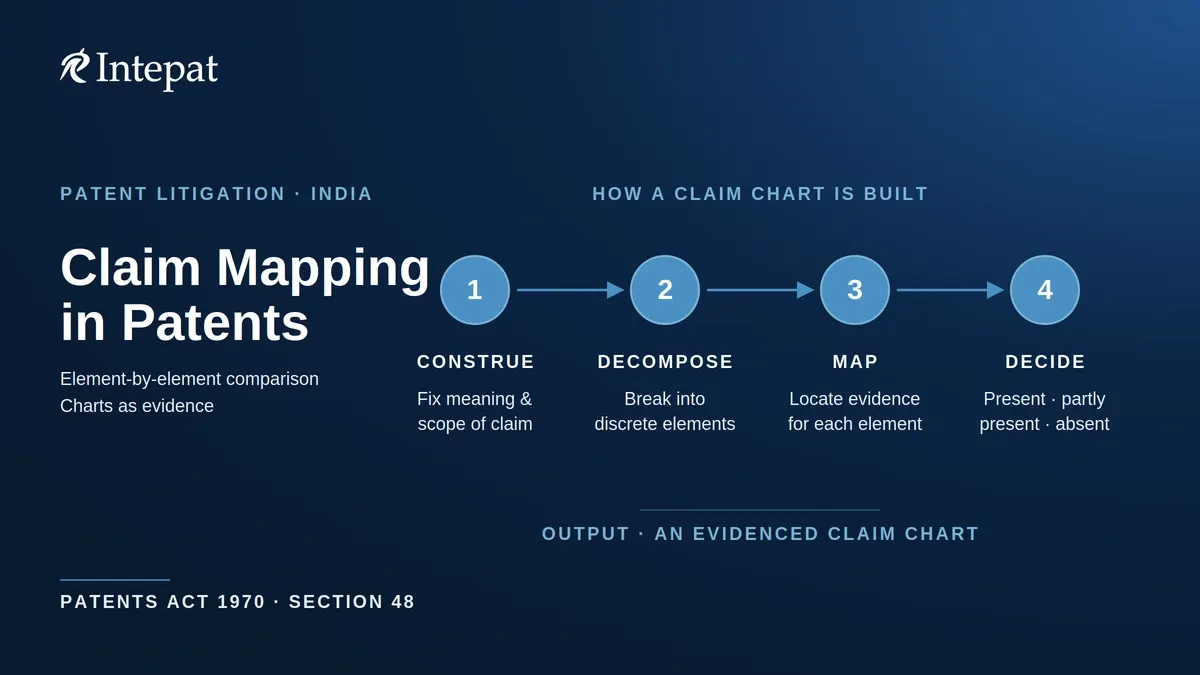
Building a claim chart follows a repeatable sequence. The first step is to construe the claim and identify the independent claim and its elements. Independent claims stand alone and are usually the broadest; dependent claims add limitations and are mapped only after the independent claim. Within the claim, the transitional phrase matters: “comprising” is open and allows the target to contain additional features, while “consisting of” is closed and can be defeated by an extra element.
The second step is to decompose the claim into discrete limitations, one per row of the chart. The third step is to locate, for each limitation, the corresponding feature in the target and to record the evidence: a paragraph or column-and-line reference in a prior-art document, a measured feature in a product, or a numbered clause in a standard. Each limitation is then marked as present, partly present, or absent, and the chart notes whether the correspondence is read against the matter actually disclosed in the patent specification.
Two reading methods sit behind those marks. Literal mapping looks for an exact correspondence between the claim language and the target’s feature. The doctrine of equivalents, applied in India through the purposive construction of claims, asks whether a variant performs substantially the same function in substantially the same way to reach substantially the same result. A target that avoids the literal words of a limitation may still map onto it as an equivalent, which is why a chart records both readings rather than stopping at the literal one.
Mapping a claim for infringement and freedom to operate
Infringement mapping places the elements of the asserted independent claim beside the features of the accused product or process. If every element is present, literally or by equivalent, the chart supports a prima facie case; if even one element is genuinely absent, the literal case fails. What counts as an infringing act is set by Section 48 of the Patents Act 1970, which gives the patentee the exclusive right to prevent others from making, using, offering for sale, selling, or importing a patented product, and from using a patented process or dealing in the product obtained directly by it. The mechanics of bringing that right to court are set out in our guide to patent infringement in India.
Indian courts have been precise about what the comparison must be. In Zydus Lifesciences Ltd v. E.R. Squibb & Sons LLC (2026:DHC:178-DB), a Division Bench of the Delhi High Court vacated an injunction that had been granted without any mapping of the defendant’s product onto the suit-patent claims. The court rejected reliance on product-to-product similarity and on the inference that a biosimilar must share the patented features; what it required was product-to-claim mapping against the actual product. The lesson generalises beyond pharmaceuticals: map the accused product onto the claim, not onto another product.
The same mechanic runs in reverse for freedom to operate. A freedom-to-operate search maps your own product against the live claims of third-party patents to find which, if any, your product reads on, and to guide design-arounds. Where certainty is needed, Section 105 allows a person to seek a court declaration of non-infringement. For process patents, Section 104A can shift the burden to the defendant to prove that its process differs, once the patentee establishes that the product is identical to one obtained by the patented process, which matters when the process itself cannot be observed directly.
Mapping a claim against prior art for patentability and invalidity
Turned toward prior art, the same chart becomes a patentability and invalidity tool. Before or during prosecution, mapping the claim against the closest prior art tests novelty and inventive step. Section 13 of the Patents Act 1970 directs the examiner to search for anticipation by prior publication and prior claiming. If a single reference maps onto every element of the claim, the claim is anticipated; if a combination of references does so without any inventive contribution, the claim is likely to be held obvious. The drafting response is to narrow the claim until at least one element no longer maps, a step that depends on sound search technique.
After grant, the same map supports a challenge. A revocation petition under Section 64, or a counter-claim in an infringement suit, can rely on a prior-art chart to argue anticipation, lack of inventive step, insufficient disclosure, or that a claim’s scope is not clearly defined or not fairly based on the specification. Because the grounds in Section 64 can also be pleaded as a defence, a defendant who is sued for infringement will often answer with an invalidity chart of its own.
Mapping a claim to a technical standard: evidence of use and SEPs
The third target is a published technical standard. An evidence-of-use chart maps the elements of a claim onto the clauses of a standard to show that anyone implementing the standard necessarily practises the claim. A claim that maps cleanly onto a mandatory part of a standard is the basis for declaring the patent standard-essential, which in turn supports licensing on fair, reasonable, and non-discriminatory terms.
A standard map and an infringement map are not the same evidence. Mapping a claim onto a standard shows essentiality; it does not, by itself, prove that a particular implementer’s product infringes. The Delhi High Court’s insistence on product-to-claim mapping carries over to standard-essential patents: to enforce one against a specific product, the patentee should still map the claim onto that product rather than rely on the standard alone or on the device’s compliance label.
Where patent claim mapping goes wrong
Mapping failures usually trace to a small set of errors. The first is skipping construction: charting against the literal words before deciding what they mean produces a map that collapses under cross-examination. The second is element-skipping, where a chart records a contested element as present on a thin reading, so that the all-elements rule is satisfied only on paper.
The third is mapping the wrong target. Comparing the accused product to another product, or to a reference standard, instead of to the claim is the precise error the Division Bench corrected in the Squibb appeal. A related problem arises in quia timet actions, where the product has not yet launched and cannot be examined; in the Roche dispute the patentee had no product to map, and the court declined relief, with the Supreme Court later allowing mapping against samples to be supplied.
A fourth error is conceptual: treating automated overlap counts as claim maps. Software that clusters patents by keyword similarity and reports a number of overlapping claims produces a portfolio signal, not an element-level map. It can help prioritise which claims to chart, but it does not replace the line-by-line comparison that infringement and validity turn on.
Putting claim mapping to work
The practical rule that emerges is to build the chart before you act. Before sending a cease-and-desist, before launching a product into a crowded field, before filing a revocation, and before asserting a standard-essential patent, the element-by-element chart is what converts a registered right into a position that can be enforced or defended.
On current Delhi High Court authority, an assertion without a map is likely to fail at the interim stage, and a clearance opinion without one offers little protection. Because construction and equivalents turn on technical and legal judgement, a registered patent agent or patent counsel should construct and review the chart before it is relied on.
| Need a Claim Chart? Our patent specialists build litigation-ready claim charts for infringement, validity, and freedom to operate. Talk to us |
Frequently asked questions
What is claim mapping in patents?
Claim mapping is the element-by-element comparison of a single patent claim against a target, such as an accused product, a prior-art document, or a technical standard. The result is a claim chart that places each claim element beside its match in the target, used to assess infringement, validity, or standard-essentiality.
What is the difference between claim mapping and claim construction?
Claim construction is the interpretation of what a claim’s words mean and how far its scope extends. Claim mapping is the comparison that follows, testing a target against the construed claim element by element. Construction fixes the meaning; mapping applies it. The Delhi High Court treated the two as distinct in Roche v. Zydus.
What is a claim chart?
A claim chart is a table that records claim mapping. One column lists each element of the patent claim; the other shows the corresponding feature in the target, with a citation to where it appears. It is an evidence document, because every mapped element points to a source rather than to an assertion.
Is claim mapping required for a patent injunction in India?
Yes, in substance. The Delhi High Court held in F. Hoffmann-La Roche AG v. Zydus Lifesciences Ltd (2024:DHC:7868) that an interim injunction cannot rest on a registered patent alone; the patentee must map its claims onto the defendant’s product. Without claim mapping, the court found no prima facie case of infringement.
What is the all-elements rule in claim mapping?
The all-elements rule requires that every element of a patent claim be found in the target for the map to support infringement or anticipation. If a single element is genuinely absent, the literal case usually fails, although the doctrine of equivalents may still capture a close variant that works in the same way.
What is evidence of use in claim mapping?
Evidence of use is a claim chart that maps a patent claim onto a published technical standard, showing that implementing the standard necessarily practises the claim. It is the basis for declaring a patent standard-essential. Proving infringement by a specific product, however, still calls for product-to-claim mapping against that product.
This article explains claim mapping as a practitioner technique and is not legal advice. A claim chart informs an infringement, validity, or freedom-to-operate opinion; it is not itself such an opinion. Outcomes depend on claim construction, the evidence available, and the facts of each matter. For a specific patent, consult a registered patent agent or patent attorney.