




If you perform on stage, in a studio, or at a live event in India, you hold a set of statutory rights in that performance from the moment it happens. No registration is required. The Copyright Act 1957 creates these rights in Chapter VIII and calls them “performer’s rights.” This article explains who qualifies, what rights arise, how long they last, and what happens when someone infringes them.
Quick answer
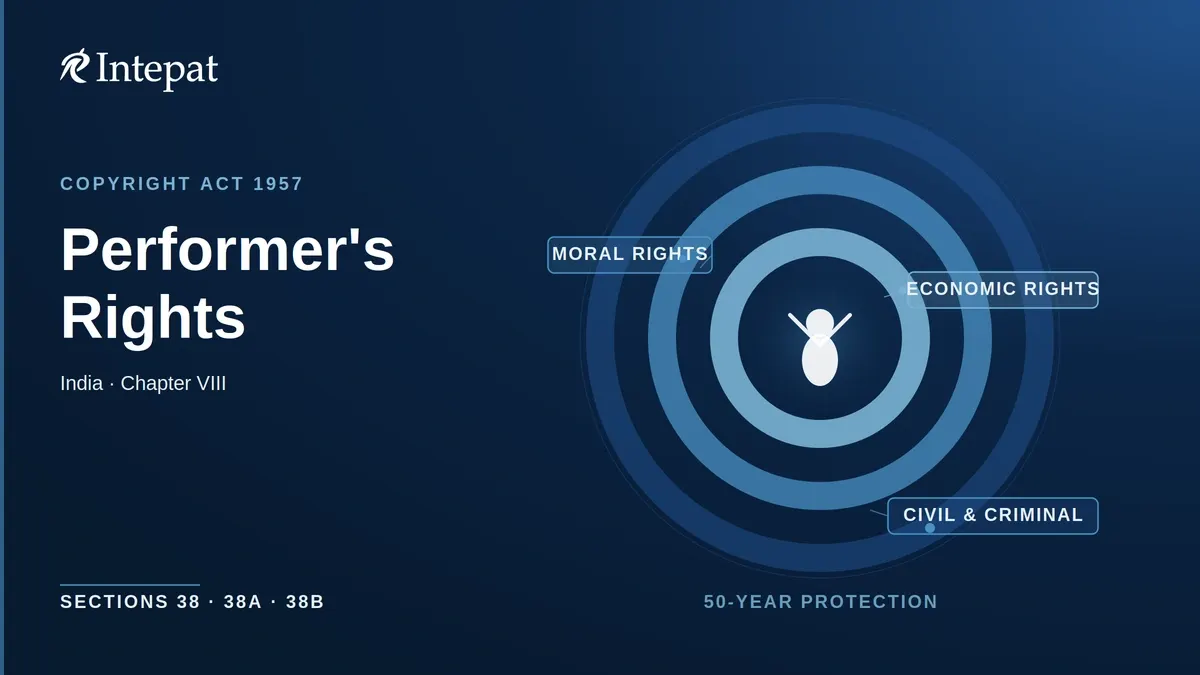
A performer acquires the performer’s right automatically on performing. The right lasts 50 years. It gives the performer control over recording, reproduction, broadcasting, and communication of the performance to the public. Moral rights, including the right to be credited and to object to distortions that harm reputation, survive even after the performer assigns the right to someone else. Infringement of a performer’s right can lead to civil remedies (injunction, damages, account of profits) and criminal prosecution.
Who Is a “Performer” Under the Act?
The Copyright Act defines a performer broadly. Under Section 2(qq), a performer includes an actor, singer, musician, dancer, acrobat, juggler, conjurer, snake charmer, a person delivering a lecture, or any other person who makes a performance.
The Act defines “performance,” for the purposes of the performer’s right, as any visual or acoustic presentation made live by one or more performers (Section 2(q)).
One qualification applies to films. A person whose performance in a cinematograph film is casual or incidental in nature, and who is not acknowledged in the credits of the film in the normal course of industry practice, is not treated as a performer. The one exception is that even such a person retains the moral right under Section 38B(b) to object to distortions that would damage their reputation.
How Does the Right Arise and How Long Does It Last?
The performer’s right arises automatically. Under Section 38(1), a performer acquires the right the moment they appear or engage in a performance. There is no filing, registration, or official grant required.
The right lasts for 50 years from the beginning of the calendar year following the year in which the performance is made (Section 38(2)). So a live dance performance given in November 2024 would be protected until the end of 2074.
This is distinct from the related broadcast reproduction right, which lasts only 25 years and belongs to the broadcasting organisation, not the performer.
What Performer’s Rights Cover Under Indian Copyright Law
Section 38A sets out the exclusive rights a performer holds during the continuance of the performer’s right. Without the performer’s consent, no person may do any of the following in respect of the performance or any substantial part of it:
Exclusive economic rights under Section 38A(1)(a):
- Make a sound recording or a visual recording of the performance
- Reproduce the performance in any material form, including storing it by electronic or other means
- Issue copies of the performance to the public, where those copies are not already in circulation
- Communicate the performance to the public
- Sell, give on commercial rental, or offer for sale or commercial rental, any copy of the recording
Section 38A(1)(b) also gives the performer the right to:
- Broadcast or communicate the performance to the public, unless the performance has already been broadcast
A broadcaster who records a live classical music concert for replay, or a streaming platform that uploads a dance performance video without the performer’s permission, would be acting without authority under this section.
The film exception. Where a performer has, by written agreement, consented to the incorporation of their performance in a cinematograph film, they cannot, in the absence of a contract to the contrary, object to the film producer’s exercise of the performer’s right in that film. An actor who signs a film agreement will generally not be able to block the producer from exploiting that film solely on the basis of performer’s rights, unless the agreement expressly reserves that control. However, Section 38A(2) preserves the performer’s statutory royalty entitlement where the performance is made for commercial use.
Moral Rights: Protection That Survives Assignment
Section 38B of the Copyright Act vests two moral rights in performers, and these rights exist independently of any assignment of the economic right. A performer may assign the performer’s right entirely, but the moral rights continue.
Right of identification. A performer has the right to be identified (credited) as the performer of their performance. The one qualification is that the omission may be justified where it is dictated by the manner of use of the performance, for example, a live event where crediting every contributor is impractical.
Right to object to harmful modifications. A performer may restrain, or claim damages for, any distortion, mutilation, or other modification of their performance that would be prejudicial to their reputation. The Act qualifies this: purely technical modifications, edits to fit a performance within a limited duration, or the removal of a portion for editing purposes, do not count as modifications prejudicial to reputation.
Assignment or licensing of the economic performer’s right does not, by itself, extinguish the performer’s moral rights under Section 38B. A producer who edits a recorded performance in a way that misrepresents or degrades it may face a moral rights claim even if they hold a valid licence for the commercial use.
Exceptions: When Using a Performance Is Permitted
Section 39 sets out acts that do not infringe the performer’s right. The key permitted uses are:
- Making a sound recording or visual recording for the private use of the person making it, or solely for purposes of bona fide teaching or research
- Using excerpts of a performance, consistently with fair dealing, for reporting current events, or for a bona fide review, teaching, or research
- Any other act that, with necessary adaptations, would not amount to copyright infringement under Section 52
The full text of Section 39 is available at the India Code, the Government of India’s official legislation repository.
Section 52 covers a range of educational, archival, personal, and public-interest uses. A journalist who uses a brief excerpt from a live concert to report on the event would fall within Section 39. A researcher who studies performance technique using recordings for genuine academic purposes would similarly be within the permitted zone.
What Section 39 does not permit is wholesale recording and distribution of a performance without consent, even for ostensibly educational or non-commercial reasons, if the use falls outside these bounds.
What Happens When Someone Infringes the Performer’s Right?
Section 39A of the Act brings a set of civil and criminal provisions that apply to copyright into effect for performers’ rights, with necessary adaptations.
Civil remedies. Under Section 55 (applied to performers via Section 39A), an aggrieved performer may approach the appropriate court for an injunction to stop the unauthorised use, damages to compensate for the loss, or an account of profits where the infringer has made gains from the unauthorised use.
Criminal liability. Section 63 applies to the infringement of performers’ rights. A person who knowingly infringes or abets the infringement of a performer’s right is liable to imprisonment for a term of not less than 6 months, which may extend to 3 years, and a fine of not less than Rs 50,000, which may extend to Rs 2 lakh. Where the infringement was not made for gain in the course of trade or business, the court may, for adequate and special reasons recorded in the judgment, impose a lesser sentence.
For a second or subsequent conviction (Section 63A), the minimum imprisonment rises to 1 year (extendable to 3 years) and the minimum fine to Rs 1 lakh (extendable to Rs 2 lakh).
The performer’s right does not affect any separate copyright that lasts in the underlying work being performed. A musician who performs a copyrighted composition holds performer’s rights in the performance; the composer retains copyright in the music itself. Both sets of rights co-exist and are independently enforceable. For a closer look at how copyright and performers’ royalties interact in the music context, see our article on performers’ royalty rights and the broader guide to copyright law in India.
Performers’ Rights and Personality Rights: Related but Different
Performers sometimes confuse performer’s rights (a statutory right under the Copyright Act) with personality rights (a broader common law and constitutional protection against the unauthorised commercial use of a person’s name, image, or identity). The two operate differently. Performer’s rights under Chapter VIII protect the specific performance from unauthorised recording and distribution. Personality rights protect the performer’s identity more broadly from exploitation without consent. Our article on personality rights in India covers that territory separately.
Protecting Your Performances: Practical Steps
The performer’s right arises automatically, but protecting it in practice requires some preparation.
Document your performances. Keep records of dates, venues, and recordings. In any dispute about whether you performed and when, evidence of the live event strengthens your position.
Use written agreements. If your performance will be recorded for a film or other production, a written agreement governs whether you are assigning your performer’s right, what the scope of that assignment is, and what royalty entitlements you retain where the performance is made for commercial use. Verbal arrangements create ambiguity.
Act promptly on infringement. If you discover that your performance has been recorded and circulated without your consent, seek legal advice early. The remedies available, including an injunction to stop further distribution, are most effective when pursued before the infringing use becomes entrenched.
Frequently Asked Questions
No. The performer’s right arises automatically when you appear or engage in a performance. Section 38(1) of the Copyright Act 1957 does not require any registration, filing, or application. The right lasts from the moment of the live performance, whether or not any recording is made of it.
A performer’s right lasts for 50 years from the beginning of the calendar year next following the year in which the performance is made. A performance given in 2024 is therefore protected until the end of 2074. This term is set by Section 38(2) of the Copyright Act 1957.
Section 2(qq) of the Copyright Act 1957 defines “performer” broadly to include actors, singers, musicians, dancers, acrobats, jugglers, conjurers, snake charmers, persons delivering lectures, and any other person who makes a performance. The list is inclusive, not exhaustive.
Section 38B provides that a performer’s moral rights, the right to be credited and the right to object to reputation-damaging modifications, exist independently of any assignment of the economic performer’s right. These rights survive even after the performer has fully transferred the economic right to a producer or other party.
Under Section 63 of the Copyright Act 1957 (applied to performers via Section 39A), a person who knowingly infringes a performer’s right is liable to imprisonment of not less than 6 months, extendable to 3 years, and a fine of not less than Rs 50,000, extendable to Rs 2 lakh. A repeat offender faces a minimum of 1 year imprisonment and a minimum fine of Rs 1 lakh under Section 63A.
Not entirely. Under Section 38A(2), if you have given written consent to incorporate your performance in a cinematograph film, you cannot object to the film producer’s exercise of the performer’s right in that film, unless your contract provides otherwise. However, you retain the right to royalties where your performance is made for commercial use, and your moral rights under Section 38B continue regardless of the film agreement.
These are two separate things. A performer’s right protects the live performance itself: the dancer performing on stage or on film. Choreography, if fixed in writing or otherwise, may qualify as a dramatic work under Section 2(h) of the Copyright Act and attract copyright protection as a separate work. The two protections can overlap when a choreographer also performs their own work.
This article explains performer’s rights under the Copyright Act 1957 in India as at June 2026 and is for general information only. It is not legal advice. For advice on your specific performance, work, or dispute, consult a qualified IP practitioner.