




Trademark infringement cases in India are suits under Section 29 of the Trade Marks Act 1999, where the owner of a registered mark asks a court to stop another trader using an identical or deceptively similar mark. The decisions below, all made between November 2025 and July 2026, show what courts ordered and refused.
This article covers Indian law only. Not every decision below is a Section 29 suit, and that is deliberate: the set spans infringement, passing off, a Section 57 rectification, an appeal from Registry proceedings and an interim Supreme Court order, because those are the forms a real brand dispute takes. Each was read in the signed judgment or order, and described at the stage it had reached.
| Quick answer for brand owners |
| ● Infringement of a registered mark runs on Section 29. Passing off, preserved by Section 27(2), runs alongside it and does not need registration. ● Holding your own registration is not, by itself, a complete answer to a passing off claim. Havells v Havai turned on that point. ● Sales figures alone may not prove that a descriptive name has become distinctive. Turnover certificates did not save D-TAN on the record in that case. ● Damages need evidence. A Delhi commercial court built its assessment on 34,950 boxes counted at the defendant’s premises, then added punitive damages for separate conduct. ● Two of these six orders are interim, and findings at that stage are prima facie. An interim position can change. |
What counts as trademark infringement under Section 29
Section 29(1) states that a registered trade mark is infringed by a person who, “not being a registered proprietor or a person using by way of permitted use, uses in the course of trade, a mark which is identical with, or deceptively similar to, the trade mark in relation to goods or services in respect of which the trade mark is registered and in such manner as to render the use of the mark likely to be taken as being used as a trade mark.”
The requirements are cumulative: the user is neither proprietor nor permitted user, the use is in the course of trade, the mark is identical or deceptively similar, it concerns the registered goods or services, and it reads as a trade mark rather than as description. Section 2(1)(h) sets the threshold, a mark being deceptively similar if it “so nearly resembles that other mark as to be likely to deceive or cause confusion.” Where a provision speaks of likely deception or confusion, no actually deceived customer need be produced.
Section 29(2) covers three combinations: an identical mark on similar goods or services, a similar mark on identical or similar goods, and an identical mark on identical goods. In each, the question is whether the use “is likely to cause confusion on the part of the public, or which is likely to have an association with the registered trade mark.” Only in the third of those, identical mark and identical goods, does Section 29(3) direct that the court “shall presume” confusion, which shifts the evidential burden onto the defendant.
Two further limbs carry conditions worth reading. Section 29(4) reaches a mark “identical with or similar to” the registered mark, used on goods or services that are not similar to those it is registered for, where the registered mark “has a reputation in India” and the use “without due cause” takes unfair advantage of, or is detrimental to, its distinctive character or repute. Those elements are cumulative. Section 29(5) covers use of the registered mark as a trade name or part of one, but only where the business concern is “dealing in goods or services in respect of which the trade mark is registered.” Section 29(6) then lists, “in particular,” what counts as use, and it runs wider than founders expect: affixing the mark to goods or packaging, offering goods for sale, importing or exporting, and use “on business papers or in advertising.”
Unregistered marks sit outside this. Section 27(1) is blunt: no person may institute a proceeding to prevent or recover damages for infringement of an unregistered trade mark. Section 27(2) preserves passing off, which is why an unregistered brand is not defenceless, and why a registered defendant is not automatically safe. Under Section 134(1), suits under either head go no lower than a District Court. Section 134(2) adds a forum where the plaintiff carries on business, but by its own words only “for the purpose of clauses (a) and (b) of sub-section (1),” so it does not reach a standalone passing off suit. On where to file, our note on choosing the forum for a trademark infringement suit sets out the practical steps.
Trademark infringement cases decided in 2025 and 2026
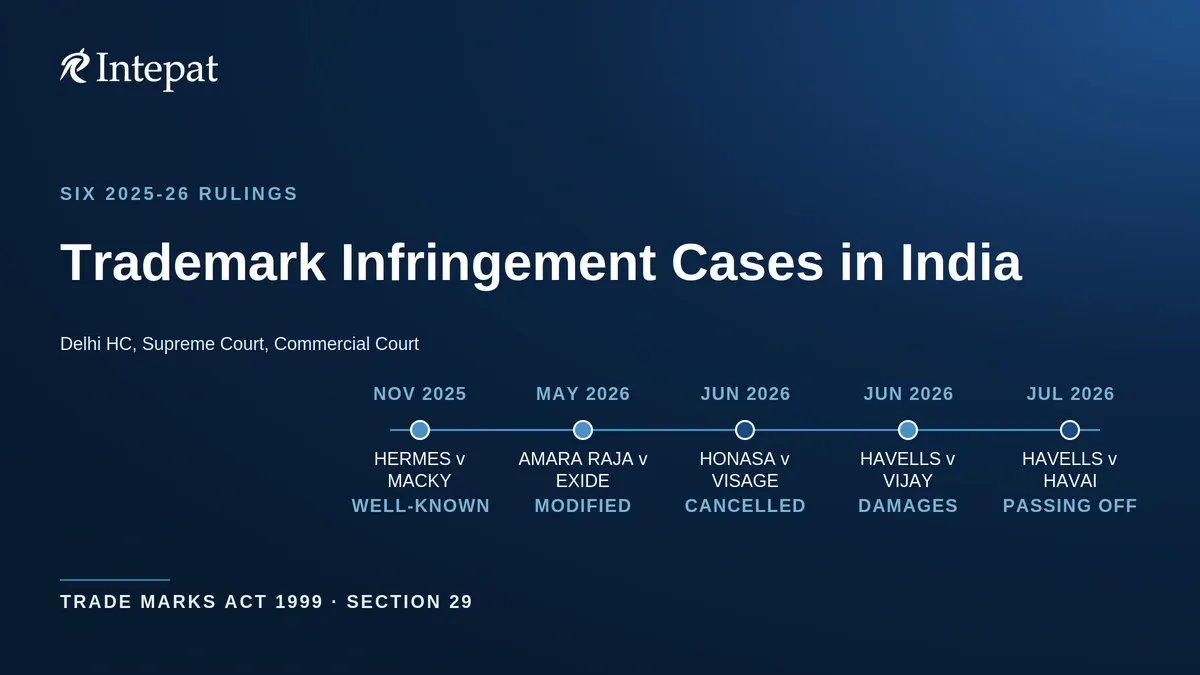
Six decisions, three examined in detail below and three set out here.
| Case | Court and date | What it decided | Stage |
| Hermès International v Macky Lifestyle | Delhi HC, 24 November 2025 | Birkin three-dimensional shape and HERMES declared well-known marks | Suit decreed |
| Amara Raja Energy & Mobility v Exide Industries | Supreme Court, 27 May 2026 | Red packaging injunction modified as to stock, not lifted | Interim |
| Honasa Consumer v Visage Beauty and Health Care | Delhi HC, 19 June 2026 | D-TAN cancelled under Section 57 as descriptive | Rectification allowed |
| Havells India v Vijay | Commercial Court, Karkardooma, Delhi, 30 June 2026 | Counterfeiting under Section 29(1); Rs 20 lakh in damages plus costs | Decreed |
| Havells India v Havai Home Products | Delhi HC, 13 July 2026 | Own registration no answer to a passing off claim | Interim |
| Parle Products v Registrar of Trade Marks | Delhi HC, Division Bench, 28 July 2026 | Earlier filing prevailed over use begun later, on these facts | Appeal dismissed |
A handbag shape can be a well-known trade mark
In Hermès International & Anr v Macky Lifestyle Private Limited & Anr (CS(COMM) 716/2021, decided 24 November 2025), Tejas Karia J. of the Delhi High Court held that the subject marks “have acquired extensive recognition and association within the relevant section of the public engaged in or familiar with the fashion industry.” Applying the Section 11(6) and 11(7) factors, the Court concluded they “merit recognition as well-known Trade Marks within the meaning of Section 2(1)(zg) of the Act.” The suit was decreed, with no order as to costs.
What makes the ruling useful is the subject matter. The declaration covered the HERMES word mark and the three-dimensional shape of the Birkin bag, among others. Section 2(1)(m) already includes the shape of goods and packaging within the definition of a mark, and here an Indian court treated a product shape as capable of the same well-known status as a word.
A distinctive form may therefore justify separate trade mark and design analyses, since eligibility under one does not establish eligibility under the other. Section 9(3) is the trade mark gate: it bars a mark consisting exclusively of the shape resulting from the nature of the goods, the shape necessary to obtain a technical result, or the shape giving substantial value to the goods. Our guide to well-known trademarks in India explains what the Section 11(6) evidence exercise involves.
What an interim trade dress order does to stock you have already made
In Amara Raja Energy & Mobility Ltd v Exide Industries Ltd (SLP(C) No. 18549/2026), Nagarathna and Ujjal Bhuyan JJ. dealt on 27 May 2026 with a temporary injunction granted by the Calcutta High Court over red battery packaging. The Court did not lift it. It modified it, letting products already packaged in red cartons and lying with third party franchisees, distributors or retailers sell through, while directing that unused empty cartons “be destroyed and not utilised and therefore, the temporary injunction insofar as those empty cartons are concerned, shall continue.” Existing stock held by the company could be marketed only “in any other package which is not red in colour.” The order was expressly “only for the purpose of considering the controversy relating to the issuance of the temporary injunction.”
The order did not determine whether the get-up is protectable, or the merits. It dealt with the operation of the temporary injunction and existing stock, and that is the commercial point. A trade dress injunction lands on inventory you have already made, and another case on other facts could go differently. Anyone planning a packaging refresh into a colour a competitor has used for years should price that exposure before the print run. Our overview of trade dress protection covers what makes get-up protectable in the first place.
An earlier filing prevailed over use that began later
Parle Products Pvt Ltd v The Registrar of Trade Marks & Anr (LPA 316/2026), decided by a Division Bench of V. Kameswar Rao and Manmeet Pritam Singh Arora JJ. on 28 July 2026, concerned the marks 20-20, TWENTY-20 and T20 in Class 30. The Bench held the respondent’s registration “would still be prior to the adoption and use, both, by the appellant,” and that the appellant “commencing its manufacture and use of the same mark in the interregnum, will not give any special benefit.” The appeal was dismissed.
The Bench also recorded that the appellant had itself earlier described the competing marks as “visually, phonetically and conceptually different,” and treated that as approbation and reprobation. That is a discipline point worth carrying into every filing. Positions taken in examination or opposition sit on the record and may later be relied on as inconsistent positions, depending on their wording and context.
Read the outcome narrowly. It does not establish that a registration date always defeats use: Section 34 protects a person who has continuously used a mark from a date earlier than the other side’s use or registration, whichever is earlier. What failed was use commenced in the interregnum, after the respondent’s registration had been granted. Our note on prior user rights sets out what continuous prior use has to show.
What damages for trademark infringement looked like in one 2026 decree
Founders ask what an infringement suit is worth. Havells India Limited v Vijay (CS(Comm.) No. 294/2024), decided on 30 June 2026 by Sh. Sanjay Sharma-II, DHJS, in the Commercial Court at Karkardooma, Delhi, answers that unusually openly. The plaintiff held a Class 9 registration dating from 2020, with use claimed from 2008. On the defendant’s premises a Local Commissioner recovered 34,950 packaging boxes bearing the plaintiff’s mark and trade dress. The Court found that the defendant “has not only copied entire trademark alongwith logo and device of the plaintiff’s trademark ‘HAVELLS’ but he has copied entire trade dress of the plaintiff’s packaging material,” and concluded that “the defendant committed statutory infringement of trademark of the plaintiff under Section 29(1) of ‘The Trade Marks Act, 1999’.”
The damages reasoning rewards close reading. The Court worked from the plaintiff’s computation of the cost of finished products at Rs 9,46,18,000, applied what it described as a moderate assessment of a 10 per cent profit, and held that “the claim of the plaintiff to the extent of damages in the sum of Rs. 10,00,000/- is just and reasonable.” The compensatory award was capped by what the plaintiff asked for, not by the calculation. Punitive damages followed on a separate footing, the Court recording that the defendant was a habitual infringer who continued printing and selling boxes bearing the mark even while an interim injunction was operating.
The final decree granted a permanent injunction and awarded Rs 10,00,000 in damages, a further Rs 10,00,000 in punitive damages, Rs 3,00,000 towards legal fees and Rs 3,40,000 for the Local Commissioner’s fees.
Two practical points follow. First, the award rested on evidence of scale. The inventory gave the Court a number to reason from, but it is one route among several: accounts, invoices, discovery and admissions each do the same work, and Section 135(1) offers an account of profits as an alternative. Section 135(2) supports that evidence-gathering, permitting interlocutory orders for discovery and for preserving infringing goods, documents or other evidence.
Second, the Court pointed to the defendant’s recorded history and its continued printing and selling despite the interim injunction when awarding punitive damages. Breaching an interim order can weigh against you and carries its own enforcement consequences. Our guide to remedies for trademark infringement sets out the civil and criminal routes in full.
Practitioner note
Section 135(3)(b) bars an award of damages or an account of profits, though not an injunction, where a defendant satisfies the court on two cumulative points: that when it began using the mark it was unaware and had no reasonable ground for believing the plaintiff’s mark was on the register, and that it ceased forthwith on becoming aware of the existence and nature of the plaintiff’s right. Nominal damages are carved out of the bar. A proved notice that identifies the registration can help establish when awareness began; once it is established, a defendant that continues cannot show it ceased forthwith. Notice should not be automatic, though. Section 135(2) contemplates ex parte relief and orders preserving infringing goods and evidence, and warning a counterfeiter first can destroy that option. Decide case by case.
Why turnover did not save the D-TAN mark from cancellation
Honasa Consumer Ltd v Visage Beauty and Health Care Pvt Ltd & Anr (C.O.(COMM.IPD-TM) 215/2023), decided by Tushar Rao Gedela J. on 19 June 2026, is the cautionary case for anyone naming a product after what it does. The mark was D-TAN, registered in Class 3 in 2018.
The Court read the mark for its ordinary meaning, holding that combining “de” and “tan” “would clearly demonstrate removal or reversal of tanned condition of the skin,” and that the mark “would undoubtedly imply a product which, when used, may bring about removal or reversal of the tanning of the skin.” It concluded that the mark “is not capable of distinguishing the goods or services of one person from those of another. Therefore, not only is the mark ‘D-TAN’ of respondent no.1 descriptive but also appears to be common to trade.”
The proprietor’s answer was commercial success, supported by chartered accountant certificates. The Court accepted the sales and rejected the inference: the certificates “prima facie establish, commercial success of respondent no.1’s products, the same do not, and cannot, in the facts of the present case … establish as a fact that the mark ‘D-TAN’ … has been imprinted in the minds of the general consumer.” It was “unable to accede to the argument that the mark ‘D-TAN’ has gathered secondary significance,” and directed cancellation within four weeks.
This is a validity challenge under Sections 9(1)(a) and 9(1)(b), raised after registration through Section 57. The proviso to Section 9(1) lets such a mark through where, before the date of application, it “has acquired a distinctive character as a result of the use made of it or is a well-known trade mark.” Note what the reasoning turned on: the certificates were the material on record, and on that record they showed sales without showing that consumers associated the word with a single source. Read the decision as fact-specific, not as authority that revenue can never assist.
Two provisions soften the picture. Section 31(2) may preserve the registration where the proprietor proves the mark had become distinctive by the date of registration, even though that evidence was not put before the Registrar beforehand. Section 32 goes further: a mark registered in breach of Section 9(1) is not to be declared invalid if, through use, it acquired distinctive character after registration and before the validity challenge began. Section 30(2)(a) cuts the other way: there is no infringement where the impugned use genuinely indicates the kind, quality or intended purpose of the goods, which narrows what a descriptive registration can stop. Our guide on distinctiveness versus descriptiveness explains the spectrum before you commit to a name, and rectification of a registered trademark explains the Section 57 route a competitor would use against you.
Your own registration may not defeat a passing off claim
Havells India Limited & Anr v Havai Home Products Pvt Ltd & Ors (CS(COMM) 778/2024, I.A. 38970/2024), decided by Jyoti Singh J. on 13 July 2026, addresses the defence founders most often rely on: we have our own registration. The defendant held a Class 11 registration for HAVAI, but the complaint was not about the mark as registered, it was about the mark as used. The Court found the letter “I” restyled to read as an “L,” holding that “the change in the stylization and font of the letter ‘I’ in the marks actually used, is indeed a mala fide attempt to sail close to HAVELLS marks,” and that “the overall commercial impression is one of deceptive similarity in the two, the foundation being misrepresentation.”
On the registration defence the Court applied S. Syed Mohideen v P. Sulochana Bai: a registered proprietor can sue for passing off under Section 27(2) even against another registered proprietor of a deceptively similar mark. The defendants were restrained from selling, marketing, advertising and offering for sale under the impugned marks, and the application was allowed to that extent. This is interim relief pending trial, not a final decree, and findings at that stage are prima facie.
The statutory scaffolding is worth knowing. Section 28(1) confers exclusive rights only “if valid,” and Section 28(3) provides that where two persons hold registrations for resembling marks, neither acquires rights against the other merely by registration. Section 30(2)(e) does help a registered defendant, but only against infringement: it protects use of one registered mark against another where the two resemble each other. It does not answer passing off, and here the complaint concerned a materially altered form of the registered mark. If you are weighing what registration buys, our comparison of registered and unregistered trademarks is the place to start.
What to check in your own portfolio this quarter
Five checks worth running now.
- Compare your registration certificate against your packaging. Material divergence between the mark you registered and the mark you use can weaken reliance on the registration and create passing off exposure. Minor variation is different: Section 55 permits a tribunal, where it thinks right, to accept use with alterations not substantially affecting the mark’s identity.
- Test every brand name against Section 9(1)(b). If the name says what the product does, assume a competitor may apply under Section 57, and that sales figures alone may not answer the challenge.
- Collect evidence of consumer association, not just revenue. What counts is material showing buyers link the name to one source: duration of use, advertising, market recognition, unsolicited press.
- Decide whether your product shape or get-up is a mark. Section 2(1)(m) covers shape and packaging, and the Hermès declaration shows a shape carrying well-known status. Test the form against the Section 9(3) exclusions first.
- Plan the evidence route, not just the notice. The Havells assessment rested on 34,950 counted boxes. Inventories, accounts, invoices and discovery each serve; decide early which you will use.
If someone is already using a mark you rely on, verify their Registry position and actual marketplace use, preserve evidence, then choose between a notice, an opposition, a rectification, passing off and infringement, weighing whether an ex parte application is the better opening move. Our trademark search guide covers clearance, and the complete guide to trademark registration in India covers the registration that must underpin any Section 29 action. Where marks are close but not identical, deceptively similar trademarks and Section 17 on composite marks explain how courts compare them.
You can read Section 29 in full on the official text of the Trade Marks Act 1999 at India Code.
Frequently asked questions
Section 29 of the Trade Marks Act 1999 defines several forms. The core is unauthorised use in trade of a mark identical or deceptively similar to a registered mark on the goods it covers. Others include reputation-based use on dissimilar goods, specified trade name use, infringing advertising and spoken use.
No. Section 27(1) of the Trade Marks Act 1999 bars any proceeding to prevent or recover damages for infringement of an unregistered trade mark. Section 27(2) preserves a passing off action instead, which requires proof of goodwill, misrepresentation and damage rather than a registration.
Not by itself. In Havells India v Havai Home Products, decided on 13 July 2026, the Delhi High Court granted interim relief against a defendant holding its own registration, applying Section 27(2). Section 28(3) also provides that two registered proprietors of resembling marks gain no rights against each other by registration alone.
Section 135(1) allows an injunction and, at the plaintiff’s option, either damages or an account of profits, with or without delivery up for destruction. Section 135(3) restricts damages in defined cases. In Havells India v Vijay, decided 30 June 2026, a Delhi commercial court awarded Rs 10,00,000 in damages and Rs 10,00,000 in punitive damages.
Section 9(1)(b) refuses a mark consisting exclusively of indications designating the kind, quality or intended purpose of the goods. A merely suggestive mark is not caught. Where it is caught, the proviso admits it if distinctive character was acquired before the application date, or the mark is well known.
Yes, subject to limits. Section 2(1)(m) includes the shape of goods and packaging within the definition of a mark. Section 9(3) bars a shape resulting from the nature of the goods, one necessary to obtain a technical result, and one giving substantial value to the goods.
Infringement is the statutory action under Section 29 of the Trade Marks Act 1999 and requires a registered mark. Passing off is the common law action preserved by Section 27(2), needs no registration, and requires goodwill, a misrepresentation likely to deceive, and resulting or likely damage. Both can be pleaded in one suit.
Section 134(1) provides that no such suit may be instituted in any court inferior to a District Court having jurisdiction to try it. That sets the floor rather than the answer. Which District Court, Commercial Court or High Court commercial division actually hears it turns on territorial jurisdiction, valuation and the applicable court structure.
This article discusses decisions of the Supreme Court of India, the Delhi High Court and a Delhi commercial court, read in the signed judgments and orders, and is current as of July 2026. The proceedings are of different kinds: an infringement decree, interim applications, a rectification petition under Section 57 and an appeal arising from Registry proceedings. A holding in one form of proceeding does not transfer automatically to another. The orders in Havells India v Havai Home Products and in Amara Raja Energy & Mobility v Exide Industries are interim, findings at that stage are prima facie, and interim positions can be varied, vacated or reversed on appeal. Every outcome turns on its own facts, pleadings and evidence. Nothing here is legal advice or a prediction of any result. For advice on a specific mark or dispute, consult a qualified trade marks attorney.