




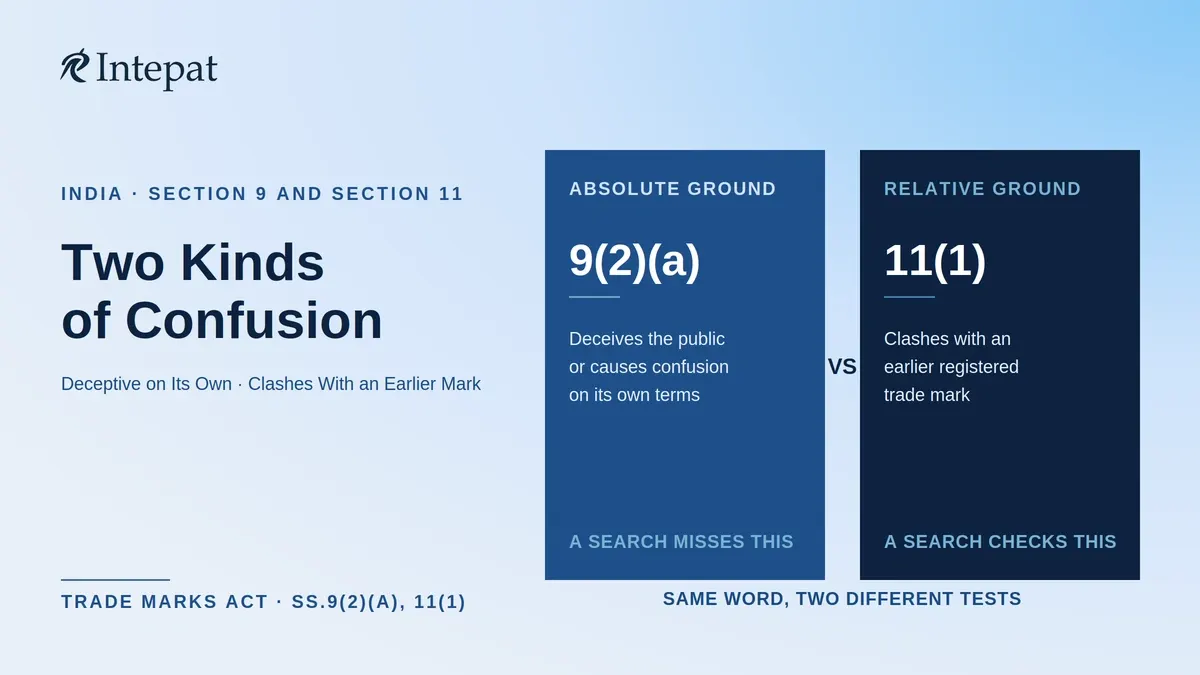
“Confusion” is a ground for refusing a trademark under two separate provisions of the Trade Marks Act, 1999. Section 9(2)(a) refuses a mark that deceives on its own terms. Section 11(1) refuses a mark because it clashes with an earlier trademark. This article covers India only.
Quick answer
- Section 9(2)(a) is an absolute ground. It does not compare the mark to any other mark; it asks whether something inherent in the mark or its use is likely to deceive the public about the nature, quality, or geographical origin of the goods or services.
- Section 11(1) is a relative ground, subject to Section 12. It compares the applied-for mark against an earlier trade mark as defined in the Explanation to Section 11, and asks whether the similarity, combined with similarity of goods or services, creates a likelihood of confusion.
- A register search mainly addresses Section 11(1) risk, not Section 9(2)(a) risk, and it is not full clearance: well-known-mark and unregistered-rights conflicts under Section 11(2) and 11(3) sit outside a straightforward register search too.
- The Registrar can raise a Section 9(2)(a) objection on his own initiative. A Section 11(2) or 11(3) objection can be raised only by the proprietor of the earlier right in opposition.
What “confusion” means as a ground for refusal
An applicant who receives an examination report citing “confusion” needs to know which section is behind it before drafting a reply. A Section 9(2)(a) objection is answered by addressing what the mark itself says or suggests. A Section 11(1) objection is answered by addressing the similarity of the marks and goods or services, and the resulting likelihood of confusion. Treating the two as interchangeable produces a misdirected reply.
Section 9(2)(a): when the mark deceives on its own
Section 9 sets out the absolute grounds for refusal, grounds that do not depend on conflict with an earlier trade mark. Section 9(2)(a) of the Trade Marks Act, 1999 provides:
“A mark shall not be registered as a trade mark if it is of such nature as to deceive the public or cause confusion.”
Not comparing the mark to another mark does not mean the mark is assessed in a vacuum: under Section 9(2)(a), the mark is assessed in relation to the specified goods or services and its proposed or actual use. The Trade Marks Registry’s draft Manual of Trade Marks Practice and Procedure frames the examiner’s objection in near-identical terms: a mark is liable to be refused under Section 9(2) where it is likely to deceive the public or cause confusion in the mind of the public, most commonly by suggesting a nature, quality, geographical origin, or characteristic the goods or services do not in fact have. A mark that spells out “all wool” but is used on goods that are not entirely wool illustrates the point: the wording itself misdescribes the product, independent of any other mark on the register. Evidence of acquired distinctiveness does not displace a Section 9(2)(a) objection in the way that it can address an objection under Section 9(1). The applicant must instead show that there is no real potential for deception. Depending on the facts, the issue may also be addressed by appropriately narrowing the specification or through a condition or undertaking: current Rule 30(2) of the Trade Marks Rules, 2017, for example, permits an undertaking to vary a name or description appearing on the mark when it is used for goods or services other than those named or described.
Section 11(1): when the mark clashes with an earlier mark
Section 11 of the Trade Marks Act, 1999 sets out the relative grounds for refusal, which depend on comparing the applied-for mark against earlier rights. Section 11(1) provides that, save as provided in Section 12, a mark shall not be registered where its identity or similarity with an earlier trade mark, and identity or similarity of the goods or services covered, creates a likelihood of confusion, including a likelihood of association. Section 12 lets the Registrar permit registration despite a conflict for honest concurrent use or other special circumstances. The Explanation to Section 11 defines “earlier trade mark” to include a registered mark, an earlier-filed application under Section 18, specified international and convention applications, and a mark entitled to protection as well-known as of the relevant date; it is not limited to marks already on the register.
Under Section 11(5), a Section 11(2) objection (a well-known mark, for dissimilar goods) or a Section 11(3) objection (passing off or copyright) can be raised only by the proprietor of the earlier right through opposition, not by the examiner. A straightforward Section 11(1) citation the examiner raises directly.
The marks must ultimately be compared as wholes, taking in phonetic, visual, and conceptual similarity, though dominant or memorable elements can carry weight within that comparison; courts also weigh the goods or services, the relevant purchasers, and imperfect recollection. Nothing about the mark’s own wording needs to be false or misleading for Section 11(1) to apply: a coined, meaningless word can still draw a citation because of its similarity to an earlier mark, for example a near-homophone spelled differently, provided the goods or services are also identical or similar and confusion is likely as a result.
Starbucks v. Sardarbuksh: confusion in a civil suit, not at examination
Starbucks Corporation instituted CS(COMM) 1007/2018 against Sardarbuksh Coffee & Co. and others before the Delhi High Court. The Court’s order dated 27 September 2018 records that the parties submitted signed settlement terms, were held bound by them, and that the suit was decreed accordingly. The published order does not reproduce the complete settlement terms or adjudicate deceptive similarity; it should not be treated as a reasoned authority on the likelihood-of-confusion test. More generally, Section 11(1) concerns registrability, while Section 29 governs infringement of registered marks and Section 27(2) preserves the separate remedy of passing off. Section 29(2) specifically carries a confusion test comparable to Section 11(1); Section 29 also contains separate tests for identical marks on identical goods and for reputation-based harm on dissimilar goods, so it is not a single uniform test.
Section 9(2)(a) and Section 11(1) side by side
| Section 9(2)(a) | Section 11(1) | |
| Type of ground | Absolute | Relative |
| What is examined | The applied-for mark, in relation to the goods, services and use, without comparison to an earlier mark | The applied-for mark against an earlier trade mark |
| Source of the confusion | Something inherent in the mark or its use | Similarity of marks plus similarity of goods or services |
| Who raises it in examination | The Registrar, on his own initiative | The Registrar, where an identical or similar earlier mark exists |
| Displaced by acquired distinctiveness | No; show there is no real potential for deception, and, where the facts support it, amend or limit the specification or accept a condition | Not a statutory cure for the conflict; address the Section 11(1) test and, where available, Sections 11(4) or 12 |
| Typical response strategy | Show the wording or use does not misdescribe the goods or services | Contest similarity; consider consent under Section 11(4) or Section 12 concurrent use |
What this means when you are choosing or clearing a mark
A trademark search tests the applied-for mark against earlier applications and registrations, and mainly addresses Section 11(1) risk. It is not, by itself, a complete clearance review. Section 9(2)(a) risk comes from the mark’s own wording, not from what else is filed, so a clean search result does not rule it out (a mark that misdescribes what the goods are made of is one example). A register search may also turn up registered well-known marks, but it cannot exhaust well-known-mark risk under Section 11(2): protection can depend on evidence of reputation a basic search will not show, and unregistered or copyright conflicts under Section 11(3) turn on rights that may not be recorded at all. Founders should treat a register search as the starting point, then separately check for deceptive similarity risk in unregistered use and confirm the mark’s own wording does not misdescribe the goods or services on offer. The broader landscape of absolute and relative grounds is in our guide to Sections 9 and 11 grounds for refusal, and well-known-mark conflicts are covered in our guide to well-known trademarks.
FAQ
Section 9(2)(a) is an absolute ground that refuses a mark deceptive by its own nature, independent of other marks. Section 11(1) is a relative ground that compares the application with an “earlier trade mark” as defined in the Explanation to Section 11, including specified earlier applications and registrations and qualifying well-known marks.
No. Acquired distinctiveness can overcome a Section 9(1) objection, such as lack of distinctive character. It does not apply to a Section 9(2)(a) deceptiveness objection.
No. A trademark search mainly checks earlier applications and registrations for Section 11(1) purposes. It does not assess whether the mark’s own wording or use is deceptive under Section 9(2)(a), and it is not a substitute for a full legal clearance review.
Only the proprietor of the earlier well-known mark, and only through opposition proceedings under Section 11(5). The examiner does not raise a Section 11(2) or 11(3) objection during examination.
No. It was a civil suit alleging infringement of registered trade marks under Section 29 and passing off, a distinct remedy preserved by Section 27(2). The published final order disposed of the suit in accordance with settlement terms and did not adjudicate the likelihood of confusion. Section 11(1) governs whether an application may proceed to registration; Section 29 governs infringement through unauthorised use in trade that conflicts with a registered mark.
This article explains the law on trademark confusion in India as at August 2026 and is for general information only. It is not legal advice. Registry fees, forms, and timelines change; confirm current details with the Trade Marks Registry before you act. For advice on your specific mark, consult a trademark attorney.