




The Karnataka High Court has set aside an ex parte patent injunction (granted before the defendant was heard) against a Davanagere maker of areca nut dehusking machines. The order did not show the patent’s claims were compared with the machine or that the expert report was considered. The suit was then ordered transferred to the High Court.
The judgment was delivered at Bengaluru, India, on 22 July 2026 by a Division Bench (a two-judge bench) of Chief Justice Vibhu Bakhru and Justice K.S. Hemalekha in Priya Industries and Another v. Vishwanatha K., Commercial Appeal No. 351 of 2026 (2026:KHC:37651-DB). The appeal was against an order on I.A. No. 2, the injunction application in the patentee’s suit. It is a short oral judgment given when the appeal came up for admission.
| Quick answer: |
| An order that restrains a business on a patent before it has been heard must show its reasoning. The High Court found the trial court’s order did not show that the patent claims were considered, did not identify which features of the accused machine were said to infringe them, and did not show that the expert report was considered. It set the order aside but did not decide infringement. |
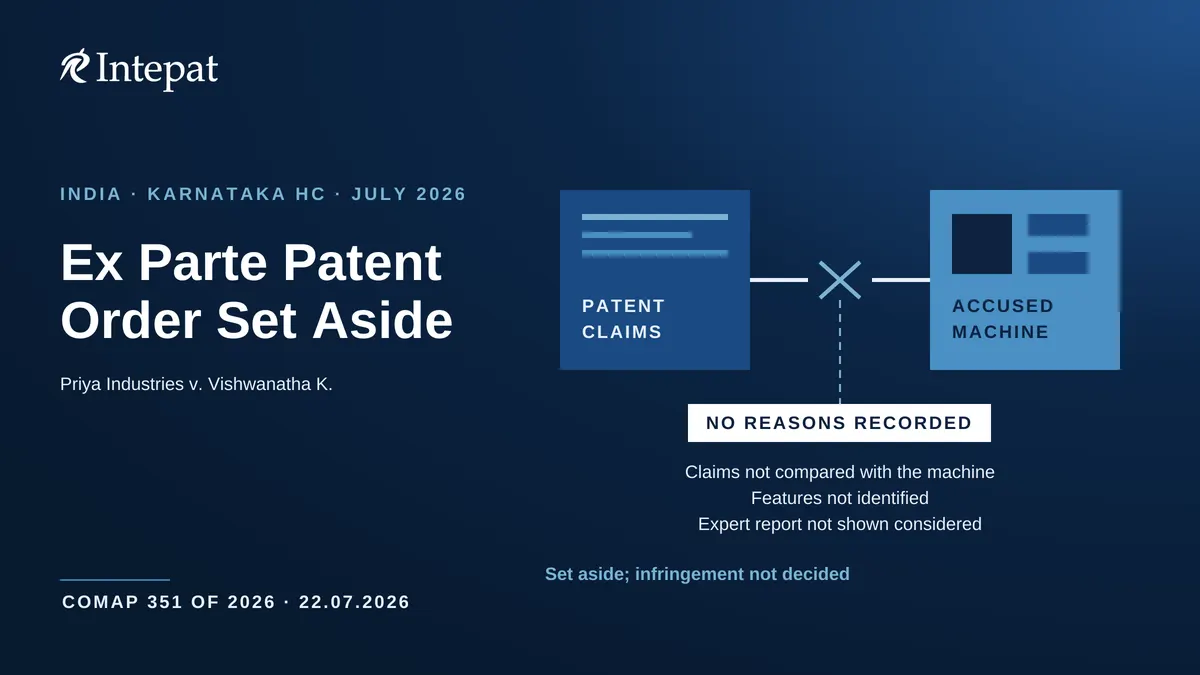
Ex parte patent injunction: what did the Karnataka High Court decide?
The High Court allowed the appeal and set aside the trial court’s order of 8 June 2026. It held the order was not sustainable because it did not clearly set out the reasons for a prima facie view (a provisional, first-look view) that the patent had been infringed. It did not decide whether the machine infringes.
The operative finding is short. In the Bench’s words, the order “does not clearly set out the reasons for arriving at a prima facie view that the respondent’s patent has been infringed”, and there was “no analysis of the patent, or of the appellants’ machine”. The appeal was allowed on that ground alone.
The Bench added a clarification and a request. The trial court remained free to consider the patentee’s application on its merits and to pass a fresh ad interim order (a temporary order made before the application is finally heard). The High Court also requested it to decide the application “as expeditiously as possible and preferably within a period of four weeks”. On 7 August 2026 the commercial court ordered the suit and its pending applications transferred to the High Court, as explained below.
What was the dispute about?
Vishwanatha K., who runs V-Tech Engineers in Shivamogga district, holds Indian Patent No. IN259204 for a machine that removes the husk from areca nuts. He sued Priya Industries of Channagiri, Davanagere, alleging that its machine infringed the patent, and asked for an interim injunction.
The judgment reproduces twelve claims. Claim 1, the broadest, describes a machine with an aluminium wheel, blades with grooves or teeth, a husk separator, a nylon brush, a conveyor chain, a tub and a “nurling shaft” (a shaft that turns the nut). Claim 1 also requires timing: the blade and the shaft are synchronised so that when the blade turns anticlockwise the shaft turns clockwise, the blade’s teeth stripping the husk while the shaft rotates the nut. Priya Industries told the High Court that this synchronisation is the claim’s principal feature. The other eleven claims refer back to claim 1 and add details such as wheel diameter, speed ratios and tooth angles; how independent and dependent claims fit together is explained in our guide to patent claim structure and types.
On 8 June 2026 the commercial court restrained Priya Industries, in the High Court’s description, “from manufacturing or selling, in any manner, any product that constitutes infringement” of IN259204 until the next hearing. Priya Industries appealed to the High Court under the Commercial Courts Act, 2015. Its senior counsel told the High Court that the patentee had sent a legal notice on 8 August 2025, that Priya Industries had replied in detail on 6 September 2025, and that the commercial court had taken up the application on 29 April, 2 May and 3 June 2026 without issuing notice to it. The High Court recorded these points but did not rule on them.
Why could the injunction not stand?
The High Court found three gaps in the trial court’s order. It did not indicate that the patent claims had been considered. It did not identify which features of the accused machine were said to infringe. And it did not show that the expert report the patentee relied on had been analysed.
| What the order needed | What the High Court found |
| The patent’s claims read and identified | “A plain reading of the said order does not indicate that the patent claims were considered” |
| The accused machine’s features matched to those claims | The order “does not indicate, which of the features of the machine … are alleged to infringe the patent claims” |
| The expert evidence engaged with | The order “does not indicate that the said expert’s report was analyzed or considered” |
The third gap is the instructive one. The patentee’s senior counsel accepted that the order did not clearly analyse the claims, but argued that the court had an expert report from NIT Karnataka and other material showing infringement, and had passed the order with that material in mind. The Bench allowed that he “may be right” that the report was before the court. That did not save the order. Evidence on the file is not reasoning in the order.
The patentee’s counsel also pressed urgency: he submitted that the patent expires on 23 August 2027, so an interim order was essential. The High Court set the order aside nonetheless, while leaving the door open for a properly reasoned fresh order.
What did the Court not decide?
The High Court did not find that Priya Industries’ machine falls outside the patent. It decided only that the trial court’s order lacked reasons. Whether the machine infringes, and whether a fresh interim injunction should issue, were left open. We have not verified any later decision on either question.
The point matters because the appeal raised arguments that the judgment records but does not rule on. Priya Industries’ senior counsel argued that its machine does not have the synchronised blade and shaft movement in claim 1. He also argued that the legal notice relied on the claims as originally filed, while the claims as granted are narrower, and that the trial court had dismissed Priya Industries’ detailed reply as a “bald reply”. These are submissions, not findings.
A defendant in a similar position should treat the judgment as a ruling on how an order must be written, not on whether its product is free to sell. As a Division Bench decision of the Karnataka High Court, the principle it declares binds the courts below the High Court in Karnataka, and single judges of that Court, in materially comparable cases. Because it is a short ruling on one order, its value lies in what it found missing rather than in any broad rule. Courts elsewhere may find it persuasive.
What happened after the High Court’s ruling?
On 7 August 2026 the commercial court ordered the suit, with all pending interim applications, transferred to the Karnataka High Court. The order records that Priya Industries had filed a counter-claim seeking revocation of the patent, and the Patents Act requires transfer in that event. The order did not decide the injunction application.
The 7 August order dealt only with jurisdiction. Priya Industries argued that the question had to be decided before anything else, and the judge agreed, relying on Supreme Court authority that a court must answer a disputed question of jurisdiction at the threshold. He held that the Patents Act “leaves the court with no other alternative but to transfer the suit”, and directed his office to send the entire records to the High Court forthwith.
As pleaded, the suit seeks a permanent injunction against infringing parts and products, including Priya Industries’ 2, 4, 6, 8, 10 and 12 belt dehusking machines, with delivery up of infringing goods, damages of Rs. 99,50,000 and costs. These are prayers in the plaint; the 7 August order decided none of them. This article has not verified the registration details of the transferred High Court proceeding, or any later order, as at 16 October 2026.
What does the law require when an injunction is granted without notice?
Any temporary injunction needs a prima facie case, a balance of convenience in the applicant’s favour, and a risk of irreparable injury. To grant one without notice, a court must also record why delay would defeat its purpose, and must try to decide the application within thirty days of the grant.
Where an injunction is proposed without notice, the Code of Civil Procedure says the court “shall record the reasons for its opinion that the object of granting the injunction would be defeated by delay”. In Shiv Kumar Chadha v. Municipal Corporation of Delhi (1993), the Supreme Court held that “the requirement for recording the reasons for grant of ex parte injunction, cannot be held to be a mere formality”, and that the court should consider “how the object of granting injunction itself shall be defeated if an ex parte order is not passed”.
The applicant has duties too. Immediately after an injunction is granted without notice, it must deliver or send to the other side copies of the application, the supporting affidavit, the plaint and the documents relied on, and file an affidavit confirming this on the day of the grant or the next day.
If the application is not decided within thirty days of the grant, the court must record its reasons for being unable to do so. In A. Venkatasubbiah Naidu v. S. Chellappan (2000), the Supreme Court held that an ex parte order “does not ipso facto become illegal merely because it was not restricted to a period of thirty days or less”, and that the aggrieved party “shall be entitled to the right of appeal notwithstanding the pendency of the application”.
The Priya judgment does not cite these provisions or any earlier decision. Its point is narrower and specific to patents: an order finding a prima facie case of infringement must show that the claims were considered and the accused machine compared with them. Read with the ordinary test, an ex parte patent injunction should also explain why the case could not wait for the defendant to be heard.
If you hold the patent: what should your application show?
A patentee seeking an urgent order should give the court what it needs to write a reasoned order: the granted claims, the accused product compared with each claim, and evidence the court can follow. The Priya order did not show that the claims were considered, the machine compared or the expert report analysed.
A useful filing aid is a claim chart (a table placing each element of a claim beside the matching feature of the accused product). It should map every asserted claim, including the elements a dependent claim carries over from claim 1, with photographs, drawings and supporting evidence. The chart helps the court test the comparison and record its own reasons; Priya does not prescribe a format. For how claims are drafted at different patent offices, see our note on claim drafting at the IPO, EPO and USPTO. Five items repay the effort:
- The claims as granted, not as filed. Priya Industries’ counsel argued that the legal notice relied on the wider claims as filed.
- A claim chart for every asserted claim. The work starts earlier than the suit: claims drafted with the commercial product and likely design-arounds in view are easier to map later, which is how our engineering patents team approaches mechanical inventions.
- Where expert evidence is relied on, a report that explains the technical comparison claim by claim, so a reasoned order can engage with it.
- The defendant’s reply to any legal notice, and a specific answer to it rather than a dismissal.
- Specific grounds of urgency: the threatened harm, its timing, and why the case cannot wait for the defendant to be heard. An approaching expiry date may not, on its own, explain that. In Priya the expiry date was pressed, but urgency did not save an unreasoned order.
The power itself is not in doubt: the Patents Act lists an injunction, on such terms as the court thinks fit, among the reliefs in an infringement suit, and the Code of Civil Procedure governs when one may be granted before the defendant is heard.
If you have been restrained: what should you check in the order?
A business restrained without being heard should check whether the order identifies the asserted patent claims, explains how the accused product is said to fall within them, and addresses the evidence relied on. Priya illustrates a failure to give reasons; it does not make all three defects a necessary threshold for challenging another injunction.
Check the procedure as well: whether the order records why the case could not wait for you to be heard, whether the patentee served the papers and filed its compliance affidavit, and whether the application was decided within thirty days of the grant or reasons were recorded for not doing so.
Next, assemble the record. In Priya the defendant’s senior counsel told the High Court that it had replied in detail to the legal notice, and that the commercial court had taken up the application on three dates without issuing notice to it. The High Court did not decide the appeal on those points, but they are the facts a challenge will need. Keep your reply to any legal notice, and note every date on which the application was listed.
Two further points deserve attention. First, the claims as granted may be narrower than those quoted in a legal notice; obtain the granted specification (the patent as finally granted) and compare it with your product, element by element. Second, under the Patents Act every ground on which a patent can be revoked is also available as a defence in an infringement suit, so validity can be raised alongside non-infringement. An early review of the patent’s file history and the prior art (earlier publications and products), such as an invalidity search, usually shapes which defence leads.
Validity can be raised as a defence in the suit, or revocation can be sought by a counter-claim or by a separate revocation petition. A defence alone does not move the suit; a counter-claim for revocation in a district-level court does, as happened in Priya. In Boehringer Ingelheim v. Controller of Patents (February 2026), a Delhi High Court Division Bench explained that a successful revocation removes the patent from the register, while a successful defence only defeats the suit in hand. It also held that a defence can accompany either revocation route, but that a defendant cannot pursue both a counter-claim and a revocation petition. That choice deserves advice before the written statement (the defendant’s formal reply in the suit) is filed.
Finally, a win on reasons is limited: in Priya the trial court was left free to pass a fresh order, so prepare a full answer on infringement.
Frequently Asked Questions
It is a court order restraining a business from making or selling a product on the ground of patent infringement, granted before that business has been heard. In Priya Industries the commercial court granted one until the next hearing date. It is a temporary measure and does not decide whether the patent is in fact infringed.
No. The High Court set aside the injunction because the order lacked reasons. Priya Industries’ argument that its machine lacks the synchronised blade and shaft movement was recorded as a submission, not decided. The High Court left infringement open, and we have not verified any later decision in the transferred suit.
Yes, in principle. The High Court said its order does not prevent the application being considered on merits or a fresh ad interim order being passed. On 7 August 2026 the commercial court ordered the suit, with its pending applications, transferred to the Karnataka High Court. We have not verified any later order.
Because the order did not show that the report had been analysed or considered. The patentee argued that an expert report from NIT Karnataka showed infringement and was before the commercial court. The High Court allowed that the report may have been on file, but held that the order did not engage with it.
Because Priya Industries counter-claimed for revocation of the patent. Under the Patents Act, once a defendant in a district-level suit makes that counter-claim, the suit and the counter-claim must be transferred to the High Court for decision. The commercial court ordered the transfer on 7 August 2026, with all pending interim applications.
As a Karnataka High Court Division Bench decision, the principle it declares binds the courts below the High Court in Karnataka, and single judges of that Court, in materially comparable cases. Courts elsewhere may find it persuasive. Separately, the Code of Civil Procedure requires every Indian court granting an injunction without notice to record why delay would defeat its purpose.
Intepat IP’s patent team, led by Senthil Kumar, compares products with granted patent claims, element by element. For clearing a product before launch, see our freedom to operate search service.
This article discusses the cited decisions and statutory provisions as at 16 October 2026 for general information. It is not legal advice. For advice on a pending patent suit, interim injunction or appeal, consult an advocate experienced in patent litigation after review of the complete record. Verified as of 16 October 2026.